Round-Robin Assignment: The Fair Split That Quietly Misallocates
Round-robin assignment walks a pointer through a pool of owners, giving each the next arriving record in turn so counts finish level. Variants add weighting or availability checks. Its limit is structural: the rotation observes only the count handed out, so record value, workload and unintended skips are all invisible to it.
Key takeaways
- Equal distribution is a fairness property, not an outcome property. It guarantees nobody was starved of chances and guarantees nothing about conversion.
- Two ordinary states break plain rotation: an owner who is unavailable, and an owner whose queue is already deep. The second compounds, because the rotation never slows the flow into a backlog.
- An unintended skip looks exactly like a working rotation. Every assignment succeeds, so only a skip log with a reason column can surface it.
- Report per-owner outcomes next to per-owner counts. Measuring the rotation by its own optimised metric is a tautology dressed as a report.
Round-Robin Assignment: The Fair Split That Quietly Misallocates
Round-robin assignment distributes incoming records to a pool of owners one at a time in a fixed rotation, so that each owner receives an equal count. The first record goes to the first person in the pool, the second to the second, and when the list runs out the rotation returns to the top and continues. It is the simplest possible answer to the question of who gets the next one, and it is used everywhere: inbound replies, demo requests, trial signups, booked meetings, support tickets.
The term exists because the alternative was worse and nobody could defend it. Before a rotation, the next record went to whoever was quickest to claim it, which rewarded people for watching a queue rather than for working what they already had. Round robin removed the argument by removing the judgment. Every owner can see their own count, every owner can see everyone else's, and the allocation is auditable by anyone who can count. That auditability is most of why it survives, and it is a real property worth having.
Round-robin assignment is one mechanism inside the wider assignment layer that decides who owns an arriving record, which is the lead routing topic covered separately. This entry is about the rotation itself.
How round-robin assignment actually works
Three variants are in common use, and they differ in how much they are allowed to know.
Plain rotation. A pointer walks a list of owners. Each arriving record advances the pointer by one. No other information is consulted. It is trivially correct, trivially explainable, and completely blind.
Weighted rotation. Owners carry a weight, and the pointer visits them in proportion to it. A senior rep on a larger quota takes three records for every one that goes to somebody in their first month. This handles the common case where the pool is not made of interchangeable people, which is most pools.
Availability-aware rotation. The pointer skips owners the system believes cannot work a record right now: outside working hours, on holiday, marked away, or over a capacity limit. This is the version that survives contact with an actual team, and it is the version that introduces the failure mode described further down.
- Every owner receives the same count
- Trivially auditable by anyone who can count
- Blind to holiday, workload and record value
- Correct on a team where everyone is genuinely interchangeable
- Fails quietly the first time somebody takes a week off
- Owners take records in proportion to a weight
- Handles seniority, ramp and part-time capacity
- Still blind to what is already sitting in the queue
- The weights are a policy and go stale as the team changes
- Nobody reviews the weights unless something breaks
- Skips owners who are away, offline or at a capacity limit
- The only variant that reflects a live team
- Depends entirely on the availability data being true
- Introduces the silent skip, where a skipped owner looks like a working rotation
- Needs a report on skips, or the skips are invisible
What the rotation is keyed on
A rotation is always a rotation over something, and the something matters more than the algorithm. Common keys:
The pool. One rotation across a team. Simple, and appropriate when everyone sells the same thing to the same kind of buyer.
The segment. A separate rotation per segment, so enterprise records rotate among the enterprise reps and small-business records among the rest. Most teams end up here, because a single rotation across mixed segments sends records to people who cannot work them.
The queue. A rotation per source or per queue: inbound replies rotate separately from booked meetings, which rotate separately from partner referrals. This keeps a spike in one source from starving the others.
What resets the rotation is worth deciding deliberately, because most tools do it by accident. A pointer that resets nightly, or whenever the pool membership changes, quietly restarts the count from the top and hands the first person in the list a disproportionate share. A pointer that never resets accumulates the effect of every past skip. Neither is wrong, and both produce a distribution the team did not choose unless somebody chose it.
The two states that break the simple version
Plain rotation assumes every owner is equally able to take the next record. Two states break that assumption, and both are ordinary.
The first is an owner who is unavailable. On holiday, in back-to-back meetings, ill, or simply outside their working hours because the record arrived at four in the morning their time. A plain rotation hands them the record anyway. It sits there, correctly assigned, doing nothing, and the count on the report looks perfect.
The second is an owner whose queue is already full. This one is more damaging because it compounds. A rep who is behind receives records at the same rate as a rep who is clear, so the backlog grows monotonically. The rotation cannot see the backlog, so it never slows the flow into it, and the records at the bottom of that queue age out entirely.
Equal count and equal work are not the same distribution
This is the sentence the whole entry turns on. A rotation equalises the number of records handed to each owner. It does not equalise the amount of work those records represent, the revenue they carry, or the difficulty of working them.
- MondayBoth owners take three records each
The rotation is doing exactly what it promises
- TuesdayOne owner is at a client site all day
Records still arrive on their name and sit unopened
- WednesdayA large multi-site opportunity lands
It counts as one record, the same as a single-user trial signup
- ThursdayThe backlog on one side is now a day and a half deep
The rotation cannot see it, so the flow does not slow
- FridayCounts are level and outcomes are not
The report shows a fair week, the queue shows a lopsided one
How it is measured
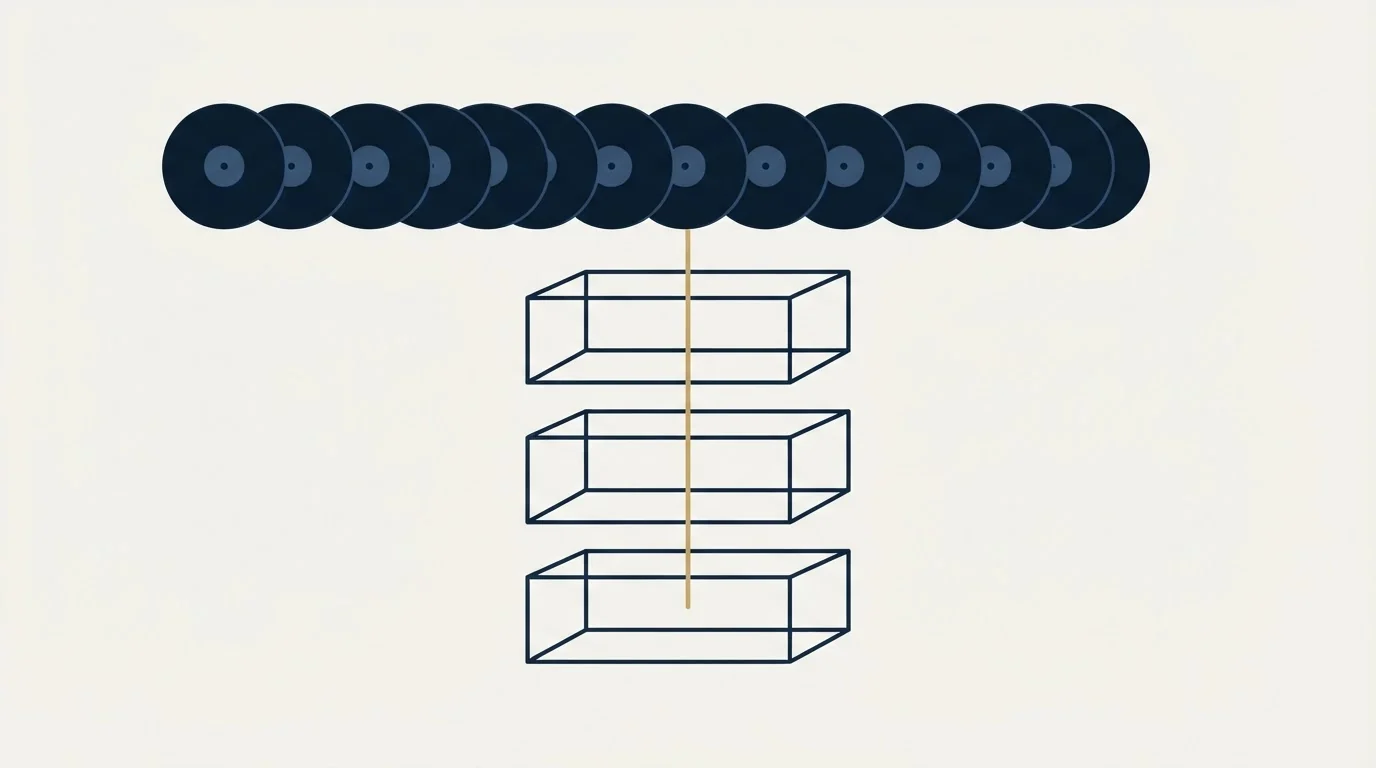
Round robin is almost always measured by the thing it optimises, which is the count. That number will look correct in every period, because making it correct is the entire mechanism. Measuring it that way is a tautology dressed as a report.
The measurements that carry information are outcome-side and per owner: qualified conversations produced per record received, time from assignment to first activity, the age of the oldest unworked record, and the share of assigned records that were never opened at all. If the rotation is working, those numbers are similar across the pool. When they diverge, the rotation is still perfectly fair by its own definition and is misallocating anyway.
Where the textbook definition breaks

Round robin optimises the only property it can observe. It sees the count of records handed out. Every other property of a good allocation is invisible to it. It cannot see that one record is a fifty-seat opportunity and the next is a student doing research. It cannot see that an owner is on holiday unless somebody told it. It cannot see that the person it just fed has forty unworked records and the person before them has three.
So the honest framing: equal distribution is a fairness property, not an outcome property. It guarantees that nobody can claim they were starved of chances, which is a real and useful guarantee about the process. It guarantees nothing whatsoever about whether the records went to the people most likely to convert them. Measuring the rotation by outcome rather than by count is the entire fix, and it is a reporting change rather than a tooling change.
A rotation with a silent skip is indistinguishable from a rotation that is working. This is the second break and the more dangerous one. Availability-aware rotations skip people. When a skip happens for a reason the system understands, that is the feature working. When a skip happens for a reason nobody intended, a stale away status, a permissions error, a capacity limit set once and forgotten, a user deactivated in one system and live in another, the rotation does exactly the same thing: it moves on to the next person and assigns the record successfully.
There is no error. The record has an owner. The count report shows a slightly uneven split, which everybody reads as normal variance. Meanwhile one member of the pool has been receiving nothing for three weeks and the others have been absorbing their share without noticing, because a rotation that quietly excludes somebody looks identical to a healthy rotation with a smaller pool.
The check that catches this is a skip log: every time the rotation passes over an owner, record who and why. If the reason column is ever empty or ever reads as an error rather than a policy, that is the defect. Without that log there is no signal at all, because the assignment succeeded every single time.
What to do with it

Keep the rotation and change what you report on it. Publish per-owner outcome numbers next to the per-owner counts, in the same table, at the same frequency. The moment those two columns sit side by side, the conversation about allocation becomes a conversation about results, and any genuine misallocation becomes visible without anybody having to argue about fairness in the abstract.
Then add two guards. Give the rotation a capacity limit so that an owner with a deep backlog stops receiving new records until they clear it, and log every skip with its reason so that an unintended exclusion cannot hide inside a normal-looking split. Both are small pieces of configuration, and between them they close the two failure modes above.
Weight the rotation deliberately if the pool is not made of interchangeable people, and put a date on the weights. Weights set during a hiring push and never revisited are a common source of allocations that nobody can explain and everybody has opinions about.
Related terms and guides
Round robin decides which member of a group takes a record, which only matters once the group is right. What the person receiving it is actually accountable for is set out in the SDR role definition, and how the size and shape of that pool should be planned is covered in sales hiring.
The outcome side of the measurement question connects directly to unit economics: if records are worth materially different amounts, an equal split by count moves your cost per customer acquisition without anybody deciding to. For booked meetings specifically, the allocation question and the qualification standard interact, which is the subject of B2B appointment setting.
Where the rotation runs is usually the CRM or the tool immediately in front of it. The Apollo and HubSpot integration guide works through how records reach a system of record in the first place, and LinkedIn CRM integration covers the same problem for conversations that start on LinkedIn rather than in an inbox.
A rotation only helps when there is enough arriving to be worth splitting. If the constraint is the volume of qualified conversations rather than their distribution, see what a first campaign looks like.
Frequently asked questions.
Frequently asked questions- Is round-robin assignment fair?
- It is fair in one specific sense: everyone receives the same number of records, and that is auditable by anyone who can count. It is not fair in the sense people usually mean, because records differ enormously in value and difficulty. A rotation can hand two people identical counts and wildly different opportunities, and by its own definition that is a perfect week.
- When should you use weighted round robin instead of plain rotation?
- Whenever the pool is not made of interchangeable people, which is most pools. New hires still ramping, part-time capacity, a senior rep carrying a larger number: all of these argue for weights. Put a review date on them. Weights set during a hiring push and never revisited produce allocations nobody can explain and everybody has an opinion about.
- How do you stop round robin overloading someone who is behind?
- Add a capacity limit so the rotation stops feeding an owner whose queue is past a threshold until they clear it. Without one, a rep who falls behind keeps receiving records at the same rate as everyone else, so the backlog only grows and the records at the bottom age out. Log every skip with its reason so the limit cannot hide a different problem.
- What should you measure instead of the count?
- Outcome-side numbers, per owner: qualified conversations produced per record received, time from assignment to first activity, the age of the oldest unworked record, and the share of assigned records never opened. When those numbers diverge across the pool, the rotation is still perfectly fair by its own definition and is misallocating anyway.