SDR Role Definition: The Work Automation Left
List building, enrichment, sequencing, data entry and first-draft personalisation have moved. What remains is judgment, which changes how you scope the seat.
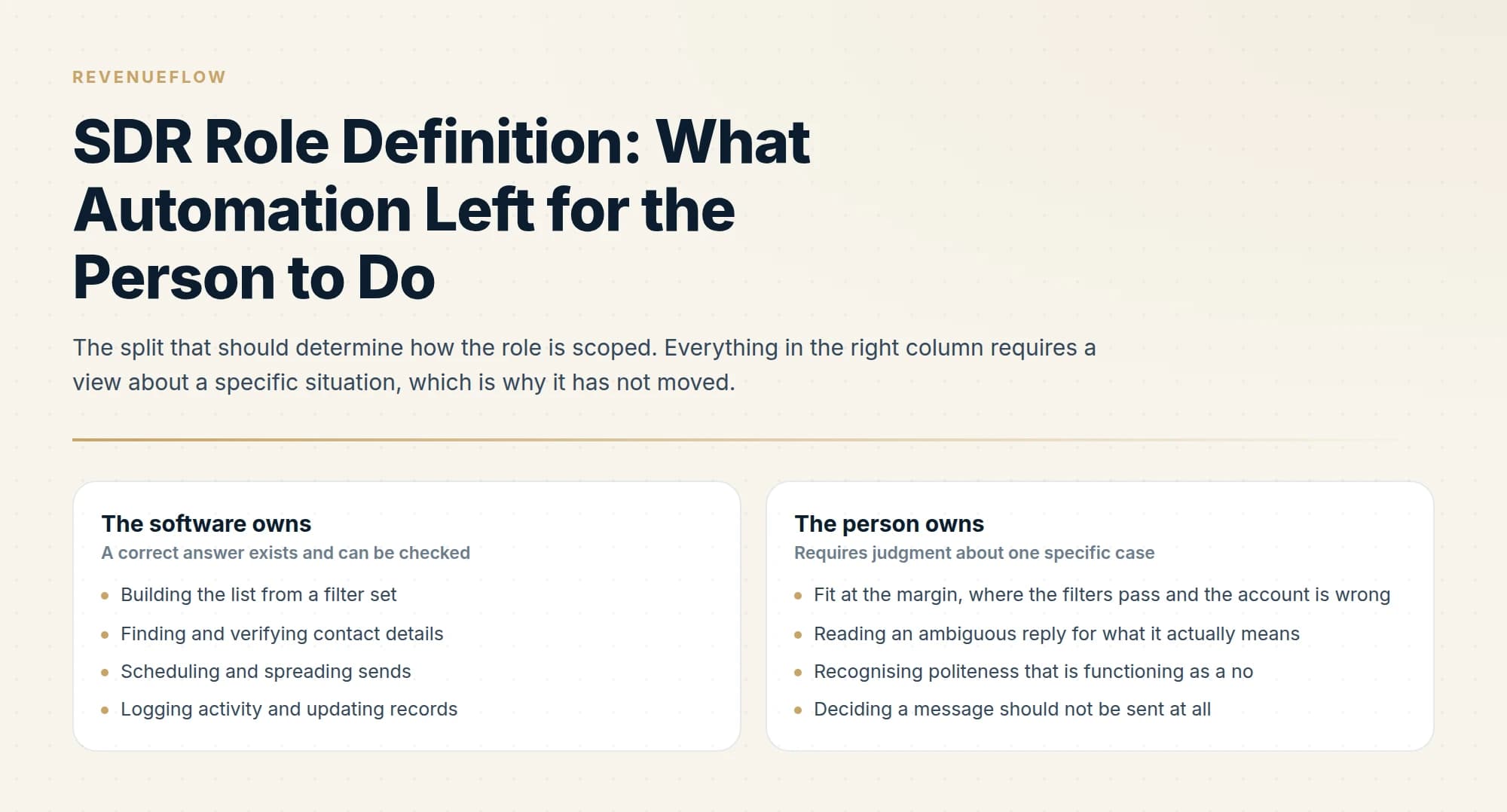
Automation absorbed the five mechanical parts of sales development: list building, enrichment, sequencing, data entry and first-draft personalisation. What remains is judgment about specific cases, including fit at the margin, ambiguous replies, polite refusals, and the decision that a message should not be sent at all.
Key takeaways
- The five tasks that automated share one property, which is that a correct output exists and can be checked.
- A role composed of the hard half of the old job means fewer seats and a higher hiring bar, so entry-level rates will fail quietly.
- Once a system produces the activity, sends per day measures a setting rather than a person.
- Sends stopped is the only metric that rewards the judgment to hold a message back, and almost nobody tracks it.
Reviewed and updated September 1, 2026
The familiar sales development job description asks for a hundred dials a day, fifty emails and twenty LinkedIn touches. Every one of those quotas is now a field in a settings panel. A posting written that way is describing a tool's configuration and then hiring a person to be measured against it, which is how teams end up with an SDR whose main skill is keeping a dashboard green.
The four things sales development exists to do have not changed: find the right accounts, reach them, work out whether there is anything there, and hand over the ones where there is. What changed is which of those a machine performs reliably, and the answer splits the job much more cleanly than most job descriptions admit.
What automation actually absorbed
The parts that moved are the parts with a checkable right answer.
List building. Pulling accounts that match a set of filters is a query. It was manual because the interfaces were bad, and it stopped being manual when they got better.
Enrichment. Finding a contact, verifying a mailbox, resolving a domain. All of it is mechanical, all of it is now cheaper as a credit than as an hour of somebody's morning.
Sequencing and scheduling. Deciding when a message goes out, spreading volume across mailboxes, holding sends inside a working window. This is scheduling, and software has always been better at it than people.
Data entry. Logging activity, updating fields, keeping a record of who was contacted when. The reason reps hated this task is precisely the reason it automates cleanly.
First-draft personalisation from public sources. Reading a company's site, its careers page, a funding announcement, and producing an opening line grounded in something real. A language model does this at volume, and it does it better than a rushed rep at 4pm on a Thursday.
What those five share is that a correct output exists and can be checked. The list either matches the filters or it does not. The mailbox either exists or it does not. Nothing in that set requires a view about anything.
The catalogue of what moves and what tooling does it is covered in SDR tasks you can automate, and the state of the packaged software category is in AI SDR. This article is about the person left standing next to all of it.
What automation did not absorb
- Building the list from a filter set
- Finding and verifying contact details
- Scheduling and spreading sends
- Logging activity and updating records
- Drafting an opener from public sources
- Classifying a reply into a rough bucket
- Fit at the margin, where the filters pass and the account is wrong
- Reading an ambiguous reply for what it actually means
- Recognising politeness that is functioning as a no
- Deciding a message should not be sent at all
- Choosing which objection to answer and which to leave
- Everything after the second exchange with a human
Fit at the margin. Every filter set produces accounts that pass on paper and are obviously wrong to anyone who knows the market. They just got acquired. They built the thing you sell in house last year. They are a competitor's subsidiary. Somebody has to notice, and noticing requires context that was never written into a filter.
The ambiguous reply. "Send me some information" is three different messages depending on who sent it and what came before. It can mean genuine interest with no time this week, a polite exit, or a request to be qualified out with minimal friction. A classifier puts all three in the same bucket. A person who reads the sender's title, the company's situation and the exact wording gets it right most of the time, and the difference between those two outcomes is the entire value of the seat.
Since the term covers both a staffed seat and a software subscription, it helps to see how each one handles the ambiguous reply that stalls outbound before buying either.
Politeness as a no. "This is interesting, let's reconnect in Q3" is usually a decline delivered kindly. Treating it as a warm lead produces a pipeline report full of accounts that were never going anywhere, and the forecast built on that report is wrong in a way nobody catches until the quarter closes.
Deciding not to send. This is the one that matters most and the one no software has a mechanism for. An automated system has no cost function for a message that should never have gone out. It does not know that the account is in a live deal with your AE, that the contact is a customer's employee, that the timing is grotesque because of something in the news that week. The judgment to stop is a human function, and it is the function that protects the domain reputation everything else depends on.
What that means for scoping the role

If the mechanical half is produced and the judgment half is not, then the job is judgment applied to produced work. That reads as a small change and it inverts the shape of the role.
The old role was front-loaded with production and back-loaded with a small amount of decision-making. The new one is the reverse. The person spends their day reading: replies, accounts, signals, and the output of the systems that built the list. They intervene where a machine would be wrong, and they carry every conversation the moment it becomes a conversation.
Two consequences follow, and both are uncomfortable to plan around.
The first is that the seat count goes down. One person adjudicating produced work covers a volume that used to need several people producing it. That is the actual efficiency, and it is real.
The second is that the bar goes up. The remaining work is the hard part of the old job with the easy part removed. Reading a reply correctly, knowing when to stop, writing something a specific person will answer: these were always the skills that separated a good rep from an average one. A role composed entirely of them is a harder hire from a smaller pool, and paying entry-level rates for it will fail quietly.
- Step 1Send
List built from filters and signals, message drafted and grounded, send scheduled and spread across mailboxes. No human in the loop.
- Step 2Classify
The reply is bucketed into roughly positive, neutral, negative, out of office, referral. Fast and approximately right.
- Step 3Adjudicate
A person reads the actual words, decides what the sender means, and chooses to book, answer with a question, hand over, or close the loop.
- Step 4Carry
Every exchange after this point is human. The handoff to the AE happens against criteria that were written down before launch.
Measuring the role once the activity is produced
Activity metrics existed because effort was the constraint. Counting dials and sends was a reasonable proxy for whether somebody worked hard, back when working hard was what produced the activity.
Once the activity is produced by a system, an activity count measures the system's configuration. Sends per day is a setting. Contacts touched is a list size. Both are now closer to a spend figure than to a performance figure, and a rep whose activity jumped between two quarters may have done nothing except raise a cap. Worse, the metric is actively harmful in the one place it used to be useful, because the fastest way to raise it is to widen the list, and widening the list is the thing that damages reply rates and sender reputation together.
What survives as a measure of the person:
The mix of replies, not the rate. A reply rate can be moved by sending to more people. The proportion of replies that are genuinely positive against neutral and negative is a measure of targeting and message quality, and it is much harder to game.
Meetings that survive the written definition. Booked is a soft number. Booked, attended, and accepted against criteria agreed before launch is a hard one. The gap between the two is the honest measure of qualification judgment.
Same-day response rate on inbound replies. This is a real behaviour, it is entirely within the person's control, and it correlates with whether interested people ever get booked.
Sends stopped. Count the messages the person pulled before they went out, and the accounts they removed from a list that passed every filter. This is the only metric that rewards the judgment-to-stop function, and almost nobody tracks it.
Because activity counts no longer prove effort, how compensation plans define the paying unit decides whether reps are rewarded for judgment or for volume.
The handoff standard sits underneath all of this. If the boundary between a marketing-qualified and a sales-qualified account is fuzzy, none of the meeting metrics mean anything, because two people will count the same account differently. That boundary is worth defining properly, and MQL versus SQL covers what a workable version looks like.
Hiring for the version of the job that now exists

Interviewing for this role with a role-play cold call tests a skill the job no longer centres on. Test the judgment instead, with exercises that take twenty minutes and are impossible to fake.
- Yes: Hand over ten real anonymised replies and ask which to book, which to close out, and which to answer with a question
- Yes: Give them a named account, five minutes and a browser, and ask for a first message plus the reason they chose that angle
- Yes: Show a list of twenty accounts that passed the filters and ask which three should be removed and why
- Yes: Present a polite deferral and ask them to say plainly whether it is a yes, a no, or genuinely undecided
- Depends: Ask what they would need to see before recommending the campaign be stopped
The third exercise is the most diagnostic and the least used. Candidates who spot the acquired company, the competitor and the existing customer have the context-building instinct the job runs on. Candidates who accept the list because it came from a system will accept every list they are given.
There is also a career question that teams should answer honestly rather than avoid. Sales development was widely used as a training ground: two years of volume, then promotion to a closing seat. A judgment-heavy role with fewer seats and a higher bar is a different ladder, and pretending otherwise creates a retention problem eighteen months out. Where the function goes from here, including the operator role that sits alongside it, is set out in SDR versus AI SDR versus GTM engineer.
The part that got harder, not easier
Cheap sending raised the standard for the message rather than lowering it. When any team can send at volume, volume stops being an advantage and the single message has to earn a reply on its own. That is one reason we run one message per campaign with no thread replies and no bumps: a follow-up under an ignored message adds nothing except another impression of a company that did not read the room the first time. Under those constraints the writing and the targeting carry all the weight, and both belong to the person.
The short version

Automation took the five mechanical parts of sales development: list building, enrichment, sequencing, data entry and first-draft personalisation. It did not take fit judgment at the margin, reading an ambiguous reply, recognising a polite no, or deciding a message should not be sent at all. That leaves a role made almost entirely of the hard half of the old job, which means fewer seats and a higher hiring bar. Stop counting sends and dials, because those now measure a setting rather than a person, and count reply mix, meetings that survive a written definition, same-day response on replies, and the sends the person stopped. Interview with reply-triage and list-culling exercises rather than a call role-play.
RevenueFlow runs the produced half and is paid on attended meetings that meet criteria agreed in writing before launch. You can see what a campaign would look like for your market.
Frequently asked questions.
Frequently asked questions- What does an SDR actually do now?
- The person reads: replies, accounts, signals and the output of the systems that built the list. They intervene where a machine would be wrong, decide which accounts should come off a list that passed every filter, judge what an ambiguous reply actually means, and carry every exchange from the moment it becomes a conversation with a human.
- Which parts of the SDR job did automation take?
- List building from a filter set, enrichment and mailbox verification, sequencing and send scheduling, activity logging and data entry, and first-draft personalisation from public sources. Each has a correct output that can be checked, which is exactly why it moved. Reply classification into rough buckets moved too, though deciding what a reply means did not.
- How should you measure an SDR today?
- On reply mix rather than reply rate, since a rate can be moved by sending to more people. On meetings that survive a written definition, meaning booked, attended and accepted against criteria agreed before launch. On same-day response to inbound replies. And on sends stopped, which counts the messages pulled and the accounts removed from a list that passed every filter.
- How do you interview for the role?
- Test judgment rather than a call role-play. Hand over ten real anonymised replies and ask which to book, close out or answer with a question. Give a named account, five minutes and a browser, and ask for a first message plus the reasoning behind the angle. Show twenty accounts that passed the filters and ask which three to remove and why.
About the author.

B2B cold email experts helping companies generate qualified leads through done-for-you outreach campaigns.
RevenueFlow Team
Explore more.
Ready to scale your outreach?
We build GTM engines that book real meetings. See the receipts.
Related articles.
Sales Productivity: Four Different Ratios Wear the Same Name
Sales productivity names four ratios that share no denominator, and improving one can move another the wrong way. The version you mean decides what happens next.
Sales Performance Improvement Plan Samples: What to Include
Three worked sales PIP samples, and the diagnosis that comes first. Most published plans set a target on an outcome the rep does not control alone.
Sales Rep Scorecard: What the Rep Cannot Control
Most rep scorecards carry lines the rep cannot move. The controllability test, the six lines that earn a place, and the two ways the document stops meaning anything.
SDR Salary and the Fully Loaded Cost: The Real Number
A worksheet rather than a benchmark. Seven inputs, the order to combine them in, and the two adjustments that move the answer more than base pay does.
SDR Metrics: Which Numbers the Rep Controls
A sales development scorecard mixes three kinds of number and only one is about the person being reviewed. Sorting them by who controls what turns it into a diagnosis.
Inbound vs Outbound Sales: How the Two Motions Differ
Inbound and outbound sales compared as motions: what the rep knows at first touch, what each costs, the team each needs, and the metrics that belong to each.