Sales Rep Scorecard: What the Rep Cannot Control
Most rep scorecards carry lines the rep cannot move. The controllability test, the six lines that earn a place, and the two ways the document stops meaning anything.

A sales rep scorecard is a short document of the numbers one seller answers for, reviewed in a regular one to one. Every line should pass one test: the rep can move it next week without anyone else deciding something. Six lines carry the weight, from accounts worked to record quality.
Key takeaways
- A sales rep scorecard, also called a salesperson scorecard, lists only the numbers one seller can move; lines the rep cannot move belong on the manager's input review.
- Two tests sort every line: can the rep change it next week without a decision from somebody else, and does it require a buyer to do something.
- Six lines carry the weight: accounts worked against assigned, conversations opened, meetings held, meetings meeting the written standard, opportunities created and record quality.
- Rep-level denominators are small: in an invented quarter of 9 closed opportunities, one deal moves the win rate between 22%, 33% and 44%, so carry the count beside every rate.
Reviewed and updated September 21, 2026
A sales rep scorecard arrives in a weekly one to one carrying fourteen lines. The rep reads down it and finds four they can change by Friday. The other ten describe the territory they were given, the volume of inbound the marketing team produced, the pricing they cannot flex and the average deal size of the segment somebody else assigned them. The conversation that follows is about all fourteen, and the rep leaves it believing they are behind on ten things, only four of which are theirs.
That is the failure mode this document has, and it is not a formatting problem. A scorecard is a claim about what a person is accountable for, and every line on it that the person cannot move converts a management problem into a performance problem.
Deciding who actually owns that management problem often means weighing arrangements for buying sales leadership before the scorecard gets rebuilt.
What is a sales rep scorecard?
A sales rep scorecard is a short document listing the numbers one seller is held accountable for, read in a regular one to one with their manager. Some teams call it a salesperson scorecard or a sales rep performance scorecard, and the name changes nothing. What makes one useful is that every line on it is a number the rep can move without anyone else deciding something.
The difference from a dashboard is the point. A dashboard shows everything the system records about a team, and a scorecard shows only what one person answers for, which is why it should stay short. The rest of this page is about keeping it that way: the test each line has to pass, the six lines that pass it, and the two ways the document stops meaning anything.
The test every line has to pass
One question sorts a scorecard faster than any framework: could this rep change this number next week without a decision from somebody else.
If yes, it belongs on their scorecard. If no, it belongs on the manager's input review, which is a different meeting about different objects. Both meetings are necessary. Merging them is what produces the fourteen-line document nobody can act on.
The test is about internal dependencies rather than effort, and a second test stacks on top of it: a line the rep can satisfy without any buyer doing anything is a compliance line whatever its position on the first test. Both have to pass. Logged attempts clear the first and fail the second, which is why they are absent from the six below.
The lines that pass are usually fewer than people expect. Conversations opened. Meetings held. Whether those meetings met the written qualification standard. Opportunities created from them. Notes good enough that a manager who was not there can reconstruct the conversation. The share of assigned accounts actually worked.
The lines that fail are the ones a spreadsheet makes easy to include. Inbound lead volume. Territory quality. Average deal size in the segment. Marketing-sourced pipeline. The reply rate of a list somebody else built. Each of those is a real number worth watching, and each one is an input the manager owns. The manager side of that split is the other half of this system, and a scorecard is only readable when both halves exist.
The manual-tally rule deserves its own line because it decides whether the scorecard survives a busy quarter. A number a rep types into a form each Friday is a number that gets typed optimistically in a bad week and skipped entirely in a worse one. The scorecard that lasts is the one assembled from the system of record without anybody being asked for it.
Six lines carry most of the weight
A scorecard is more useful at six lines than at fourteen, and the six that earn their place describe a chain rather than a collection.
Accounts worked, against accounts assigned. Coverage is the first honest question, because a rep who has contacted a third of their list has an entirely different problem from one who has worked all of it and heard nothing.
Conversations opened. Replies that went somewhere, rather than sends. This is the output the rep most directly controls and the one that moves first when something changes.
Meetings held. Booked and attended are two different numbers, and only the second one is worth carrying.
Meetings that met the written standard. The qualification criteria have to exist in writing before the period starts, or this line becomes an argument every week. What qualified has to mean when money depends on it sets out how the definition gets settled in advance.
Opportunities created from those meetings. This is where a rep's meetings meet somebody else's judgement, and a gap between held meetings and accepted opportunities is the most informative gap on the page.
Record quality. Whether the account notes let a manager reconstruct what the buyer actually said. It reads as administrative and it is the line that makes every other line reviewable.
Notice what is missing. Activity counts sit outside the six, and they belong in a separate view rather than on the scorecard, because a rep can complete every activity in a week while nothing at all happens on the buyer's side.
The denominators are small, and that changes how it gets read

Company-level metrics survive being quoted as a single figure. Rep-level metrics frequently do not, because the denominator underneath them is small enough that one deal rewrites the number.
In that invented example the rep's win rate is quoted three ways from one quarter's work, and the difference between the best and worst reading is one deal. Treating that spread as performance produces a coaching conversation about something that has not been measured yet. The response is not to drop the line. It is to carry the count beside the rate, always, and to read rate movements over a longer window than the review cycle. Why the denominator decides the number applies to every rate on the page, and quota attainment carries the same problem with a plan attached.
The same arithmetic governs a ramping rep. Comparing a seller in month two against a full scorecard measures the calendar rather than the person, and the honest handling is a reduced bar with the interval named, which is what ramp time exists to make explicit. Scoring a new rep against the standard bar and then discounting the result informally leaves the discount in somebody's head, where it moves with how the quarter is going.
The two ways a scorecard stops meaning anything
Neither requires anybody to act in bad faith, which is why both are durable.
It becomes a compliance sheet. Once a line is scored, the behaviour it names gets produced. A scorecard that rewards a phrase reliably produces the phrase, and a scorecard that rewards contact volume produces contact volume. This is why the six lines above sit as close to the buyer's response as they can: a rep cannot manufacture a reply, an attended meeting or an accepted opportunity, and every one of those requires somebody outside the company to do something.
The definitions drift under pressure. A meeting that would not have counted in January counts in March, because the quarter is tight and the standard lives in a conversation rather than a document. Nothing on the scorecard changes visibly. The numbers improve, the pipeline that follows does not, and the only way to tell the difference afterwards is a dated definition with a readable history. Where the standard is written down before contact starts, the drift becomes a visible edit rather than a gradual reinterpretation.
The rep's scorecard
Lines the rep can move by Friday
- Accounts worked, against accounts assigned
- Conversations opened
- Meetings held
- Meetings that met the written standard
- Opportunities created from those meetings
- Record quality
The manager's input review
Real numbers, owned by the manager
- Inbound lead volume
- Territory quality
- Average deal size in the segment
- Marketing-sourced pipeline
- The reply rate of a list somebody else built
The input review is not a lesser list. A problem that starts there cannot be fixed from the seat, and a rep who can name which of the two lists their problem sits in is a rep who escalates instead of quietly working harder. Teaching that distinction is part of training a development hire, and it is the difference between a team that reports input problems and a team that absorbs them.
Where we differ from standard practice
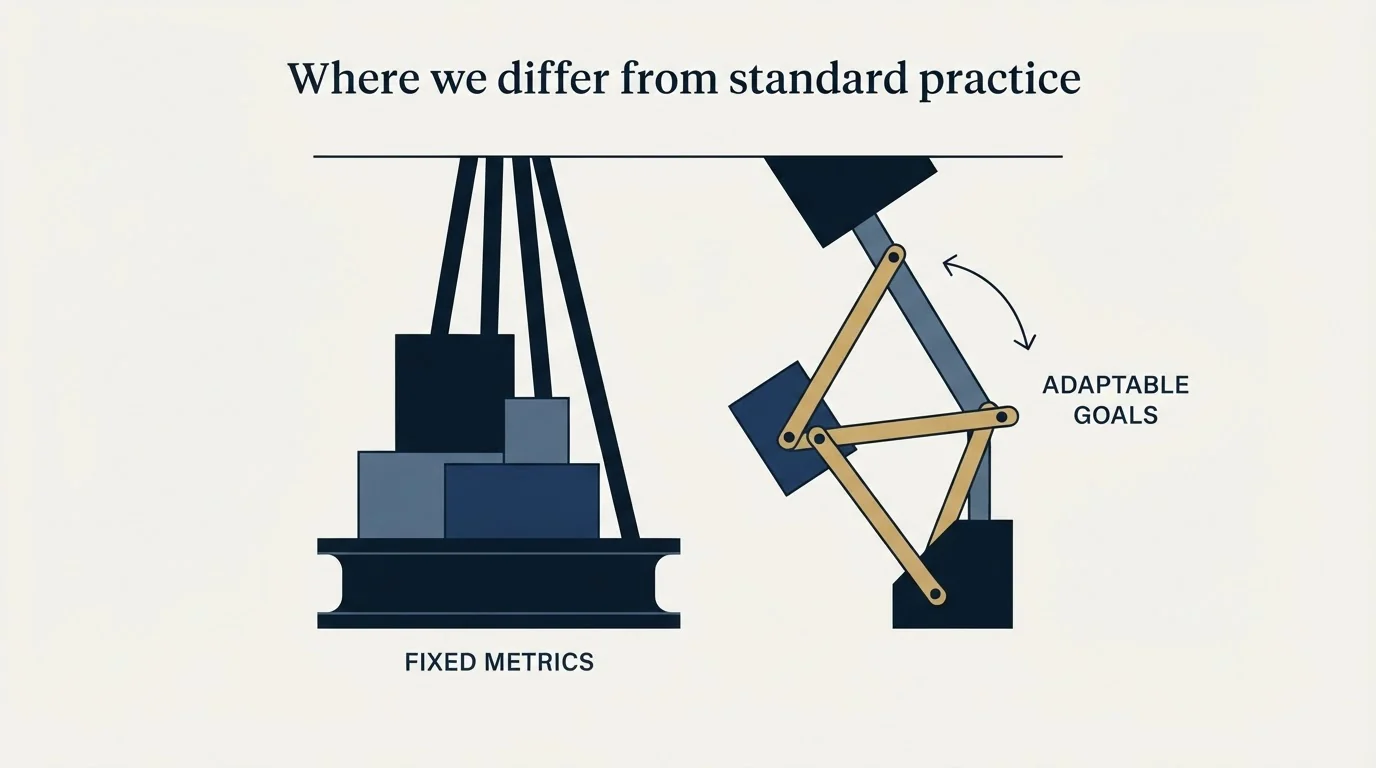
Prospecting scorecards built around a sequencing tool often carry an adherence line that scores how faithfully a rep worked a prescribed contact plan, with the later messages landing in the same thread. Since this page sits on our site, the divergence is worth naming plainly. One message per campaign, no bumps, no thread replies, and where an audience does not respond the next approach is a separate campaign with a genuinely different premise. There is therefore no adherence line on our version of this document, and the reasoning is mechanical rather than stylistic: a reminder reaches the population that already saw the message and chose not to answer, which is the population most likely to complain, and the cost of that lands on the sending domain across everything else it sends.
The practical effect on a scorecard is that the lines which would have measured process compliance are replaced by lines measuring whether a real person responded. Meetings we are paid for are qualified against criteria agreed in writing before launch, and budget, timing and authority are deliberately outside that definition, so a meeting that happened does not become unqualified later because the buyer's circumstances changed. The full trade, including what it costs us, is in why we stopped using follow-ups.
Running the review
A scorecard is a document for a conversation, and the conversation decides whether the document does anything.
Three habits make it work. Read the inputs before the outputs, so a segment problem is named before a rep is asked to work harder. Have the rep read their own scorecard first, because a rep who can identify their own weakest line has learned something transferable, while a rep told about it has received a correction. And change one thing at a time, since a rep given five improvements applies none of them.
The rhythm that fits is weekly against real artefacts, which is a recorded conversation and a set of sent messages rather than a summary of the week. That is a coaching conversation and it belongs to the manager's job rather than to the reporting layer. Where the artefacts are conversations, running discovery so it disqualifies well is usually the specific skill under review.
One structural warning. A manager carrying seven reps plus their own reporting and hiring load will quietly drop the review before they drop anything else, and a scorecard that is produced and never discussed is a report rather than an instrument. If the weekly conversation cannot happen for every rep, the scorecard is measuring a system that does not exist.
The short version

Sort every proposed line with one test: can the rep move it next week without somebody else deciding something. Six lines carry most of the weight, and they run from accounts worked through conversations, held meetings, meetings meeting the written standard, opportunities created, and whether the record supports a review. Keep activity counts in a separate view, because they can all be completed without a buyer doing anything.
Carry the count beside every rate, since rep-level denominators are small enough that one deal rewrites the number, and give a ramping rep a bar with the interval named rather than an informal discount. Watch for the two silent failures: a scorecard that becomes a compliance sheet, and a qualification standard that drifts when the quarter is tight.
Where the constraint turns out to be the number of qualified conversations rather than what a rep does with them, that is the half we run, and you can see what a campaign would look like for your market.
Frequently asked questions.
Frequently asked questions- What should be on a sales rep scorecard?
- Only lines the rep can move next week without somebody else deciding something, and that need a buyer to do something. That leaves six: accounts worked against accounts assigned, conversations opened, meetings held, meetings that met the written qualification standard, opportunities created from those meetings, and record quality. Activity counts belong in a separate view.
- What is the difference between a salesperson scorecard and a sales dashboard?
- A dashboard shows everything the system records about the team. A salesperson scorecard shows only what one person answers for, which is why it is short. Inbound volume, territory quality and the reply rate of a list somebody else built are real numbers worth watching, and they belong on the manager's input review instead of on the rep's document.
- Why do rep win rates swing so much between quarters?
- Because the denominator is small. In an invented example, a rep who closed nine opportunities in a quarter and won three is quoted at 33%, and one more or one fewer win moves that to 44% or 22%. The response is to carry the count beside the rate and read rate movements over a longer window than the review cycle.
- How does a sales rep scorecard get gamed?
- Two ways, and neither needs bad faith. Once a line is scored, the behaviour it names gets produced, so a scorecard that rewards contact volume produces contact volume. And definitions drift under pressure, so a meeting that would not have counted in January counts in March. Lines close to the buyer's response and a dated written standard resist both.
About the author.

B2B cold email experts helping companies generate qualified leads through done-for-you outreach campaigns.
RevenueFlow Team
Explore more.
Ready to scale your outreach?
We build GTM engines that book real meetings. See the receipts.
Related articles.
Prospecting Methods: Six Ways In, and What Each One Demands
Six prospecting methods, grouped by economics rather than preference: what each one needs before it works, where it stops scaling, and how to choose.
Sales Performance Improvement Plan Samples: What to Include
Three worked sales PIP samples, and the diagnosis that comes first. Most published plans set a target on an outcome the rep does not control alone.
Prospect Meaning in Sales: A Name Is Not a Prospect
A prospect is a name that passed a fit check, not a name that replied. What lead, prospect and opportunity each assert, and what the boundary decides.
Lead Prospecting: Where Lead Generation Ends
The work between an acquired name and a person worth contacting is real, unglamorous and usually unowned. What it involves and where the handover breaks.
Virtual SDR: One Term Covering Two Different Purchases
One vendor sells a vetted remote person, another sells software from $250 a month. The term does not separate them, and they fail in opposite directions.
Sales Prospecting: Most of the Job Happens Before You Send
Prospecting is selection, not sending. The five decisions inside the motion, the one most teams never make, and what changes when you buy it as a service.