Prospect Meaning in Sales: A Name Is Not a Prospect
A prospect is a name that passed a fit check, not a name that replied. What lead, prospect and opportunity each assert, and what the boundary decides.
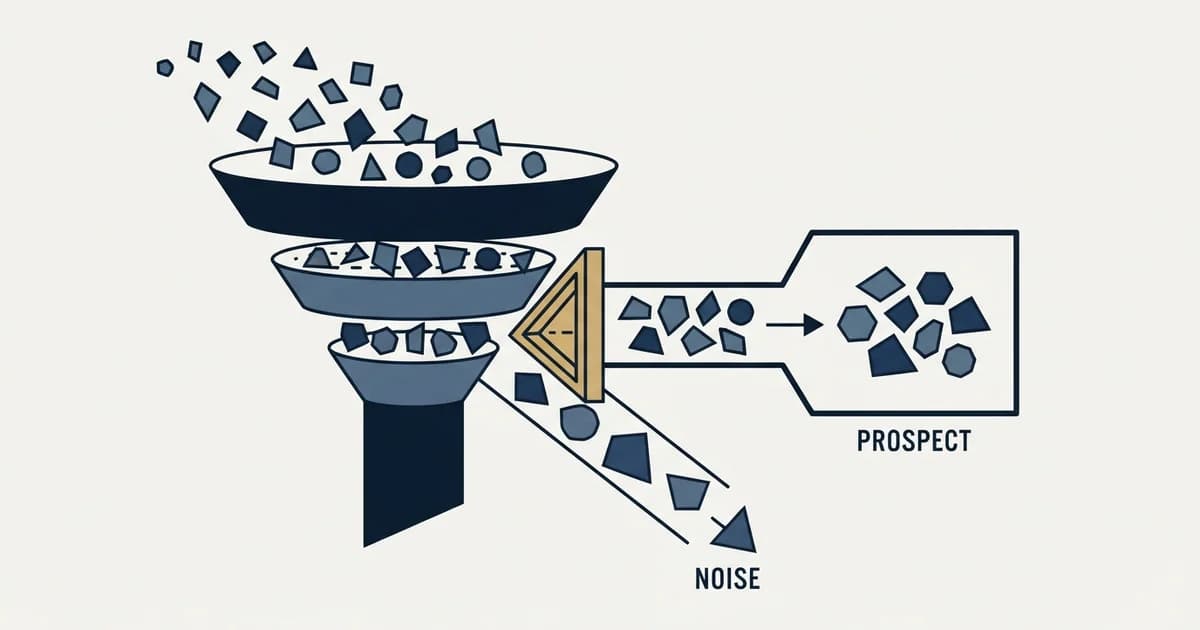
In sales, a prospect is a person or account that has been checked against your fit criteria and found to plausibly match, whether or not they have shown any interest. A lead is an unqualified name and an opportunity is a prospect with an active conversation and an identified need.
Key takeaways
- Fit and intent are separate axes. A checked account that has ignored three campaigns is still a prospect, because fit did not change; what changed is your evidence about timing, which belongs in a different field.
- The lead-to-prospect line decides who gets seller time, what a coverage claim means, what a conversion rate isolates and which departments argue with each other. It is an operational decision rather than a vocabulary one.
- CRM object names are storage details, not definitions. A record can be a prospect by your criteria and sit unconverted, or be converted without anyone checking fit, so the fit decision needs its own field.
- A definition without a demotion rule leaks. Accounts move from lead to prospect and almost never back, so the population grows monotonically until the word stops carrying information.
Reviewed and updated September 1, 2026
Two people look at the same CRM record. One calls it a lead because it arrived from a form, the other calls it a prospect because a rep has spoken to them, and the forecast that gets built on top of that record depends entirely on which of them is right. The vocabulary argument looks like pedantry until somebody has to explain why pipeline coverage moved without anything happening in the market.
Ask what is a prospect and you get two different answers depending on who is answering. The prospect definition that matters inside a sales team is this one: a person or an account that has been checked against your criteria and found to plausibly fit, whether or not they have shown any interest yet. The check is the thing that makes them a prospect. Interest is a separate axis.
The three words, and what each one commits you to
Most teams use lead, prospect and opportunity, and most teams define at most one of them precisely.
A prospective lead is the phrase people reach for when they are not sure which of the three they mean, and in practice it describes a lead: a name that has entered your world without anybody yet establishing that they fit or that they are engaged. Treat it as the entry state rather than a fourth category, because inventing a fourth word for a boundary is how the boundary stops being agreed.
A lead is an unqualified name. It arrived from somewhere, a form, a list, an event badge scan, a data provider, and nobody has yet decided whether it belongs in your market. The word carries no promise about fit and no promise about intent.
A prospect is a lead that has passed a fit check. Someone or something has compared the account against the criteria that define your buyer and concluded it plausibly matches. That check can be manual or automated, but it has to have happened, because the whole value of the word is that it separates a checked name from an unchecked one.
A qualified prospect is that same record described in full: the fit check has been run against stated criteria and recorded, so the label carries evidence rather than a seller's impression of the conversation.
An opportunity is a prospect with an identified need, a conversation in progress and, usually, a value and a date attached. It has left prospecting entirely and entered the sales process.
- Source is known
- Fit is unknown
- Intent is unknown
- Costs almost nothing to hold
- Counting them measures data collection
- Fit has been checked against stated criteria
- Intent may still be zero
- Someone decided it was worth attention
- Costs seller time to work
- Counting them measures selection
- Fit checked and a need identified
- A conversation is happening
- Usually carries a value and a close date
- Costs the most attention per record
- Counting them measures the pipeline
The order matters in one direction only. Every opportunity was a prospect and every prospect was a lead, but nothing forces a lead to become a prospect, and a large share of them should not.
A prospect in business, and a prospect in sales
Outside a sales team, the word gets used more loosely. In general business language a prospect is anything with future potential: a prospect for a partnership, a prospect for a site, prospects for the quarter. That sense is real and it is what the dictionary leads with, which is why searching the word returns as much general English as it does sales vocabulary.
Inside a sales team the word has to be narrower, because it is doing operational work. It decides who enters a working list, who a seller is accountable for touching, and what gets counted when somebody asks how much of the market has been covered. A definition that stretches to cover any promising thing cannot carry that load.
Teams that still lack anyone senior enough to enforce that fit line will find sales leadership arrangements explained useful before drawing it themselves.
The narrow reading also settles a common argument. A prospect is not defined by whether they replied. A checked account that ignored three campaigns is still a prospect, because fit did not change. What changed is your evidence about timing, which belongs in a different field.
The boundary is an operational decision, not a vocabulary one

Where a team draws the lead-to-prospect line determines four things that show up in reporting long before anyone notices the definition caused them.
Who gets seller time. The line is a gate. Set it loose and sellers work a population that includes accounts nobody believes in. Set it strict and the working list shrinks to something a person can actually cover, which is usually the point.
What coverage means. A claim that eighty percent of the market has been contacted answers a different question depending on whether the denominator is leads or prospects. Both numbers are honest and they are not comparable, so the denominator has to travel with the figure.
A similar denominator confusion sits inside sales productivity metrics, where four different ratios share a name but no common base.
What conversion rates measure. Lead-to-opportunity rate mixes a data problem with a selling problem. Prospect-to-opportunity rate isolates the selling problem, because the data problem was resolved at the gate.
Who argues with whom. Marketing and sales disputes about lead quality are almost always disputes about where this line sits and who is allowed to move it. The version of that argument that concerns qualification stages rather than fit is worked through in MQL versus SQL.
- Step 1Name acquired
From a form, a list, an event, a data provider or your own research. No claim attached yet.
- Step 2Fit check
Compared against stated criteria: sector, size, structure, stack, geography, buying motion. Passing makes it a prospect.
- Step 3Reason check
Is there something dated that makes this week the right week. Failing this does not remove the prospect, it defers the approach.
- Step 4Conversation
A reply that opens a real exchange. From here it is an opportunity and the sales process owns it.
Why the CRM cannot settle the argument for you
Part of the confusion is structural. Most CRMs ship an object model that splits records into an unconverted pool and a converted one, typically a lead object that holds a name until somebody promotes it, and a contact attached to an account once they have been promoted. The vocabulary of the product and the vocabulary of the sales team are not the same vocabulary, and neither one is wrong.
The mismatch shows up in three predictable places. A record can be a prospect by your definition and still sit in the lead object because nobody ran the conversion step. A record can be converted, and therefore a contact, without anyone having checked fit, because conversion was triggered by an activity rather than by a criterion. And an account can hold five contacts of whom two are prospects by your definition and three are not, which a record-level flag cannot express at all.
None of that is a reason to change the definition to match the software. It is a reason to write down which system field carries the fit decision, and to accept that the object name is a storage detail rather than a statement about the buyer. A team that treats object conversion as the definition ends up with a population shaped by whoever last clicked a button.
The account-versus-person problem deserves the same treatment. Fit is usually an account property, and the reason to write is usually a person property, so a single flag on a single record will always compress one of them. Holding them separately is the cheaper fix, and it is what makes an ideal customer profile usable as a filter rather than as a description.
Where the textbook definition breaks

A prospect is an account and a person at the same time, and the two disagree. The company fits and the individual is wrong, or the individual is perfect and the company is out of scope. Systems that hold one flag per record force a choice that reality does not support, and the usual casualty is the person-level nuance.
Fit criteria age. A prospect qualified against last year's criteria is carrying a decision nobody has revisited. Companies cross size bands, change stack and enter or leave a market, and the record does not update itself. The underlying data has a refresh cycle that most teams cannot name, which is the same problem firmographic data has everywhere it is used.
The word gets used as a compliment. In practice "that's a good prospect" often means the seller liked the conversation. That is intent talking, not fit, and letting it move records across the gate quietly destroys the only property the word had.
Nobody demotes. Accounts move from lead to prospect and almost never back, so the prospect population grows monotonically and stops meaning anything after a few years. A definition without a demotion rule is a definition with a leak in it. What the criteria should test, and how to keep them honest, is covered in lead qualification.
What to do with the distinction
Write the fit criteria down as conditions that return a count. A criterion you cannot run against a list is a description rather than a filter, and descriptions cannot gate anything.
Decide, explicitly, whether an inbound lead skips the fit check. Most teams behave as though raising a hand proves fit, and a portion of inbound is out of scope by any honest reading of the criteria. Skipping the check for inbound is a defensible policy; doing it accidentally is not.
Keep the timing question in a separate field from the fit question. Fit is durable and timing is dated, and merging them into one status is how a checked account with no current reason ends up deleted rather than deferred. The distinction between a durable filter and a dated signal, and how to build a working list from the second one, is in B2B prospecting.
A prospect whose timing is not there yet has failed the second gate and not the first, and collapsing the two is how a checked account with no current reason ends up deleted rather than deferred.
State the denominator every time you report a number built on either word. Most disagreements about coverage and conversion in this area are two people counting different populations correctly.
The short version

A lead is an unqualified name, a prospect is a name that has passed a fit check, and an opportunity is a prospect with a conversation and a need attached. Fit and intent are different axes, and a prospect who has never replied is still a prospect. The place a team draws the lead-to-prospect line decides who gets seller time, what coverage claims mean, what conversion rates measure and which department argues with which. Write the criteria as conditions that return a count, keep timing in its own field, and give the definition a demotion rule so the population cannot grow forever.
If you want the fit criteria applied to a real list rather than a document, we will build the campaign and show you the population it produces.
Frequently asked questions.
Frequently asked questions- What is the difference between a lead and a prospect?
- A lead is a name whose fit nobody has checked yet, whatever the source. A prospect is a lead that has been compared against your criteria and found to plausibly match. The check is the whole difference, which is why a team that promotes records based on activity rather than criteria ends up with two words for one thing.
- Is someone a prospect if they have never responded?
- Yes, if they passed the fit check. Responding is evidence about timing and interest, not about whether the account belongs in your market. Merging the two into a single status is how a well-qualified account with no current reason to buy ends up deleted rather than deferred until something at that account changes.
- What does prospect mean in business more generally?
- Outside a sales team it usually means anything with future potential: a prospect for a partnership, prospects for the quarter, a promising candidate. That reading is real and it is what general dictionaries lead with. Inside a sales team the word has to be narrower, because it gates who enters a working list and who a seller is accountable for.
- When does a prospect become an opportunity?
- When a conversation is under way and a need has been identified, usually with a value and a date attached. At that point the record has left prospecting and the sales process owns it. Teams that promote on activity rather than on an identified need inflate the pipeline and discover it at the forecast review rather than at the gate.
About the author.

B2B cold email experts helping companies generate qualified leads through done-for-you outreach campaigns.
RevenueFlow Team
Explore more.
Ready to scale your outreach?
We build GTM engines that book real meetings. See the receipts.
Related articles.
Prospecting Methods: Six Ways In, and What Each One Demands
Six prospecting methods, grouped by economics rather than preference: what each one needs before it works, where it stops scaling, and how to choose.
Sales Rep Scorecard: What the Rep Cannot Control
Most rep scorecards carry lines the rep cannot move. The controllability test, the six lines that earn a place, and the two ways the document stops meaning anything.
Lead Prospecting: Where Lead Generation Ends
The work between an acquired name and a person worth contacting is real, unglamorous and usually unowned. What it involves and where the handover breaks.
Virtual SDR: One Term Covering Two Different Purchases
One vendor sells a vetted remote person, another sells software from $250 a month. The term does not separate them, and they fail in opposite directions.
Sales Prospecting: Most of the Job Happens Before You Send
Prospecting is selection, not sending. The five decisions inside the motion, the one most teams never make, and what changes when you buy it as a service.
Outbound Prospecting: When Nobody Raised Their Hand
Going first means supplying the attention, timing, framing and permission that inbound gets free. Where outbound earns its cost, and what it really charges.