Inbound vs Outbound Sales: How the Two Motions Differ
Inbound and outbound sales compared as motions: what the rep knows at first touch, what each costs, the team each needs, and the metrics that belong to each.
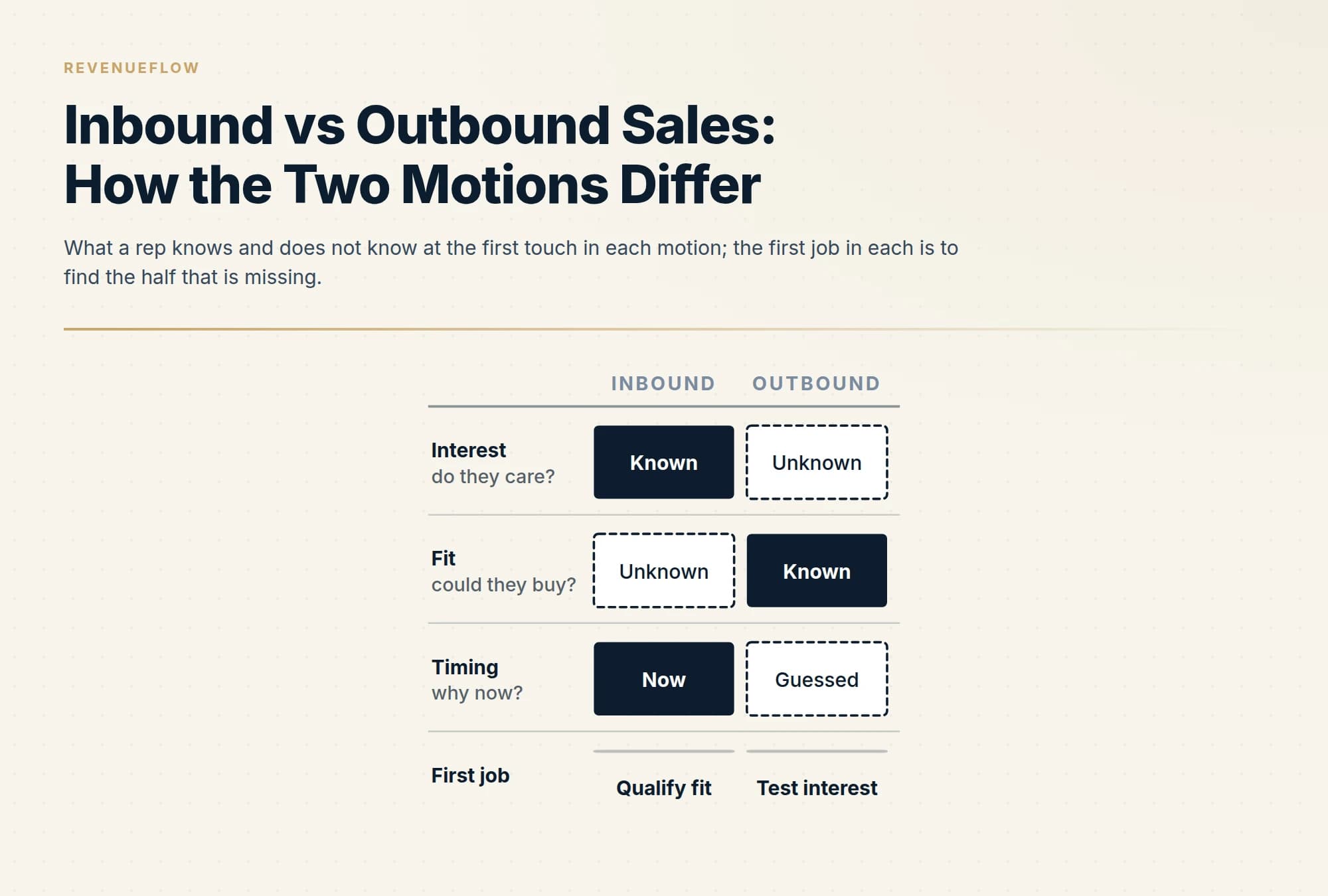
Inbound sales begins when a buyer raises a hand, and outbound sales begins when a seller reaches out. Inbound reps start knowing interest and must establish fit, while outbound reps start knowing fit and must test interest. Inbound is limited by demand and response speed, outbound by market size and list quality, and most companies eventually run both.
Key takeaways
- Salesforce and Gong both define the difference as who initiates contact, the buyer in inbound sales and the seller in outbound sales.
- An inbound rep knows the buyer is interested and must establish fit; an outbound rep knows the company fits and must test for interest.
- Inbound runs on a clock and cannot be scaled on demand, while outbound runs on a finite list and can be started within weeks.
- Time to first response and share of leads that fit belong to inbound; delivery and reply rate belong to outbound; meetings held and pipeline belong to both.
Reviewed and updated September 18, 2026
Two reps at the same company start the same Tuesday. One opens a notification: somebody from a logistics firm read the pricing page twice and filled in the demo form at 8:40. The other opens a spreadsheet of sixty companies that have never heard of them. They sell the same product to the same kind of buyer, and almost nothing about their next hour is the same.
The first is inbound sales and the second is outbound sales, and the difference goes further than where the lead came from. It changes what the rep knows when the conversation starts, what the work costs, who else has to be on the team, and which numbers tell you whether it is working. This page sets the two motions side by side on each of those. It treats them as sales motions. Comparing the marketing channels that feed them is a separate question, covered in inbound marketing vs outbound, and running the two as one loop is covered in allbound.
The difference everyone agrees on
The large publishers on this topic use nearly the same sentence. Salesforce's guide, by Erin Hueffner and dated February 5, 2024, says "The key difference between inbound and outbound sales is who initiates the sale, the buyer or the seller." Gong's guide, first published on June 15, 2023 and last modified on March 6, 2026, says "The main difference between inbound and outbound sales is who initiates contact."
Their definitions of each side match too. Salesforce: "Inbound sales happen when prospective customers approach you to learn about your products or services", and "Outbound sales happen when a rep reaches out to prospective customers directly." Our own glossary holds the longer definitions of outbound sales and of an inbound lead, so they are not repeated here.
Who initiates sounds like a small distinction. It is the root of every other difference on this page, because the side that starts the conversation is the side that chose it.
What the rep knows at first touch
In an inbound conversation the buyer chose you. They have told you something by arriving: which page they read, which form they filled in, what they typed in the message box. You know they have some interest and you know roughly when it peaked, which is now. What you do not know is whether they fit. The form could be from a perfect customer, a student, a competitor or a company a tenth of the size you can serve.
In an outbound conversation you chose the buyer. You know they fit, because fit is how they got onto the list: the industry, the size, the role, perhaps a signal such as a new hire or a funding round. What you do not know is whether they care, or whether this is the month they would.
So the two motions begin with opposite halves of the same information, and the first job in each is to find the missing half. Inbound qualifies for fit. Outbound tests for interest. A team that runs inbound leads through an outbound script, pitching people who have already said what they want, wastes the one advantage it had. A team that treats outbound replies like inbound leads, waiting for the buyer to drive, loses conversations it paid to start.
The economics: a clock against a list
Each motion has one resource that runs out, and they are different resources.
Inbound runs on a clock. Interest that peaked at 8:40 is lower by lunchtime and gone by Friday, when the buyer has spoken to whoever answered first. The best-known research on this was published in Harvard Business Review in March 2011 under the title The Short Life of Online Sales Leads, and the public summary by its authors, James Oldroyd, Kristina McElheran and David Elkington, states their finding as "most companies are not responding nearly fast enough." The cost structure follows from that. The marketing that produces the lead is a sunk cost by the time it arrives, so the controllable economics of inbound sit in response: how fast, by whom, and how well the first reply picks up what the buyer already said.
Inbound also has a supply problem no sales leader can solve. You cannot decide to have forty more demo requests next month. Volume is set by demand, brand and search position, which move over quarters.
Outbound runs on a list. You can decide to start forty more conversations next month, and that controllability is the reason companies turn to outbound when a number has to move. The constraint is the size of the market. There are only so many companies that match your criteria, each can be approached only so often before the approach does harm, and every message sent to the wrong company costs sending reputation as well as time. The controllable economics of outbound sit before the conversation: who is on the list, whether the address is real, whether the message arrives, and whether it gives a stranger a reason to reply.
Inbound
Runs on: a clock. Interest decays from the moment the buyer raises a hand.
You control: speed and quality of the response.
You do not control: how many hands go up this month.
What spoils it: a slow or generic first reply.
Outbound
Runs on: a list. The market of companies that fit is finite.
You control: who is contacted, when, and with what reason.
You do not control: whether this is the month they care.
What spoils it: a wrong list, a dead address, or mail that never lands.
Neither motion is cheaper by nature. At small deal sizes a person-led outbound motion can cost more per conversation than the deal returns, and at large deal sizes waiting for a named enterprise account to fill in a form can take longer than the company has.
The team each motion needs
The job titles overlap and the work behind them does not.
An inbound motion needs someone to catch the lead and respond, usually an SDR working an inbound queue, and behind that person it needs routing, so the lead reaches an owner in minutes rather than sitting in a shared inbox. It depends on marketing for supply and on operations for the plumbing between form, CRM and calendar. The skill at the front is qualification: finding out quickly and politely whether the interested person can buy.
An outbound motion needs someone to define and build the list, someone to write a message worth answering, and the sending infrastructure underneath, meaning domains, mailboxes and deliverability monitoring, before an SDR has anything to work. The skill at the front is relevance: giving a stranger a specific reason to reply. What that role involves day to day is set out in our guide to the outbound SDR.
One consequence is that the two motions fail in different departments. A weak inbound quarter is usually a marketing or routing problem that shows up in the sales number. A weak outbound quarter is usually a list or deliverability problem that shows up as a copy complaint. Outbound can also be bought rather than built, which moves the ramp and the infrastructure onto a supplier, and the trade-offs in that decision are covered in outbound sales outsourcing.
The numbers that belong to each
Both motions end in the same place, a meeting held and then a deal, so they share their late-stage metrics. The early ones are different, and borrowing a metric across motions produces nonsense.
| Row | Inbound | Outbound |
|---|---|---|
| Time to first response | Yes | No |
| Share of leads that fit | Yes | No |
| Share of messages delivered | No | Yes |
| Reply rate, positive replies counted apart | No | Yes |
| Meetings held, against leads or companies contacted | Yes | Yes |
| Pipeline created and win rate | Yes | Yes |
Time to first response is the defining inbound number and has no outbound equivalent, since there is no waiting buyer. Share of leads that fit is inbound's quality check, because fit is its unknown. Delivery and reply rate are outbound's, because reach and interest are its unknowns, and a reply rate should always count positive replies apart from the polite refusals.
Two cautions apply to both. Count meetings held, never meetings booked, since a no-show is not a conversation. And write the denominator beside every rate: a meeting rate measured against replies flatters a campaign that a meeting rate measured against companies contacted would expose. The stage definitions that keep those denominators honest are laid out in our sales funnel template.
Which one a company needs
Most companies end up needing both, a point Jason Lemkin makes at SaaStr in a post titled Inbound or Outbound Sales? The Answer is Yes, which closes with "Because usually, it takes both." The useful question is which to build first, and four conditions answer it.
How many companies could buy. If the market is a few hundred named accounts, waiting for them to find you is a plan to talk to a fraction of them. A small, knowable market favours outbound. A market of tens of thousands of small buyers favours inbound, because nobody can afford to approach each one.
What a deal is worth. Outbound puts a person's time into every conversation, so it needs a deal size that repays it. Low-priced products need buyers who arrive by themselves.
Whether buyers know the problem exists. Inbound needs people searching. If the category is new and nobody types the query, there is no inbound to capture yet, and outbound has to carry the explanation.
How soon the number has to move. Outbound can start conversations within weeks. Inbound demand is built over quarters. The mechanics of inbound lead generation explain why that side cannot be hurried.
Where we sit
RevenueFlow runs outbound, by cold email and LinkedIn, and does not run inbound programmes or phone outreach. Our documented practice is one message per campaign, with no bumps and no thread replies, and meetings qualified against criteria agreed in writing before launch. That is a statement of policy, and it shapes what this page can claim: we have a position on how outbound should be run, and none on which motion your company should prefer, because the four conditions above decide that and they are yours.
If the conditions point to outbound and you would rather see it than staff it, you can see what a first campaign produces against your own market.
The short version
Inbound sales begins when the buyer raises a hand and outbound sales begins when the seller reaches out, a definition Salesforce and Gong state in almost the same words. Everything else follows. Inbound starts knowing interest and has to establish fit; outbound starts knowing fit and has to test interest. Inbound runs on a clock and is limited by demand you cannot command; outbound runs on a list and is limited by the size of the market. They need different teams before the account executive, fail in different departments, and are measured by different early numbers. Market size, deal value, problem awareness and urgency decide which to build first, and most companies eventually run both.
Quotations above were read from the named publishers' own pages on 18 September 2026, from stored snapshots; publication dates are the ones each page displays. The Harvard Business Review article is quoted from its public summary only. No conversion or cost figures are given because none could be tied to a source we could read in full.
Sources: Salesforce, Inbound vs. Outbound Sales, Gong, Inbound vs. outbound sales, Harvard Business Review, The Short Life of Online Sales Leads, SaaStr, Inbound or Outbound Sales? The Answer is Yes
Frequently asked questions.
Frequently asked questions- What is the difference between inbound and outbound sales?
- Who starts the conversation. In inbound sales a prospective customer approaches the company, through a form, a search or a referral, and a rep responds. In outbound sales a rep contacts a company that has not asked to hear from them. That single difference decides what the rep knows at first touch, what the work costs and how it is measured.
- Is inbound or outbound sales better?
- Neither is better in general. A small market of named accounts, a large deal size, a new category and an urgent target all favour outbound, because the seller controls who is contacted and when. A large market of small buyers who already search for the problem favours inbound. Most companies end up running both, which is the conclusion Jason Lemkin reaches at SaaStr.
- Do inbound and outbound sales need different teams?
- Yes, before the account executive. Inbound needs marketing to create demand, routing to get each lead to an owner quickly, and a rep skilled at qualifying fit. Outbound needs someone to define and build the list, someone to write the message, sending infrastructure that lands in inboxes, and a rep skilled at giving a stranger a reason to reply.
- Which metrics matter for inbound and outbound sales?
- Inbound is judged early on time to first response and the share of leads that fit, because interest is known and fit is not. Outbound is judged early on delivery and reply rate, with positive replies counted apart, because fit is known and interest is not. Both share meetings held, pipeline created and win rate, each with its denominator written beside it.
About the author.

B2B cold email experts helping companies generate qualified leads through done-for-you outreach campaigns.
RevenueFlow Team
Explore more.
Ready to scale your outreach?
We build GTM engines that book real meetings. See the receipts.
Related articles.
President's Club in Sales: How the Criteria Decide Who Goes
A rep finishes at 134 percent of plan and the bar was 135. What a President's Club actually buys, and the two ways to set the criteria.
Parallel Dialing: The Line Count Is the Whole Decision
Orum's help centre publishes the line count its own team uses, and it is half the ceiling its product page advertises. That gap is the whole subject.
The Agoge Sequence: What Sam Nelson Actually Built
A documented 15-touch, 27-day cadence built by Sam Nelson at Outreach. What the primary sources say, which part transfers, and where our own practice differs.
Sales Rep Coaching: The Cadence That Survives a Busy Quarter
Coaching that changes behaviour needs an artifact on the table and one named focus. The weekly loop, and the three layers a flat number can be hiding.
SDR Comp Plans: The Definition You Are Really Paying For
An SDR comp plan is three numbers and one definition, and the definition decides the rest. What to pay on, how to write acceptance, and what a bad month is made of.
Cold Calling Sales Training: Diagnose Before You Buy It
Calling results come from the list, the offer and the execution. Training reaches the third, and the third is frequently not the one that broke.