Outbound Sales: Who Starts the Conversation, and What That Decides
Outbound sales is the motion in which the seller starts the conversation, contacting companies that have not asked to hear from them on a premise about a problem they likely have. It is the only demand whose timing you control, it is bounded by how many companies match your criteria, and targeting decides most of the result.
Key takeaways
- Outbound sales is defined by who initiates: the seller contacts a company that has not asked to hear from them, where inbound responds to a buyer who raised a hand.
- The programme is a six-link chain from criteria to a held conversation, and targeting and premise account for most disappointing results, with copy mattering least.
- Outbound is the only source of conversations a company can time, but it is bounded by market size and lags revenue by a full sales cycle.
- The honest diagnostic is a reply classification, because engaged declines, confused replies and silence each point at a different fix that one response rate conceals.
Outbound sales is the motion in which a seller initiates contact with a company that has not asked to hear from them, on the basis that the seller believes the company has a problem worth a conversation. The initiative sits with the seller, which is the single property that separates it from everything else in a go-to-market plan.
Inbound sales works the other way: somebody raises a hand and the seller responds. Both produce meetings and both produce revenue, and they differ in who decided the conversation should happen, which decides almost everything else about how each one is run and measured.
What is outbound sales?
Outbound sales is selling that starts with the seller. Your team decides which companies to approach, contacts them by email, phone or a professional network before they have asked for anything, and works the replies into booked conversations. The alternative is inbound sales, where the buyer makes the first move and the seller responds. Most B2B companies run both, and they are planned, staffed and measured differently.
What the motion consists of
An outbound programme is a short chain, and each link has a distinct failure mode.
It starts with a definition of who to contact, written as criteria a stranger could check rather than as adjectives. Then a list built against those criteria and verified, so the addresses resolve. Then infrastructure: sending domains and mailboxes, authenticated and warmed before real volume moves through them. Then the message, written on a premise believed to be true of everybody on the list. Then replies, worked by a person, sorted and qualified against the written criteria. Then a booked conversation, held and handed over.
The chain is worth stating because a disappointing result is a broken link rather than a general failure, and the links are not equally likely to be the cause. Targeting and premise account for most of it. Infrastructure accounts for the rest, and copy for less than anybody expects.
Why it matters: it is the only demand you control the timing of
Inbound arrives when it arrives. Referrals arrive when they arrive. Outbound is the one source of conversations a company can decide to create, which is why it is the input asked to close a gap when the others have already been spent.
That controllability comes with a constraint that is easy to miss and expensive to learn. Outbound is bounded by the size of the addressable market rather than by effort: a plan to double contacted volume is available only if twice as many companies match the criteria. Where the market is a few thousand companies, the whole of it can be reached deliberately over a year, and pushing harder inside that year exhausts the list rather than growing the pipeline. Reach is a cycle, not a throttle.
The second reason it matters is the lag. A conversation booked today enters the pipeline today and closes a sales cycle later, so outbound cannot repair the current period. Treating it as an in-period fix produces rushed targeting and opportunities that inflate a pipeline total without closing, which makes the next quarter worse rather than better.
That lag is why supply belongs in the plan rather than in a mid quarter rescue, and sales goals sets out how to derive the required volume of conversations from the plan and pair every outcome with a mechanism somebody can act on this week.
| Outbound: the seller initiates | Inbound: the buyer initiates | |
|---|---|---|
| Timing | Chosen by you | Chosen by the market |
| Bounded by | How many companies match the criteria | Awareness and search demand |
| Works where | The buyer has the problem and is not searching | The buyer is already evaluating |
| The premise | You have to supply one | Arrives with the buyer |
| Fails when | Nobody recognises the problem described | The category is unfamiliar or the volume is small |
Where the textbook definition misleads
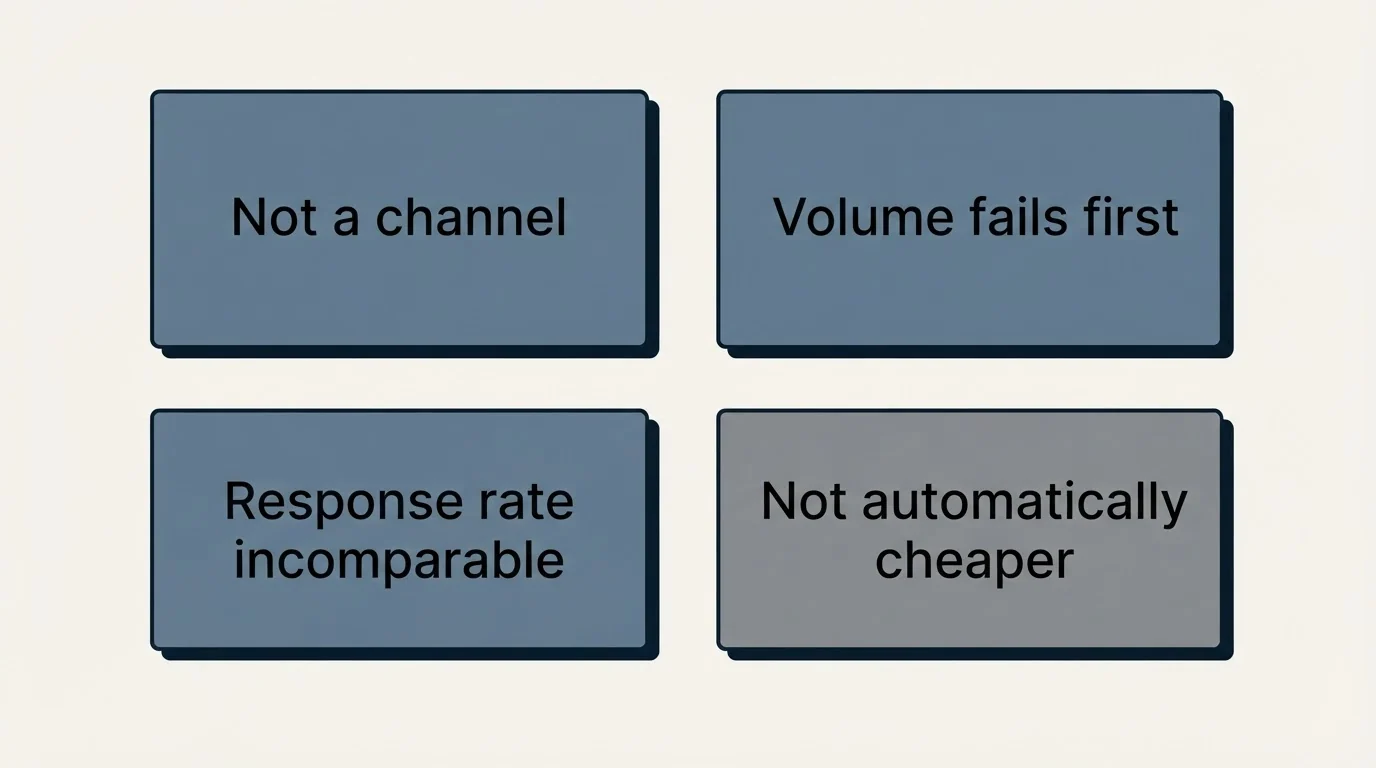
Outbound is not a channel. Cold email, LinkedIn and the telephone are channels; outbound is the decision about who initiates. A programme described by its channel tends to be planned as a channel, which is how targeting becomes an afterthought and volume becomes the lever.
Volume is the lever that stops working first. More sends against a list that was not chosen carefully produce more silence and a worse sending reputation at the same time, and the two compound. The constraint that actually moves results is who is on the list and whether the premise is true of them.
A response rate is not comparable to anybody else's. It depends on the market's size, the seniority contacted, how well the premise fits, and whether the sending infrastructure is placing mail at all. Benchmarks are useful as a rough band and useless as a target, and the comparison that means something is against your own previous campaigns.
It is not automatically cheaper than the alternatives. The cost per conversation depends on the market and the seniority, and at low deal sizes a motion with a person in the loop can cost more than the deal returns. The arithmetic that decides which motions a business can afford runs off annual contract value, and what a meeting has to cost to make sense is set out in B2B appointment setting.
How it is run: our own position, stated as policy
Industry practice is sequence-based. A campaign contacts a person several times over a period, with follow-ups, bumps and break-up messages, and most published playbooks are mostly a description of that schedule.
We do not run it that way, and it is worth stating as our documented practice rather than as a universal rule. We send one message per campaign. There are no thread replies and no bump sequences. The same applies on LinkedIn, where a second message lands directly beneath the first one they ignored and reads as a bump whatever the campaign structure claims.
The reasoning is mechanical rather than stylistic. Each additional message to somebody who did not answer is another opportunity to be marked as spam, and complaint rate is the signal receiving providers act on fastest. It also changes where the work sits: with one message, the list, the premise and the infrastructure carry the entire result, and there is no schedule to hide behind. The operating model that rule forces, written as something you can run, is in the outbound sales playbook.
The reply classification in the middle is the cheapest instrument the motion has. Replies that engage with the offer and decline it are a finding about the offer or the timing. Replies that are confused are a finding about the premise or the category. Silence with healthy delivery is a finding about the list. Each of those instructs a different change, and a single response rate conceals all three.
| What comes back | What it is a finding about |
|---|---|
| Replies that engage with the offer and decline it | The offer or the timing |
| Replies that are confused | The premise or the category |
| Silence, with healthy delivery | The list |
Who runs it, and what that decides
The motion can be built inside a company or bought, and the decision is usually made on price when it is better made on timing and on what the arrangement puts at risk.
Building it means hiring, ramping and equipping people, and standing up the sending infrastructure that sits underneath. The ramp is the part that gets underestimated: a new seller carries a fully loaded cost long before they carry a number, and the infrastructure carries a warming period before any real volume moves through it. Both of those are weeks to months of cost with no output, and neither is avoidable by paying more attention.
Buying it moves that ramp onto somebody who has already paid it, and moves the risk onto how the arrangement is priced. A retainer pays for effort and leaves the outcome with you. A price per meeting pays for output and makes the definition of a meeting the entire contract, which is why that definition has to be written down before anything sends rather than negotiated afterwards. What sits inside each price point, and the six rungs of scope a quote can stop at, is in appointment setting services.
The question worth answering before either is whether the constraint is genuinely supply. A team with enough conversations and a poor conversion rate does not have an outbound problem, and adding created pipeline to a conversion problem produces a bigger pipeline with the same output and a less accurate forecast.
How it is used alongside everything else
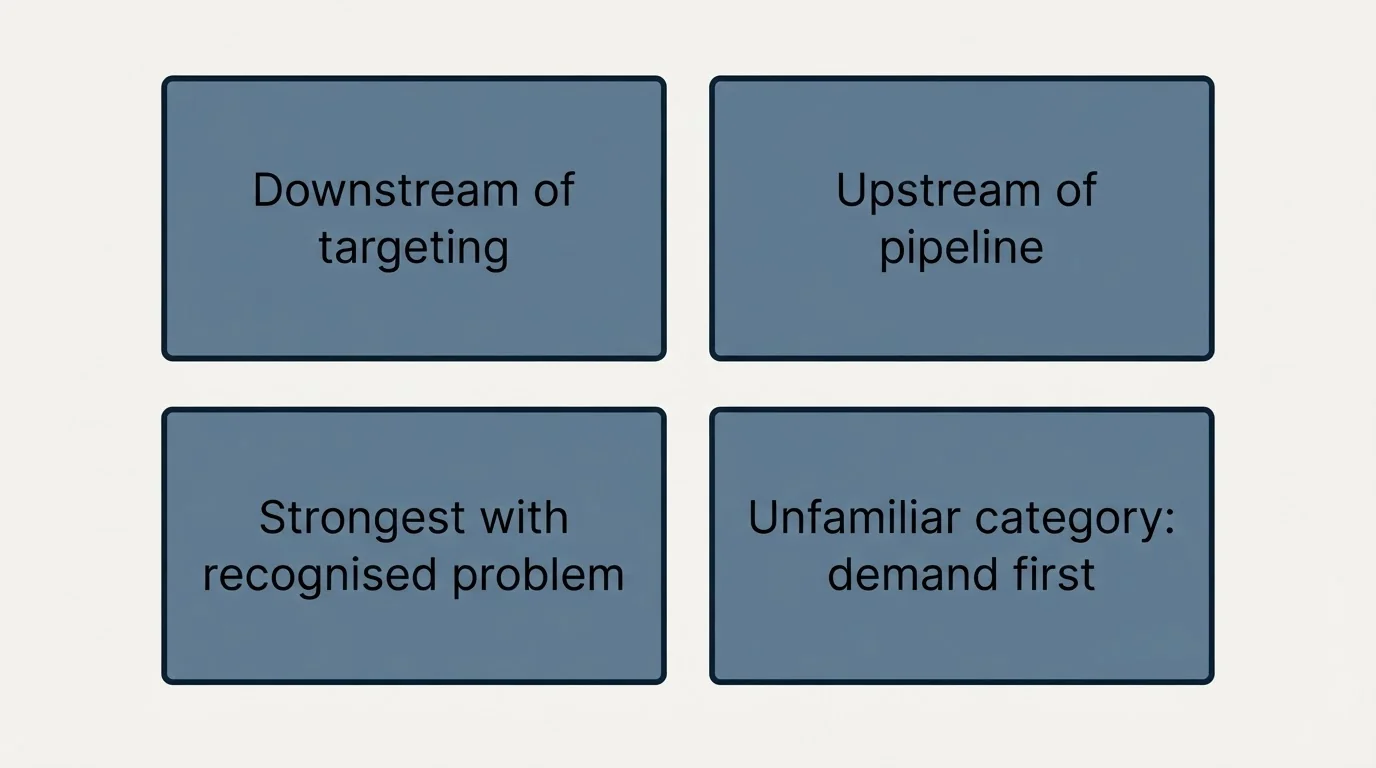
Outbound sits downstream of the targeting work and upstream of the pipeline, and it is strongest when the market already recognises the problem, because the message then has to establish only the fit. Where the category is unfamiliar, the message carries the category and the problem and the fit at once, which is a heavy load for a first touch and is the condition demand generation exists to change.
What a buyer reads once that conversation is under way is a separate body of work, and sales collateral covers which asset answers which buyer question and why every one of them has to survive being forwarded to somebody who was never on the call.
Two pieces of work make the difference before any message is written. The criteria come from building an ICP with the arithmetic attached, and the difference between a filter and a signal, which is what makes a premise worth writing rather than a demographic slice, is in B2B prospecting. On the infrastructure side, the diagnostic order when mail is not landing is in the cold email deliverability guide.
Related terms
Inbound lead is the other motion's output, and the contrast that defines this one. Outsourced sales is the arrangement where the motion is run by somebody else. Qualified appointment is the commercial test a booked meeting has to pass when it is being paid for. Sending domain and email deliverability are the infrastructure the email channel depends on, and lead qualification is what happens to a reply once it arrives.
The short version
Outbound sales is the motion where the seller initiates, on a premise about a company that has not asked to hear from them. It is the only demand whose timing you control, and it is bounded by how many companies match your criteria rather than by effort. Its results are set by targeting and premise long before copy matters, its lag means it cannot repair the current period, and the honest diagnostic is a reply classification rather than a response rate. We run it one message per campaign, with no follow-ups.
RevenueFlow runs cold email and LinkedIn outreach for B2B teams and is paid on attended qualified meetings against criteria agreed in writing before launch. See what a first campaign produces.
Frequently asked questions.
Frequently asked questions- What is outbound sales?
- Outbound sales is the motion in which a seller initiates contact with a company that has not asked to hear from them, because the seller believes the company has a problem worth a conversation. Contact is made by email, telephone or a professional network, replies are worked by a person, and the output is a booked conversation.
- What is the difference between outbound and inbound sales?
- Who decided the conversation should happen. In outbound the seller chooses the timing and has to supply a premise, and the motion is bounded by how many companies match the criteria. In inbound the market chooses the timing, the buyer arrives with their own premise, and volume is bounded by awareness and search demand.
- Why is outbound sales not working?
- Usually a broken link early in the chain, not the copy. Check in order: criteria written as checkable filters, a premise true of every company on the list, mail actually being placed, and replies being classified. Engaged declines point at the offer or timing, confused replies at the premise, and silence with healthy delivery at the list.
- Is outbound sales a channel?
- No. Cold email, LinkedIn and the telephone are channels. Outbound is the decision about who initiates the conversation. A programme described by its channel tends to be planned as a channel, which is how targeting becomes an afterthought and volume becomes the lever, and volume is the lever that stops working first.