Email Deliverability: What It Measures, and Where Delivery Stops Being It
Email deliverability is whether mail reaches somewhere a recipient will see it rather than being refused or filed into spam. It differs from delivery, which only records that a receiving server accepted the message. Its inputs are authentication, sender reputation, list quality, sending volume and the message, and only authentication has an objective answer.
Key takeaways
- Delivery is a success code from the receiving server; deliverability is where the message then went, which the server never reports back.
- Most tools compute accepted divided by sent and label it deliverability, a figure that does not move when a provider starts filing your mail in spam.
- Google's sender guidelines set the complaint threshold at spam rates below 0.30% in Postmaster Tools, and require SPF or DKIM of every sender.
- Reputation is held per provider, so a campaign-wide average hides a problem concentrated at one receiving domain.
Email deliverability is whether the mail you send reaches the place a recipient will actually see it, rather than being refused, discarded or filed in spam. It is an outcome produced by several independent inputs, principally authentication, sender reputation, list quality, sending volume and the message itself, and no single one of them controls it.
The word sits next to a much narrower one that gets used interchangeably with it, and separating the two is the first useful thing a definition can do. Delivery is a fact the receiving server states: it answered the SMTP transaction with a success code and took custody of the message. Deliverability is a judgment about where that message then went, which the receiving server never reports back.
Delivered, placed, and the gap between them
A sending platform marks a message delivered on that success code and its knowledge ends there. What happens next is a filing decision made by the provider, using the provider's own view of you, and all of the outcomes report identically to the sender.
That gap is the entire reason the term exists. A campaign whose delivery column reads close to perfect can still have a large share of its mail sitting in spam folders, and nothing in the sending dashboard will contradict it. The measurement that closes the gap is inbox placement, which has to be produced deliberately with a seed list rather than read off a delivery column.
Inbox delivery is the phrase most sending platforms print above that column, and it is worth reading as a claim about acceptance rather than about where the message was filed.
Messages the platform attempted
The receiving server answered with a success code and took custody
What a sending dashboard counts, and where its knowledge ends
Primary inbox rather than spam or a secondary tab. Never reported back to the sender.
Why it matters: the inputs are independent and only one is binary
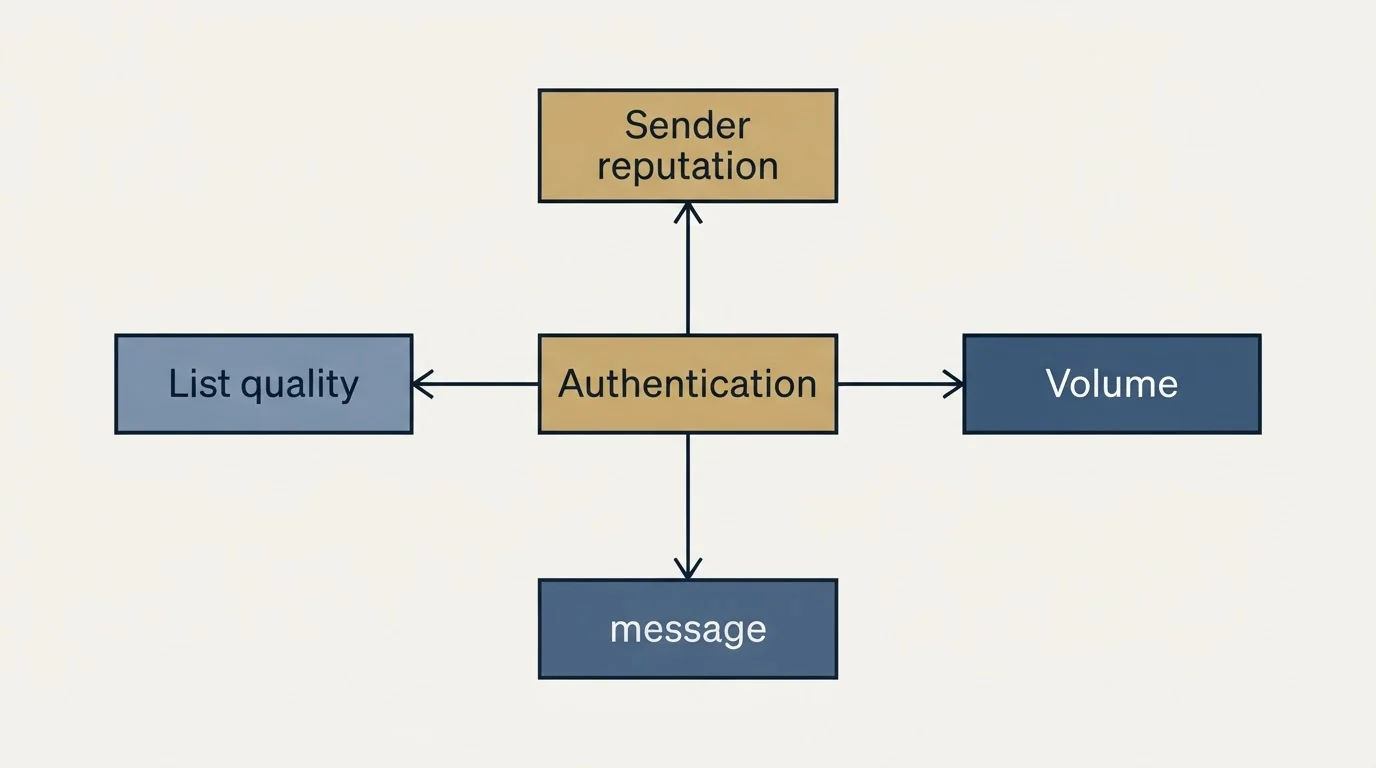
Deliverability degrades for reasons that have nothing to do with each other, which is why a single number for it is a poor diagnostic and why the remedies are not interchangeable.
Authentication is the only input with an objective answer. A record either resolves and aligns or it does not, it costs almost nothing to fix, and it is checkable by a third party in minutes. It is also the entry bar rather than an advantage. Google's sender guidelines state the requirement plainly, "Set up SPF or DKIM email authentication for your sending domains", with the full set required above the bulk threshold. Meeting it earns the right to be judged on reputation.
Sender reputation is the receiving side's accumulated judgment of the domains and addresses you send from. It is slow to build, faster to lose, and held privately by each provider, so it cannot be read directly and can only be inferred from behaviour.
List quality shows up as bounces and complaints, and both are read by receivers as statements about how the list was assembled. Google's guidelines carry a hard operational number here: "Keep spam rates reported in Postmaster Tools below 0.30%".
Volume and pacing matter because a domain earns its capacity rather than being granted it. Sending more than a domain's history supports produces deferrals and filtering that look exactly like a content problem.
The message is the input people reach for first and it is usually the last one to matter. Copy changes are cheap, visible and satisfying, and they do nothing at all when the cause is a record that does not resolve.
- Bounce rate has risen, or a provider rejects outright
- Concentrated at one receiving domain or one gateway vendor
- Visible in the sending platform without any extra tooling
- Fixed by list hygiene or by the sending side
- Delivery looks healthy and replies fall
- Only a seed-list placement test shows it
- Usually reputation, volume or authentication underneath
- Fixed upstream of the copy
- Bounces normal, complaints normal, placement fine
- Replies arrive and are polite declines
- No amount of infrastructure work touches it
- Fixed by the list or the offer
The third column is the one worth sitting with. Delivery mechanics and demand produce the same visible symptom, which is silence, and silence is frequently the only signal anybody is looking at. That is how deliverability work gets bought to solve a targeting problem, and the engagement ends with a report saying the mechanics were fine.
Where the textbook definition misleads
A deliverability rate is usually a delivery rate wearing the other word. Most tools compute accepted divided by sent and label it deliverability. That figure moves when addresses bounce and stays completely still when a provider starts filing your mail in spam, which is the event the word is supposed to describe.
Providers do not agree with each other. Reputation is held per provider, so a domain can be in good standing at one and distrusted at another, and a campaign-wide average hides it. A drop concentrated at one provider is a different investigation from a drop that appears everywhere, and only reporting split by receiving domain distinguishes them.
Nothing about it is a one-time fix. Vendor records change, provider policies move, domains age, lists decay. The work is a standing check rather than a project, and the version that fails is the audit performed once and filed.
A high score from a testing tool is not placement. Content scanners and spam-score checkers evaluate a message against rules; they do not observe where a real provider files real mail from your real domain. The only evidence that answers the question is a placement test run against your own sending, compared with a baseline you took before you changed anything.
How it is used in outbound
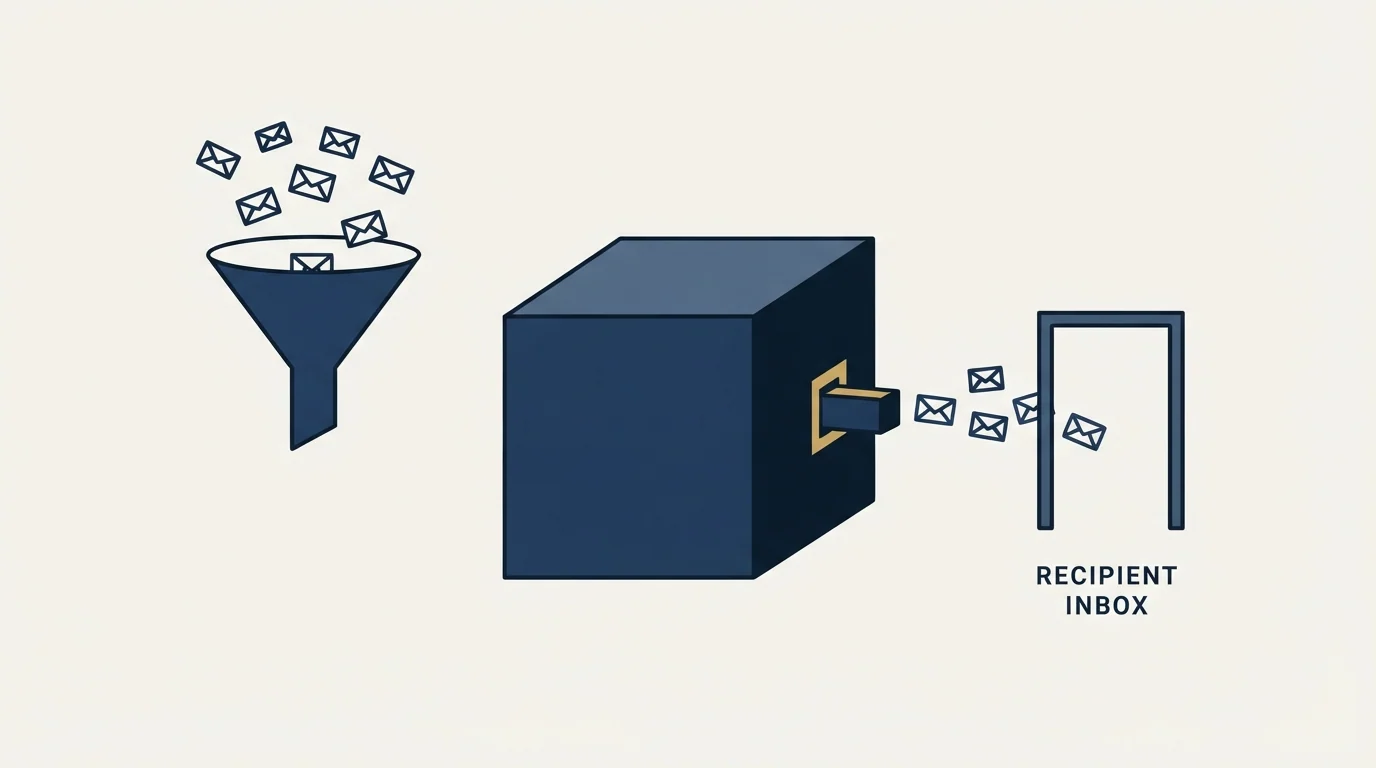
For a programme sending from an inventory of domains, deliverability is a property of the inventory rather than of any campaign, and three habits carry it.
Authenticate before the first send, not after the first problem. A new domain with no records asks receivers to build a reputation for an identity they cannot verify, which is the slowest possible way to warm a domain. Records first, then volume.
Verify the list, then read what still bounces. Verification removes the addresses that would have failed permanently, and the point is not only the saved sends: it shrinks the address-level noise enough that a policy refusal aimed at your sending becomes visible against it. The rate to expect once verification has run is in cold email bounce rate benchmarks.
Establish a baseline before changing anything. Bounce data, complaint rate against Google's 0.30% ceiling, and a placement test are an afternoon's work, and without them every later change is unfalsifiable. Inbox placement testing covers how the seed measurement is produced, and the spam rate itself is read in Google Postmaster Tools.
Volume discipline is the part that is a policy decision rather than a technique. We send one message per campaign. That constrains how fast a programme can move and it also constrains how much of a receiving provider's patience a single sending domain consumes, which is the input that sets deferral and filtering behaviour in the first place.
There is a scale effect worth planning for on an inventory rather than a single domain. Deliverability is cheap to establish once and expensive to keep correct across a set of domains that keeps changing, because every change is a chance to introduce a record that resolves but does not align, or a mailbox sending at a rate its domain has not earned. None of those produce an error anybody sees. They produce an inventory that performs slightly worse than it did last month, and the first symptom is a placement drift that gets blamed on copy. The defence is a standing check on a schedule rather than an audit after a bad week: resolve every sending domain's records from outside your own network, read the complaint rate, and compare a placement test against the last one.
- Yes: Bounce rate has risen, or a named provider is rejecting outright
- Yes: A placement test shows mail landing in spam at one or more providers
- Yes: The spam complaint rate reported by receivers has moved
- Yes: Authentication is incomplete or failing on one of the sending domains
- No: Mail is accepted and delivered, and the reply rate is what fell
- No: Replies are arriving, and they are polite declines
- No: The drop began when the target list or the offer changed
- Depends: Volume was increased shortly before the drop
Where the answers sit in the bottom half, the honest reading is that the mechanics are already working. The full diagnostic order is in the cold email deliverability guide, what a vendor engagement can and cannot fix is in email deliverability services, and a deliverability audit is the faster path when records are correct and placement is still poor.
Related terms
Inbox placement is the measurable half of deliverability, expressed as a share of delivered mail. Sender reputation is the judgment that decides it, built from domain reputation and IP reputation. Email authentication is the floor underneath all of it. On the list side, a hard bounce and a soft bounce are the two failure classes, and the spam complaint rate is the figure providers act on fastest.
The short version
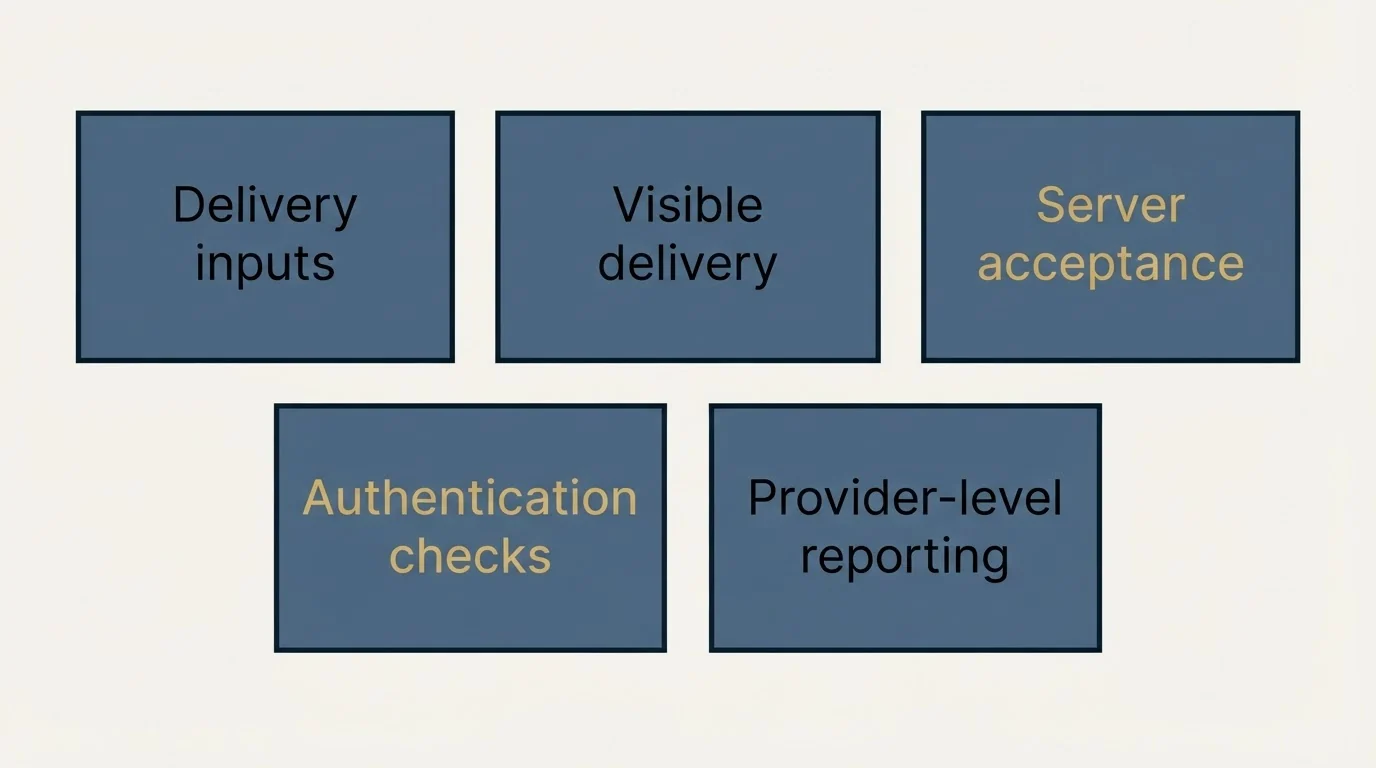
Email deliverability is whether mail reaches somewhere the recipient will see it, and it is distinct from delivery, which only says a server accepted the message. It has several independent inputs and only authentication has an objective answer, so a single deliverability number diagnoses nothing. Split the reporting by receiving provider, take a baseline before changing anything, and check whether mail is being accepted and read before spending money on the plumbing, because an accepted message that nobody answers is a list or an offer problem that no infrastructure work will reach.
RevenueFlow runs cold email and LinkedIn outreach for B2B teams on sending infrastructure we authenticate and monitor ourselves. If you would rather that layer were somebody else's job, see how the campaigns work.
Verified as of mid-2026 against Google's sender guidelines. Provider requirements change; verify current terms with the source before relying on them.
Frequently asked questions.
Frequently asked questions- What is the difference between email delivery and email deliverability?
- Delivery means the receiving server answered the SMTP transaction with a success code and took custody of the message. Deliverability is whether that message then reached somewhere the recipient sees it. The receiving server never reports the second one, so a campaign can show a very high delivery rate while most of its mail sits in spam folders.
- How do I know whether I have a deliverability problem?
- Check whether mail is being refused or merely ignored. Rising bounces, outright rejections from a named provider, a moved complaint rate, or a seed-list placement test showing spam placement all point at mechanics. Mail that is accepted and delivered, with replies arriving as polite declines, points at the list or the offer, which no infrastructure work reaches.
- Does better copy improve deliverability?
- Rarely, and it is the first thing most teams change because it is cheap and visible. Content is one input among several and usually the last to matter. When a record does not resolve, a domain is sending beyond its history, or a complaint rate has moved, rewriting the message changes nothing. Establish the baseline before deciding the copy is the cause.
- Can a deliverability service fix a bad list?
- No. Deliverability work changes whether a message arrives, and it has no opinion about whose inbox it arrives in. A list of people who are not buyers produces more silence from a better-targeted place, and an offer nobody wants looks identical in a reply column whether it landed in the inbox or in spam.