How Long to Warm Up a Cold Email Domain Before You Send
What warmup is actually building, what vendors say about duration, and why the volume ramp after warmup ends matters more than the warmup itself.
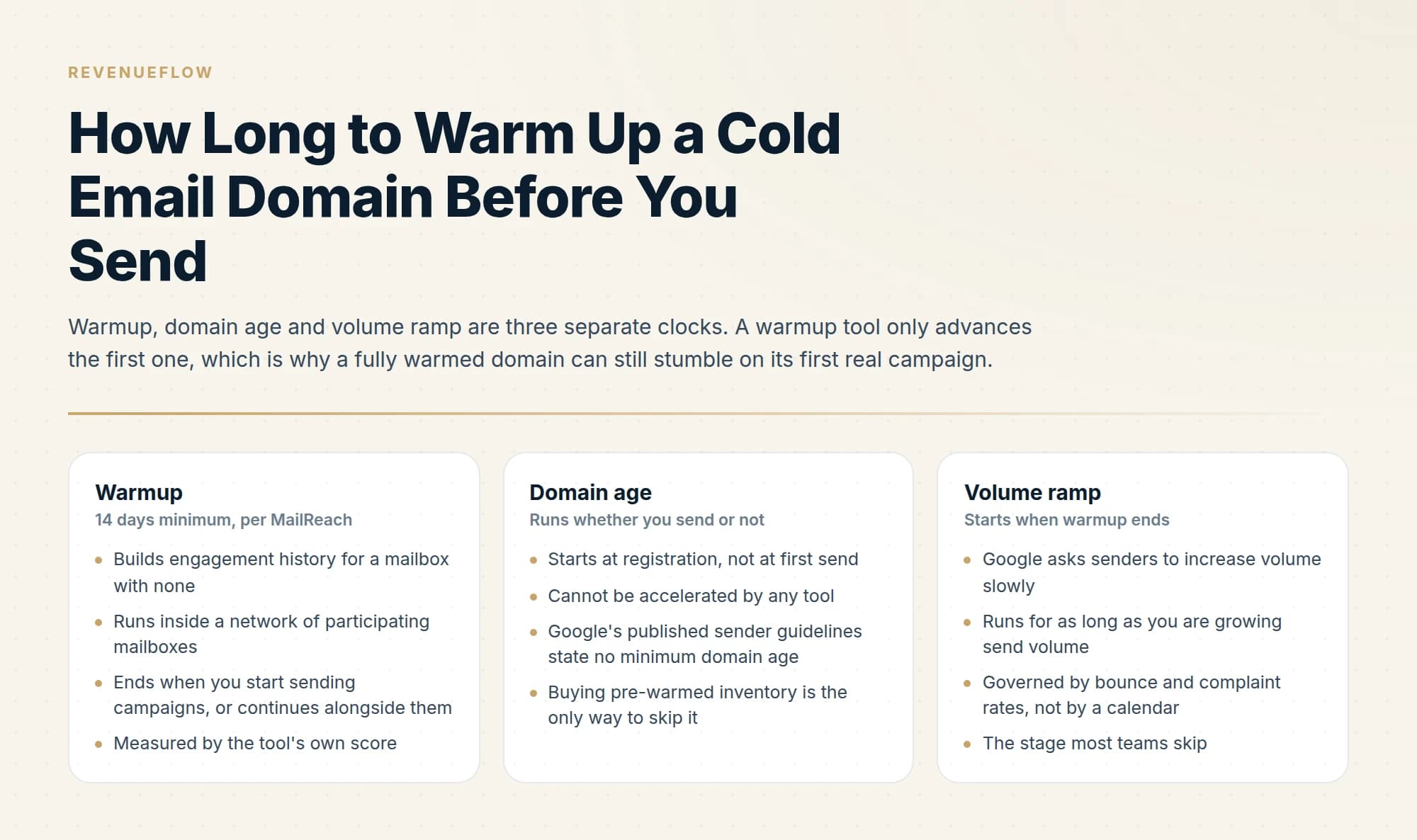
Warm up a new email domain for at least 14 days before the first campaign, with no campaigns sent in that window. That floor comes from MailReach, the one vendor that publishes a figure. Then open at low volume and ramp slowly, as Google's sender guidelines ask, and keep warming running alongside the campaigns.
Key takeaways
- Fourteen days is the only warmup duration with a published vendor source: MailReach states 14 days minimum with no campaigns sent during the phase.
- Warmup, domain age and volume ramp are three separate clocks, and a warmup tool advances only the first of them.
- Google's sender guidelines state no minimum domain age but do ask senders to start at low volume and increase slowly, which a day-fifteen jump to full capacity violates.
- Readiness is a state rather than a date: authentication on the sending domain, fourteen clean days, a Postmaster Tools baseline, a verified list and a written ramp.
Reviewed and updated September 18, 2026
How long should you warm up an email domain before a campaign? At least 14 days, with no campaign sent in that window, and then a ramp that starts at low volume. The reasons are below.
Domains bought on a Monday, mailboxes connected to a warmup tool by Monday afternoon, and the only question the team actually cares about is which Monday they are allowed to start sending. The warmup dashboard will not answer it. It shows a score climbing toward green, and a score is not a date.
The honest answer has three parts. There is one duration floor with a published source behind it, there are several clocks running at once that people collapse into a single one, and there is a volume ramp on the far side of warmup that most teams skip entirely and then blame on the warmup.
How long to warm up an email domain before a campaign
Warm up a new email domain for at least 14 days before the first campaign, and send no campaigns during that fortnight. That is the only duration with a published source, from the warmup vendor MailReach. The first campaign then opens at low volume and ramps in steps, so plan on two weeks before the first message and several more before full volume.
What warmup is actually doing to your reputation
A warmup service enrols your new mailbox in a network of other mailboxes. Those mailboxes exchange messages with yours, open them, reply to some, and pull anything that landed in spam back into the inbox. The result over a couple of weeks is a mailbox with a history: mail sent, mail received, mail engaged with, very little mail marked as junk.
That history is the product. Mailbox providers score sending reputation per domain and per sending IP, and a brand new domain has no score at all. An unknown sender is not automatically a bad sender, but it is a sender with nothing to weigh against the first spike of unsolicited mail, which is why the first campaign from a cold domain is the riskiest mail that domain will ever send.
So warmup makes a new mailbox look used. Four things it does not do are worth naming, because each one gets attributed to warmup when it fails.
It does not authenticate your domain. SPF, DKIM and DMARC are DNS records you publish, and warmup mail sent from a domain with broken authentication is teaching receivers something you do not want them to learn. Publish the records first. The mechanics are in our SPF, DKIM and DMARC setup guide for cold email.
It does not age the domain registration. Warmup and domain age are separate clocks, covered below.
It does not create any history with the people you are about to email. Every warmup interaction is with a mailbox in the warmup network. Your actual recipients have never seen you.
And it does not improve the message. A warmed domain sending copy that generates complaints degrades faster than a cold one, because now there is a reputation to lose.
The one duration number with a source behind it
Most warmup duration advice circulates without an origin. One vendor states a figure on its own product page, so it is worth quoting exactly.
MailReach, which sells warmup bundled with spam testing and prices it per mailbox, states: "The initial warmup phase should last 14 days minimum. No campaigns should be sent during this phase." The same page advises keeping engagement high afterwards, on the basis that constant engagement is what maintains sender reputation over the long run.
Two words in that sentence do the work. Minimum, which means fourteen days is a floor rather than a target. And no campaigns, which rules out the common shortcut of running warmup and a small live campaign in parallel during the first fortnight to save a week.
For contrast on how little is published here, Warmy puts no duration figure and no pricing on its plans page at all, structuring around B2B, B2C and custom volume tiers with a seven-day trial. Instantly and Smartlead bundle warmup into their sending plans rather than selling it as a separate product with its own published protocol, which quietly moves the duration decision from the vendor to you.
Worth saying plainly: independent, published evidence on the optimal warmup duration is thin. What exists is vendor guidance, and warmup vendors sell a subscription billed monthly. That does not make fourteen days wrong, and it is the most specific published floor available. Treat it as a floor stated by an interested party rather than as a measured optimum, and do not go looking for a study that settles it, because the number that matters for your domain is a state rather than a date.
The survey of which warmup tools exist and what each one includes is a separate question, covered in email warmup services. This piece is about time.
Three clocks, and only one of them is warmup

Teams collapse all of this into "the domain is warm". Three separate things are running.
| Clock | Starts | What moves it | Published number |
|---|---|---|---|
| Warmup | When the mailbox joins a warmup network | The tool, measured by its own score | 14 days minimum, per MailReach |
| Domain age | At registration, not at first send | Nothing. No tool accelerates it | None. Google states no minimum age |
| Volume ramp | When warmup ends | Clean bounce and complaint rates | No calendar. Google asks for slow increases |
On domain age specifically, be careful what you believe. Google's published sender guidelines set requirements for authentication, spam rates and unsubscribe handling, and they say a great deal about volume. They do not state a minimum domain age. Specific age thresholds circulate widely in outbound communities and none of them appear in any provider's published requirements, so treat them as folklore until somebody points you at the source.
What is published, and published clearly, is about volume.
The ramp is the part people skip
The question of how to keep email inboxes warm, rather than how to get them warm, is answered here: warming continues alongside campaigns because sustained engagement is what holds the reputation, and stopping it on launch day gives back the thing the fourteen days bought.
Google's sender guidelines carry a section headed "Increase sending volume slowly to avoid delivery problems". The instructions inside it are direct: "Start with a low sending volume to engaged users, and slowly increase the volume over time," and "Avoid introducing sudden volume spikes if you do not have a history of sending large volumes."
Read that against what a finished warmup looks like. MailReach's warmup runs up to 100 emails a day per mailbox. A team that has just spent fourteen days building a history at warmup volume, then opens a campaign at full platform capacity on day fifteen, has produced precisely the sudden volume spike the guidance names, on a domain with no history of sending large volumes. The warmup was not wasted. It was undone in an afternoon.
The provider limits are worth knowing so you can see how much room the guidance leaves you. In Google Workspace, a standard account can send 2,000 messages a day to 3,000 unique recipients, of which 2,000 may be external, and a trial account is held to 500. Those are the points at which Google stops you, and they sit far above where a cold sender should ever operate. The ceiling is not the target.
The bulk sender threshold is the other published marker. Send 5,000 or more messages a day to Gmail and you must have SPF, DKIM and DMARC in place, keep the spam rate reported in Postmaster Tools below 0.30%, and support one-click unsubscribe on marketing and subscribed messages. Most cold programmes never cross 5,000 a day to Gmail specifically, but the authentication and complaint bars are worth meeting from day one regardless.
Our own planning number is roughly 20 sends per mailbox per day on a healthy inbox, which is why capacity for a campaign is planned as a count of mailboxes rather than as a number typed into a daily limit field. Because we send one message per campaign and never bump, daily send volume equals new people contacted per day, which makes the arithmetic unusually simple: the ramp is a plan for how many strangers hear from you each day, and nothing else.
How to decide you are ready to send
Readiness is a state, and every line of it is checkable on the morning you want to launch.
All six are true
- SPF, DKIM and DMARC are published on this specific sending domain, not just the primary company domain
- Warmup has run at least 14 days with no campaigns sent during the phase
- The domain is registered in Postmaster Tools so you have a pre-campaign baseline
- The first list has been verified, so the opening send is not testing invalid addresses
- A ramp is written down with a volume per step and a rule for when to hold
- Warming continues after campaigns start
Neither of these is
- The first campaign opens at the platform's daily limit
- The warmup score alone is being used as the go signal
The list-quality line is the one that surprises people. Fourteen clean days of warmup followed by a first campaign against a list with a high invalid rate produces a bounce spike on a domain with no history to absorb it, which is a worse opening move than sending nothing at all. Verification is cheap relative to the domain, and the email verification tools comparison covers the options.
The Postmaster Tools line is about baselines. Registering the domain after the first campaign means the first data you see is already contaminated by whatever the first campaign did. Google Postmaster Tools for cold email covers what it shows and what it does not.
What no schedule can tell you
Warmup duration is the question people ask because it has a number in it. The things that actually decide whether a new domain survives its first month are list quality, message quality and complaint rate, and none of those has a published timeline attached.
A domain that warms for six weeks and then sends a poorly targeted message to a stale list will be in trouble by week eight. A domain that warms for fourteen days and then sends something relevant to verified addresses at twenty a day will generally be fine. The calendar is the smallest of the three variables, which is uncomfortable, because it is the only one you can control by waiting.
Trouble of that kind can surface as a listing you did not earn alone, and a threshold that catches neighbouring senders explains how an address range escalates.
The ongoing maintenance side, once a domain is live and sending, is covered in the cold email deliverability guide. If you are still choosing the sending stack that all of this runs on, build versus buy at every volume tier is the decision that comes first.
The short version

Fourteen days is the only warmup duration figure with a published vendor source behind it: MailReach states the initial phase should last 14 days minimum, with no campaigns sent during that phase, and advises keeping warming running afterwards. Independent evidence on the optimum is thin, so treat that as a floor from an interested party.
Warmup, domain age and volume ramp are three separate clocks. A warmup tool advances only the first. Google's published sender guidelines state no minimum domain age, and they do explicitly ask senders to start at low volume and increase slowly rather than spiking, which is what a day-fifteen jump from warmup volume to full campaign volume is.
Be ready in a state rather than on a date: authentication published on the sending domain itself, fourteen clean warmup days behind you, Postmaster Tools registered for a baseline, a verified list, a written ramp with hold conditions, and warming still running alongside the campaigns.
We run domains, warmup, authentication and the ramp as part of our outbound engagements, which is the part of this that needs continuous attention rather than a single setup pass. You can see what a campaign would look like for your market.
Vendor pricing and stated warmup guidance verified as of mid-2026. Google sending limits and sender requirements are per Google's published documentation as of mid-2026. Verify current terms with the vendor or provider before relying on them.
Sources: MailReach pricing, Google email sender guidelines, Gmail sending limits in Google Workspace
Frequently asked questions.
Frequently asked questions- How long should you warm up an email domain before a campaign?
- At least 14 days, with no campaigns sent during that time. MailReach states on its own page that the initial warmup phase should last 14 days minimum. Treat that as a floor from an interested party, since independent evidence is thin. The first campaign then opens at low volume, so full sending volume is several more weeks away.
- Can I send a small campaign while the domain is warming up?
- Not in the first fortnight, if you follow the one published protocol. MailReach's wording is that no campaigns should be sent during the initial 14 day phase, which rules out running a small live campaign in parallel to save a week. After that phase, warming is meant to continue alongside your campaigns.
- Should I stop warmup once campaigns start?
- No. MailReach advises keeping warming running for as long as you send campaigns, because sustained engagement is what maintains sender reputation. Stopping on launch day gives back what the fourteen days bought. Warmup traffic and campaign traffic run side by side, with campaign volume stepping up only while bounce and complaint rates stay clean.
- Does domain age matter for cold email?
- It is a separate clock from warmup. It starts at registration, runs whether you send or not, and no tool can accelerate it. Google's published sender guidelines set requirements for authentication, spam rate and unsubscribe handling and state no minimum domain age, so the age thresholds that circulate in outbound communities are folklore until somebody cites a source.
About the author.

Tim Carden is CMO / CTO at RevenueFlow, which builds and operates outbound revenue engines for B2B companies. Studied at McGill University.
Tim Carden · CMO / CTO
Connect on LinkedIn →Explore more.
Ready to scale your outreach?
We build GTM engines that book real meetings. See the receipts.
Related articles.
Email Warmup Tools: What Actually Moves Placement
Warmup pools are now free in every major sending tool. What the mechanism actually is, why nobody publishes controlled placement data, and the levers that do work.
Email Warmup Services: What They Do and What They Cost
What warmup actually does, what the market charges, how long vendors say it takes, and why the published evidence for how much it helps is thinner than the marketing.
How Lemwarm Works: The Network, the Ramp and the Score
What lemwarm's pool of real inboxes does, how the ramp is sized in the vendor's own numbers, what the score is made of, and where the tool stops.
Warmup Inbox Pricing: Per Inbox, Annual Loads First
Warmup Inbox prices per inbox and its page opens on the annual switch. Both states for all three plans, the reply ceiling meter, the trial and how a fleet bill is built.
Manyreach Pricing: Credits Buy Sends and Warmup Alike
Manyreach prices in credits rather than seats: a one-time pack or a monthly refill. What a credit buys, the two IP figures on one page, and where a pack beats a plan.
MailReach Pricing: The Headline Rate Is the Second Band
MailReach prices warmup on a slider with four mailbox bands and two billing states. Every band at both states, and why the printed rate is not the entry rate.