Warmup Inbox Pricing: Per Inbox, Annual Loads First
Warmup Inbox prices per inbox and its page opens on the annual switch. Both states for all three plans, the reply ceiling meter, the trial and how a fleet bill is built.
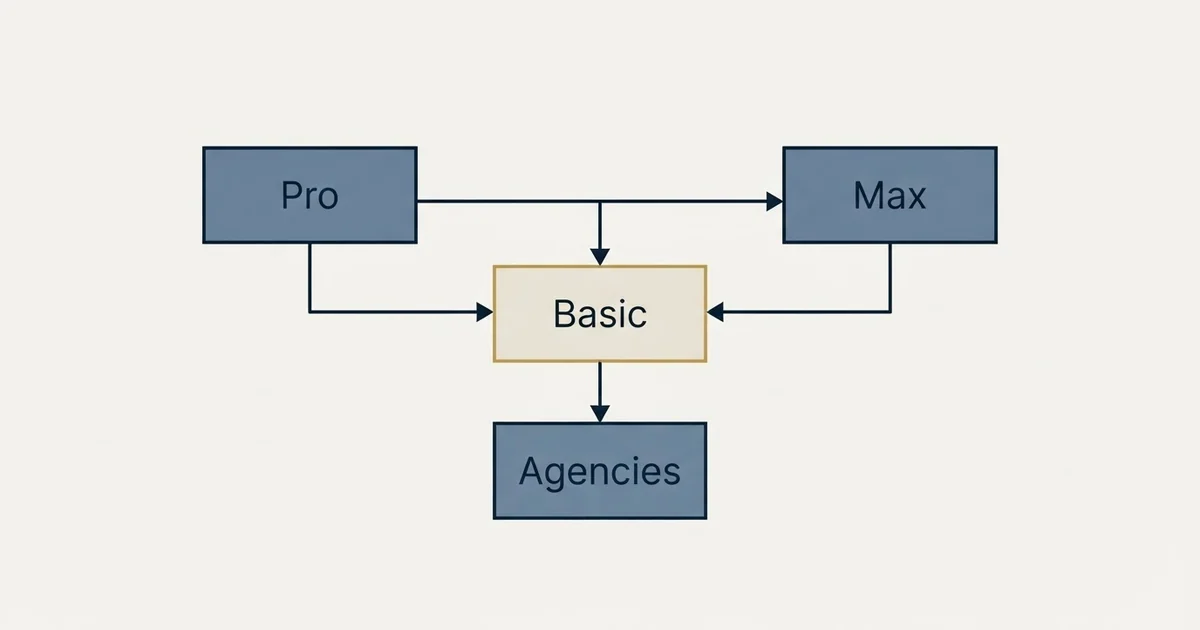
Warmup Inbox pricing starts at $15, $49 and $79 per inbox a month billed yearly for Basic, Pro and Max, or $19, $59 and $99 monthly, for one inbox. An inbox slider lowers the rate from the second inbox, to $7.5, $23.5 and $38 yearly at 50 inboxes, and 51 or more are quoted.
Key takeaways
- The pricing switch opens on annual with a Save 20% badge, so the first figures shown are the one-inbox list prices of $15, $49 and $79 rather than the monthly $19, $59 and $99.
- An inbox slider lowers the per-inbox rate on all three plans from the second inbox: at ten inboxes billed yearly Basic is $12.5, Pro $40 and Max $65, and from 51 inboxes the price is quoted.
- Every plan meters per inbox: 75, 250 or 1,000 warmup messages a day and a reply ceiling of 25%, 45% or 50%, so stepping up to Pro buys volume and replies together.
- No Warmup Inbox page read for this article says one account can mix plans, and its FAQ page still bills each inbox at the plan's rate from $19, which contradicts the slider.
Reviewed and updated September 21, 2026
Warmup Inbox prices per inbox, and its pricing page loads on the annual state. The Monthly and Annual switch above the ladder opens with Annual selected and a Save 20% badge, so the first figures a visitor sees are the discounted ones. As published on Warmup Inbox's pricing page on 2026-09-04, those are Basic at $15 per inbox a month, Pro at $49 and Max at $79, each with the annual total printed underneath: $180, $588 and $948 billed yearly. Switch to Monthly and the same plans read $19, $59 and $99 per inbox a month, billed monthly.
Those are list prices for one inbox. The page now carries an inbox slider under the switch, with the line "Every inbox you add lowers the average." beside it, and every step along it lowers the per-inbox rate on all three plans at once. At 50 inboxes the cards read up to 52% off, and past 50 the price is quoted. So the rate depends on your inbox count, and the count is the first number to bring to the page.
Warmup Inbox pricing in 2026: list rates and volume rates
Warmup Inbox pricing starts at list rates for one inbox: Basic $15, Pro $49 and Max $79 per inbox a month billed yearly, or $19, $59 and $99 billed monthly. The rate falls as you add inboxes, to $7.5, $23.5 and $38 billed yearly at 50 inboxes, and from 51 inboxes the page quotes a price per account.
The ladder at both states
Basic. On the page, $15 per inbox a month billed yearly, $180 a year per inbox, or $19 per inbox a month billed monthly. 75 warmup messages a day, reply rate up to 25%.
Pro. On the page, $49 yearly, $588 a year, or $59 monthly. 250 warmup messages a day, reply rate up to 45%.
Max. On the page, $79 yearly, $948 a year, or $99 monthly. 1,000 warmup messages a day, reply rate up to 50%.
51 inboxes and up. Quoted. The slider stops at 50, and past it the page reads "From 51 inboxes we price per account." and asks for a short call, listing consolidated billing, multi-client workspaces and specialized reports for that size.
The annual saving is close to the 20% the badge states on Basic ($19 to $15 is 21%) and smaller on the upper tiers ($59 to $49 is 17%, $99 to $79 is 20%). The pricing page's own FAQ states that annual plans bill once at signup for 12 months and save 20% versus monthly.
The meter is per inbox, and the volume is per inbox too
Unlike a plan-pooled warmup product, every Warmup Inbox limit is per inbox. A Basic inbox warms at up to 75 a day and a Max inbox at up to 1,000 a day; whether one account can mix the two is a question the vendor's pages leave open, below. The price scales with the count, though less than linearly: on the slider, ten Basic inboxes billed yearly come to $125 a month, $12.5 each, and ten Max inboxes to $650, $65 each.
The reply rate ceiling is the second meter and the one buyers tend to skip. A warmup network sends messages to your inbox and replies to yours; a higher reply ceiling means a higher share of your warmup sends get answered, which is what the mailbox providers appear to weight. Basic caps replies at 25% of sends, Pro at 45%, Max at 50%. For a mailbox that only needs 50 warmup messages a day, the argument for Pro over Basic is the reply ceiling rather than the volume.
The inbox slider, stop by stop
The slider's labelled stops are 1, 5, 10, 15, 25 and 50 inboxes, and it moves all three cards together. Driven through every stop in both billing states, the per-inbox rate a month reads $14, $45 and $73 billed yearly at 5 inboxes ($18, $54 and $92 monthly); $12.5, $40 and $65 at 10 ($16, $48 and $82); $11, $35 and $56 at 15 ($14, $42 and $70); $9, $29 and $47 at 25 ($12, $35 and $59); and $7.5, $23.5 and $38 at 50 ($9.5, $28.5 and $47.5). The page labels the 50 stop "Our deepest published rate." and its FAQ says "The per-inbox price comes down from your second inbox".
The vendor's own FAQ page tells a flatter story. It answers the inbox limit question with "Each inbox you sync is billed at your plan's per-inbox rate, from $19 per month." and describes plans that start at $19 per inbox per month, or $15 when paid annually, with no mention of the slider. The two surfaces disagree on whether the rate moves with the count, and the pricing page, where the price is quoted and bought, is the one this article follows.
| Inboxes | Basic | Pro | Max |
|---|---|---|---|
| 1 | $15 / $19 | $49 / $59 | $79 / $99 |
| 5 | $14 / $18 | $45 / $54 | $73 / $92 |
| 10 | $12.5 / $16 | $40 / $48 | $65 / $82 |
| 15 | $11 / $14 | $35 / $42 | $56 / $70 |
| 25 | $9 / $12 | $29 / $35 | $47 / $59 |
| 50 | $7.5 / $9.5 | $23.5 / $28.5 | $38 / $47.5 |
| 51+ | Quoted per account | ||
Each cell: billed yearly / billed monthly, per inbox a month.
Trial and proration
The FAQ states a seven day free trial with no card required, and that an inbox added mid-month is billed pro-rated from the day it is added, while a removed inbox becomes a credit on the next invoice. Those two terms together make the product cheap to test: connect one inbox, watch it for a week, add the fleet when you are ready and pay from that day.
Who the vendor says it is for
The customers page names Mangools, Wishpond, SellersCommerce, Leadspicker, i-batu, Italian Artisan, Avvy.co and Aerosend, with labels running from marketing automation, B2B ecommerce, sales automation and B2B SaaS to staffing, luxury manufacturing and an email service provider, and the site's by-role menu names sales, marketing, agencies and recruiters. The quoted tier from 51 inboxes, with its multi-client workspaces, is sized for a firm warming client fleets rather than its own.
Pricing a real fleet
A team with ten sending mailboxes on Basic pays $125 a month billed yearly on the slider, $1,500 a year, or $160 a month billed monthly. Move the same ten to Pro for the higher reply ceiling and it is $400 a month yearly or $480 monthly. That step, from $12.5 to $40 per inbox at this count, more than triples the rate, as it does at list price, and the volume goes from 75 to 250 a day. A fleet that does not need the volume is paying for the reply ceiling alone.
At the top, Max at $79 per inbox yearly with 1,000 messages a day is priced for a mailbox that sends at real volume. A cold email mailbox sending 30 to 50 campaign emails a day is warmed by a Basic inbox at 75 warmup messages a day at one and a half to two and a half times its campaign volume. Max is for a different kind of mailbox.
The slider matters most at the size where warmup becomes a real line. On Pro billed yearly, 25 inboxes come to $725 a month and 50 to $1,175, where the list rate of $49 times 50 inboxes would be $2,450, an illustrative figure the page never charges.
With the rate now moving along a slider, a comparison against another warmup product only means something at your own inbox count; the warmup services survey prices the rest of the category. Price the vendor's nearest alternatives at the same count and billing state, because a flat per-inbox rate and a sliding one cross somewhere along the slider.
Mixing plans across a fleet
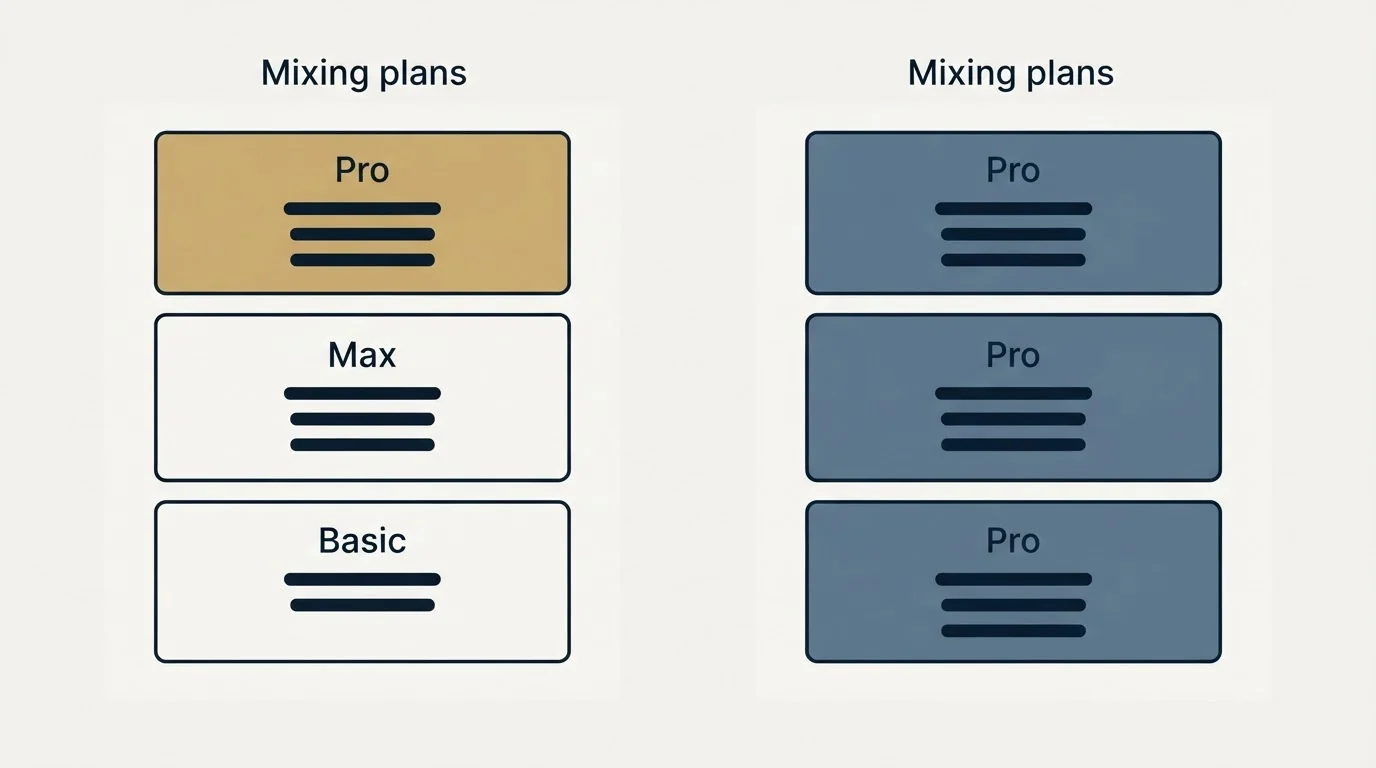
A fleet with a few high-volume mailboxes and many quiet ones would be cheapest with the quiet ones on Basic, but whether one account can mix plans is not stated on any Warmup Inbox page read for this article. The slider sets one inbox count for all three cards, and the FAQ page bills each inbox at "your plan's per-inbox rate", which reads as one plan per account. Ask before designing a mixed fleet, and ask whether the volume discount counts every inbox on the account or only those on one plan.
The reply ceiling makes the choice per mailbox rather than per team. A new domain in its first month wants the higher ceiling, because replies are the signal that a fresh sender is legitimate; an established mailbox that has been sending for a year wants volume maintenance more than replies. If a mixed fleet is allowed, moving a mailbox from Pro to Basic after its ramp is where it pays, and the pricing page's FAQ says downgrades take effect at the next billing cycle.
What the rate buys against running warmup yourself
The alternative to any warmup product is warming by hand: sending real mail at low volume for weeks and rising slowly. That costs nothing in subscription and several weeks in time, and it produces fewer replies than a network does. At Basic's list rates a three-month ramp for one inbox costs $57 on monthly billing; the $15 annual rate is cheaper per month but bills $180 up front for twelve months. Either is a small number against the campaign volume a mailbox sends once warm. The case against paying it is a sender or mailbox vendor that already bundles warmup, in which case the product duplicates something you have.
The trial gives full access to your chosen plan for 7 days, per the pricing page's FAQ, so a team testing the network should connect the inbox that most needs the help rather than the healthiest one.
Reading the third-party numbers
Roundups quote this vendor at $15 and at $19, and some quote Pro at $59 and Max at $99 without a billing state. All of those figures are on the page today as one-inbox list prices; the first set is the annual tab the page opens on, the second is the monthly tab. None of them carries the slider, which takes Pro to $40 an inbox at ten inboxes billed yearly. One roundup also states a half-yearly billing option, which the page does not print, so it is not in this article.
The pricing page
- "Every inbox you add lowers the average."
- "The per-inbox price comes down from your second inbox"
- "From 51 inboxes we price per account."
The FAQ page
- "Each inbox you sync is billed at your plan's per-inbox rate, from $19 per month."
- Plans start at $19 per inbox per month, or $15 when paid annually
- No mention of the slider
Neither page says whether one account can mix plans, or how a mixed fleet counts toward the discount.
Warmup is a cost of sending, priced separately
Warmup Inbox is sold as a warmup product, though its pricing page now lists outreach sequences on Basic and up, and its product menu sells a cold email sequence feature whose page says a campaign can only send from an inbox that is actively warming. If your sender bundles warmup, this is a line you may not need; if your mailbox vendor does not, it is a line you will pay somewhere, and the mailbox pricing guide sets out why warmup should be priced as its own item whether it is bought, run in another tool, or absorbed as slow ramping. The warmup tools review covers how these products behave once connected, and the deliverability guide covers what warmup can and cannot fix.
What it cannot fix is sending discipline. A warmed inbox that sends the same offer twice to the same list, or that chases the people who did not reply with a LinkedIn message carrying the same pitch, is spending the reputation the warmup built. One message per campaign, sent once, costs nothing and does more than any reply ceiling.
The short version
On Warmup Inbox's pricing page, opening on annual, the one-inbox list prices are Basic $15 per inbox a month yearly or $19 monthly for 75 messages a day, Pro $49 or $59 for 250 a day, and Max $79 or $99 for 1,000 a day. The inbox slider lowers every rate from the second inbox, to $7.5, $23.5 and $38 yearly at 50, and 51 inboxes and up are quoted. The trial is seven days with no card, and inboxes added mid-month are billed pro-rated.
If the warmup line is one you would rather not carry, the sending infrastructure of an outbound program is something we run as part of a campaign engagement, and you can see what one would look like for your market.
Pricing and features are taken from the vendor's own pages: the pricing page read at both switch states with its inbox slider driven through every stop, the FAQ page and the customers page. Verify current terms with the vendor before relying on them.
Sources: Warmup Inbox pricing page, Warmup Inbox FAQ
Frequently asked questions.
Frequently asked questions- How much does Warmup Inbox cost?
- For one inbox, the pricing page lists Basic at $15, Pro at $49 and Max at $79 per inbox a month billed yearly, or $19, $59 and $99 billed monthly. Annual plans bill once at signup for 12 months, so Basic is $180 a year. The rate falls as the inbox slider rises, and from 51 inboxes the page quotes a price per account.
- How does Warmup Inbox pricing change with more inboxes?
- The pricing page's slider lowers the per-inbox rate on every plan from the second inbox. Billed yearly, ten inboxes cost $12.5, $40 and $65 each on Basic, Pro and Max, and 50 inboxes cost $7.5, $23.5 and $38, which the page calls its deepest published rate. Past 50 inboxes the vendor prices per account after a short call.
- Does Warmup Inbox have a free trial?
- Yes. The pricing page's FAQ gives full access to your chosen plan for 7 days with no credit card required up front, and says you will not be charged if you cancel during the trial. It also bills inboxes added mid-month pro-rated from the day they are added, so a team can test one mailbox before connecting the rest.
- How much does Warmup Inbox cost for ten inboxes?
- With the slider at ten inboxes, the pricing page shows Basic at $125 a month billed yearly or $160 billed monthly, Pro at $400 or $480, and Max at $650 or $820. Those totals are ten times the displayed per-inbox rates of $12.5, $40 and $65 billed yearly, which are 17% to 18% below the one-inbox list prices.
About the author.

Tim Carden is CMO / CTO at RevenueFlow, which builds and operates outbound revenue engines for B2B companies. Studied at McGill University.
Tim Carden · CMO / CTO
Connect on LinkedIn →Explore more.
Ready to scale your outreach?
We build GTM engines that book real meetings. See the receipts.
Related articles.
Mailwarm Pricing: The Page Opens on Its Yearly Tab
Mailwarm's pricing tabs open on yearly and the plans meter daily volume rather than mailboxes. Both tabs, the overage rate, the no-trial rule and the per-mailbox cost.
MailReach Pricing: The Headline Rate Is the Second Band
MailReach prices warmup on a slider with four mailbox bands and two billing states. Every band at both states, and why the printed rate is not the entry rate.
Email Warmup Pricing in 2026: What 20 Tools Charge, and What 10 Mailboxes Cost
Email warmup tools start at a median of $29 a month, but warming ten mailboxes costs from $7.50 to $1,190 depending on how the vendor prices a mailbox.
Manyreach Pricing: Credits Buy Sends and Warmup Alike
Manyreach prices in credits rather than seats: a one-time pack or a monthly refill. What a credit buys, the two IP figures on one page, and where a pack beats a plan.
EmailBison Pricing: One Plan, Priced by Sends
EmailBison publishes a single plan and no toggle. The dated price, what it includes, the unpriced send buckets above it, and the figure the vendor's blog still carries.
ReachInbox Pricing: The Page Loads on Its Yearly Rate
ReachInbox's pricing toggle loads on the yearly side. Both ladders, the four meters behind unlimited accounts, and the fair use question the page leaves open.