Email Warmup Tools: What Actually Moves Placement
Warmup pools are now free in every major sending tool. What the mechanism actually is, why nobody publishes controlled placement data, and the levers that do work.
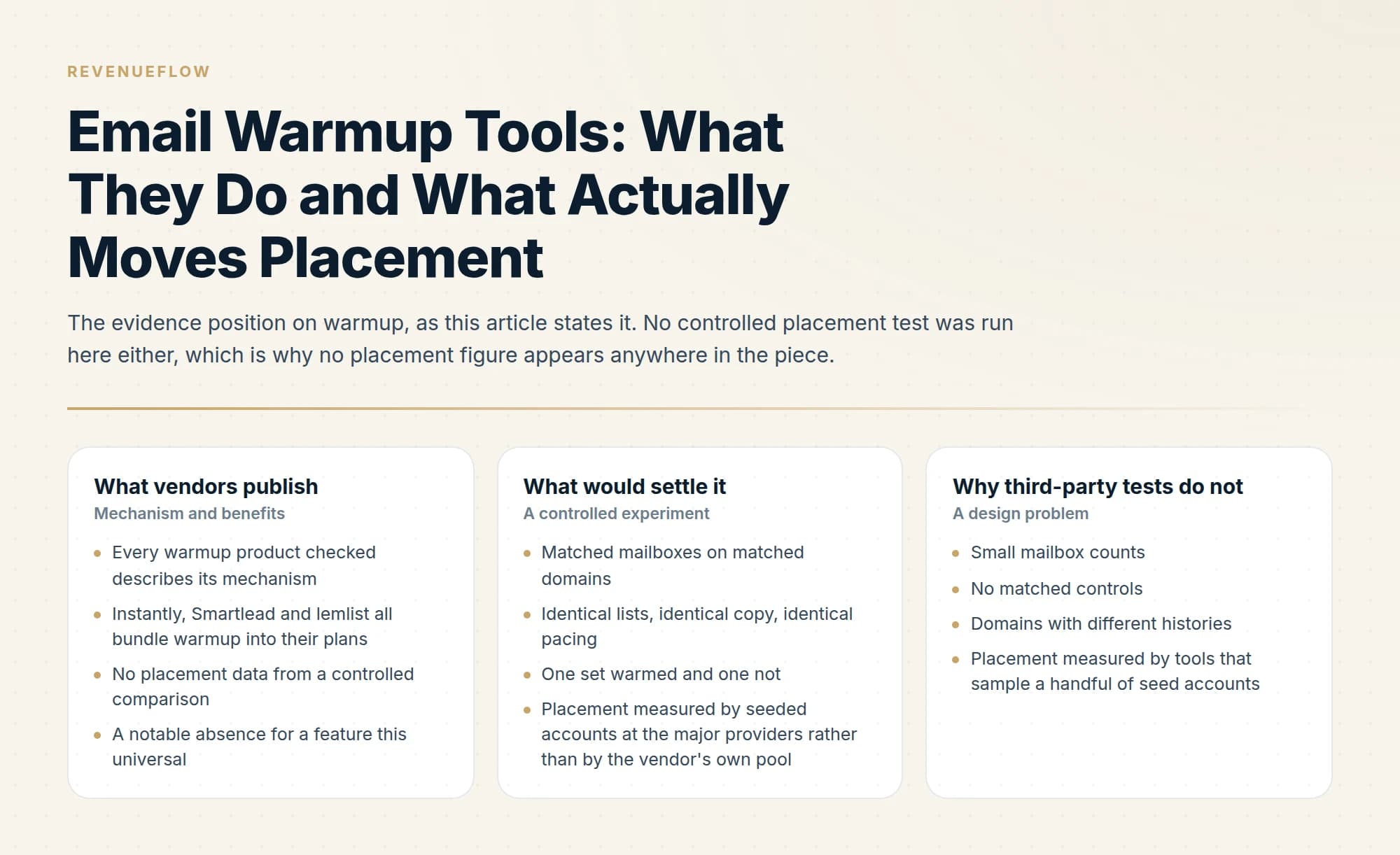
Warmup tools enrol your mailbox in a pool where accounts send, open and reply to each other while daily volume ramps. The ramp is genuinely protective. The reported score measures placement inside the pool rather than with real recipients, and no vendor publishes controlled placement data.
Key takeaways
- A warmup dashboard reports placement within the vendor's own pool, which is not a measurement of how real campaigns land with real prospects.
- No warmup vendor publishes a controlled comparison of matched mailboxes with and without warmup, which is a notable absence for a universal feature.
- Google's published requirements are the certain part: SPF or DKIM, valid forward and reverse DNS, TLS, and spam rates below 0.30% in Postmaster Tools.
- Gradual volume ramping is the defensible component of warmup, and you get it from any tool's pacing controls whether a pool is involved or not.
Reviewed and updated September 5, 2026
Every cold email platform now bundles warmup, usually described as unlimited and usually included free. Instantly gives unlimited email warmup on every paid plan. Smartlead includes warmup across all connected mailboxes and sells an Ultra Premium Warmup tier on top. Lemlist bundles a Deliverability Hub and warm-up into all plans.
Recruiting teams weighing which bundled or standalone option fits their mailbox volume can compare vendors built for that niche in warmup tool picks for staffing teams.
When a feature is simultaneously essential according to the marketing and free according to the pricing, it is worth asking what it actually does. The mechanics are documented. The effect on inbox placement is not, by any vendor, and that gap is the whole story.
What a warmup tool does mechanically
The core mechanism is consistent across products. Your mailbox is enrolled in a pool of other mailboxes. Those mailboxes send each other messages, open them, mark them as important, move them out of spam where they land there, and reply. Volume ramps gradually from a low daily figure upward.
Smartlead's API documentation exposes the settings directly, which is the clearest published description of the model: warmup_enabled, max_email_per_day, and daily_rampup. A daily cap and a ramp increment. Smartlead describes the purpose as gradually increasing sending volume to build sender reputation with email providers, aimed at new accounts building credibility, better inbox placement, higher daily limits and account health.
That is the honest mechanical description, and every vendor's version is a variation on it.
- Step 1Enrol in a pool
Your mailbox joins a network of other mailboxes, usually other customers of the same vendor.
- Step 2Exchange messages
Pool members send, open, reply to and de-spam each other's messages on a schedule.
- Step 3Ramp the volume
A daily cap rises by a set increment, so sending grows gradually rather than starting at capacity.
- Step 4Report a score
The tool reports its own metric, derived from the pool's behaviour rather than from real recipients.
Step four is where the reasoning gets slippery. A warmup dashboard reporting 98% inbox placement is reporting placement within the warmup pool, measured on mail sent by participants to participants. It is not a measurement of how your real campaign lands with real prospects at real companies, and the two can differ substantially.
What nobody publishes
Here is the claim we will not make: that warmup tools do or do not improve inbox placement for cold campaigns. We have not run a controlled test, and neither, publicly, has any vendor.
What would settle it is a controlled experiment: matched mailboxes on matched domains, identical lists, identical copy, identical pacing, one set warmed and one not, placement measured by seeded accounts at the major providers rather than by the vendor's own pool. No vendor publishes that. Every warmup product we checked describes its mechanism and its benefits without publishing placement data from a controlled comparison, which is a notable absence for a feature this universal.
Third-party tests exist and mostly do not survive scrutiny. They tend to run on small mailbox counts, without matched controls, on domains with different histories, measuring placement with tools that themselves sample a handful of seed accounts. That design cannot separate the warmup effect from the domain-age effect, the volume-ramp effect or the list-quality effect, and those confounds are all larger than the thing being measured.
- Every warmup product checked describes its mechanism
- Instantly, Smartlead and lemlist all bundle warmup into their plans
- No placement data from a controlled comparison
- A notable absence for a feature this universal
- Matched mailboxes on matched domains
- Identical lists, identical copy, identical pacing
- One set warmed and one not
- Placement measured by seeded accounts at the major providers rather than by the vendor's own pool
- Small mailbox counts
- No matched controls
- Domains with different histories
- Placement measured by tools that sample a handful of seed accounts
- Confounds larger than the thing being measured
What is structurally true
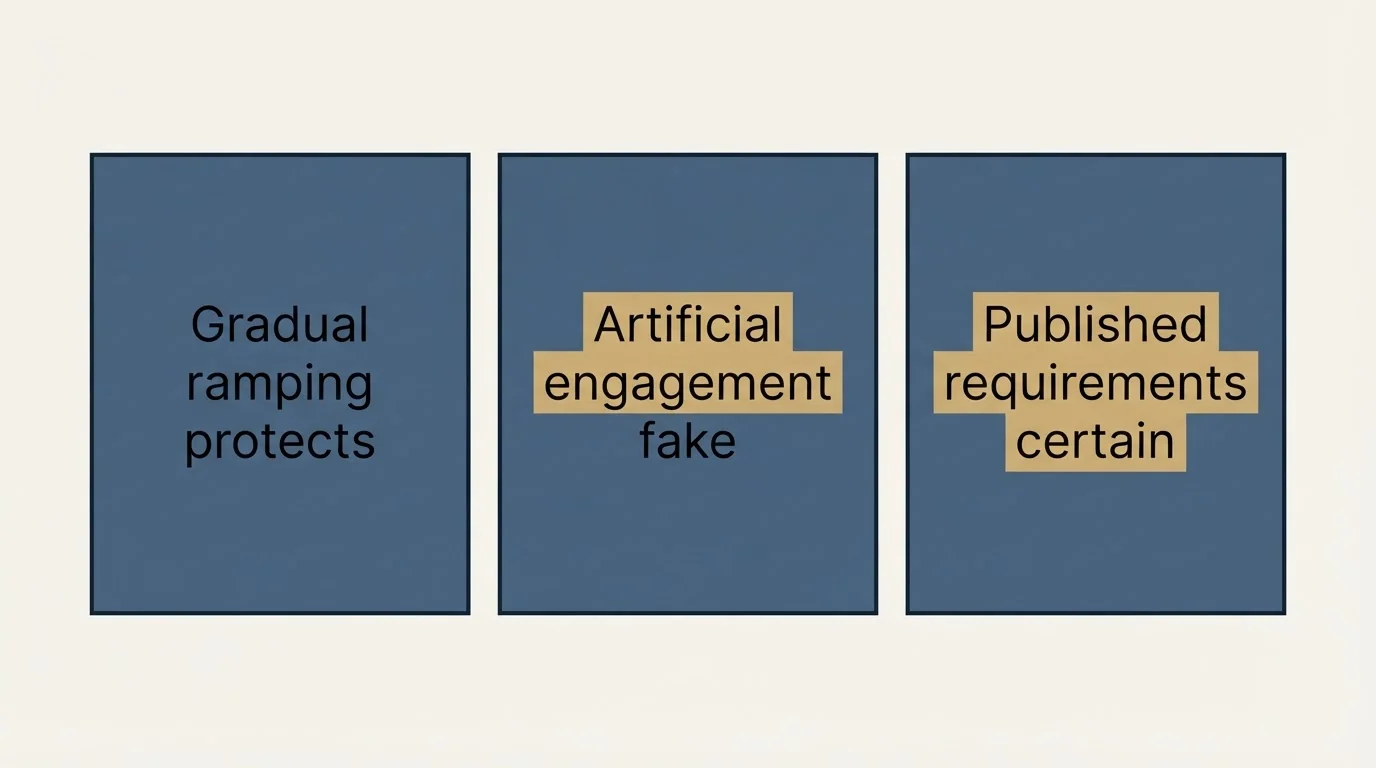
Three things can be said with confidence, and they matter more than the placement question.
Gradual volume ramping is genuinely protective, warmup pool or not. A new domain that starts at 200 sends a day looks different from one that starts at 10 and climbs. The ramp is the part of warmup with an obvious mechanism, and you get it from any tool's pacing controls whether or not a pool is involved.
Artificial engagement is not real engagement. Pool traffic is machine-generated mail between accounts that opted into generating it. Recipient reputation systems are built by people whose job is distinguishing genuine engagement from manufactured engagement, and assuming they cannot is a bet against a well-resourced adversary.
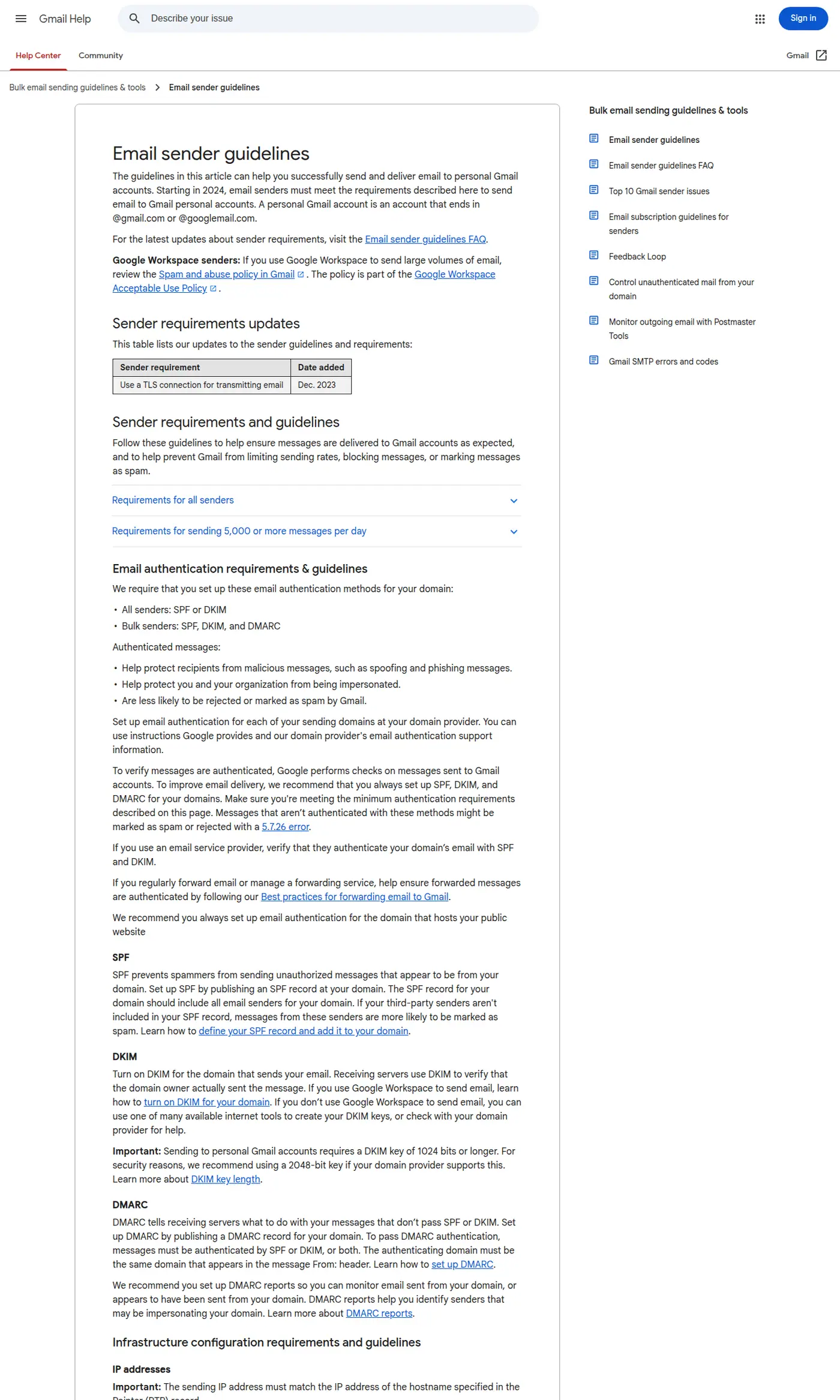
The published requirements are where the certainty is. Google states what it needs, and none of it involves warmup. All senders need SPF or DKIM, valid forward and reverse DNS records, TLS, and spam rates in Postmaster Tools below 0.30%. Senders above 5,000 messages a day to Gmail need SPF, DKIM and DMARC together, with the DMARC enforcement policy permitted to be set to none, plus one-click unsubscribe on marketing and subscribed messages. Those are the requirements, they are published, and meeting them is not optional in the way warmup is.
Why the question is hard to settle
It is worth understanding why good evidence does not exist, because the reason is structural rather than negligence.
Placement is not directly observable. You cannot see whether your message landed in a prospect's inbox or their spam folder. The industry works around this with seed lists, sending to accounts it controls at each provider and checking where those land. That is a sample of a handful of mailboxes standing in for a population of thousands, at providers whose filtering is partly personalised to each recipient's own behaviour.
The confounds are larger than the effect. Domain age, sending history, list quality, content, volume ramp and recipient engagement all move placement, and several of them move together with warmup in any real test. A mailbox that has been warming for a month is also a mailbox that is a month older, on a domain with a month more history.
Filtering adapts. Whatever pattern a warmup pool generates is a pattern that recipient systems can learn to recognise, and both sides change continuously. A result from two years ago describes an equilibrium that no longer exists.
That combination means an honest answer requires a well-controlled test repeated periodically, which is expensive and which no vendor has an incentive to publish if the answer is unflattering.
What actually moves placement
- Yes: Authentication: SPF, DKIM and DMARC published and passing
- Yes: List quality: verified addresses, so bounce rates stay low
- Yes: Spam complaint rate held below Google's 0.30% Postmaster threshold
- Yes: Conservative per-mailbox daily volume with a genuine ramp
- Yes: Relevance, because complaints are a response to irrelevance
- No: A warmup pool score as evidence your campaigns will land
- Depends: Warmup as a ramp mechanism, which is the defensible part of it
The ordering is deliberate. The first three are measurable, published by the mailbox providers, and mechanically connected to how filtering works. The fifth is the one people treat as a copywriting concern rather than a deliverability one, and it is upstream of everything: complaint rate is what happens when the wrong people receive your message, and complaint rate is the metric Google actually publishes a threshold for.
Our own position follows from that ordering. We run one message per campaign and do not send thread follow-ups or bump sequences. Most of the market runs multi-step sequences and warms hard to support the volume. We would rather send fewer, better-targeted messages, because the complaint rate that governs placement responds to relevance and volume together, and a sequence increases the second without improving the first.
The failure mode warmup encourages
The practical harm from warmup tools is rarely the tool itself. It is what teams do because of the reassurance.
A mailbox showing a healthy warmup score feels ready, and ready feels like permission to send at volume. So the ramp that warmup exists to enforce gets truncated: the score hits 95%, somebody decides the mailbox is warm, and the daily cap jumps from 15 to 80. The tool has just been used to justify skipping the one intervention it genuinely provides.
The second version is worse. When placement is poor, warmup is the thing teams reach for, because it is the lever labelled deliverability. Weeks get spent warming harder while the actual cause, an unverified list producing bounces or a poorly targeted audience producing complaints, continues unaddressed and continues damaging the domain.
Checking the actual cause is cheaper than warming harder, and a listing that escalates to neighbouring addresses can catch a clean sender who did nothing.
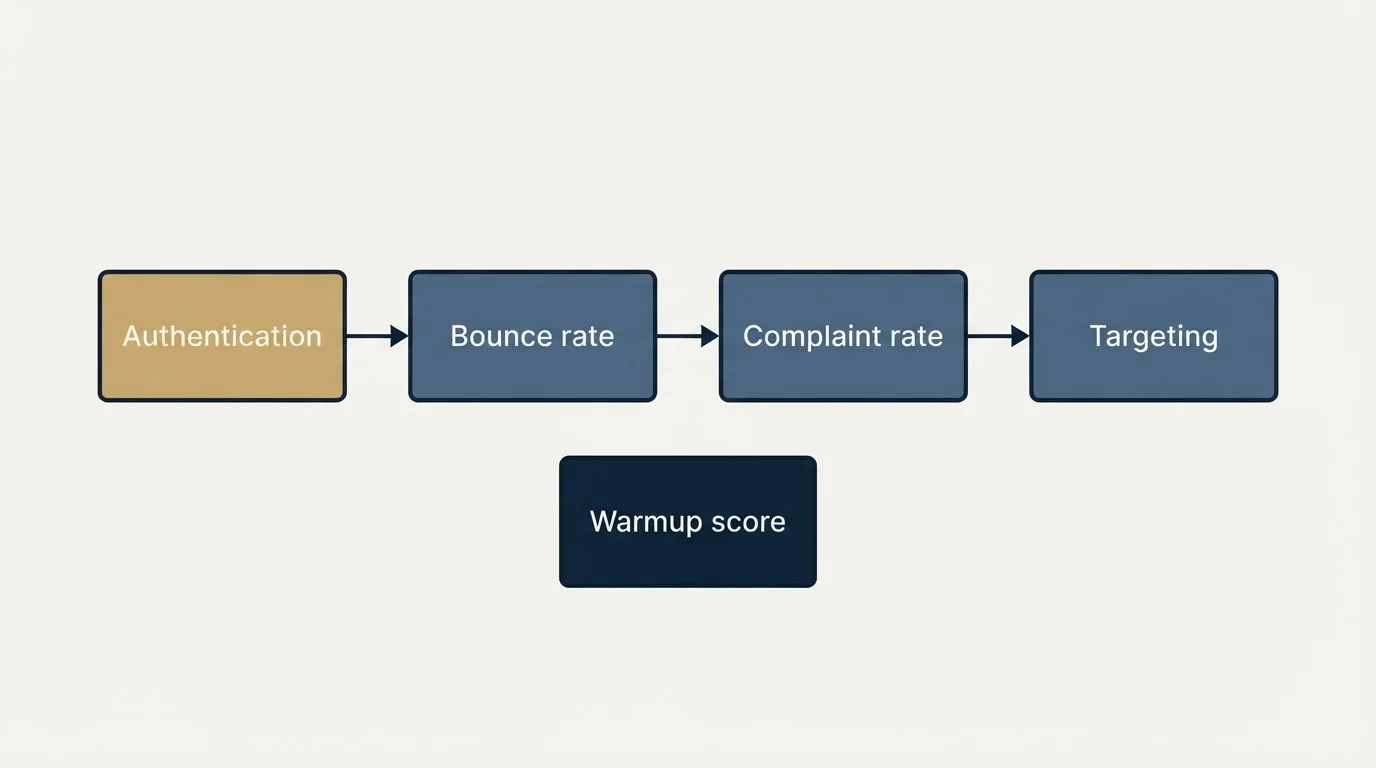
The diagnostic order is the reverse of the instinct. Check authentication, then bounce rate, then complaint rate, then targeting. Warmup is not on that list because warmup is not a remedy for any of them.
Should you turn it on?
Yes, mostly, and for unglamorous reasons.
It is bundled free with every major platform, so the cost is zero. The ramp component is genuinely useful on new mailboxes. And the downside risk is small provided you do not treat the resulting score as evidence about your real campaigns.
That is also the honest answer to the question people search as the best email warm up tool, because the mechanism is identical in every product and the bundled one costs nothing.
What you should not do is buy a standalone warmup subscription to fix a placement problem, delay a campaign waiting for a warmup score to hit an arbitrary number, or read a healthy pool score as confirmation that your list and copy are fine. If mail is not landing, the diagnosis lives in authentication, bounce rate, complaint rate and list quality, in that order. Our deliverability guide works through it, the SPF, DKIM and DMARC setup guide covers the authentication layer, and Google Postmaster Tools is where the spam rate above is actually measured.
For the platforms that bundle warmup, the Instantly review and the Smartlead review cover what each includes.
We run sending infrastructure as part of our outbound engagements, on a pay-per-qualified-meeting basis, which means placement is our problem rather than a dashboard you have to interpret. You can see what a campaign would look like for your market.
Warmup mechanics are per Smartlead's API documentation and the warmup inclusions published on Instantly's, Smartlead's and lemlist's pricing pages, all fetched 11 August 2026. Sender requirements and the 0.30% spam-rate threshold are per Google's published sender guidelines, same date. No controlled placement test was run for this article and no placement figures are stated.
Sources: Google email sender guidelines, Smartlead email accounts and warmup, Instantly pricing
Frequently asked questions.
Frequently asked questions- Do email warmup tools actually work?
- The ramp component has an obvious mechanism and is genuinely protective on new mailboxes. Whether the pool traffic improves placement is unproven: no vendor publishes a controlled test of matched mailboxes with and without warmup, measured by seeded accounts rather than by the vendor's own pool. Turn it on, since it is free, but do not rely on the score.
- What does a warmup score actually measure?
- Placement within the warmup pool, on mail sent by participants to participants who opted into generating that traffic. It is not a measurement of how your campaign lands with real prospects at real companies, and the two can differ substantially. Treat a high score as evidence the pool is working, not that your campaign will.
- Do I need a paid warmup tool?
- Almost certainly not. Warmup is bundled free with every major sending platform, including on entry tiers. Buying a standalone warmup subscription to fix a placement problem is treating the wrong layer. If mail is not landing, look at authentication, bounce rate, complaint rate and list quality, in that order.
- What actually improves inbox placement?
- Authentication first: SPF, DKIM and DMARC published and passing. Then list quality, so bounces stay low, and complaint rate held below Google's published 0.30% Postmaster threshold. Then conservative per-mailbox volume with a genuine ramp. Relevance sits underneath all of it, because complaints are what irrelevance produces.
About the author.

Tim Carden is CMO / CTO at RevenueFlow, which builds and operates outbound revenue engines for B2B companies. Studied at McGill University.
Tim Carden · CMO / CTO
Connect on LinkedIn →Explore more.
Ready to scale your outreach?
We build GTM engines that book real meetings. See the receipts.
Related articles.
Graymail vs Spam: What the Difference Costs a Sender
Graymail is a claim about a sending pattern. Spam is a claim about intent. They respond to different repairs, and confusing them sends teams to rewrite copy.
Instantly.ai Review: What the Plans Include and Who It Suits
Instantly gives unlimited inboxes on every paid plan and meters contacts and send volume instead. What that changes, where each tier runs out, and who it fits.
Email Warmup Services: What They Do and What They Cost
What warmup actually does, what the market charges, how long vendors say it takes, and why the published evidence for how much it helps is thinner than the marketing.
Migrating Cold Email Tools Without Losing Domain Reputation
Domain reputation survives a platform switch. Warmup schedules, sending caps and suppression lists do not. How to sequence a migration so mailboxes come through intact.
Smartlead Review: Unlimited Mailboxes and What the Plans Cap
Smartlead includes unlimited mailboxes on every plan and bundles verification on the upper tiers. What rotation does, what it cannot do, and where the ceilings bite.
Blacklist IP Search: Whose IP the Lookup Is Checking
The address your browser reports is almost never the one a receiving server refused. What a blocklist lookup queries, and which IP to run it against.