Annual Contract Value: What Gets Folded In, and What It Decides
Annual contract value is the recurring revenue one customer contract is worth over a year, calculated by stripping non-recurring charges from the total and dividing by the term. It differs from total contract value, which covers the whole term, and from ARR, which covers the whole customer book.
Key takeaways
- ACV covers one contract for one year, total contract value covers one contract for its whole term, and ARR covers the entire customer book at a moment in time.
- Implementation fees, ramped multi-year pricing and usage-based components are folded in inconsistently, so no accounting standard makes two companies comparable.
- A change in reported ACV between periods is worth investigating as a definitional change before it is read as a commercial one.
- ACV sets the budget available to acquire a customer, and that budget decides which sales motions are affordable at all.
Annual contract value is the recurring revenue a single customer contract is worth over one year. It is a per-customer, per-year money figure, normally quoted as an average across a cohort of new business, and it exists so that contracts of different lengths can be compared on the same footing. A three-year agreement and a one-year agreement of the same annual size have the same ACV and very different totals.
The definition is short and the calculation is not, because the things a contract contains do not all divide neatly into years.
ACV in sales conversations is usually quoted as an average across new business rather than as one contract's figure, which is the first thing to establish when somebody states one.
ACV deals is shorthand for ranking opportunities by annual contract value, and the arithmetic below is what the shorthand assumes.
ACV, total contract value and ARR
Three figures describe the same commercial relationship at three different scopes, and they get used interchangeably by people who mean quite different things.
ACV covers one contract for one year. Total contract value covers one contract for its whole term, and conventionally includes the one-off charges that ACV is supposed to exclude. Annual recurring revenue covers the whole customer book at one moment, as a run rate rather than as a contracted amount.
The relationship people assume is that ARR equals the sum of every active customer's ACV. That holds only when every contract is being counted on the same basis, which is exactly the condition that fails in practice.
- Annualised recurring value of a single agreement
- Lets contracts of different lengths be compared
- Conventionally excludes one-off charges
- Usually reported as an average over new business
- Sets what a company can afford to spend winning a customer
- Everything the customer has committed to across the term
- Conventionally includes implementation and one-off fees
- Grows simply by signing longer terms
- Useful for cash planning and for commission design
- Flattering, and the figure most often quoted without a label
- Run rate of recurring revenue at a point in time
- A property of the customer base, not of any contract
- Moves with churn and expansion, not only with new sales
- Should approximate the sum of active ACVs
- Diverges from that sum wherever counting bases differ
The calculation, stated plainly
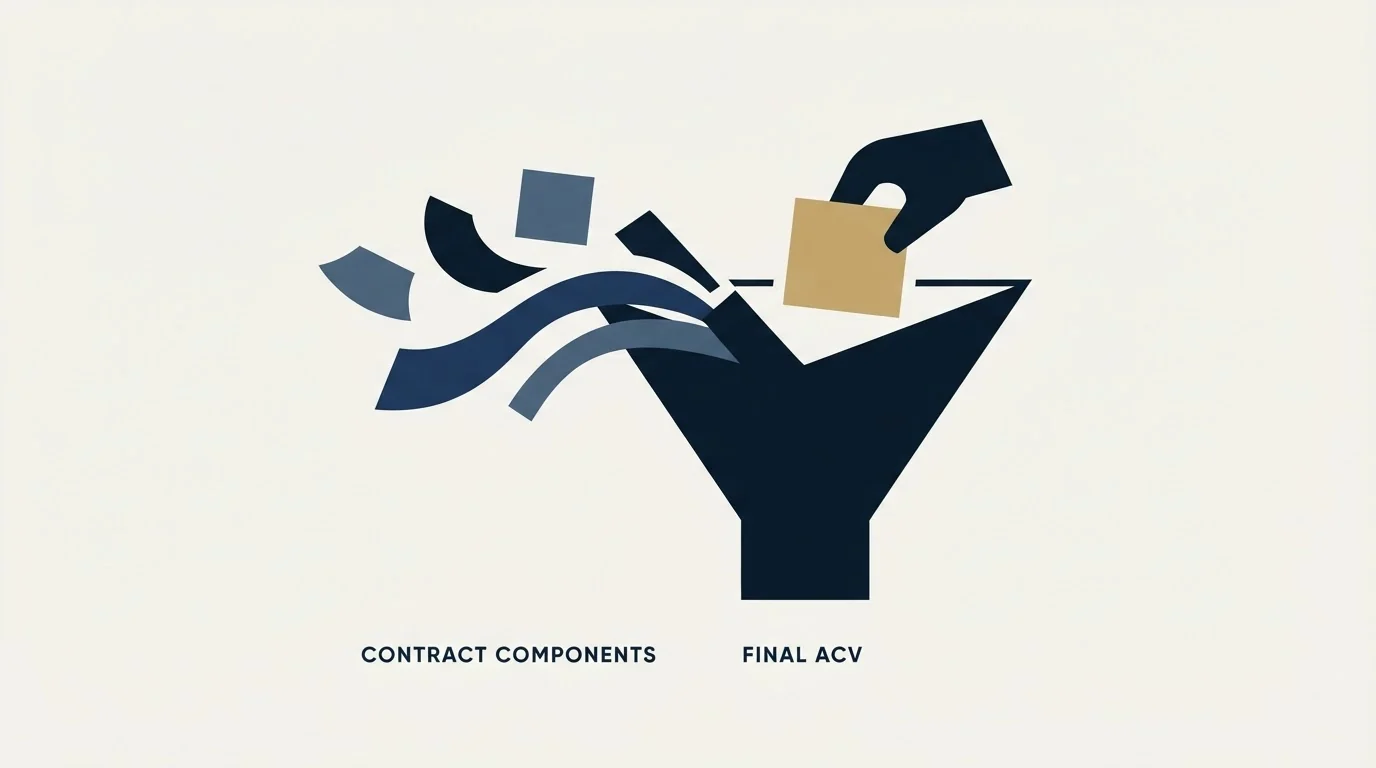
The standard construction is to take the total value the customer has committed to across the term, remove anything that is not recurring, and divide what remains by the number of years in the term.
An illustrative signature makes the shape visible. Suppose a customer commits to a two-year agreement carrying sixty thousand dollars of subscription across the term, plus ten thousand dollars of one-off implementation billed at the start. Total contract value is seventy thousand. Strip the implementation, divide the remaining sixty by two, and ACV is thirty thousand. Leave the implementation in and divide by two and it reports as thirty five thousand, a difference of one sixth on the same contract, produced entirely by a decision nobody wrote down.
That single step is where most of the divergence between companies originates, and the rest of it comes from three components that resist the division itself.
The three components that get folded in inconsistently
One-off implementation and services revenue. Onboarding, configuration, migration, training and professional services are real revenue and are not recurring. The disciplined treatment excludes them from ACV entirely. The common treatment folds them into year one, which raises reported ACV for every customer who bought them and makes a cohort with heavy services look like a cohort with a stronger product. The tell is an ACV that falls in year two for customers who did not churn or downgrade.
Multi-year deals with ramped pricing. A three-year agreement priced low in year one and higher in year three has at least two defensible ACVs: the amount contracted for the first year, or the total term value divided evenly across the years. The first describes what the customer will actually pay next year. The second describes the average commitment. Neither is wrong and they can differ substantially on the same signature.
Usage-based components. Where part of the contract is consumption billed after the fact, ACV can be built from the committed minimum, from the customer's expected consumption at signature, or from trailing actual usage. The first is conservative and verifiable, the second is a forecast, and the third does not exist yet at the moment the deal is signed and reported.
Two smaller conventions cause more argument than their size warrants. Free periods, where a customer receives the first two or three months at no charge, leave a first contract year whose invoiced total sits below the annualised rate the agreement actually establishes, and the two readings differ for every deal a promotional offer touched. Mid-term expansions raise the value of a live contract without a new signature, so a company that restates ACV when an account grows and one that holds the figure at its original signature will report different cohort averages from identical customers.
- SignatureTerm and ramp agreed
Three years, with the annual charge stepping up at each anniversary
- Year oneThe lowest contracted year
Taking this as ACV describes what will actually be invoiced next year
- Year twoThe step up lands
Reported ACV rises for a customer who bought nothing new
- Year threeThe highest contracted year
Term total divided by three sits between the years and matches none of them
Why two companies quoting ACV are often measuring different things
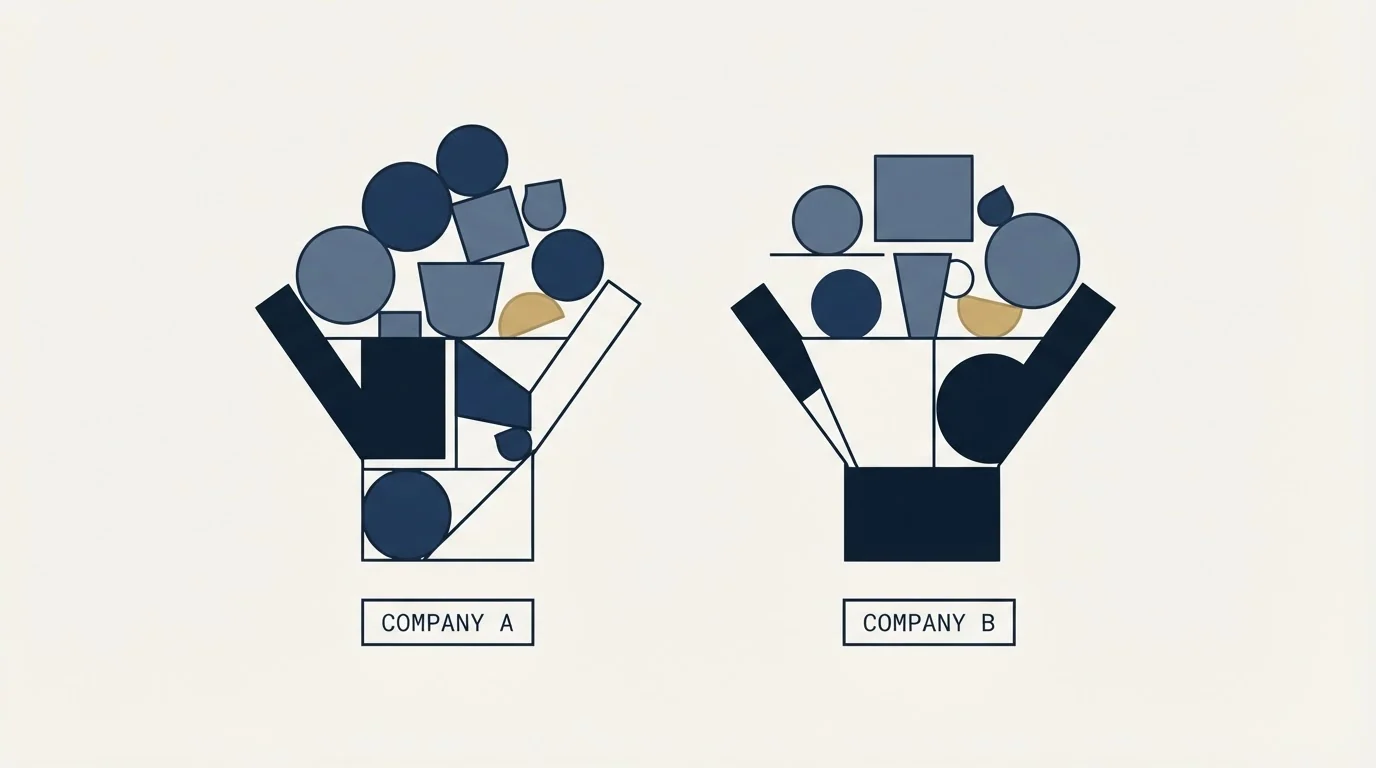
None of the choices above is governed by an accounting standard. ACV is a management figure, defined internally, and every company defines it in whichever way its history made convenient.
That has two practical consequences. Comparing your ACV against a published figure from another company, an investor deck or a market report tells you very little, because you cannot see which components were folded in on the other side. And a change in your own ACV between periods is worth investigating as a definitional change before it is read as a commercial one, particularly after a pricing revision, a packaging change, or the arrival of somebody new in a reporting role.
The same discipline applies to the figure one layer up. Any recurring-revenue number quoted at you carries the same folding problem in a larger form, and how to interrogate an ARR claim sets out the questions that separate a run rate from a total. The questions transfer to ACV almost unchanged: what is in it, over what term, and how was anything non-recurring treated.
- Yes: Are one-off implementation and services charges included or excluded
- Yes: For multi-year deals, is it year one or the term total divided by the years
- Yes: For usage-based components, is it the committed minimum or a consumption estimate
- Yes: Is it an average over new business, or over the whole active book
- Yes: Does it net out discounts, or sit at list value
- Depends: Did the definition change between the periods being compared
- Depends: Does the reported figure fall in year two for customers who did not downgrade
What ACV actually decides
Here is the part that matters more than the accounting. ACV sets the budget a company is allowed to spend acquiring a customer, and that budget decides which sales motions are available at all.
The chain is short. Acquisition cost has to be recovered out of gross margin, over a period the business can finance. Gross margin is a fraction of ACV. So ACV, multiplied by that margin and by however many years of payback the balance sheet will tolerate, is the ceiling on everything spent to win the customer: the seller's time, the marketing that generated the conversation, the tooling, and any external help.
Work the illustrative extremes and the constraint becomes concrete. A contract worth a couple of thousand dollars a year produces, at a healthy software margin, perhaps sixteen hundred dollars of first-year gross profit. That will not fund a motion in which a quota-carrying seller runs several meetings, builds a business case and negotiates a redline, because the fully loaded cost of that person's time exceeds the budget long before the deal closes. Businesses at that ACV either sell without a human in the loop or they lose money per customer and describe it as growth.
A contract worth a hundred thousand dollars a year inverts every one of those constraints. Months of pursuit, several meetings, a proof of concept and a procurement process all sit comfortably inside the budget, and the binding constraint moves from cost per conversation to whether the right conversations can be found at all. That is why what works above and below a given deal size reads like advice about two different industries: it is advice about two different budgets.
The same arithmetic decides how outbound should be bought. At low ACV the only defensible arrangements are ones priced per unit of output rather than per seat, because a seat has a fixed cost and the deals it produces do not carry it. At high ACV a dedicated team is affordable and the question becomes quality rather than unit cost. The pricing models for outsourced sales development map onto exactly that split, and what a qualified meeting actually costs is the number to hold against your own ACV before signing anything.
Reading it well

Treat ACV as a definition before treating it as a number. Write down what your version includes, keep it fixed across periods, and report a second figure alongside it when the answer changes materially under a different convention. A company that can state its own ACV two ways and explain the gap is in a much stronger position than one that quotes a single figure it has never interrogated.
It is also worth keeping apart from average selling price, which the two terms get used for interchangeably in sales meetings. Average selling price describes what a deal sold for, in whatever shape it was sold, one-off charges and all. ACV describes the recurring annual slice of it. In a business selling only annual subscriptions with no services attached, the two coincide and nobody notices the difference. In every other business they diverge, and a compensation plan written against one while a board pack reports the other will produce arguments that look commercial and are really definitional.
Read as an average, it also hides distribution, and a cohort containing a handful of very large contracts will report an average ACV that no individual customer resembles. Median ACV alongside the mean costs nothing to produce and usually changes the conclusion about which customers the motion is actually built for.
Finally, ACV is one of the two inputs to unit economics, and on its own it says nothing about whether the business works. Held against acquisition cost it becomes the LTV to CAC ratio; held inside a pipeline calculation it becomes the deal-value term in sales velocity. Neither of those is readable if the ACV underneath has quietly absorbed a year of implementation fees. When the arithmetic says the acquisition budget is tight, our pay per qualified meeting offer prices outbound against the unit that budget is actually measured in.
Frequently asked questions.
Frequently asked questions- What is the difference between ACV and ARR?
- ACV describes a single contract annualised over one year. ARR describes the recurring revenue of the entire customer book as a run rate at a point in time. The sum of every active customer's ACV should approximate ARR, but only when every contract is counted on the same basis, which is the condition that usually fails.
- Should implementation fees be included in ACV?
- Under the disciplined treatment, no. Implementation, onboarding and professional services are real revenue but they are not recurring, so folding them into year one inflates ACV for every customer who bought them. The tell is a reported figure that falls in year two for customers who neither churned nor downgraded.
- How do you calculate ACV on a multi-year contract?
- Take the total the customer committed to, remove anything non-recurring, and divide by the number of years in the term. On a ramped agreement priced lower in year one, that even division sits between the contracted years and matches none of them, so state whether you are quoting the term average or the first year.
- Why does ACV determine what our sales process can look like?
- Acquisition cost has to be recovered out of gross margin over a period the business can finance, and gross margin is a fraction of ACV. A contract worth a couple of thousand dollars a year cannot fund several meetings with a quota-carrying seller. A contract worth a hundred thousand comfortably funds months of pursuit.