Outsourced SDR Pricing by Seat, Meeting or Qualified Meeting
Three pricing units, three different distributions of risk. How to normalise quotes onto one number, and why per-qualified-meeting is not per-meeting.
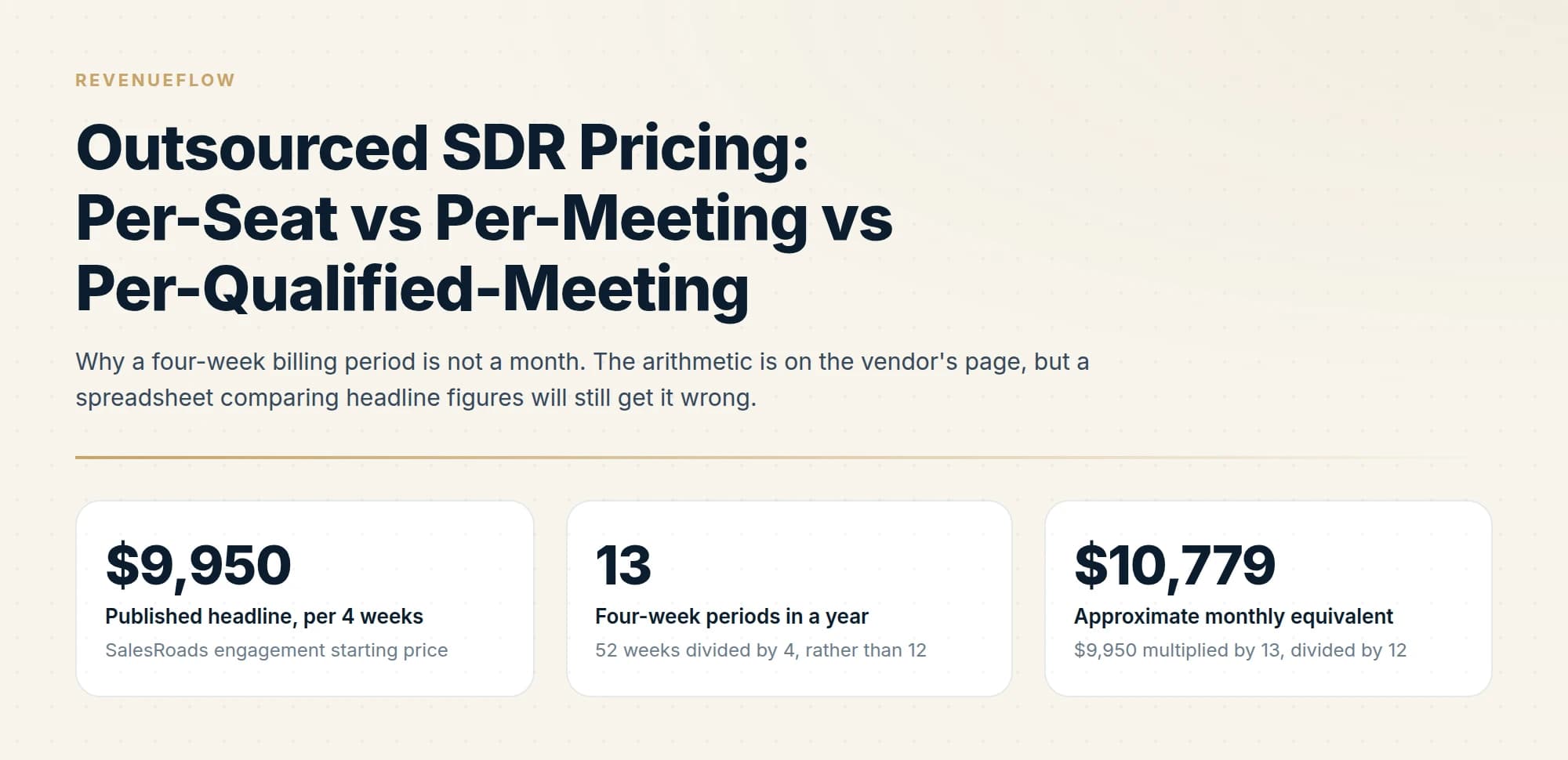
Outsourced SDR pricing uses three main units: per seat, per meeting, and per qualified meeting. Each distributes delivery risk differently and each makes the vendor optimise for something different, so quotes must be normalised onto a single comparable figure before any of them can be judged.
Key takeaways
- Per seat buys capacity and leaves output risk with you, so the vendor is paid identically whether the seat produces anything.
- Per meeting moves output risk to the vendor and creates an incentive to book volume, which the qualification standard is what restrains.
- Per qualified meeting is a materially different unit from per meeting, and the gap between them is entirely the written definition.
- A four-week billing period is thirteen periods a year rather than twelve, so SalesRoads' $11,950 per four weeks is about $12,946 a month in annual terms.
Reviewed and updated September 21, 2026
Outsourced SDR pricing comes in three units, and most comparisons go wrong by putting them in one column. Three quotes land in the same week. One is priced per seat per four weeks, one per meeting booked, one per qualified meeting attended. The spreadsheet has a single column headed "price", the three numbers go into it, and from that moment the comparison is broken, because those are three different products sold to three different risk appetites.
The unit is the most informative thing on a quote. It tells you who absorbs a bad quarter, what the vendor will optimise for once the contract is signed, and which arguments you are going to have in month four.
SDR outsourcing pricing: the unit decides who eats a bad quarter
Buyers ask the commercial version of this directly: whether a supplier charges more per meeting when there is no upfront cost. Usually yes, and the reason is on the line above rather than in anybody margin. Removing the retainer moves the risk of a slow quarter onto the supplier, and the per-meeting rate is where that transferred risk gets priced.
| Unit | Who carries the risk | The month-four argument |
|---|---|---|
| Per seat | You carry all delivery risk; the vendor optimises for retention and visible activity | Effort |
| Per meeting booked | The vendor carries sourcing; you carry qualification and attendance | Who was in the room |
| Per qualified meeting | The vendor carries sourcing, qualification and attendance | The written definition |
Per seat
You are buying capacity, and an unproductive month costs full price. The vendor's rational optimisation is retention plus demonstrable activity, because activity is the only thing they can show you when output is thin.
Seat prices in adjacent tooling behave the same way, and a dialer licence that carries its number inventory costs more per seat while absorbing a separate invoice.
That is why activity commitments exist as a category. Martal publishes an average monthly production funnel for each tier as ranges: 3,000 to 5,000 prospects targeted, 9,000 to 12,000 emails sent, 20 to 30 qualified leads and 5 to 15 flipped leads. Volumes of work are auditable and the vendor can commit to them honestly. The two lead figures are stated as an average rather than as a guarantee, which is the distinction worth reading carefully on any page like this.
Per seat is still the cheapest unit when the programme works, because you are not paying anyone a premium to hold your risk. It also buys you direction, which the outcome models deliberately take away.
The Chili Piper breakdown of seat floors and per-rep costs shows how a per-seat model introduces its own step-changes once headcount grows past the included tier.
Per meeting booked
The vendor now funds sourcing, sending infrastructure, copy and reply handling before seeing any revenue. You keep two risks: whether the person in the room is the right person, and whether they turn up at all.
The optimisation follows the unit precisely. The vendor is paid for bookings, so bookings are what improves. Whether that is a problem depends entirely on how tightly the booking is specified, which is a contract question rather than a pricing one. The specific failure modes and the clauses that close them are in pay-per-appointment B2B.
Per qualified meeting attended
The vendor absorbs qualification and attendance on top of everything above, so their targeting narrows without you having to police it. Booking someone who will not survive your criteria costs them the whole cost of producing that meeting.
This unit carries the highest headline rate, and most of that premium is the cost of work that never becomes billable, priced in rather than absorbed. Buyers who compare a per-qualified-meeting rate against a per-booking rate and conclude the first vendor is expensive are comparing a number that includes wastage against one that does not.
Hybrid: retainer plus commission
The question buyers ask first is what happens to deals that were already in the pipeline when the engagement starts, and it is answered by writing the exclusion down rather than by trusting the attribution: an account already in an active opportunity is excluded at the build, so it cannot produce a billable meeting in the first place.
A retainer priced against a promised number of qualified meetings sits in this row too, and it is worth dividing rather than reading as a monthly fee: the retainer and the count together give a per-meeting figure that can be compared with an outcome quote, and the comparison is usually closer than either side expects.
Both sides hold a piece. Martal's tiers are the visible published example of the structure: Tier 1A is a flat monthly fee, while Tiers 2 and 3 are a flat fee plus sales commission. The pilots differ accordingly, three months for Tier 1A and four months for the commission tiers.
The commission extends the vendor's interest past the meeting into whether it closes, which is the strongest alignment available and also the most administratively demanding. It requires them to see enough of your CRM to verify outcomes, and it requires both sides to agree attribution rules before the first deal, including what happens when a sourced meeting closes eleven months later or when the deal arrives through a different channel after the meeting. Longer pilots on commission tiers make sense for a plain reason: commission is worth nothing to the vendor until deals close, so they need runway before the model pays them anything.
The billing-unit trap

The single most common arithmetic error in this category is treating a four-week period as a month.
The same arithmetic on a two-SDR engagement: $16,750 per four weeks is $217,750 a year, which is roughly $18,146 a month. Across any four-week quote the effect is one extra period in twelve, so a monthly comparison understates a four-week vendor by about 8.3 percent before you have looked at anything else.
This is not a hidden fee. The slider prints both the four-week total and the per-rep figure, and SalesRoads states "No long-term commitment. Cancel anytime." beside them. It is a normalisation step that spreadsheets skip, and it is large enough to reverse a close comparison on its own.
Normalising three quotes onto one number
The same question arrives as what the fee for qualified meetings is, and it is answerable only once the qualification standard is written down, since two suppliers quoting the same figure against different standards are not quoting the same product.
The question buyers open with is what do you charge per meeting, and a figure answered without its definition is not comparable across two suppliers, which is why the normalisation below starts with the written standard rather than with the rate.
This normalisation is also what settles how many qualified meetings per month make commercial sense against a given retainer, which is the question buyers are usually asking when they ask for a meeting target. Divide the committed spend by the rate under each unit and the answer is arithmetic on the quote rather than a number anybody has to promise.
The target number is cost per attended qualified meeting. Everything else is an input.
Multiply by periods a year: 12 for monthly pricing, 13 for four-weekly. Compare annual figures, never headline ones.
Pilots and minimum terms are spend before you can walk away. Record them as totals.
From every vendor, in writing, before any price comparison.
A guaranteed count gives a real cost per meeting. Where there is none, leave the cell blank.
That last step is the one to be strict about. The temptation is to fill the blank with a case-study number, but a case study is a selected result and not a commitment. A blank cell is information in its own right: it tells you which vendors are asking you to carry the delivery risk, which is exactly the thing you are trying to price.
One published pairing does yield a computable figure, and it is worth walking through because it demonstrates the method. Belkins publishes an average starter price "from $5,000" beside 1,500 leads a month and 100 guaranteed appointments a year, without stating the period the $5,000 covers. Read as a monthly figure, which is how the leads beside it are counted, twelve months at $5,000 is $60,000, divided by 100 appointments, which is $600 per guaranteed appointment. Confirm the billing period on the call before using it.
Three caveats travel with that number and all three matter. It is a "from" price, so it describes the entry configuration rather than the one that will match your market. The guarantee is a floor rather than a forecast, so real cost per appointment falls if they overdeliver. And the guarantee counts appointments, so $600 is cost per appointment and not cost per usable meeting until you have read the definition behind the word.
Why per qualified meeting is a different unit, not a discount
A quote arriving with a cost per qualified meeting higher than the current provider is frequently the same programme priced with the wastage included, and the way to test that is to ask what share of the cheaper supplier's bookings would survive the buyer's own written criteria.
The objection this produces is about risk rather than about the rate: nobody minds a high number for a meeting that survives their own criteria, and paying a high rate for meetings that may not be qualified is the thing being refused, which is why the written standard rather than the price is the term to negotiate.
This is why a straight answer to what somebody charges per qualified lead is worth less than the definition attached to it: two suppliers quoting the same figure against different qualification standards are not quoting the same product, and the cheaper one is frequently the more expensive per useful conversation.

Two vendors quoting per meeting can be quoting for different things, and the qualification standard is the function that converts one into the other.
Run the same programme twice with the same activity and the same bookings. Under a loose standard, every booking invoices. Under a tight one, some fraction is rejected and never billed. The activity did not change and the count did, so a rate on its own is uncomparable across two vendors whose standards differ.
The practical move is to ask each per-meeting vendor what share of their bookings they would expect to survive your written criteria, then price against that reduced number rather than against their headline count. A vendor with an honest answer has thought about your ICP. A vendor with no answer is quoting you a rate that is an upper bound on quality and a lower bound on cost.
Tightening the standard also moves cost between the parties rather than removing it. Loose standards push cost onto your side as sales hours spent in meetings that should not have happened, and that cost is invisible because nobody invoices for it. Tight standards push it onto the vendor as unbillable work, and it becomes visible as a higher rate. Net cost per usable meeting frequently falls when you tighten, which is counterintuitive right up until you price your sellers' time.
One boundary applies whatever unit you pick. Budget, timing and authority belong in the qualifying questions the setter asks, never as conditions on the invoice, because requiring them means paying outbound rates to reach only the people already running an evaluation. What a defensible standard does contain is set out in pay-per-appointment B2B.
The cost lines that are not the rate
Buyers ask whether the fees are one-time or recurring, and the honest answer is usually both, because a per-meeting rate recurs per unit while setup charges, minimum terms and annual commitments sit outside it.
Four items move the real annual figure and none of them are the headline.
Setup fees. SalesHive states no setup fees, ever. Not everyone does, and onboarding charges are usually quoted separately from the monthly figure.
What sits inside the fee. SalesHive's flat monthly fee covers the SDR team, a strategist, the AI platform, data and tools. Elsewhere, data, sending infrastructure and tooling can be passed through at cost or billed on top. Ask for the inclusion list in writing, because the same headline number can mean two quite different totals.
Minimum term. SalesRoads and SalesHive both state no long-term contract and cancellation at any time, SalesHive with written notice. Martal starts with a three or four month pilot depending on tier. Cancel-anytime has genuine option value and belongs in the comparison as a reduction in risk rather than in price.
Annual versus monthly. SalesHive runs month to month by default: once outreach has started, a written notice ends outreach and billing at the end of the next billing month. It also states that annual plans run at a lower monthly rate than month to month. That is a financing decision about how much flexibility you want to sell back, and it should be evaluated as one.
The staffing shape behind these numbers is a separate axis and the two get conflated constantly. Any of these units can be attached to an agency pod, a fractional rep, an offshore team or a pure outcome vendor, and the shape determines what you can direct rather than what you pay. That comparison is in SDR outsourcing. What each major vendor actually publishes, and what they leave off the page, is in appointment setting companies. For the wider retainer market outside the SDR category specifically, the lead generation agency cost guide covers the same structures at a different altitude, and the fully loaded comparison against hiring is in outsourced SDR versus in-house.
The short version

The billing unit is a risk allocation. Per seat leaves delivery risk with you and buys direction. Per meeting moves sourcing risk to the vendor and leaves you holding qualification and attendance. Per qualified meeting moves all of it and prices the wastage in, which is why its rate looks high next to a booking rate that quietly excludes the same work. Hybrids align interest furthest and cost the most to administer. Normalise by annualising first, since a four-week period is thirteen periods a year and understates by roughly 8.3 percent against a monthly quote, then divide by committed output only where output is actually committed, and leave the rest blank.
RevenueFlow is paid on attended meetings that meet criteria agreed in writing before launch, which places the whole delivery risk on the third unit above. See if you qualify.
Vendor pricing and stated terms are taken from the vendors' own pages. Derived monthly and per-appointment figures are arithmetic on those published numbers, shown in the text. Confirm current terms directly before contracting.
Sources: SalesRoads pricing, SalesRoads appointment setting, SalesHive pricing, Martal pricing, Belkins appointment setting
Frequently asked questions.
Frequently asked questions- How is outsourced SDR work priced?
- Usually per seat as a monthly retainer for a dedicated or fractional resource, per meeting booked, or per qualified meeting measured against written criteria. Hybrid arrangements add a commission on closed revenue to a lower base fee. Each unit moves risk to a different party, which is why the unit matters more than the headline rate.
- Should an outsourced SDR contract be month to month or annual?
- Month to month buys the option to leave, and annual buys a lower rate: SalesHive, for example, runs month to month with written notice ending billing at the end of the next billing month, and states that annual plans run at a lower monthly rate. Price the flexibility as a reduction in risk rather than ignoring it.
- How do I compare SDR pricing quotes fairly?
- Normalise everything to an annual figure and divide by twelve, since some vendors quote per four weeks, which is thirteen periods a year. Then convert each to a cost per attended qualified meeting using whatever output the vendor will commit to, and leave the figure blank where they commit to none.
- Which SDR pricing model transfers the most risk to the vendor?
- Per qualified meeting, because the vendor funds all activity and earns only on output that passes an agreed standard. That is priced accordingly, so the unit cost looks high next to a retainer. The comparison only makes sense in total cost against delivered qualified meetings.
About the author.

B2B cold email experts helping companies generate qualified leads through done-for-you outreach campaigns.
RevenueFlow Team
Explore more.
Ready to scale your outreach?
We build GTM engines that book real meetings. See the receipts.
Related articles.
SDR Outsourcing: The Four Models and What Each Costs
Dedicated team, fractional SDR, offshore staffing or outcome-based agency. What you control in each, how ramp works, and what happens when the person leaves.
Prospecting Methods: Six Ways In, and What Each One Demands
Six prospecting methods, grouped by economics rather than preference: what each one needs before it works, where it stops scaling, and how to choose.
No Show Email Template: What to Send After a No Show
A no-show accepted the meeting, so writing to them is correspondence rather than a bump. The checks to run first, what to send, and the policy behind it.
SDR Outsourcing Companies: What Each One Publishes
Three of eleven SDR outsourcing companies publish a price per head. None publishes a price per meeting. What each puts on its own pricing page, and why the unit matters.
Fractional VP of Sales: Four Arrangements, One Title
Interim executive, shared leader, consultant and managed pod are sold under one title. Which one you are buying, and the conditions that decide it.
Prospect Meaning in Sales: A Name Is Not a Prospect
A prospect is a name that passed a fit check, not a name that replied. What lead, prospect and opportunity each assert, and what the boundary decides.