No Show Email Template: What to Send After a No Show
A no-show accepted the meeting, so writing to them is correspondence rather than a bump. The checks to run first, what to send, and the policy behind it.
An event no-show gets one message: thank them for registering, send the recording and the next date, ask nothing. A sales meeting no-show accepted a slot with you, so check logistics first, send a short same-day note with a link, one more a few days later, then close the loop.
Key takeaways
- An event registrant who missed the session gets one message with the recording, the slides and the next date, and no reminder after it.
- A meeting no-show accepted an agreement with you, so writing to them is correspondence rather than a bump: check the invite, link, time zone and reminder first.
- Send a short same-day note with a link and two times, one more a few days later, then a close-the-loop note, and keep every message free of guilt.
- If a vendor books your meetings, get the attendance term in writing: the vendor pages checked describe reminders and rescheduling, never what a no-show costs.
Reviewed and updated September 19, 2026
An event no-show email template is one message to somebody who registered and did not attend: thank them for registering, hand over the recording or the next date, and ask nothing of them. That template comes first below. A missed sales meeting is a different case, because that no-show accepted a meeting with you, and the rest of this page covers what to send then.
Ten past the hour, the video room still shows one participant, and the calendar says the invite was accepted. Somebody agreed to this meeting, put it in their week, and is not here. What you send in the next few hours decides whether that slot is recovered or written off, and most teams either send nothing or send something faintly wounded.
The message is the easy part. The policy around it, meaning how many times you write, who rebooks, and what your vendor contract says happens to a meeting nobody attended, is the part that costs money when it is undefined.
Event no-show email template
A registrant who missed a webinar or an event made a much smaller commitment than somebody who accepted a meeting. They filled in a form. One message is the right amount: it says thank you, hands over what they missed, and offers the next date. It does not ask why they were absent, and no reminder follows it.
Subject: The recording from [event name]

Hi [First name],

Thanks for registering for [event name]. In case the day got away from you, the recording is here: [link], and the slides are here: [link].

If you would rather see it live, the next session is on [date] at [time, in their zone]: [registration link].

[Your name]
Send it the same day or the next morning, while the registration is still recent, and send it once. A registrant who wants more will click; one who does not has answered already.
A no-show is somebody inside a live agreement with you
This distinction comes first because it changes what you are allowed to write. A no-show accepted a meeting. That is a two-way arrangement, and writing to somebody who did not show up for an arrangement they made is ordinary correspondence, the same as replying to any other message from a person you are already talking to.
Sellers usually raise this as no-shows wasting the team on prospects who were never going to buy, which is two problems wearing one complaint: the attendance half is recovered by the messages below, and the qualification half belongs upstream in the written standard a booking is judged against.
It is a different activity from emailing a prospect who never answered a cold email. Our own rule for campaigns is one message per campaign and no bumps to people who never engaged, and none of this is that. Say it once internally so nobody confuses the two, then write the note like a human whose Tuesday also got away from them.
The five minutes before you write anything

Some no-shows are logistics rather than disinterest, and the logistics ones cost nothing to rule out. Sending a disappointed note to a person whose calendar invite rendered in the wrong hour is an avoidable own goal, and it burns a meeting you had already won.
If one of the first five checks comes back wrong, the note you send is a different message entirely. It leads with your own mistake, fixes the thing that broke, and offers a new time without asking them to explain anything or account for their morning. A prospect who was sent a link that did not work, and then receives a gentle nudge about their absence, will not book again, and they will be right not to. Two of those checks take one click each, which makes skipping them hard to justify.
What to send
Every message below is short, contains a link, and gives the prospect a path that requires no explanation from them. The tone rules are simple. No guilt, no passive aggression, no reference to how long you waited, and no phrase that requires them to apologise before they can rebook. Somebody who feels caught will stay quiet.
Four phrases do most of the damage, and they turn up constantly in no-show copy: "I waited for 15 minutes", "I noticed you did not attend our scheduled call", "just checking if you are still interested", and any version of "I assume this is no longer a priority". The first two invoice the prospect for your time. The third asks them to re-argue a decision they already made. The fourth is a test disguised as a question, and the polite answer to it is silence. Delete all four and the message gets shorter, which is the other thing it needs.
The same-day note
Sent within a couple of hours, while the slot is still in their memory.
Subject: Missed you today

Hi [First name],

Sorry we did not manage to connect at [time] today. These things happen.

Here is our calendar if you want to pick another slot: [reschedule link]
[Day] at [time] or [day] at [time] in your zone both work too, and we can just send the invite.

[Your name]
The short one
For a prospect who was already terse, or where the relationship is early and formality would be odd.
Subject: Another time?

Hi [First name], sorry we missed each other today. [Link] has open slots if you still want to talk about [the thing they raised].

[Your name]
The one more note, a few days later
You are still inside the agreement they made, so one more short message is reasonable. Set the expectation with yourself that it is the last calendar-chasing message you send.
Subject: Re: [original subject]

Hi [First name],

Still glad to have the conversation about [the specific thing they wanted from the call]. [Link] has times, or send a window and we will work around it.

If the timing has simply moved, say so and we will check back in [month] instead of filling your inbox.

[Your name]
The close-the-loop note
The most underrated message in the set. It ends the thread cleanly, leaves the door open, and it is the one that most often gets a reply, because there is nothing left to dodge.
Subject: Closing the loop

Hi [First name],

We will stop chasing the calendar. If [the problem they described] comes back onto your desk, our line is open and [link] still works.

Good luck with [the specific thing they mentioned].

[Your name]
The internal handback
When a repeated no-show goes back to whoever sourced the meeting, it needs facts rather than a verdict.
Prospect: [Name], [title], [company]
Booked: [date], via [campaign or channel], for [meeting date and time]
Attendance: no-show x[N]. Invite accepted: [yes or no]. Reminder delivered: [yes or no].
Contact since: [any reply, or none]
Recommendation: [rebook once more / return to nurture / suppress]
The policy matters more than the wording
Five decisions turn these templates into something a team can run consistently.
How many attempts, and who decides. Two written attempts inside the original agreement, then the close-the-loop note, is a defensible standard that nobody will read as pestering. Write the number down. Left undefined, it becomes a matter of individual temperament, and the range across a team is wider than anyone expects.
Automatic or manual rebooking. An automated rebook offer fires reliably and reads as automated. A human note lands better and does not always get written. The workable compromise is an automatic same-day message where volume is high, with a manual note reserved for meetings that took real effort to win. Whichever you choose, make sure the automation cannot fire at somebody who did attend, which is the standard failure when attendance is inferred from a calendar entry rather than read from a participant log.
What a second no-show means. One missed meeting is noise. The same person missing twice is information, and the useful response is to change the shape of the offer rather than the wording of the email. Some buyers will never hold a scheduled slot and will happily answer a question in writing, so offering a short asynchronous exchange instead of a third calendar invite recovers conversations that a fourth reschedule link never will. Where the account genuinely matters, a colleague reaching out on a different channel is a fresh start rather than more of the same thread. Everything else goes back to the source with the record attached, and the decision to suppress or to revisit later belongs to whoever owns that pipeline.
What your vendor contract says. If somebody else is booking meetings for you, whether a no-show is rebooked, credited or billed is a real commercial term, and it is not on their website. Vendor pages describe the prevention process in detail and stay silent on the money. Belkins states that its SDRs send reminders usually 24 hours and 1 hour before the call and proactively reschedule when something changes on either side (Belkins), which is process rather than terms. SalesHive's pricing page describes three tiers billed as one flat monthly fee, with no setup fees and cancellation at any time with written notice, publishes no rate, and does not mention no-shows or rescheduling at all (SalesHive). SalesRoads prices one SDR at $11,950 per four-week engagement and, likewise, publishes no attendance terms (SalesRoads).
Because vendor pages often blur commercial details, pricing inconsistencies at one appointment setting vendor shows why reading the fine print before signing matters just as much as any no-show policy.
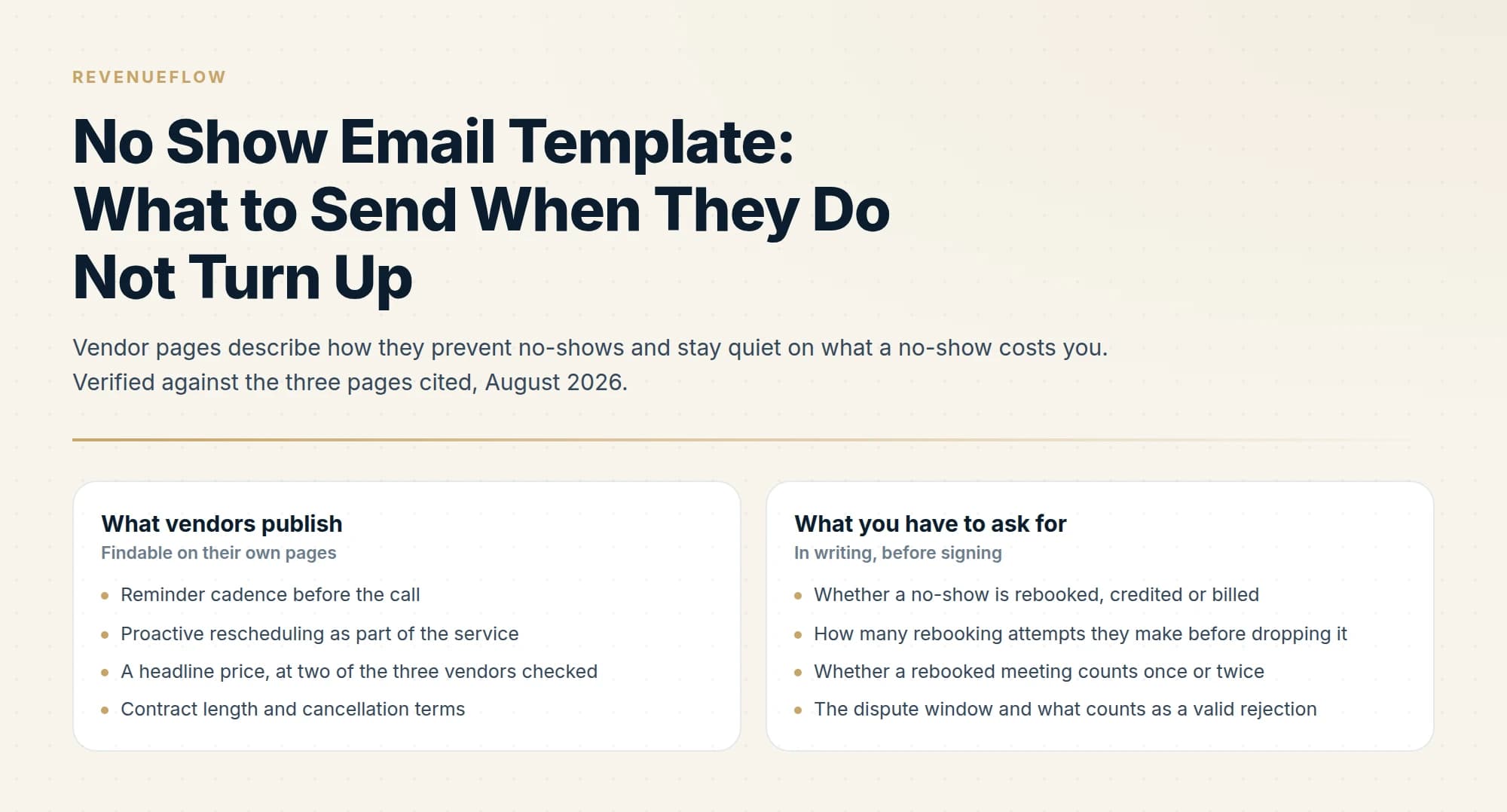
What vendors publish
- Reminder cadence before the call
- Proactive rescheduling as part of the service
- A headline price, at two of the three vendors checked
- Contract length and cancellation terms
What you have to ask for
- Whether a no-show is rebooked, credited or billed
- How many rebooking attempts they make before dropping it
- Whether a rebooked meeting counts once or twice
- The dispute window and what counts as a valid rejection
- Who confirms attendance, and from which record
That last column is the one to take into a first call. A meeting count means very little until attendance is defined, because a booked meeting and an attended meeting are different products at the same price.
Where attendance gets recorded. The dispute nobody plans for is a dispute about the facts, and it arrives weeks later with two people reading two different records. Decide up front which system holds attendance and who writes to it: the calendar, the meeting recorder, the CRM activity, or a shared sheet somebody updates by hand. Recording it from the video tool's participant log is the version least open to argument, because it exists whether or not anyone remembered to update anything. Write the outcome the same day, while the person who was in the room still remembers. A record built later from memory is a reconstruction, and a reconstruction is exactly what a dispute window is for.
Prevention does more than any template
Everything above is recovery, and recovery is the expensive path. The three levers that reduce the problem in the first place are all upstream of the meeting.
Whether a vendor calls to confirm is worth asking directly where somebody else books your meetings, because confirmation is the lever with the shortest path to attendance and it is frequently outside a cheaper quote. Some providers call, some send a written confirmation, and some do neither and report booked meetings. The three levers below are the ones to establish ownership of at kickoff rather than after the first month of attendance numbers, since a provider paid on booked meetings has no commercial reason to build them.
Confirmation quality comes first: a confirmation that names the time in their zone, who is attending, and what the call covers turns a calendar entry into a commitment. The booking-to-meeting gap is second, and it matters more than most teams treat it, because intent decays across a week in a way it does not across two days. Offer the nearest sensible slots rather than the tidiest ones. A human reminder is third, and it earns its cost specifically on meetings booked well in advance, where a generic automated reminder is the only thing standing between the booking and a forgotten Tuesday. If you outsource the setting work, ask to see the confirmation and reminder copy going out under your name before launch, the same way you would review campaign copy. Outsourced appointment setting covers what else belongs in that review.
If you are evaluating vendors on this, the wider picture of what each one publishes about price, guarantees and terms is in appointment setting companies, and the structural difference between buying meetings and buying leads is in appointment setting versus lead generation. For teams weighing the model itself, B2B appointment setting covers where the function sits.
The short version

Check the logistics before you write, because a broken link or a mangled time zone is your fault and the wrong note makes it permanent. Send a short same-day message with a link and two alternatives, one more a few days later, then close the loop cleanly. Keep every message free of guilt, and never make the prospect explain themselves before they can rebook. Write the attempt limit down so it does not depend on who is having a patient week. And if a vendor is booking your meetings, get the attendance term in writing, because none of the pages we checked publish it.
RevenueFlow is paid on attended meetings against criteria agreed in writing before launch, and attendance is one of the five points in that written standard, so a meeting nobody joined is not a billable one. That is documented practice rather than a promise about outcomes. The commercial shape of that arrangement, including how the definition gets exploited when it is loose, is in pay per appointment. You can also see what a campaign would look like for your market.
Vendor pricing and stated terms verified against the vendors' own pages in mid-2026 and re-read for this update. All are subject to change; confirm current terms directly before contracting.
Sources: Belkins appointment setting, SalesHive pricing, SalesRoads pricing
Frequently asked questions.
Frequently asked questions- What should an event no-show email say?
- Thank the person for registering, give them the recording and the slides, and offer the next live date with its registration link. Keep it to one message, sent the same day or the next morning. Do not ask why they missed it and do not follow it with a reminder; a registrant who wants more will click.
- What should I send after a sales meeting no-show?
- First rule out logistics: whether the invite was accepted, the link worked, the time was right in their zone and the reminder arrived. Then send a short same-day note with a reschedule link and two concrete times, with no reference to how long you waited. If there is no answer, send one more a few days later, then close the loop.
- How many times should I follow up after a no-show?
- Two written attempts inside the original agreement, then a close-the-loop note, is a defensible standard nobody will read as pestering. Write the number down so it does not depend on individual temperament. A second no-show from the same person is a reason to change the offer, such as a written exchange, rather than the wording.
- Do appointment setting vendors charge for no-shows?
- Their pages rarely say. Belkins describes reminders 24 hours and 1 hour before the call and proactive rescheduling, SalesHive's pricing page does not mention no-shows, and SalesRoads publishes no attendance terms. Whether a no-show is rebooked, credited or billed is a contract term, so ask for it in writing before signing.
About the author.

B2B cold email experts helping companies generate qualified leads through done-for-you outreach campaigns.
RevenueFlow Team
Explore more.
Ready to scale your outreach?
We build GTM engines that book real meetings. See the receipts.
Related articles.
SDR Outsourcing: The Four Models and What Each Costs
Dedicated team, fractional SDR, offshore staffing or outcome-based agency. What you control in each, how ramp works, and what happens when the person leaves.
Prospecting Methods: Six Ways In, and What Each One Demands
Six prospecting methods, grouped by economics rather than preference: what each one needs before it works, where it stops scaling, and how to choose.
Outsourced SDR Pricing by Seat, Meeting or Qualified Meeting
Three pricing units, three different distributions of risk. How to normalise quotes onto one number, and why per-qualified-meeting is not per-meeting.
Fractional VP of Sales: Four Arrangements, One Title
Interim executive, shared leader, consultant and managed pod are sold under one title. Which one you are buying, and the conditions that decide it.
Cold Call Appointment Setting: The First Ten Seconds
The opening decides the call, and what wins it is a specific reason for phoning this person today. That is a property of the list before it is a property of the script.
Prospect Meaning in Sales: A Name Is Not a Prospect
A prospect is a name that passed a fit check, not a name that replied. What lead, prospect and opportunity each assert, and what the boundary decides.