Superhuman Prospecting Pricing: Two Entry Prices, Two Pages
The pricing page starts at $1,998 a month and the appointment setting page says as low as $1,125. Both are live, and the gap is the useful part.
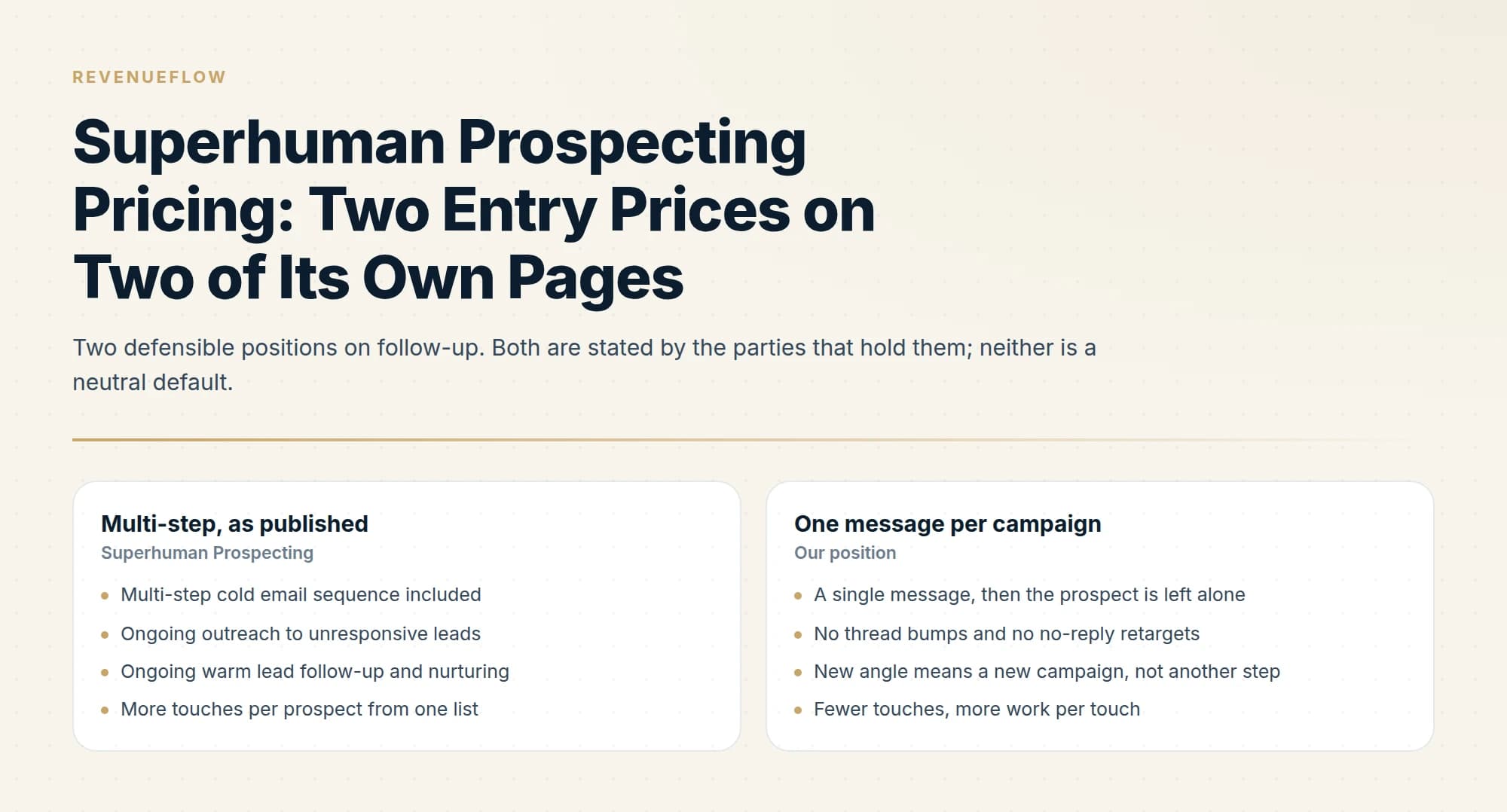
Superhuman Prospecting publishes prices on two pages that disagree. Its pricing page lists a calls-only subscription starting at $1,998 a month and a Premium SDR Bundle at $4,995, both marked starting at with setup fees on top. Its B2B appointment setting page says it starts as low as $1,125 a month.
Key takeaways
- The pricing page lists a Calls Only Flex Subscription starting at $1,998 a month and a Premium SDR Bundle starting at $4,995 a month.
- The B2B appointment setting page answers its own cost question with as low as $1,125 per month, and neither page references the other.
- List building is priced separately at $3.00 per contact, so a 2,000-contact list is $6,000 and can exceed the first month of the service it feeds.
- Both subscriptions carry no long-term commitment, which shifts ramp risk back to the agency and is worth more than a discount on a locked term.
Reviewed and updated September 1, 2026
Superhuman Prospecting sells cold calling as the primary channel at a time when most of the category has quietly moved to email-first programmes with calling as an add-on. It also publishes its prices, which puts it in a small minority of outbound agencies you can budget for before speaking to anyone. Its pricing page lists a calls-only subscription starting at $1,998 a month and a multi-channel bundle at $4,995, while a separate service page quotes appointment setting from $1,125. Those two entry points do not match, and that turns out to be the most useful thing on the site.
A disclosure up front, because we are not a neutral party. RevenueFlow is an outbound agency and competes for some of the same buyers. We run email and LinkedIn rather than phone, and we are paid on attended qualified meetings rather than a monthly subscription. Everything below comes from Superhuman Prospecting's own pages, and where our models differ we have tried to describe the trade-off rather than score a point.
The published pricing, and which page it is on
| Product | Basis | Published price | Page |
|---|---|---|---|
| Calls Only Flex Subscription | Monthly, starting at | $1,998 | Pricing page |
| Premium SDR Bundle | Monthly, starting at | $4,995 | Pricing page |
| List Building | Per contact, starting at | $3.00 | Pricing page |
| CRM integration | One-time fee | $250 | Pricing page |
| Appointment setting | Monthly, "as low as" | $1,125 | Appointment setting service page |
That last row is not a typo, and it is the reason this table names the page for every figure.
Superhuman Prospecting publishes two different entry prices on two live pages of its own site. The pricing page puts the cheapest subscription at $1,998 a month. The B2B appointment setting service page says, in answer to its own question about what appointment setting costs, "We start as low as $1125 per month and we don't have any long-term commitments."
Both were fetched fresh on the same day. Neither page references the other. We are not going to guess which one governs, and neither should you: ask which applies to the scope you want, and get the answer in writing before it becomes a renewal conversation.
The general lesson is worth more than the specific number. A vendor's pricing page is not automatically the authoritative statement of its pricing, and a service page is not automatically stale marketing. Check both, because the gap between them is where a buyer either finds a cheaper entry point or discovers that the number they budgeted from was never the one on offer.
Both subscription tiers on the pricing page are marked "starting at", and that page notes that additional setup fees apply, so treat these as floors rather than quotes. Both carry the same two headline inclusions: no long-term commitments, and USA-based experienced callers.
The calls-only tier is aimed, in the company's own framing, at startups, small businesses and companies looking to start at a smaller scale. The Premium SDR Bundle is the multi-channel product, described as full-service campaigns incorporating calls, emails and lead nurturing.
What sits inside the multi-channel bundle
The Premium tier's published inclusions are specific enough to reason about, and they describe a particular philosophy of outbound.
Alongside the calling, the bundle includes a multi-step cold email sequence, ongoing cold email outreach to unresponsive leads, ongoing warm lead follow-up and nurturing, and domain registration, setup and warming. CRM integration is available at a $250 integration fee.
Two of those deserve highlighting because they are commitments, not features. Domain registration and warming inside the engagement means the agency stands up sending infrastructure rather than borrowing yours, which is the correct instinct: outbound sending belongs on domains separate from your primary company domain so a reputation problem in one cannot reach the other. Any agency doing this properly is protecting an asset of yours that most buyers do not know is at risk.
The other is the sequence model, which is where we differ and where a buyer should make a deliberate choice rather than inherit one.
- Multi-step cold email sequence included
- Ongoing outreach to unresponsive leads
- Ongoing warm lead follow-up and nurturing
- More touches per prospect from one list
- Suits buyers who believe persistence surfaces timing
- A single message, then the prospect is left alone
- No thread bumps and no no-reply retargets
- New angle means a new campaign, not another step
- Fewer touches, more work per touch
- Suits buyers who believe relevance beats repetition
Neither column is a criticism of the other. Persistence genuinely does surface prospects whose timing was wrong the first week, and a serious share of replies in the industry arrive after the first message. Our position is that the same effort spent on targeting produces better conversations than the same effort spent on repetition, and that a second message to someone who ignored the first mostly adds volume. Pick the one you actually believe, because it determines what your market experiences.
The phone-first question
The more consequential difference is channel, and it is not primarily about price.
- Step 1The number is the bottleneck
Phone outreach needs a reachable direct line. List building is sold separately at $3.00 per contact for exactly this reason.
- Step 2The rep is the product
Every conversation is a trained human in real time, which is why the model is priced as a subscription rather than per send.
- Step 3Volume is bounded by hours
A caller makes a finite number of dials a day, so scale comes from adding people rather than from infrastructure.
- Step 4Objections surface immediately
The feedback loop is same-day rather than same-week, which is the genuine advantage over asynchronous channels.
That last point is the honest case for phone and it is underrated. An email programme learns slowly, from reply rates measured over weeks. A calling programme learns in an afternoon, because a human hears the objection and can test a different framing on the next dial. For a company still figuring out its message, that speed of learning can be worth more than the meetings.
The constraint is arithmetic. Callers are bounded by hours in a way that email is not, so the cost per conversation stays roughly flat as you scale rather than falling. That is why calls-first models tend to fit higher-value deals, where one meeting justifies substantial human time, and fit poorly where the deal size cannot carry it.
The company states it has cold called for over 1,200 companies globally, and describes a US-based team where every caller is trained and certified in an in-house methodology it calls H2H. Whether the certification means much is not something we can verify from outside, but the US-based claim is a real cost commitment: it rules out the offshore rate arbitrage that several competitors publish openly.
What "no long-term commitments" is worth

Both subscriptions carry that phrase, and it is a genuine concession that deserves more weight than buyers usually give it.
The standard shape in serviced outbound is a six or twelve month minimum, justified by ramp: the agency argues it cannot show results inside ninety days, so it needs the term to make the engagement work. There is truth in that argument and there is also convenience in it, because the term protects the agency from being judged on the first two months, which are the months most likely to disappoint.
Removing the minimum shifts that risk back. It means a programme that is not working can be stopped in month two rather than funded to month twelve, and it means the agency has to keep earning the renewal every month. For a first engagement with an unfamiliar provider, that flexibility is worth real money, and it is worth more than a modest discount on a locked term.
The counterweight is that ramp is real regardless of the contract. Domains still need warming, lists still need building, and a caller still needs weeks to get fluent in an unfamiliar product. A month-to-month arrangement does not compress any of that; it only means you can leave. Judge the first sixty days on whether the process looks sound rather than on meeting count, because meeting count that early is mostly noise.
Who each tier is for
The entry tier is a genuine starting point at either published figure, and it sits near the bottom of the serviced-outbound market. For a founder-led business that wants trained callers on a defined list without building anything, it is a reasonable first purchase, and the absence of a long-term commitment lowers the cost of being wrong. Just establish first whether your scope prices at $1,998 or at the $1,125 the appointment setting page quotes, because on an annual view that difference is around $10,000.
The $4,995 bundle is a different proposition: infrastructure, sequences and nurturing alongside the calling. Judge that tier against multi-channel competitors rather than against the calls-only tier, because that is the market it sits in.
There is also a category of buyer for whom the calls-only tier is the wrong shape at any price. If your buyers do not answer unknown numbers, and in several software and finance segments they demonstrably do not, then trained callers on a good list still produce very little. Test that assumption on your own market before choosing the channel, because it is the single input the pricing cannot compensate for.
List building at $3.00 per contact is worth pricing separately in your model. A 2,000-contact list is $6,000, which can exceed the first month of the service it feeds. That is not unusual for manually researched data, and it is a line item people routinely leave out of the comparison.
- Yes: What the additional setup fees are, in writing, for your specific programme
- Yes: Whether the quoted tier is the floor or your actual price
- Yes: What counts as a qualified appointment, agreed before launch
- Yes: Who owns the warmed sending domains if the engagement ends
- Depends: Whether your deal size supports human-hours-per-conversation economics
- No: Assuming the subscription includes the list
The short version

Superhuman Prospecting publishes what most of its competitors will not: $1,998 a month for calls-only, $4,995 for the multi-channel bundle, $3.00 per contact for list building, $250 for CRM integration, no long-term commitment on either subscription, and setup fees on top. It is a phone-first agency with a US-based team, and the multi-channel tier includes sequenced email follow-up and nurturing. If your deal size supports human conversation time and you want fast feedback on your message, the model fits. If you want a single well-targeted touch and outcome-based pricing, it does not, and that is a difference in philosophy rather than quality.
For the wider category, the five delivery models and what each costs compares the shapes, what a lead generation agency actually costs covers the ranges, and appointment setting companies covers the diligence. On the infrastructure the bundle includes, our cold email deliverability guide explains why domain separation matters.
You can also see what a campaign would look like for your market.
Figures are attributed to the specific page each appears on, all fetched fresh with cache-busting and verified in the raw response as of mid-2026. The $1,998, $4,995, $3.00 and $250 figures are from https://superhumanprospecting.com/pricing/. The $1,125 figure is from https://superhumanprospecting.com/b2b-appointment-setting/. The team and methodology claims are from the homepage. The pricing page's tiers are published as "starting at" prices and it states that additional setup fees apply. The two entry prices genuinely differ between those pages; confirm which governs your scope in writing. Verify current terms with the vendor before relying on them.
Frequently asked questions.
Frequently asked questions- How much does Superhuman Prospecting cost?
- Its pricing page publishes a Calls Only Flex Subscription starting at $1,998 a month and a Premium SDR Bundle starting at $4,995 a month, with list building at $3.00 per contact and CRM integration at a one-time $250. Both tiers are marked starting at, and the page states that additional setup fees apply.
- Why do two Superhuman Prospecting pages quote different entry prices?
- We do not know, and neither page references the other. The pricing page puts the cheapest subscription at $1,998 a month, while the B2B appointment setting page says it starts as low as $1,125 per month. Both were fetched fresh on the same day. Ask which figure governs the scope you want, and get the answer in writing.
- What is included in the Premium SDR Bundle?
- The published inclusions are calling plus a multi-step cold email sequence, ongoing outreach to unresponsive leads, ongoing warm lead follow-up and nurturing, and domain registration, setup and warming. CRM integration is available for a $250 fee. Judge that tier against multi-channel competitors rather than against the calls-only subscription, because that is the market it sits in.
- Does a calls-first model suit every market?
- No. Callers are bounded by hours, so cost per conversation stays roughly flat as you scale, which favours higher-value deals. If your buyers do not answer unknown numbers, and in several software and finance segments they demonstrably do not, trained callers on a good list still produce very little. Test that assumption on your own market first.
About the author.

B2B cold email experts helping companies generate qualified leads through done-for-you outreach campaigns.
RevenueFlow Team
Explore more.
Ready to scale your outreach?
We build GTM engines that book real meetings. See the receipts.
Related articles.
Fractional SDR: When a Shared Seat Works and When It Stalls
A shared seat keeps the machinery around the rep and gives up exclusive ownership of the person. The conditions that decide whether that trade works.
Cold Call Appointment Setting: The First Ten Seconds
The opening decides the call, and what wins it is a specific reason for phoning this person today. That is a property of the list before it is a property of the script.
Readymode Pricing: The Seat Is Dear for What Is Inside It
Readymode publishes $199 and $249 per licence per month, near the top of the dialer range. What the seat includes that others bill separately, and when that pays.
PhoneBurner Pricing: What the Seat Price Covers
PhoneBurner publishes all three seat prices in both billing states. The metered resource is contact imports, not minutes, and the spam layer is an add-on at every tier.
Koncert Dialers: Line Counts Published, Price Is Not
Koncert publishes the parallel line ceiling on every tier, which most of this category will not. It publishes no price. What its pages state, and what the quote decides.
Sales Tonality: The 38 Percent Figure and Its Author
Almost every guide to sales tonality opens with the same statistic. Its author published a scope note saying it does not apply, and the genre never carried it.