Annual Recurring Revenue: What Counts as Recurring, and What Quietly Does Not
Annual recurring revenue, or ARR, is the value of a company's contracted subscription revenue expressed annually and measured at a point in time. It counts only revenue expected to repeat, so setup fees, professional services and one-time sales are excluded. It has no accounting definition and is a management metric.
Key takeaways
- ARR is a snapshot, not a period total: it answers what the next twelve months would bill if nothing changed.
- Implementation fees, services, hardware and uncommitted usage are excluded, and folding them in overstates durability.
- There is no accounting standard for it, so two companies can report ARR on the same revenue and differ widely.
- A figure at two dates says little; the useful artifact is the bridge splitting new, expansion, contraction and churn.
Annual Recurring Revenue: What Counts as Recurring, and What Quietly Does Not
Annual recurring revenue, usually written ARR, is the value of a company's contracted subscription revenue expressed as an annual figure, counted at a single point in time and including only revenue that is expected to repeat. It is a snapshot rather than a period total: ARR on the last day of March answers "if nothing changed from here, what would the next twelve months bill?", which is a different question from "what did we invoice this year".
Two things about that definition do most of the work. It is contracted, so it excludes revenue you hope to win. And it is recurring, so it excludes anything that happens once. Almost every argument about an ARR number is an argument about the second word.
ARR in SaaS is the same measure under the label the category uses for it, and the edge cases below are where two companies reporting the same number are counting different things.
How it is put together
Start with every active subscription, normalise each one to an annual value, and add them up. A customer paying 900 a month contributes 10,800. A customer on a three-year contract worth 90,000 contributes 30,000, because the annualised value of the contract is what recurs, not the total contract value.
Then subtract nothing and add nothing else, which is where discipline is required.
- Monthly or annual subscription fees under an active contract
- Committed platform or seat minimums
- Recurring support or success plans sold as a subscription
- Usage that is contractually committed at a floor
- Implementation, onboarding and setup fees
- Professional services, training and custom development
- Hardware sales and one-time licence purchases
- Overages and variable usage above any committed floor
- Anything from a customer who has given notice
The four exclusions in the right column are not accounting pedantry. Each one is revenue that arrives once and does not arrive again unless somebody sells it again, so folding it into ARR quietly converts a sales number into a subscription number and makes the business look more durable than it is.
Why it exists at all
Recognised revenue in a set of accounts tells you what happened. ARR is designed to tell you what is currently true, which is the number an operator needs to make decisions with.
If you want to know whether you can afford a new seat, or how much a hiring plan needs to be covered by, the useful figure is the run rate you are on today. That is why ARR appears in board decks and hiring plans rather than in statutory accounts. It has no definition in any accounting standard, and that is the whole design: it is a management metric, chosen for usefulness rather than for comparability.
The cost of that choice is that the number is only as honest as the person computing it, and there is no auditor between you and the slide.
Where the textbook definition breaks

Two companies can report ARR on the same revenue and differ by a wide margin. The standard definition says "contracted recurring revenue", and every ambiguous case sits between those words. A one-year contract with a break clause after ninety days: contracted, or not? A usage-based product with no committed minimum where the customer has spent roughly the same amount every month for two years: recurring in practice, uncontracted in fact. Both readings are defensible and they produce different numbers.
The point-in-time snapshot hides the direction of travel. ARR that moved from 4 million to 4.4 million over a year looks like 10 percent growth whether that came from strong new sales against heavy churn or from modest new sales against none, and those are opposite businesses. The metric that separates them is net revenue retention, which is why it is now quoted alongside ARR rather than after it.
Annualising a short subscription overstates it. A customer on a rolling monthly plan with no commitment contributes twelve months of value to the ARR line and may leave in six weeks. Where the average customer life is short, the ARR figure is a forecast dressed as a fact, and churn rate is the correction.
"ARR" is used by companies with no subscriptions at all. The term has spread to agencies, marketplaces and services businesses, where it usually means "last month multiplied by twelve". That is a run rate, and it is a legitimate thing to track, but it carries none of the contractual commitment the term implies. When you see an ARR claim in a press release or a fundraising announcement, the practical question is which of the two things it means. That vetting process is set out in how to vet an ARR claim.
- Depends: One-time setup, services and hardware revenue is excluded
- Depends: Multi-year contracts are annualised rather than counted in full
- Depends: Customers who have given notice are removed on the notice date
- Depends: Uncommitted usage revenue is either excluded or disclosed separately
- Depends: The figure is stated as of a named date rather than for a period
- Depends: Net revenue retention is reported beside it
What it means for outbound targeting
ARR is the most commonly cited size signal in B2B prospecting, and it is a poor one used alone.
A company at 5 million ARR built on two hundred customers has a completely different buying process from one at 5 million built on eight, and the second will not respond to a message written for the first. Deal size, not company revenue, decides how many people sit in the room and how long the decision takes.
Where ARR is genuinely useful for targeting is as a staging signal rather than a size signal. A company that has just announced a funding round or crossed a round number is making hiring and tooling decisions in that quarter, and the message that lands is about the decision they are making now. A company sitting flat at the same number for three years is a different conversation entirely. Building a target list from published revenue figures alone produces the version of an ideal customer profile that looks rigorous and predicts nothing.
Two more practical notes. Published ARR figures are usually stale by a quarter or more, and they are self-reported. A vendor directory listing a company at 12 million is repeating what somebody told it. And revenue per employee is often the sharper read for outbound purposes, because it separates companies that grew by hiring from companies that grew by building.
ARR and MRR are the same number in different units
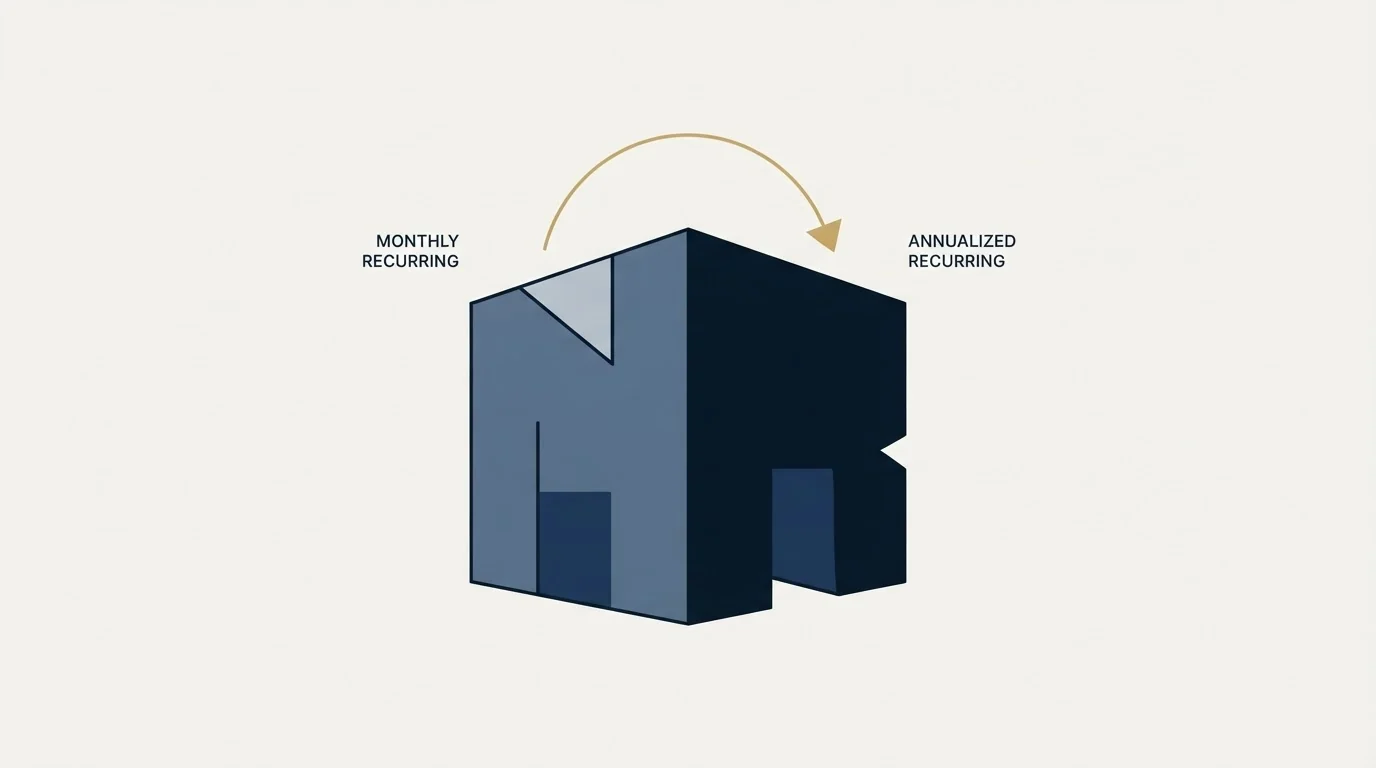
Monthly recurring revenue is the same measurement expressed monthly, and the two are related by a factor of twelve and nothing else. Which one a company reports is mostly a function of how it sells: annual contracts make ARR the natural unit, month-to-month subscriptions make MRR the natural unit.
The choice has one real consequence, which is resolution. MRR moves visibly month to month, so a change in the trend is legible within a quarter. ARR quoted quarterly smooths the same movement into something that looks steady until it does not. Businesses with short customer lives are usually better served by the monthly view, and the reason is simply that they need to see a problem sooner.
How the number moves
An ARR figure at two dates tells you very little. The useful artifact is the bridge between them, which decomposes the change into four components, each of which is a different job in the business.
New. ARR from customers who were not there at the start. Sales and marketing produced this.
Expansion. Additional ARR from customers who were already there: more seats, more usage, an additional product, a price increase. Account management and product produced this.
Contraction. ARR lost from customers who stayed but reduced. Usually a value or a pricing problem rather than a relationship one.
Churned. ARR lost from customers who left entirely.
Produced by acquisition
Seats, usage, products, price
A value problem, not a relationship one
The component that compounds
The bridge is worth building because the four components respond to completely different interventions, and a headline growth figure hides which one is the constraint. Two companies both adding 800,000 of ARR in a year look identical until you see that one did it with 900,000 new against 100,000 lost, and the other with 1,600,000 new against 800,000 lost. The second is running twice the acquisition effort for the same result, and the fix is not in the sales team.
That decomposition is also the point at which ARR stops being a vanity figure and becomes an operating one. Read alone it is a size. Read as a bridge it is a diagnosis.
The bridge is also the only view that makes the growth target arithmetic honest. A business that wants to add 2 million of ARR next year, and that lost 600,000 to churn and contraction this year, needs 2.6 million of new and expansion before the target is reached, and if expansion is worth 700,000 of that then the genuinely new number is 1.9 million. That is a different sales plan from the one implied by the headline. Teams that set the acquisition target from the growth target alone are the ones that discover the gap in the third quarter, when there is no longer time to close it.
Related terms
Net revenue retention explains where an ARR figure moved from. Churn rate sets the drag against it. And a sales cycle determines how far ahead of a target the pipeline has to be built to reach it.
The short version

ARR is contracted, repeating revenue, annualised, measured at a point in time. It excludes anything that happens once, it has no accounting definition, and it is only as trustworthy as the exclusions behind it. Read it as a snapshot, ask what is in it, and never read it alone.
If you are using company revenue to decide who to contact, the list is usually the constraint rather than the message: we will build one and show you the reasoning.
Frequently asked questions.
Frequently asked questions- What is the difference between ARR and revenue?
- Recognised revenue is a period total describing what was actually earned, including one-time work. ARR is a point-in-time snapshot of what is contracted to repeat. A company can have high revenue in a year from implementation projects and low ARR, and the two numbers answer different questions for different audiences.
- Does ARR include setup and onboarding fees?
- No. Implementation, onboarding, training, professional services and hardware sales all arrive once and do not repeat without somebody selling them again. Including them converts a subscription number into a sales number and makes the business look more durable than it is, which is the most common way an ARR figure is inflated.
- Is ARR just MRR multiplied by twelve?
- Arithmetically yes, and the choice between them is about resolution. Monthly recurring revenue moves visibly month to month, so a change in trend is legible within a quarter. ARR quoted quarterly smooths the same movement. Businesses with short customer lives are usually better served by the monthly view.
- Can a company without subscriptions report ARR?
- Many do, and it usually means last month multiplied by twelve. That is a run rate rather than contracted recurring revenue, and it carries none of the commitment the term implies. When you see an ARR claim in an announcement, the practical question is which of the two things it means.