Demand Generation: Creating the Interest That Outbound Later Harvests
Demand generation is the marketing work that creates awareness and interest in a category among people who are not yet shopping for it. Lead generation and outbound capture interest that already exists. The distinction decides the channels, the time to first pipeline, and how honestly the results can be attributed.
Key takeaways
- Demand generation grows the pool of people who could become buyers; lead generation and outbound convert the ones already in it.
- First pipeline from a demand programme arrives over one to two quarters, so cancelling at month three ends it before its own mechanism could work.
- A demand programme judged on contacts collected converts itself into a lead-capture programme, because gated content produces contacts and ungated content produces awareness.
- The deciding question is whether a prospect who fits your criteria recognises the problem when it is described plainly.
Demand generation is the marketing work that creates awareness and interest in a category among people who are not yet shopping for it. It builds the demand that other activity later captures, which is why its output is measured in market awareness and eventual inbound interest rather than in contacts collected this month.
The term is most useful held against the one it is constantly confused with. Lead generation captures interest that already exists and turns it into a contactable person. Demand generation grows the pool of people who could ever become one. Outbound harvests, demand generation plants, and a field with nothing planted does not benefit from a bigger harvester.
Demand lead generation is a search for the boundary between the two rather than a term of art: demand generation creates awareness of a problem, and lead generation captures the contact details of somebody who has it.
What the work actually consists of
Demand generation is a category of activity rather than a single channel, and the same programme looks different at two companies because the channels are chosen against the audience.
The recurring components are content that answers a question a buyer has before they know a category exists, paid media that puts that content in front of a defined audience, events and webinars, community and social presence, and analyst or partner activity where the category is unfamiliar enough to need a third party's voice. Account-based programmes sit inside this too, aimed at a named list rather than at a market.
What unites them is the audience state they assume. Every one of these is aimed at somebody who is not currently evaluating anything, and that assumption is what sets the measurement problem, the time horizon and the failure modes described below.
- Audience is not shopping and may not know the category
- Content, paid media, events, community, partners
- First pipeline in one to two quarters
- Attribution is genuinely hard and largely modelled
- Fails when the category is already well understood and crowded
- Audience has the problem now, whether or not they have named it
- Cold email, LinkedIn, calls, signal-based outreach
- First conversations in weeks
- Attribution is direct and traceable to a send
- Fails when nobody has heard of the problem yet
Why it matters: the two failures are opposite and both expensive
Buying the wrong one of those two motions costs a quarter or more, and the mistake happens in both directions for different reasons.
Buying outbound when the problem is demand. This is the more common error, because outbound is cheaper, faster and measurable, so it is the easier purchase to justify. If nobody in the market recognises the problem your product solves, a well-run outbound programme reaches the right companies and gets polite confusion back. The campaign looks like a targeting failure and the reports offer no way to distinguish it from one.
Buying demand generation when the problem is coverage. A company in a well-understood category with a defined buyer and a short list of target accounts does not have a demand problem. It has a reach problem, and awareness spend on a market of a few thousand companies is an expensive way to talk to people you could contact by name.
The distinguishing question is not about budget. It is whether a prospect who fits your criteria, presented with a clear description of the problem, recognises it as one they have. Where they do, the work is reaching more of them. Where they do not, no amount of reach produces a conversation, and the missing piece is the market's understanding of the category.
Where the textbook definition misleads
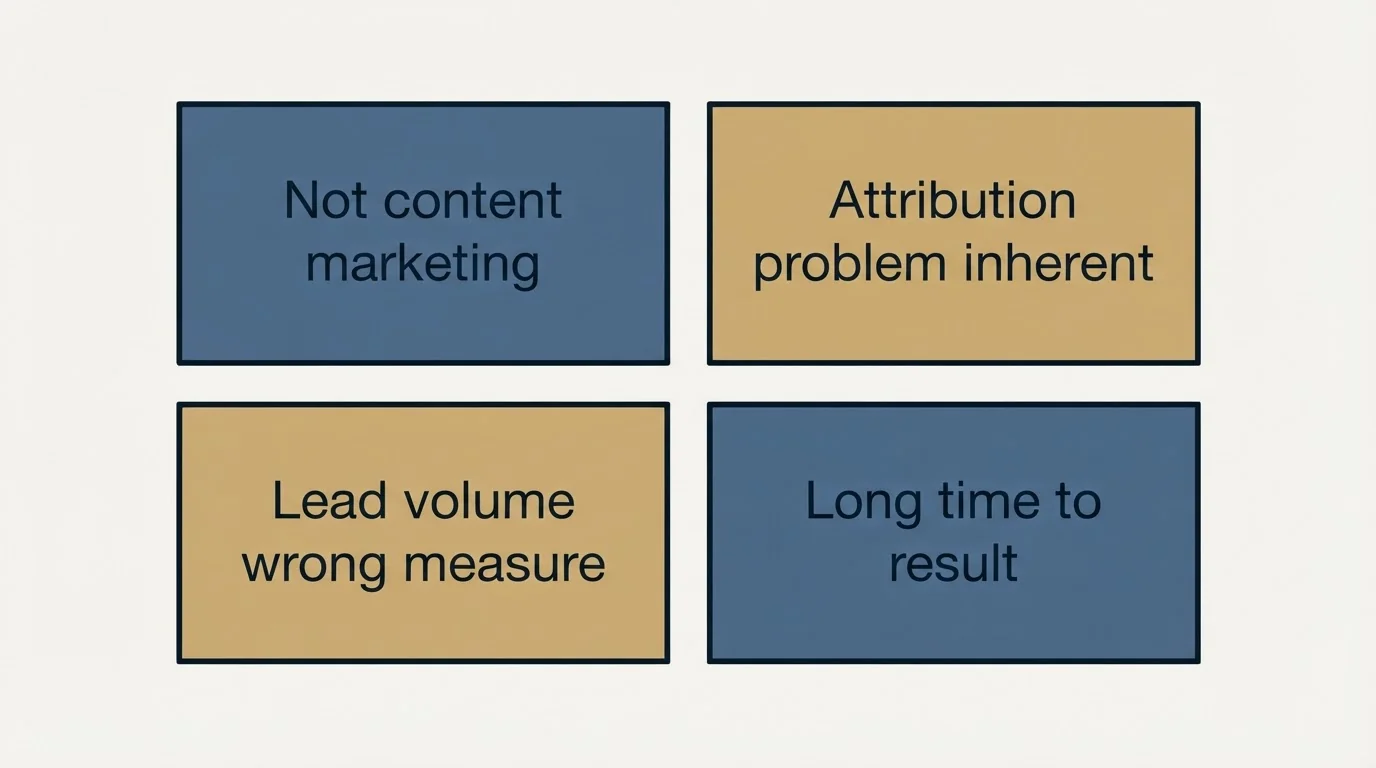
It is not a synonym for content marketing. Content is the most visible component and frequently the whole of what a small programme contains, which is why the two get used interchangeably. Demand generation is the objective; content is one channel serving it, alongside paid, events and community.
The attribution problem is not a reporting failure to be fixed. Awareness work influences a purchase that happens months later through a path nobody recorded, and no attribution model resolves that honestly. Programmes that insist on direct attribution end up optimising the channels that are easiest to measure, which is a systematic bias toward the bottom of the funnel and away from the work demand generation was bought to do.
Volume of leads is the wrong success measure and the usual one. A demand programme judged on contacts collected converts itself into a lead-capture programme within two quarters, because gated content produces contacts and ungated content produces awareness. The team is then running lead generation under the other name and reporting the numbers that made it change.
Time to first result is long and is not a performance problem. One to two quarters is the ordinary shape. A programme cancelled at month three for underperformance was cancelled before its own mechanism could have worked, and the cost of that decision is invisible because nothing that would have happened later is recorded anywhere.
Measuring it without pretending

The measurement question is where most demand programmes are won or quietly lost, and the honest position is that the primary effect is not directly attributable and the programme still has to be accountable for something.
Where the marketing function is held accountable for pipeline and closed revenue rather than for leads, that arrangement is revenue marketing, and the long-payback work described here is the first thing it tends to defund.
Three families of measure are available and each answers a different question. Reach and awareness measures, such as audience growth in a defined segment, share of search demand for the category, or unprompted mentions, describe whether more of the right people know the problem exists. Engagement depth measures, such as returning visitors from target accounts or attendance at events by named companies, describe whether the interest is concentrating where you want it. Downstream measures, such as the volume and quality of inbound over a rolling quarter, describe the eventual output at a lag long enough that no single campaign can be credited with it.
The trap is choosing only the third family because it is the one finance recognises, then attributing it to whichever touch happened last. Last-touch attribution on a motion whose whole purpose is early influence reliably credits the bottom of the funnel and defunds the top, and the effect compounds every planning cycle. A defensible programme states which family each of its numbers belongs to, keeps a segment it deliberately does not spend against as a comparison where that is possible, and reports the lag rather than hiding it.
How it is used in outbound
Demand generation and outbound are usually described as alternatives, and treating them as sequential is more useful.
The practical relationship is that demand work changes what an outbound message has to do. Writing to somebody who already recognises the problem lets the message be specific and short, because the premise is shared. Writing to somebody who has never framed their situation as a problem means the message has to establish the category and the problem and the fit, in an email, which is a heavy load for a first touch.
That is why the two are strongest at different points in a company's life rather than at different points in a budget. Early, with an unfamiliar category, awareness work is what makes the outbound message writeable at all. Later, with a category buyers understand, outbound is the efficient way to reach the part of the market that is not currently searching.
- Step 1Establish the category
Demand work makes the problem legible to people who had not named it, on a horizon of quarters.
- Step 2Define who has it
An ICP written as criteria a stranger could check, rather than as adjectives.
- Step 3Reach them directly
Outbound contacts the companies that fit, on a premise the market can now recognise.
- Step 4Read what came back
Confused replies point at the category, declines point at the offer, silence points at reach.
The reply pattern in that last step is the cheapest instrument either motion has. Replies saying the message did not make sense are a demand finding. Replies engaging with the offer and declining it are an offer finding. Both are worth more than a conversion rate, because each one names which of the two motions to change. Building an ICP with the arithmetic attached is where the criteria come from, and the outbound sales playbook covers writing a message on a premise rather than on a filter, which is the discipline that keeps the two findings separable.
Where the decision is a purchase rather than a plan, the pricing and the honest comparison between the two are in demand generation agency versus cold outbound, and the distinction between a filter and a signal, which is what makes an outbound premise worth writing, is in B2B prospecting.
- Yes: Prospects who fit the criteria do not recognise the problem when it is described plainly
- Yes: The category is new enough that buyers have no vocabulary for it
- Yes: Replies to direct outreach are confused rather than declining
- Yes: The addressable market is large enough that reaching it by name is impractical
- No: Buyers recognise the problem immediately and the constraint is contacting enough of them
- No: The market is a few thousand companies you could name today
- No: Replies engage with the offer and decline it on price or timing
The list is worth running before a budget conversation rather than after one, because the two answers point at different vendors, different timescales and different definitions of a good month. A team that has never asked the question tends to buy whichever motion the last convincing pitch described.
Related terms
An inbound lead is what demand generation eventually produces, at the point somebody raises a hand. Lead scoring and lead nurturing are the instruments applied to those people afterwards. Market segmentation decides which parts of a market a demand programme addresses separately, and positioning statement is the artifact that makes the category legible in the first place. On the capture side, lead qualification decides which of the resulting people is worth a conversation.
The short version
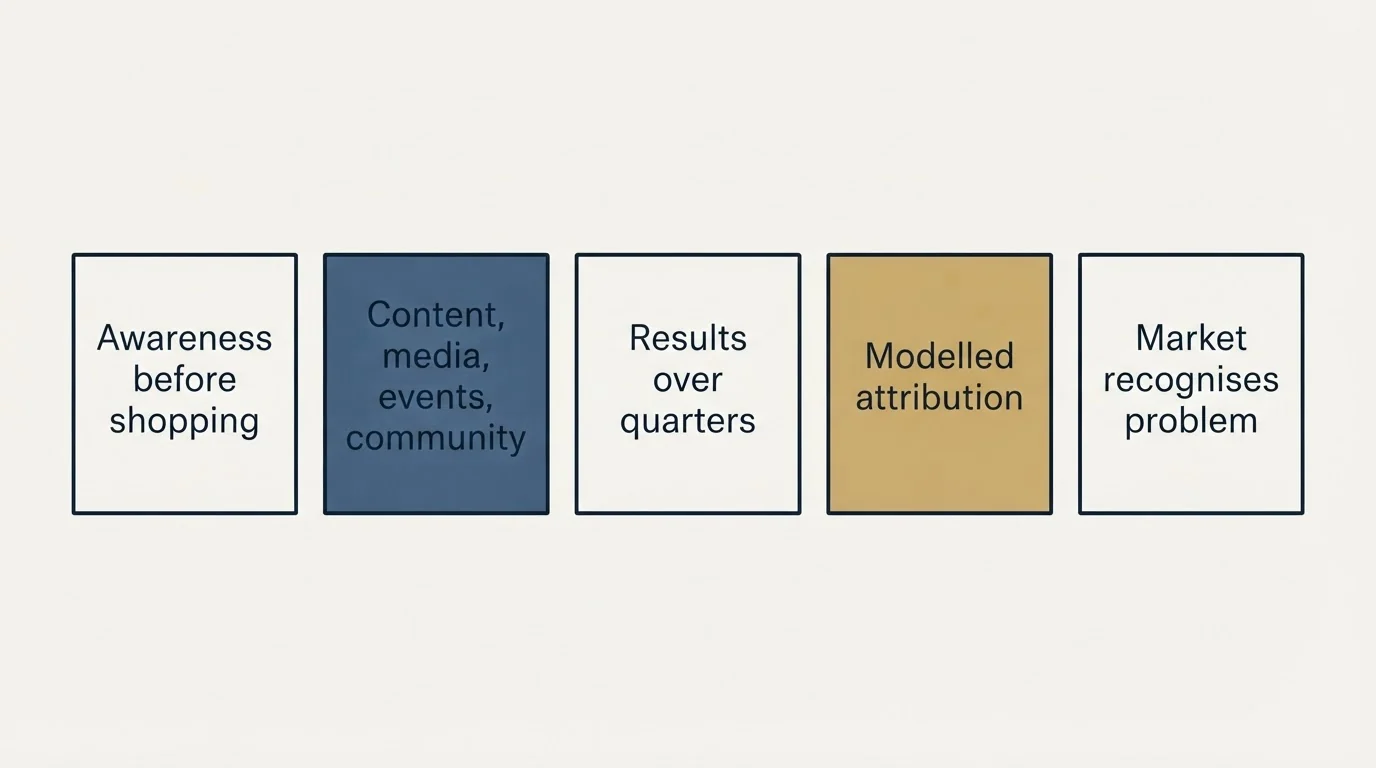
Demand generation creates awareness and interest among people who are not yet shopping, which is a different job from capturing interest that already exists. It runs on content, paid media, events and community, its results arrive over quarters rather than weeks, and its attribution is modelled rather than traced. Judge it on whether the market recognises the problem, not on contacts collected, because a demand programme measured on lead volume turns into a lead-capture programme and stops doing the thing it was bought for. Held next to outbound, the useful question is whether your buyer already recognises the problem, because that answer decides which of the two is the constraint.
RevenueFlow runs the capture half: cold email and LinkedIn outreach to companies that fit criteria agreed in writing before launch. See what a first campaign produces.
Frequently asked questions.
Frequently asked questions- What is the difference between demand generation and lead generation?
- Demand generation creates awareness and interest among people who are not yet shopping. Lead generation captures interest that already exists and turns it into a contactable person. They assume different buyer states, so they use different channels, produce results on different timescales, and fail in opposite conditions. Confusing them is the most expensive mistake in the area.
- How long does demand generation take to produce pipeline?
- Typically one to two quarters before the first attributable pipeline appears, because the work targets people who are not currently evaluating anything. That lag is a property of the mechanism rather than a performance problem, which is why programmes cancelled at month three were ended before the thing they were bought to do could have happened.
- Can you measure demand generation properly?
- Not by direct attribution, and pretending otherwise causes the damage. Awareness work influences a purchase months later along a path nobody recorded, so last-touch models systematically credit the bottom of the funnel and defund the top. Use reach measures, engagement depth within target accounts, and downstream inbound at a stated lag, and say which family each number belongs to.
- Do we need demand generation if outbound is working?
- Probably not as the priority. Outbound working means buyers recognise the problem when you describe it, which is the condition demand work exists to create. The signal that flips the answer is a pattern of replies that are confused rather than declining, because that says the market has no vocabulary for the category rather than no interest in the offer.