Positioning Statement: The Internal Sentence That Has to Survive a Cold Email
A positioning statement is a short internal sentence that fixes who a product is for, what category it belongs to, what it does better than the realistic alternative, and why that claim is believable. It is written for the people who build and sell the product rather than for customers, and it settles messaging arguments.
Key takeaways
- It is internal: a tagline is written for buyers, a mission statement explains why the company exists, and neither is a positioning statement.
- If a plausible competitor could copy the sentence word for word, it is describing a category rather than a position.
- The realistic alternative is usually inertia, a spreadsheet or an existing hire, not the three vendors you would name.
- A statement that has never rejected a piece of copy or a campaign idea is too broad to be doing its job.
Positioning Statement: The Internal Sentence That Has to Survive a Cold Email
A positioning statement is a short internal sentence that fixes who a product is for, what category it belongs to, what it does better than the alternative, and why that claim is believable. It is written for the people who build and sell the thing rather than for customers, and its job is to make everyone downstream say a consistent thing without being told what words to use.
It is not a tagline, it is not a mission statement, and it is not copy. A tagline is written to be read by buyers. A mission statement explains why the company exists. A positioning statement is a decision about where you are competing and against what, written down so that arguments about messaging can be settled by pointing at it.
A positioning strategy is the set of choices this sentence records, and the sentence is where the disagreement inside those choices becomes visible.
Product positioning is the same decision applied to one product rather than to the company, and it uses this sentence with the product in the subject position.
Service businesses hit this hardest, because service positioning has no product spec to point at: the statement has to name the situation you are hired into and the alternative the buyer would otherwise use.
A positioning strategy example almost always turns out to be a positioning statement plus the segment it was written for, which is why the sentence below is the part worth copying.
Marketing positioning and sales positioning are the same sentence read by two audiences.
A positioning statement in marketing is this same internal sentence, and the brand positioning statement that most published examples show is the outward claim it produced rather than the statement itself.
A market positioning strategy is the outward version of this sentence, and the examples that circulate as positioning strategy examples are mostly finished brand claims rather than the internal sentence that produced them.
The shape most versions share
The classic form fills four blanks, and it has survived because each blank forces a decision somebody would otherwise avoid.
For [a specific audience] who [have a specific problem], [product] is a [category] that [delivers a specific benefit]. Unlike [the realistic alternative], it [the differentiator].
Read that structure as four questions rather than as a template to be filled in prettily.
Who, exactly. Not "growing businesses". A description narrow enough that you could build a list from it, which is the same test an ideal customer profile has to pass.
What category. The mental shelf the buyer will file you on. Choosing an existing category means competing on that category's criteria. Claiming a new one means teaching the market what the criteria should be, which is expensive and occasionally correct.
Against what alternative. The honest answer is usually a spreadsheet, an agency, an existing hire, or doing nothing. Naming a competitor when the real alternative is inertia produces a statement that answers a question nobody is asking.
Why believable. The proof that makes the differentiator more than an assertion. This is the blank most statements leave empty, and it is the one that decides whether the sentence survives contact with a sceptical reader.
- Audience, category, differentiator, proof
- Settles messaging arguments
- Changes when the market or the product changes
- Never shown to a customer as written
- The benefit, in the buyer's language
- Appears on the site and in the first message
- Several may exist, one per segment
- Derived from the positioning, not a substitute for it
- Why the organisation exists
- Rarely changes
- Shapes culture and hiring
- Says nothing about competitive choice
What it is actually for

The reason to write one is that it makes disagreement visible early and cheaply.
Ask four people in a company to complete the sentence separately and the results are usually not compatible. One says the buyer is a founder, another says it is an operations lead. One names a competitor, another names the manual process. Those are the arguments that otherwise show up eighteen months later as a website that promises one thing and a sales team that sells another, and as marketing spend aimed at a person the product does not serve. The sentence is a cheap way to run that argument now.
The second use is as a filter. Every piece of copy, every campaign, every feature request can be tested against it: does this reinforce the category and differentiator we chose, or does it quietly move us somewhere else? Statements that never reject anything are not doing this job, which is a useful diagnostic all by itself. If the drafting felt easy and nobody objected, it is probably too broad to reject anything.
Where the textbook definition breaks
It gets written as a formatting exercise. Filling four blanks with agreeable words produces a grammatical sentence containing no decisions: "for growing B2B companies who want more pipeline, [product] is a platform that helps them grow faster, unlike traditional solutions." Every blank is filled and nothing has been chosen. The test is whether a plausible competitor could copy the sentence word for word. If they could, it is describing a category and not a position.
It confuses the alternative with a competitor. Most B2B purchases are decided against inertia. A statement positioned against three named rivals fails on the majority of deals where the buyer is choosing between doing this and doing nothing at all, and the cost of doing nothing is the thing the sentence should be attacking.
It is treated as permanent. Positioning is a claim about a market at a point in time. Products change, categories consolidate, and a differentiator that was rare becomes standard. A statement nobody has revisited in three years is describing a market that has moved.
Internal clarity is mistaken for external clarity. A positioning statement that the whole team agrees on will still fail if the words in it are not words a buyer uses. The category label in particular is often internal vocabulary, and the sharper version of this failure is set out in nobody knows what you're selling.
How one gets written
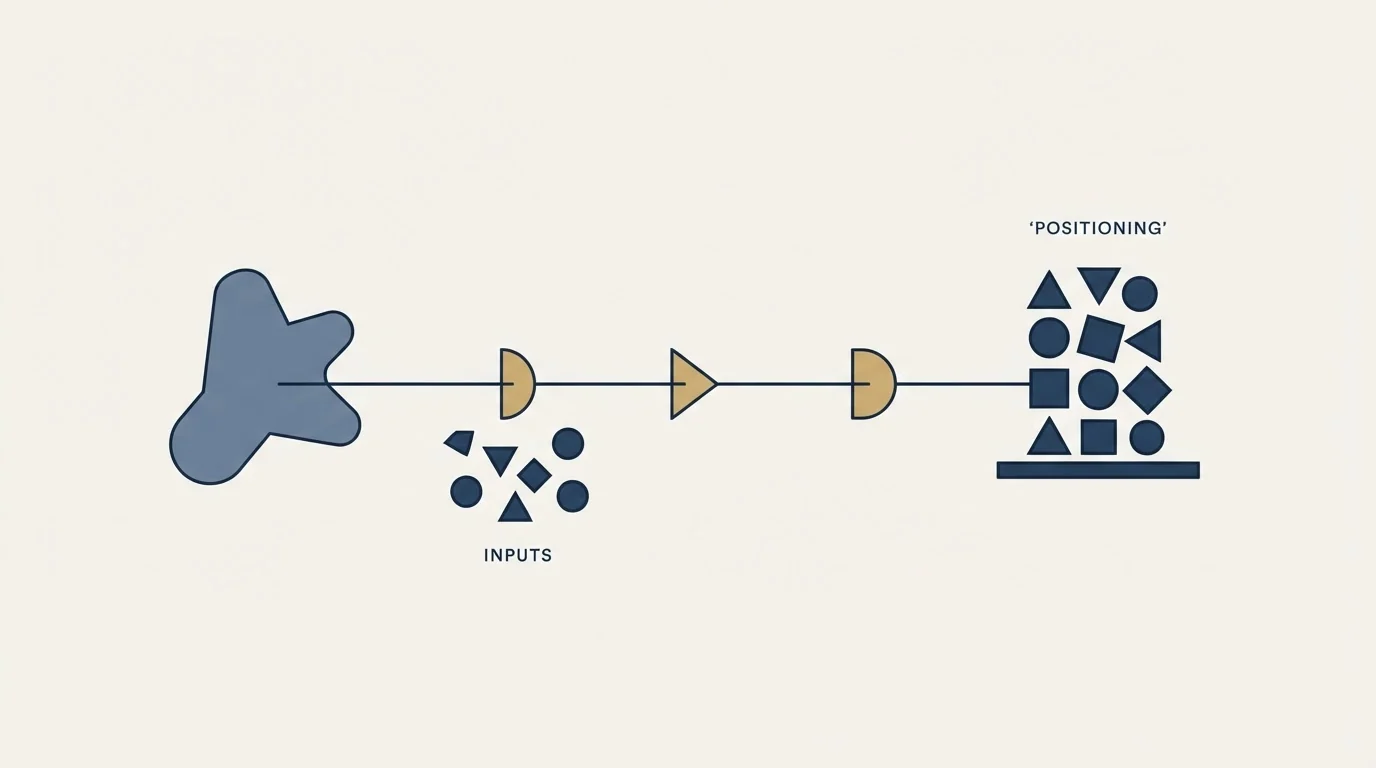
The process matters more than the wording, because the value is in the disagreement it surfaces rather than in the sentence it produces.
Write it separately before writing it together. Four or five people, ten minutes each, no discussion. Collecting the versions first is the entire diagnostic: where they agree you have consensus you did not know about, and where they diverge you have the argument that has been costing you money invisibly.
Do the alternative blank second, not last. Naming what the buyer would do instead of buying from you is the blank that most constrains the others, and teams that leave it until the end tend to write a differentiator that only makes sense against a competitor nobody is actually considering.
Source the audience blank from customers rather than from ambition. The description should fit the customers you have who are worth having, which is a different set from the customers you have. Retention by segment is the honest input here, and it is discussed under net revenue retention.
Make the proof clause checkable. If the differentiator is speed, the proof is a number or a mechanism, not the word "fast". A clause a sceptical reader cannot verify is decoration, and it will be the first thing dropped when the statement is translated into copy.
Get the words from customer language, not from the room. The single most common defect is a category label that everybody inside the company uses and nobody outside it does. Reading twenty recent inbound enquiries and noting the nouns people use is a cheap corrective.
Then stop. A positioning statement is one sentence and a supporting paragraph at most. Documents that run to several pages have stopped being a decision and become a description, and descriptions cannot reject anything, which was the point.
Two people should own the result: someone accountable for the product and someone accountable for revenue. Positioning written entirely by marketing tends to be sayable and unearned; positioning written entirely by product tends to be true and unsellable.
The test that actually matters: put it in a cold email
Internal documents are hard to falsify, because everyone reading them already knows the context. The fastest honest test of a positioning statement is to translate it into one message to a stranger who has never heard of you, and see whether anything remains.
Three things happen when you try, and each one is diagnostic.
The audience blank gets tested first. If you cannot build a list of a few hundred companies matching the description, the audience is a feeling rather than a segment.
The category label gets tested by silence. A message that names a category the recipient does not use themselves reads as being about somebody else's problem, and it is ignored without a reply that tells you why.
The differentiator gets tested hardest. In one message you have a sentence, so a differentiator that needs a demo to explain does not survive, and one that a competitor could also claim earns nothing. What survives is a specific, checkable statement about the reader's situation.
A positioning statement that produces replies from strangers has passed a test no internal review can run. One that produces nothing has told you where the vagueness is, at the price of a few hundred messages. Working versions of that translation are collected in value proposition email templates, and the honest reading of what short messages can carry is in why short cold emails get more replies.
That is the practical route to improving outbound messaging and positioning together, because the message is where a positioning claim is tested by somebody with no reason to be generous about it.
Messaging versus positioning is the same split one layer out, because positioning is the decision this sentence records and it should hold until the market moves, while messaging is what you say this quarter to make that decision land with one audience and it is expected to change.
- Depends: A competitor could not copy it word for word and have it still be true
- Depends: You could build a list of companies from the audience description
- Depends: The alternative named is the one buyers actually weigh you against
- Depends: The category label uses words your buyers say out loud
- Depends: The proof clause names something checkable rather than an adjective
- Depends: It has rejected at least one piece of proposed copy or one campaign idea
Related terms
Market segmentation is the work that produces the audience blank. Serviceable addressable market sizes it once it is chosen. And product-led growth changes what the differentiator has to do, because the product has to carry the claim without a seller present.
The short version

A positioning statement names the audience, the category, the differentiator and the proof, in one sentence, for internal use. Write it to make disagreement visible, keep it narrow enough to reject things, aim it at the alternative buyers actually consider, and revisit it when the market moves. Then test it on people who owe you no attention.
That last test is the one we run for a living: one campaign against a real list, and what came back.
Frequently asked questions.
Frequently asked questions- What goes in a positioning statement?
- Four things: a specific audience, the category you are competing in, the differentiator against the realistic alternative, and the proof that makes the differentiator more than an assertion. The proof clause is the one most often left empty, and it is the one that decides whether the sentence survives a sceptical reader.
- How is a positioning statement different from a value proposition?
- A positioning statement is internal and singular: one decision about where you compete and against what. A value proposition is customer-facing and there may be several, one per segment, written in the buyer's language. The value propositions are derived from the positioning rather than being a substitute for it.
- How do you know if a positioning statement is any good?
- Try to build a list of companies from the audience description, check that a competitor could not truthfully copy the sentence, and confirm that the category label uses words your buyers say out loud. Then check whether it has ever caused you to reject a piece of proposed copy.
- How often should positioning be revisited?
- Whenever the product, the market or the competitive set moves, which for most B2B companies is more often than they revisit it. A differentiator that was rare becomes standard, and categories consolidate. A statement nobody has looked at in three years is describing a market that has moved on.