Nobody Knows What You're Selling: Clear Value Wins
I reviewed a cold email with a six-figure offer where the prospect had no idea what they were being offered. Industry jargon might sound impressive, but if your prospect needs to Google what you're selling, you've already lost them.
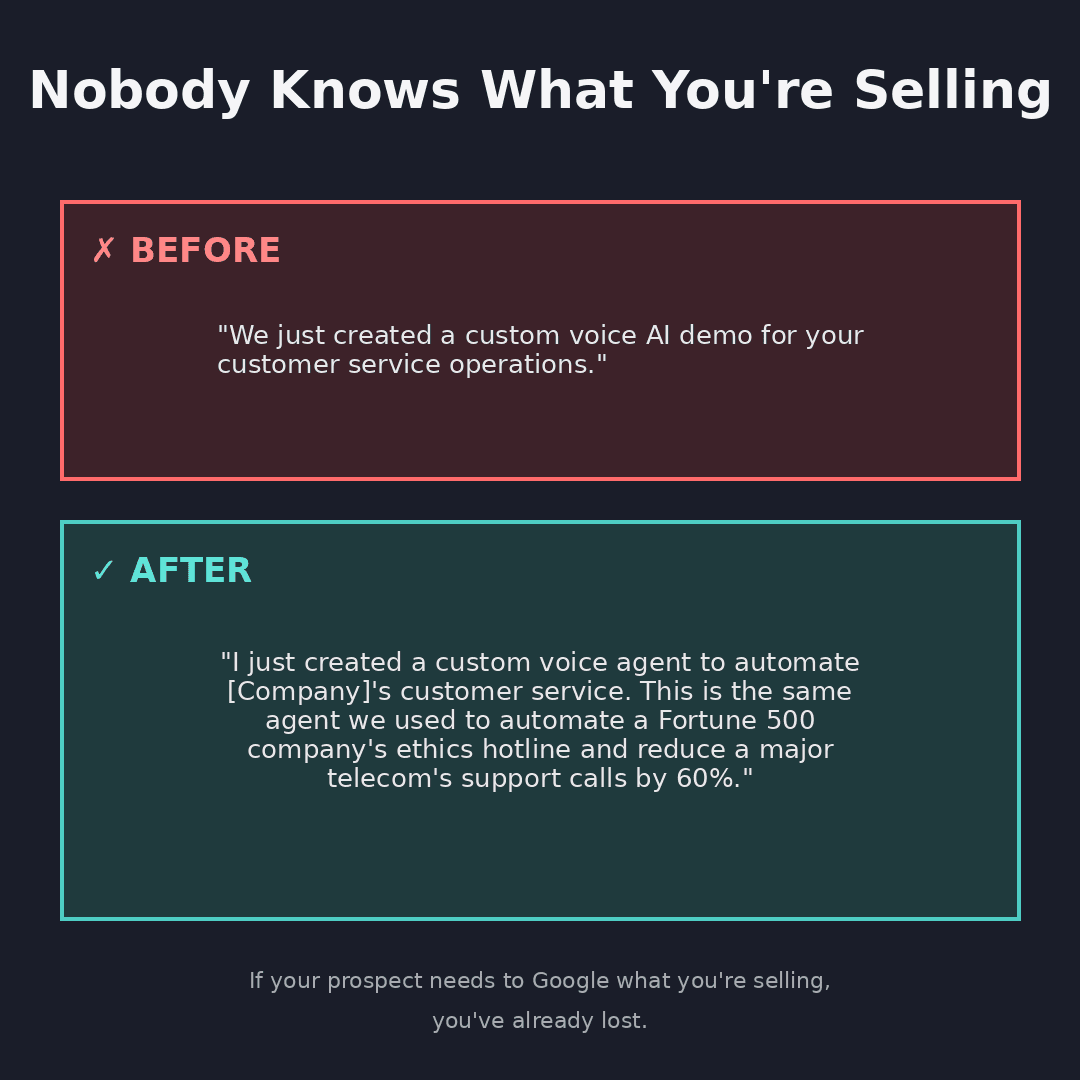
Clear value propositions explain what your product does, what problem it solves, and what outcome the prospect gets, without jargon. Replace terms like "voice AI demo" with "voice agent to automate customer service" and include specific benefits like "reduce support calls by 60%." If a 12-year-old couldn't explain your offer or a prospect needs to Google your terminology, you've already lost them.
Key takeaways
- The moment a prospect stops to decode jargon is when you lose them to the next email that requires less mental effort.
- Apple's "1,000 songs in your pocket" and Slack's "Be less busy" demonstrate that winning companies make value easy to understand, not impressive-sounding.
- Replacing "voice AI demo" with "voice agent to automate customer service" and adding "reduce support calls by 60%" transformed a confusing six-figure offer into a compelling one.
- Clear value propositions state what the product is, what problem it solves, and what measurable outcome the prospect gets, all without buzzwords.
Reviewed and updated September 1, 2026
Nobody Knows What You're Selling: Why Clear Value Propositions Win
I just reviewed a cold email that had a six-figure offer.
The prospect had no idea what they were being offered.
The email said: "We just created a custom voice AI demo for your customer service operations."
Sounds technical. Sounds impressive. Sounds like the kind of language that proves you know what you're talking about.
But here's the problem: Nobody knows what "voice AI demo" means.
The Jargon Trap
Your prospect shouldn't need a translator to understand your offer.
Most people think using industry jargon makes them sound credible. It doesn't. It makes you sound like everyone else who's confused about why prospects aren't responding.
The founder who sent this email had built something genuinely valuable. They had real case studies with Fortune 500 companies. They had a compelling offer worth six figures. But they buried it under language that required mental processing.
When someone reads "voice AI demo," they have to stop and think: What does that mean? Is it a demonstration? Is it a product? What does it actually do for me?
That moment of confusion is where you lose them. Because the next email in their inbox doesn't require them to work this hard.
The Translation That Changed Everything
We made three changes to transform this cold email from confusing to compelling.
- Yes: Replaced 'voice AI demo' with 'voice agent to automate your customer service'
- Yes: Added the specific benefit right in the offer line
- Yes: Made the credibility line flow naturally from the offer
First, we replaced "voice AI demo" with "voice agent to automate your customer service." One tells you what the technology is called. The other tells you what it does and what problem it solves. The prospect doesn't need to decode anything. They instantly understand the value.
Second, we added the specific benefit right in the offer line. Not buried in paragraph three. Not implied. Right upfront where it matters most.
Third, we made the credibility line flow naturally from the offer. Instead of throwing around vague terms like "AI-powered" or "next-generation," we showed exactly what this technology had accomplished for other companies.
The new version read: "I just created a custom voice agent to automate [Company]'s customer service operations. This is the same agent we used to automate a Fortune 500 company's ethics hotline and reduce a major telecom's support calls by 60%."
Same offer. Same technology. Same founder. But 10x more clear.
The 12-Year-Old Test
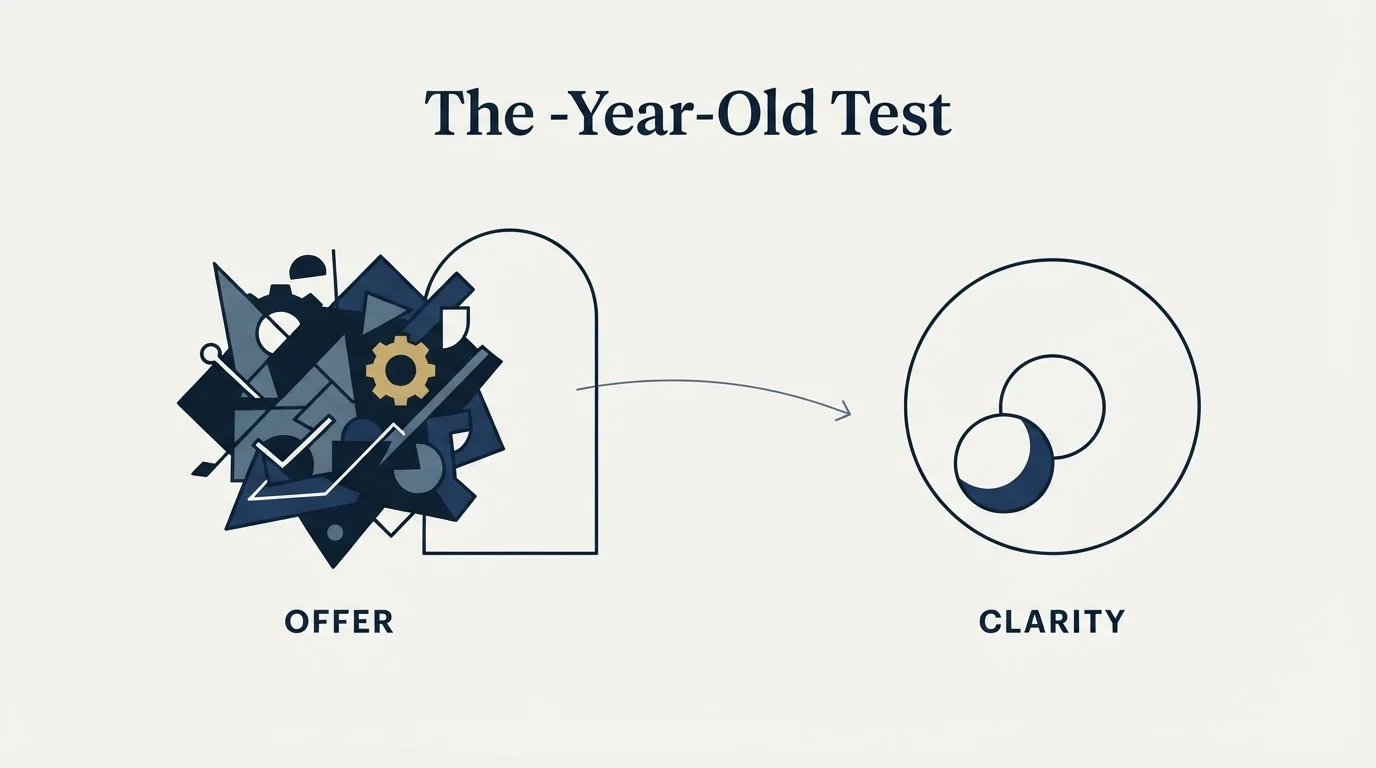
Your offer should be so clear that a 12-year-old could explain what you do and why someone should care.
That's not dumbing it down. That's removing the cognitive load that kills conversions.
That is what people are asking for when they say they want a value proposition that is clear and direct: not shorter, but readable without translation, so the reader knows what happens and what changes for them before deciding whether to care.
Think about the best marketing you've ever seen. Apple doesn't say "portable digital audio compression device with capacitive touch interface." They say "1,000 songs in your pocket." Slack didn't say "cloud-based asynchronous communication platform." They said "Be less busy."
The companies that win aren't the ones who sound the smartest. They're the ones who make it easiest to understand the value.
(This principle is fundamental to cold email success. Understanding the hierarchy of effective cold emailing shows you that clarity in your offer matters more than perfect targeting or personalization.)
Why Smart People Use Dumb Jargon
I know why this happens. I've done it myself.
When you're deep in your industry, the jargon becomes your default language. You talk to other experts who use the same terms. You read industry publications that assume everyone knows what "AI-powered customer engagement platform" means. You go to conferences where everyone nods along when someone mentions "conversational AI interfaces."
You forget that your prospect isn't living in your world. They're living in theirs. And in their world, they need to know: What problem does this solve? How much time does it save? How much money does it make or save?
The jargon feels safer too. It feels more credible. If you use simple language, you worry people might think you're not sophisticated enough to understand the technology.
But the opposite is true. The ability to explain complex things simply is the ultimate proof that you understand them deeply.
What Clarity Actually Looks Like

Clear value propositions share three characteristics.
They tell you what it is without requiring you to Google terms. Not "revenue intelligence platform." Instead, "software that records your sales calls and tells you what's working."
They tell you what problem it solves in concrete terms. Not "optimize your go-to-market motion." Instead, "book more meetings with qualified prospects."
They tell you what outcome you get with specific numbers where possible. Not "improve efficiency." Instead, "reduce support calls by 60%."
Notice what's missing: buzzwords, jargon, impressive-sounding but meaningless phrases.
- revenue intelligence platform
- optimize your go-to-market motion
- improve efficiency
- software that records your sales calls and tells you what's working
- book more meetings with qualified prospects
- reduce support calls by 60%
When you write your cold email, your LinkedIn outreach, or your website copy, ask yourself: Would my prospect need to Google any of this to understand what I'm offering?
If the answer is yes, rewrite it.
The Cost of Confusion
Every time you make your prospect work to understand your value, you lose a percentage of them.
Some will Google your terms and figure it out. Most won't. They'll just move on to the next email from someone who made their life easier.
This isn't about prospect intelligence. Smart people don't want to decode your jargon. They want to quickly evaluate whether your offer solves a problem they have. If you make that evaluation difficult, they'll skip you.
The irony is that the founders and sales teams who use the most jargon are often selling the most valuable products. They have real results. They have happy customers. They have case studies proving their solution works.
But they wrap it all in language that obscures the value instead of highlighting it.
Stop selling ice to eskimos by talking about "frozen water temperature optimization systems." Tell them you'll save them three hours a week on ice harvesting. That's what clarity looks like.
How to Fix Your Value Proposition Today
Open your most recent cold email or outreach message. Read the first sentence where you describe what you do.
Would someone outside your industry instantly understand what you're offering and why they should care? Or would they need to pause and think about what your words mean?
If it's the latter, rewrite it using this framework:
"I [action] to [result] for [who]. This is the same [thing] we used to [specific outcome with numbers] for [credible company or situation]."
Remove every word that requires specialized knowledge. Replace industry terms with plain language that describes what actually happens. Add specific outcomes with numbers where possible.
Then read it again. If you can't immediately picture what happens and what benefit someone gets, it's still not clear enough.
The Rule That Changes Everything
If your prospect needs to Google what you're selling, you've already lost them.
That's it. That's the whole test.
Your technology might be sophisticated. Your solution might be innovative. Your approach might be revolutionary. But if you can't explain it in terms that require zero translation, none of that matters.
The best cold emails don't make prospects think. They make prospects care.
Because when someone immediately understands what you do and why it matters to them, they don't hit delete. They hit reply.
Related Reading
Are you making your prospects work too hard to understand what you're offering? At RevenueFlow, we help B2B companies craft cold email campaigns with crystal-clear value propositions that convert. → See if you qualify for a free campaign
Frequently asked questions.
Frequently asked questions- Why do smart founders use jargon in their cold emails?
- Founders default to jargon because they're immersed in industry language used by peers, publications, and conferences. Jargon also feels safer and more credible: they worry simple language makes them appear unsophisticated. The opposite is true: explaining complex solutions simply proves deep understanding and makes prospects' evaluation easier.
- What is the 12-year-old test for value propositions?
- Your offer should be clear enough that a 12-year-old could explain what you do and why someone should care. This doesn't dumb down your message: it removes cognitive load that kills conversions. If your prospect needs mental processing to understand terms like "voice AI demo," you've made their evaluation too difficult and they'll move to the next email.
- How do I know if my value proposition is too confusing?
- Ask whether your prospect would need to Google any terms to understand your offer. If yes, rewrite it. Check if you're telling them what it is (without requiring translation), what problem it solves in concrete terms, and what specific outcome they get. Terms like "revenue intelligence platform" should become "software that records sales calls and tells you what's working."
- What should I replace jargon with in my cold emails?
- Replace technical terms with plain descriptions of what your product does and what problem it solves. Instead of "voice AI demo," use "voice agent to automate customer service." Add specific benefits immediately: "reduce support calls by 60%" rather than vague phrases like "optimize efficiency." Make credibility flow naturally by showing what you've accomplished for other companies, not by using buzzwords like "AI-powered" or "next-generation."
About the author.

Ben Carden is CRO at RevenueFlow, which builds and operates outbound revenue engines for B2B companies. Previously at Gartner Enterprise. Studied at London School of Economics.
Ben Carden · CRO
Connect on LinkedIn →Explore more.
Ready to scale your outreach?
We build GTM engines that book real meetings. See the receipts.
Related articles.
Cold Email Frameworks: Which One Fits Your Offer
AIDA, PAS and Before-After-Bridge arrange the same four elements in different orders. What each one assumes about the reader, and what none of them fix.
Can Buyers Tell an Email Was Written by AI?
Buyers are not running a classifier on your cold email. What they react to is a message containing nothing only somebody who looked could have written.
CAN-SPAM Act Compliance for B2B Cold Email: The Rules
The CAN-SPAM Act makes no exception for business-to-business email. Here are the seven requirements, the opt-out clocks, and where liability lands when an agency sends.
How to Write a New Year Outreach Email, Line by Line
A new year outreach email works only where January is a fact about the account. Who that is, the structure line by line, and two worked examples.
How to Write a Third Follow Up Email, Line by Line
A third follow up email belongs only in a thread where the person replied or agreed to something. When to send one, and how to write it line by line.
BASHO Email: Four Sentences Built on One Insight
A BASHO email is four or five sentences built on one researched insight about a specific person. The format is documented, and it cannot be produced at volume.