Can Buyers Tell an Email Was Written by AI?
Buyers are not running a classifier on your cold email. What they react to is a message containing nothing only somebody who looked could have written.
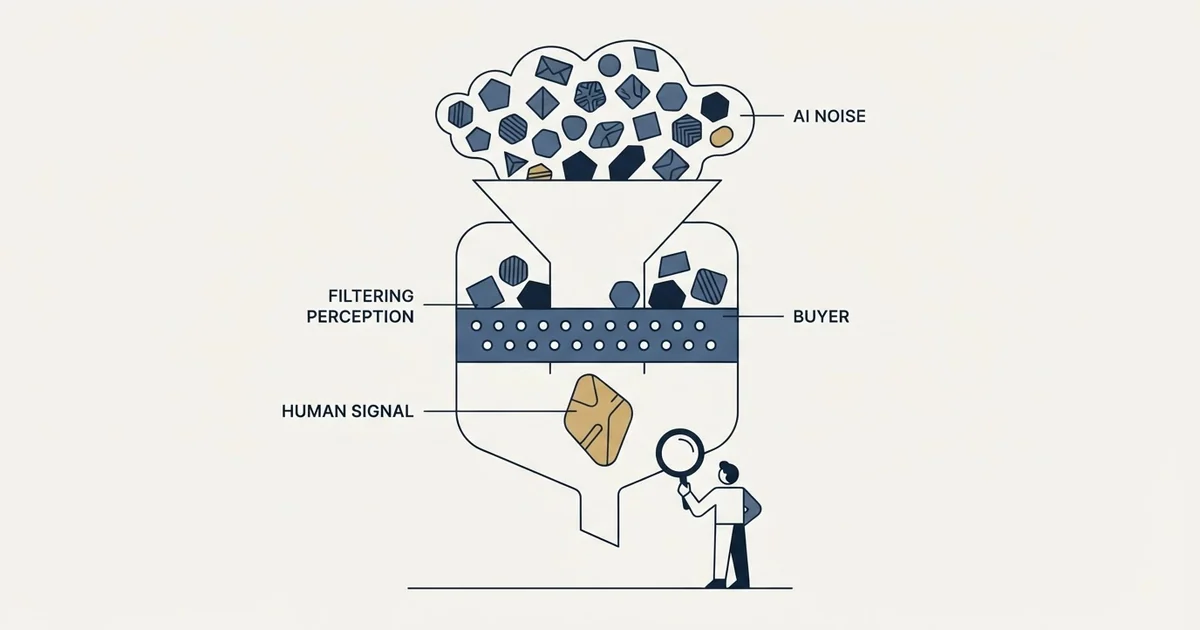
Buyers cannot reliably detect machine written text in a short email and are not attempting to. They react to empty personalisation, praise as an opener, tidy structure and a formal register attached to a small ask, all of which human written templates share. The costly failure is a confident wrong fact delivered at volume.
Key takeaways
- A hundred and twenty word email carries too little text for any statistical detector, so the reader is recognising a genre rather than an author.
- Almost every property readers name as an AI tell is shared by human written templates, which is why the detection framing misdirects the fix.
- The damaging failure is a confident wrong claim about the recipient, because it reaches the one person best placed to know it is wrong.
- Generated copy needs a gate template copy does not, since a bad generation is bad on an unknown subset of rows that nobody reads.
Reviewed and updated September 2, 2026
Can Buyers Tell an Email Was Written by AI, and What Do They Actually Notice
A prospect forwards a cold email to a colleague with two words on top: "obviously AI". The email was, in fact, written by a person. Another prospect in the same week replies to a message a model drafted in full, asks a sensible question, and books a call. Both outcomes are common, and together they say something the anxiety about detection usually misses. Buyers are not running a classifier. They are reacting to a set of properties that correlate loosely with generated text and much more tightly with laziness.
The worry itself is worth taking seriously, because it now shapes what teams send. It is also worth pointing at the right thing, since almost every practical decision that follows from "they can tell" is a decision about specificity rather than about authorship.
What detection would actually mean
Detecting machine written text is a hard problem on long documents and an unsolvable one on a hundred and twenty words. The academic detectors that people have in mind are trained on essays and abstracts, where there is enough text for statistical regularities to accumulate. A short business email carries almost none of that signal, and the shapes a detector would key on are the same shapes a competent human writer uses when writing briefly and formally.
That is why nobody in a prospect's seat is running a tool. What they are doing is recognising a genre. A message that opens by naming their industry, states a benefit, and closes with a request for fifteen minutes reads as a category of message rather than as a message, and the reader files it accordingly. It would read that way if a person had typed it, and for years before models could write it, people did.
The practical consequence is that "can they tell it was AI" is not the question with an answer attached. The question with an answer attached is whether the message contains anything only somebody who looked could have written.
The properties that read as generated
The properties that make a message read as generated cluster into a handful. None of them is a property of the model.
Specificity that is not specific. A sentence that references the company by name and then says something true of every company in the sector. "I saw you are scaling your go to market" is a personalisation slot with nothing in it.
Praise as an opener. Compliments about growth, culture or a recent post arrive constantly and cost nothing to write, so they carry no information about whether the sender looked.
A fact that is wrong. This is the one that does real damage, and it is the failure that arrives specifically with generation at volume. A model asked about a company it half recognises will produce a confident and frequently incorrect description, and the person who receives it is the person best placed to know it is incorrect.
Register that does not match the ask. Formal, balanced, slightly elevated prose attached to a request for a first conversation reads as effortful in the wrong direction.
Structural tells. Three tidy paragraphs of similar length, a list where a sentence would do, numbering that survived from the model's output into a merge field, and the long dash a model reaches for where a business writer would use a comma.
- A personalisation slot with nothing specific in it
- An opener that compliments rather than observes
- A stated fact about them that is wrong
- Formal register attached to a small ask
- Structure that is tidier than the message deserves
- Token predictability across many sentences
- Low variance in sentence construction
- Vocabulary distribution over a document
- Needs far more text than an email contains
- Says nothing about whether the message is worth answering
Read the left column again and notice what it is. Every item is a property a human written template shares. The reason generated copy gets accused more often is that generation makes it cheap to produce a great deal of the left column quickly, not that a model leaves a watermark.
The real risk is a wrong fact at volume, not the register
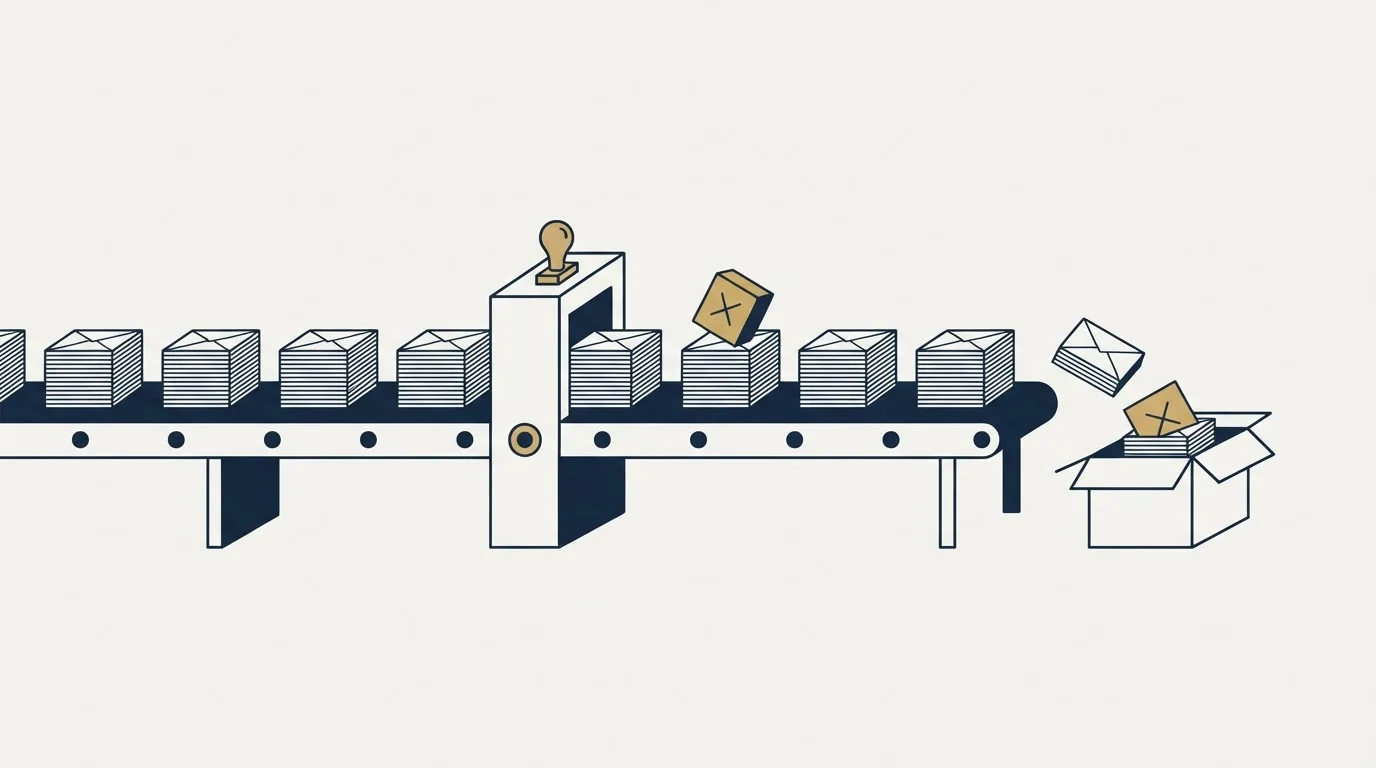
Here is the asymmetry that should govern how a team spends its attention.
A message that reads slightly machine written and contains one true, specific, checkable observation gets answered at some rate. A message that reads beautifully human and asserts something untrue about the recipient's business gets a reply that is worse than silence, from the one person on the list who knows the claim is false. A bland template reaches ten thousand people and is ignored. A generated message that states something wrong reaches ten thousand people and is read by ten thousand people who can check it.
Arrangement is the smaller variable too, and choosing a cold email framework from the offer shows why reordering problem and solution leaves a weak claim untouched.
That failure has a specific mechanism, and it is the input rather than the model. Given nothing, a model writes from the average of everything it has seen, and the average cold email is the one that gets deleted. Given a real fact about the recipient, drawn from a source that was actually fetched, the same model writes something a person might answer. That gap between a grounded output and an ungrounded one is where the attention belongs, and it sits in the input rather than in the choice of model. What a model can and cannot know about a prospect is worked through in AI email copywriters, and which steps of prospecting generation genuinely removes is in AI prospecting.
What our own practice is, stated as policy
RevenueFlow generates outbound copy with language models and runs cold outbound as a service, so this is a disclosure rather than a neutral position. What follows is documented practice rather than a claim about anybody's results.
Generation is grounded rather than open. Before anything is written for a prospect, that company's own pages are fetched, and the model writes from what those pages say rather than from what it recalls about the company. A merge variable is only safe to drop into a message if something verified put it there: names, companies and roles come from a data source, observations come from fetched pages, and nothing comes from the model's memory.
Between generation and sending there is a gate, because generated copy fails differently from template copy. A bad template is bad once and somebody notices in review. A bad generation is bad on an unknown subset of rows, and nobody reads all of them.
A gate is needed because automation fails quietly at particular stages, and where the line sits across seven outbound stages puts segment definition and message construction on that side.
- Yes: Every factual claim traces to a page that was actually fetched
- Yes: The rendered message is read, not the template with placeholders in it
- Yes: An empty variable degrades to a sentence that still reads naturally
- Yes: Numbering and list markers from the model are stripped before merge
- Yes: A sample is read end to end by somebody who knows the market
- No: The template was approved and the rendered messages were assumed to match
- No: A variant nobody read shipped because the batch was large
There is a sampling method that makes the last line tractable rather than exhausting. Sort the batch by the length of the generated content and read both ends. The shortest rows expose the empty and near empty failures, and the longest rows expose the cases where the model over produced and wandered off the evidence. The middle of the distribution is where the acceptable output lives, which is the opposite of how most people sample.
Should you disclose that a model helped
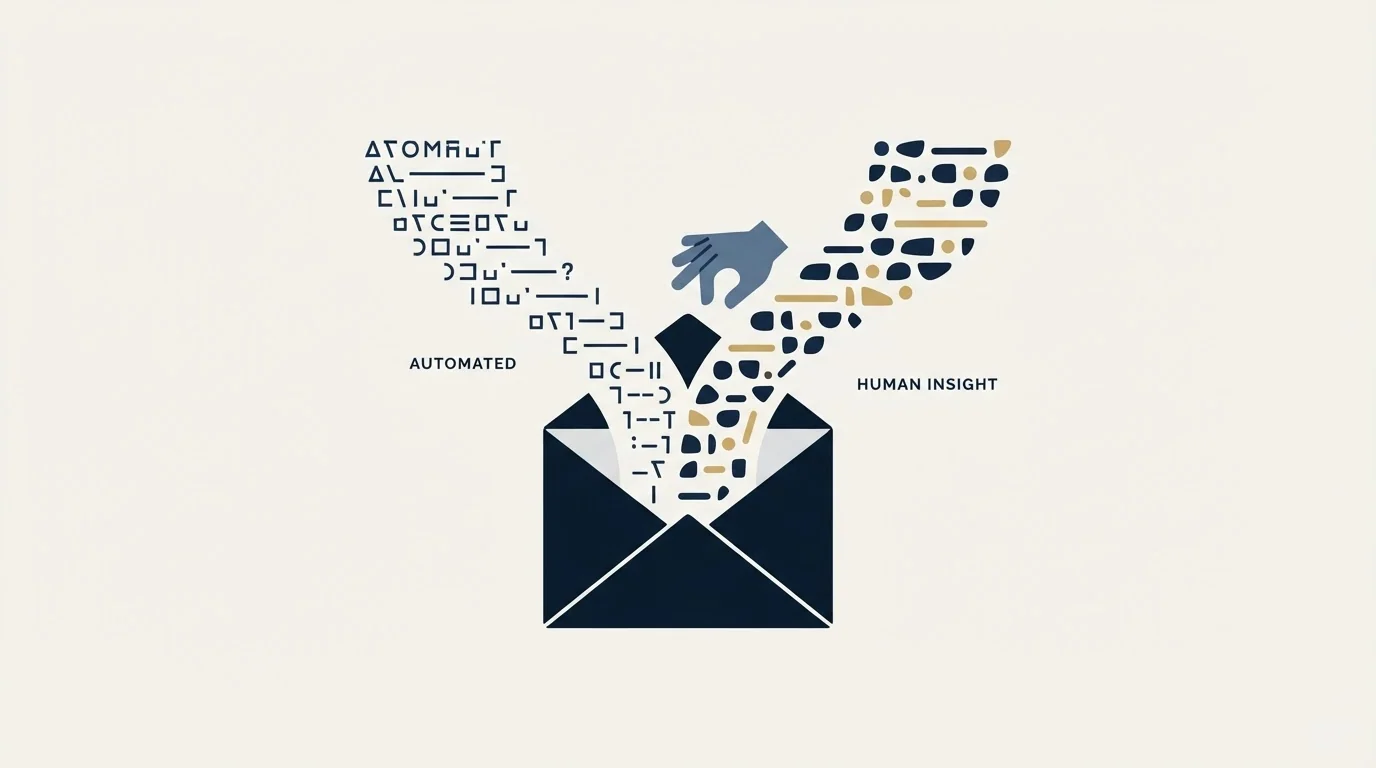
The question comes up and it deserves a straight answer rather than a principle.
Nobody discloses that a message was drafted in a word processor, and a model used as a drafting tool over evidence a person gathered sits in the same place. What changes the answer is autonomy. A message assembled, personalised and sent with no human reading any version of the output is a different artefact, and a recipient who later discovers that has a reasonable complaint about being addressed by a process rather than a person.
The workable line is the one the gate above draws. Where a person supplied the evidence, chose the premise and read the output, disclosure adds nothing. Where none of those is true, the honest response is not a disclosure notice at the bottom of the email. It is to not send it.
What actually moves the number
Three things outrank the authorship question, and each of them is cheaper to fix than a rewrite.
The offer comes first. A message asking for the wrong thing does not improve when the prose does, and the ask is the part a rewrite habitually leaves alone. That argument is made properly in prospects ignore your cold emails and it is rarely the copy.
Selection comes second. A specific message to the wrong population is still the wrong population, and no amount of writing recovers a list built to hit a number. The distinction between choosing who is on the list and choosing how much to send is in quality or quantity in outbound.
Length comes third, and it usually points the opposite way to the personalisation instinct. Shorter messages leave less room for the properties in the left column above, which is one reason they tend to survive the two second read. That trade is examined in why short cold emails get more replies.
Underneath all three sits a constraint that changes what a message has to do. We send one message per campaign, with no bumps and no thread replies, so there is no second attempt to rescue a weak first one. That removes the option of writing something forgettable and following up until it works, and it puts the whole burden on the premise and on the single message that carries it.
The short version

Buyers cannot reliably detect machine written text in a short email, and they are not trying to. What they detect is a message that contains nothing only somebody who looked could have written, and human written templates trigger the same reaction. The properties readers name, empty personalisation slots, praise as an opener, tidy structure and a formal register attached to a small ask, are all properties of laziness rather than of authorship.
The failure that actually costs something is a confident wrong fact delivered at volume, and it is prevented at the input rather than at the prose. Ground the generation in pages that were fetched, keep merge variables tied to verified sources, read the rendered message rather than the template, and sample the ends of the distribution rather than the middle. Then spend the remaining attention on the offer, the list and the length, which outrank the question of who typed it.
If you would rather see grounded copy written against your own market, with the rendered messages shown rather than described, we will build a campaign and show you the list.
Frequently asked questions.
Frequently asked questions- Can a prospect actually detect that an email was written by AI?
- Not reliably. Detectors are trained on long documents where statistical regularities accumulate, and a short business email carries almost none of that signal. What a reader recognises is a genre: an opener naming their industry, a stated benefit and a request for fifteen minutes reads as a category of message whether a person or a model produced it.
- What do buyers say makes a cold email look AI written?
- A personalisation slot with nothing specific in it, a compliment instead of an observation, a stated fact about them that is wrong, formal register attached to a small ask, and structure tidier than the message deserves. Numbering that survived from a model's output into a merge field is the one tell that genuinely indicates generation rather than laziness.
- Should we disclose that AI helped write the message?
- The line is autonomy rather than tooling. Where a person supplied the evidence, chose the premise and read the output, disclosure adds nothing, in the same way nobody discloses a word processor. Where a message was assembled, personalised and sent with no human reading any version of it, the honest response is not a disclosure notice but to not send it.
- How do you stop generated copy stating something untrue?
- Fix the input rather than the prose. Fetch the prospect's own pages and have the model write from what those pages say instead of from what it recalls about the company, and keep merge variables tied to verified sources. Then read rendered messages rather than templates, sampling the shortest and longest rows where the empty and over produced failures live.
About the author.

Ben Carden is CRO at RevenueFlow, which builds and operates outbound revenue engines for B2B companies. Previously at Gartner Enterprise. Studied at London School of Economics.
Ben Carden · CRO
Connect on LinkedIn →Explore more.
Ready to scale your outreach?
We build GTM engines that book real meetings. See the receipts.
Related articles.
BASHO Email: Four Sentences Built on One Insight
A BASHO email is four or five sentences built on one researched insight about a specific person. The format is documented, and it cannot be produced at volume.
Cold Email Frameworks: Which One Fits Your Offer
AIDA, PAS and Before-After-Bridge arrange the same four elements in different orders. What each one assumes about the reader, and what none of them fix.
ABM Personalization at Scale: Automated vs Manual
Retrieval automates well and judgement does not. The three tiers of personalization, what we automate in every build, and the failure modes worth designing against.
What a Cold Email Is, and What Separates It From Spam
A cold email is a first business email to somebody with no prior relationship with you. What that one condition rules in, rules out, and demands technically.
The Cold Email Signature Is an Identity Claim
A recipient who is mildly interested and mildly suspicious checks that you exist before replying. The signature is where that check either resolves or does not.
Cold Email Marketing Service: Four Things, One Name
An agency, an infrastructure provider, a software onboarding tier and a freelancer all use the phrase. What each hands over, and the four questions that tell them apart.