Cold Email Marketing Service: Four Things, One Name
An agency, an infrastructure provider, a software onboarding tier and a freelancer all use the phrase. What each hands over, and the four questions that tell them apart.
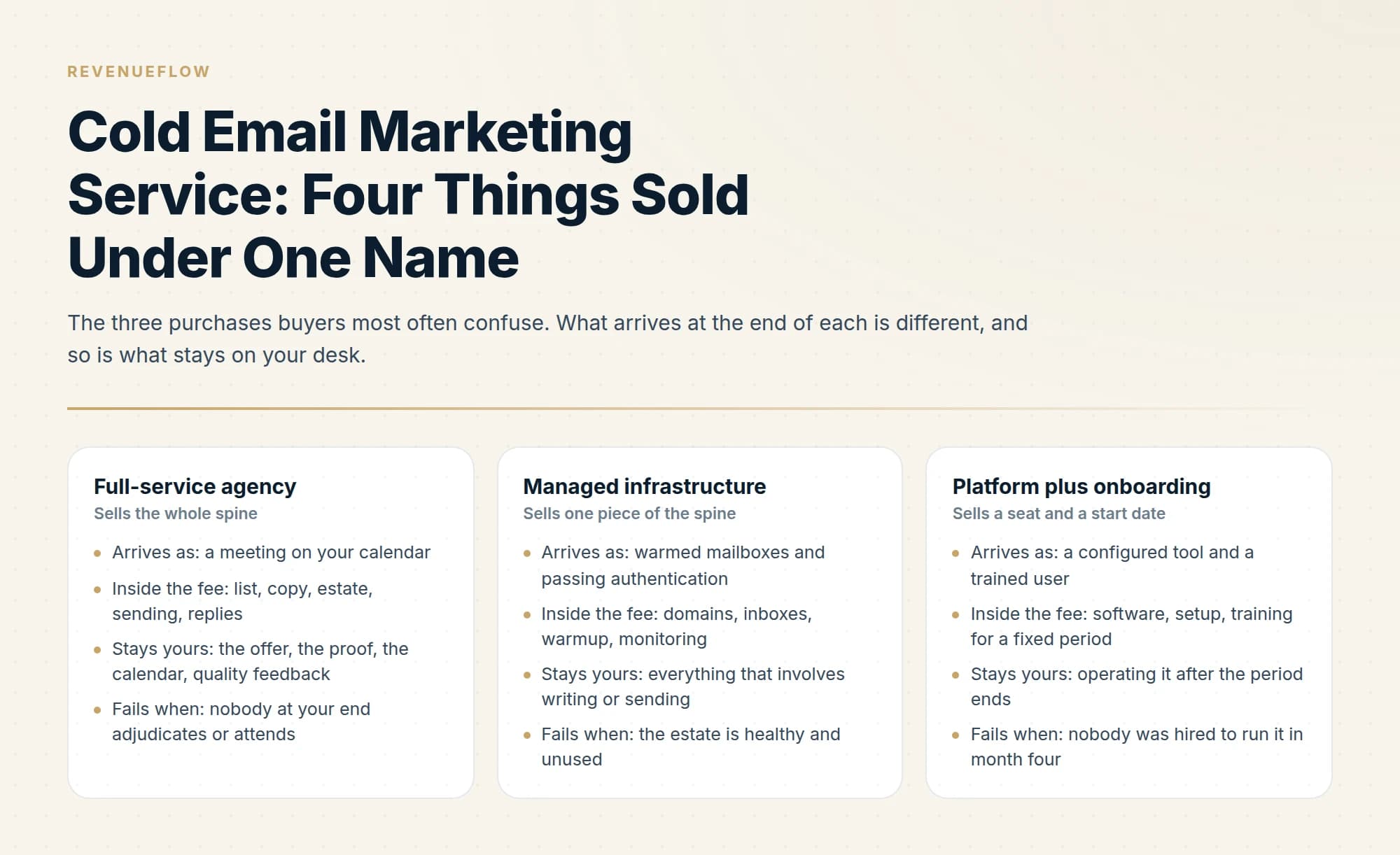
Cold email marketing service describes four different purchases: a full-service agency that books meetings, a managed infrastructure provider that supplies a warmed sending estate, a software platform with a paid onboarding tier, and a freelancer selling copy and sending. Ask who owns the domains, writes the copy, reads the replies and is accountable for the meeting.
Key takeaways
- The phrase covers four businesses selling different runs of the same six step chain, from list and offer through sending estate, copy, sending, reply handling and a booked meeting.
- Managed infrastructure is the most expensive misread, because a healthy estate with nobody contracted to send looks green on every dashboard while producing no meetings.
- Mailchimp's acceptable use policy bars campaigns sent to purchased, rented, third party, co-reg, publicly available or partner lists of any kind, so a cold campaign running on a bulk marketing platform is a terms problem carried by your account.
- The offer, the proof, calendar coverage and quality feedback stay with the buyer in every one of the four arrangements, whatever the scope document says about everything else.
Reviewed and updated September 2, 2026
Three vendors answer the same brief. The first proposes to book meetings on your calendar. The second proposes to build and warm forty mailboxes across eight domains and hand you the credentials. The third proposes a platform seat with six weeks of onboarding calls. All three call themselves a cold email marketing service, and all three are describing their business accurately.
The phrase has no fixed meaning, and the gap between what a buyer assumes and what the contract covers is where cold email programmes quietly die. Somebody buys infrastructure and waits for meetings. Somebody buys a tool and discovers the copy, the list and the reply handling were always theirs. The work does not disappear when it falls outside a scope. It just stops being anyone's job.
Cold email lead generation is the same purchase under the label buyers search for most, and it inherits the same ambiguity: the four models below all answer to it. The word lead is where it gets worse rather than better, because a provider selling a list, a provider selling positive replies and a provider selling attended meetings can each call their deliverable a lead and each be describing their own business accurately.
The decision to outsource email marketing splits in two before it splits by vendor: lifecycle and retention email runs against a list that already knows you and belongs with a marketing agency, while cold outbound runs against people who do not and carries deliverability and list risk that a retention team is not set up to hold.
The spine every programme runs on
Cold email has six pieces of work in it, and every vendor in this category sells a contiguous run of them. Which run they sell is the whole question.
- Step 1Offer and list
Who to contact and what the message promises them
- Step 2Sending estate
Domains, mailboxes, authentication, warmup
- Step 3Copy
Angles, variants, personalisation logic
- Step 4Sending and monitoring
Volume pacing, placement, reputation
- Step 5Reply handling
Reading, sorting and answering what comes back
- Step 6Meeting booked
An invite on a calendar, held and attended
Hold that spine in mind and the four businesses separate cleanly.
One: the full-service agency
Sells the whole spine. Strategy, list, copy, infrastructure, sending, reply handling, and a meeting that appears on your calendar. The fee covers labour and usually the sending estate.
What sits outside it is narrower than buyers expect but never empty. The offer is yours. The proof the copy stands on, meaning your case studies and references, is yours. Somebody at your end has to take the meeting within a few days of it being booked, and somebody has to say which meetings were good. An agency can phrase your offer well. It cannot invent a reason for your market to want it.
The failure mode is a buyer who treats the engagement as fully outsourced and stops answering. Booked meetings decay fast when nobody is available to take them, and a vendor with no quality feedback tunes toward whatever is easiest to book.
Two: the managed infrastructure provider

Sells the second piece of the spine and nothing either side of it. Domains, mailboxes, authentication records, warmup, monitoring, replacement of anything that burns. You receive a healthy sending estate with nothing in it.
This is a real and useful purchase, and the scope is visible on the vendors' own pages. Instantly's email accounts product, for instance, describes setting up "MX Records, SPF, DKIM, DMARC to best industry standards" and delivering "deliverability optimized Google accounts set-up and added to your Instantly Account in 24-72 hours" (instantly.ai/email-accounts). That is a precise description of an estate handover. Nothing in it commits anyone to writing a sentence or reading a reply.
Check what "monitoring" covers, because the word stretches. At one end it means alerting when a mailbox stops authenticating or a domain lands on a blocklist. At the other it means somebody watching placement by inbox provider and pulling volume back before reputation slips. Both get called monitoring on a pricing page, and only the second one protects a live campaign.
The failure mode here is the most expensive of the four, because it presents as success. The mailboxes are warm, the authentication passes, the dashboard is green, and no meetings exist, because nobody was contracted to send anything. If you are buying at this layer, the deliverability work is genuinely being done, and our cold email deliverability guide and the SPF, DKIM and DMARC setup walkthrough describe what a competent provider should be handling. What they cannot tell you is who is writing the campaign.
Three: software with an onboarding or managed tier
Sells a platform seat plus a human for a fixed period. An implementation consultant configures the account, imports your data, sets up sequences, runs training, and then the period ends and the tool is yours to operate.
The seam here is a date. Everything before it is guided, everything after it is self-serve, and the buyer who did not staff for the second half ends up with a well-configured account nobody logs into. Ask what happens in month four, and ask who is expected to be in the tool daily.
Working out whether a platform's monthly fee covers mailboxes or just metered credits determines whether the account still works later, a question the Salesforge pricing and sending breakdown answers directly.
Data is the other thing to pin down at this layer. A platform tier may include a contact database with a monthly credit allowance, or it may include none and expect you to arrive with a list. Those are very different purchases at similar headline prices, and the difference only surfaces once somebody has to build the first audience.
Four: the freelancer or small studio
Usually copy plus sending, occasionally infrastructure, rarely data at meaningful scale. The good ones are very good and materially cheaper than an agency, because you are paying for one person's time rather than a team's overhead.
The exposures are concentration and coverage. One person has holidays, other clients, and no redundancy, and the pieces of the spine they do not touch stay with you by default rather than by agreement. Get the boundary in writing precisely because the relationship is informal.
- Arrives as: a meeting on your calendar
- Inside the fee: list, copy, estate, sending, replies
- Stays yours: the offer, the proof, the calendar, quality feedback
- Fails when: nobody at your end adjudicates or attends
- Arrives as: warmed mailboxes and passing authentication
- Inside the fee: domains, inboxes, warmup, monitoring
- Stays yours: everything that involves writing or sending
- Fails when: the estate is healthy and unused
- Arrives as: a configured tool and a trained user
- Inside the fee: software, setup, training for a fixed period
- Stays yours: operating it after the period ends
- Fails when: nobody was hired to run it in month four
The categories blur inside a single brand

A vendor name does not tell you which of the four you are buying, because larger players now sell several at once. Instantly is a sending platform, and it also sells mailbox provisioning, and it also sells a managed service under the name VIP Managed Outreach Service, described on its own page as "We set up your domains, infrastructure, prospecting engine, and AI reply agents" (instantly.ai/vip). That page carries no price and its call to action is an application form, which is normal for the managed tier of a platform business and worth knowing before you assume the seat price on the pricing page is the relevant number.
None of that is a criticism. It does mean the disambiguation has to happen at the scope-document level rather than the brand level. Read the deliverables list, not the homepage.
The ESP trap
A subset of cheap offers in this category run cold campaigns through mainstream email marketing platforms, and those platforms prohibit exactly that in their own terms.
Mailchimp's Acceptable Use Policy lists, among the things customers may not do, "Upload or send email Campaigns to purchased, rented, third-party, co-reg, publicly available data, or partner lists of any kind" (mailchimp.com/legal/acceptable_use). The phrase "publicly available data" is the important part, because it forecloses the usual argument that a scraped or enriched business address is fair game.
Klaviyo's Acceptable Use Policy is written the same way. It prohibits sending to "Email addresses, phone numbers, or other contacts that are purchased, rented, borrowed, third-party owned/provided or any other lists that have not consented to receive communications, promotions or advertisements from your business", and separately bars using the service to send "spam messages to addresses obtained through any internet-based harvesting or scraping methods" (klaviyo.com/legal/acceptable-use-policy).
So a service running your cold campaign on that class of platform is operating against the platform's terms, and the account carrying the risk is usually yours. Suspension takes the list, the templates and the reporting with it. Purpose-built cold email tooling exists partly because of this line, and a vendor who cannot tell you which platform they send from has answered the question.
What stays with you in all four
The four categories differ in how much they take on. They do not differ in what they can never take on, and that list is short enough to read in one go.
The offer is yours. A vendor can test angles against it, sharpen the wording and tell you when the market is not responding, and none of that substitutes for a commercial decision about what you are promising and to whom. The proof is yours too, because case studies, named references and defensible numbers come out of your business and cannot be sourced externally without inventing them.
Calendar coverage is yours, and it is the input that most often quietly breaks an otherwise working programme. A prospect who agrees to a conversation is at their most willing in the hours after they reply, and a first available slot eleven days out converts a booked meeting into a cancelled one.
Quality feedback is yours, and it needs a person and a window rather than good intentions. Somebody has to say which meetings matched the target and which did not, quickly enough to change the next wave rather than the next quarter. A vendor receiving no signal optimises toward volume, because volume is the only thing they can see.
The four questions that settle it

Four questions identify which business you are talking to, and they work because each one has a single owner. Ask them before price.
Asking before price is the same move when a vendor quotes rather than publishes, and the questions worth settling before an Amplemarket quote lists what its one published tier leaves open.
- Yes: Who buys and owns the sending domains, and who holds them when the engagement ends
- Yes: Who writes the copy, and who signs it off before it sends
- Yes: Who reads the replies, and how fast, including the negative ones
- Yes: Who is accountable for a meeting appearing on the calendar
- Yes: Which sending platform is used, and does its acceptable use policy permit cold outreach
- Depends: What the buyer still owes: offer, proof, calendar coverage, quality feedback
- No: Assuming the vendor category from the brand name
Domain ownership is the one people leave until the end. If the vendor bought and warmed the domains, leaving can mean losing the warmed estate the results were built on. Buying the domains yourself and lending them for the duration costs nothing if you arrange it at the start.
The reply-handling question separates more vendors than any of the others. Reading replies is unglamorous, high-volume work, and it is the piece most quietly left out of a scope that otherwise sounds complete. If nobody names an owner and a response window, assume it is yours.
The short version
Four different businesses share one phrase. A full-service agency sells the whole spine and hands over a meeting. A managed infrastructure provider sells a healthy sending estate and hands over credentials. A platform with an onboarding tier sells a configured tool and a date after which you operate it. A freelancer sells copy and sending, with the boundary usually undefined. Larger vendors now sell two or three of these under one brand, so the answer lives in the deliverables list.
For what each of these costs and when hiring an agency is the wrong move at all, our cold email agency guide covers the pricing and the build-versus-buy arithmetic. If the piece you are missing is the estate itself, email warmup services covers that layer, and Google Postmaster Tools covers reading whether it is working.
RevenueFlow sells the first category, and we are paid on attended meetings against criteria agreed in writing before launch, which makes the seam question easy to answer: it is ours up to the meeting. You can see what a campaign would look like for your market.
Vendor terms and published scope verified against the vendors' own pages in mid-2026. All are subject to change; confirm current terms directly before contracting.
Sources: Mailchimp Acceptable Use Policy, Klaviyo Acceptable Use Policy, Instantly email accounts, Instantly VIP Managed Outreach Service
Frequently asked questions.
Frequently asked questions- What does a cold email marketing service actually do?
- It depends which of four businesses you are talking to. A full-service agency runs list, copy, infrastructure, sending and replies and books meetings. An infrastructure provider supplies domains and warmed mailboxes only. A software vendor sells a seat plus onboarding for a fixed period. A freelancer usually sells copy and sending.
- Can I run cold email through Mailchimp or Klaviyo?
- Their own terms say no. Mailchimp's acceptable use policy bars sending campaigns to purchased, rented, third party, co-reg, publicly available data or partner lists of any kind. Klaviyo prohibits sending to purchased, rented or borrowed contacts and treats scraped addresses as spam. Suspension takes your lists and reporting with it.
- Who should own the sending domains?
- Buy them yourself and lend them to the vendor for the duration. It costs nothing to arrange at the start and it means leaving the engagement does not cost you the warmed estate your results were built on. If the vendor already owns them, agree in writing what happens to them at the end.
- What does a cold email service not cover?
- Four things stay with you in every arrangement. The offer, which is a commercial decision. The proof the copy stands on, meaning your case studies and references. Calendar coverage, so booked meetings happen soon after the reply. And quality feedback, delivered fast enough to change the next wave.
About the author.

Ben Carden is CRO at RevenueFlow, which builds and operates outbound revenue engines for B2B companies. Previously at Gartner Enterprise. Studied at London School of Economics.
Ben Carden · CRO
Connect on LinkedIn →Explore more.
Ready to scale your outreach?
We build GTM engines that book real meetings. See the receipts.
Related articles.
BASHO Email: Four Sentences Built on One Insight
A BASHO email is four or five sentences built on one researched insight about a specific person. The format is documented, and it cannot be produced at volume.
SMTP Reply Codes: What Each Class Instructs
The digits are a verdict and the text is the reason. Separating an address failure from a policy refusal before reacting is what decides whether the fix works.
Cold Email Frameworks: Which One Fits Your Offer
AIDA, PAS and Before-After-Bridge arrange the same four elements in different orders. What each one assumes about the reader, and what none of them fix.
SURBL Blacklist: What It Lists and How to Get Removed
SURBL tests the domains inside your message rather than your sending IP. Which of its six lists fired, what the bitmask means, and the fix that works.
The Cold Email Signature Is an Identity Claim
A recipient who is mildly interested and mildly suspicious checks that you exist before replying. The signature is where that check either resolves or does not.
Can Buyers Tell an Email Was Written by AI?
Buyers are not running a classifier on your cold email. What they react to is a message containing nothing only somebody who looked could have written.