Cold Email Agency: What You Get and What It Costs
What a cold email agency delivers, 2026 pricing across retainer, per-meeting and hybrid models, the in-house comparison, and when hiring one is wrong.
A cold email agency builds and runs outbound sending for you: domains and mailboxes, list building and verification, copy, daily campaign operations, and reply handling. Market pricing in 2026 runs $2,500 to $8,000 per month on retainer, $200 to $600 per booked meeting on performance deals, plus $300 to $2,000 monthly infrastructure.
Key takeaways
- Cold email agency retainers cluster between $2,500 and $8,000 per month in 2026, with budget tiers at $1,000 to $3,000 and premium programs above $8,000.
- Performance pricing runs $200 to $600 per booked meeting, and hybrid deals pair a $1,500 to $3,000 base with $150 to $400 per meeting.
- Infrastructure is usually billed outside the retainer and adds $300 to $2,000 per month: domains at $10 to $15 a year, mailboxes at $1.90 to $8.40 each per month.
- Six workstreams define the deliverable: infrastructure, data, copy, campaign operations, reply handling, and reporting on meetings attended.
- Break-even math uses attended meetings, not booked: a 20 percent close rate on a $24,000 contract needs 1.42 attended meetings a month to cover a $6,800 program.
- Outbound agencies are a poor fit below roughly 1,500 target accounts or below roughly $3,000 average contract value with no expansion.
Reviewed and updated September 5, 2026
Cold Email Agency: What You Actually Get, What It Costs, and When to Hire One
A cold email agency sells one outcome: conversations with people who did not know you existed. Everything else on the proposal (domains, copywriting, enrichment, reply handling) is machinery pointed at that outcome.
The category is crowded and the pricing is deliberately vague. This page does the unglamorous part: what the deliverable actually is, what the market charges in 2026, how the arithmetic compares to building it yourself, and the specific situations where hiring an agency is the wrong call.
The six workstreams behind every retainer
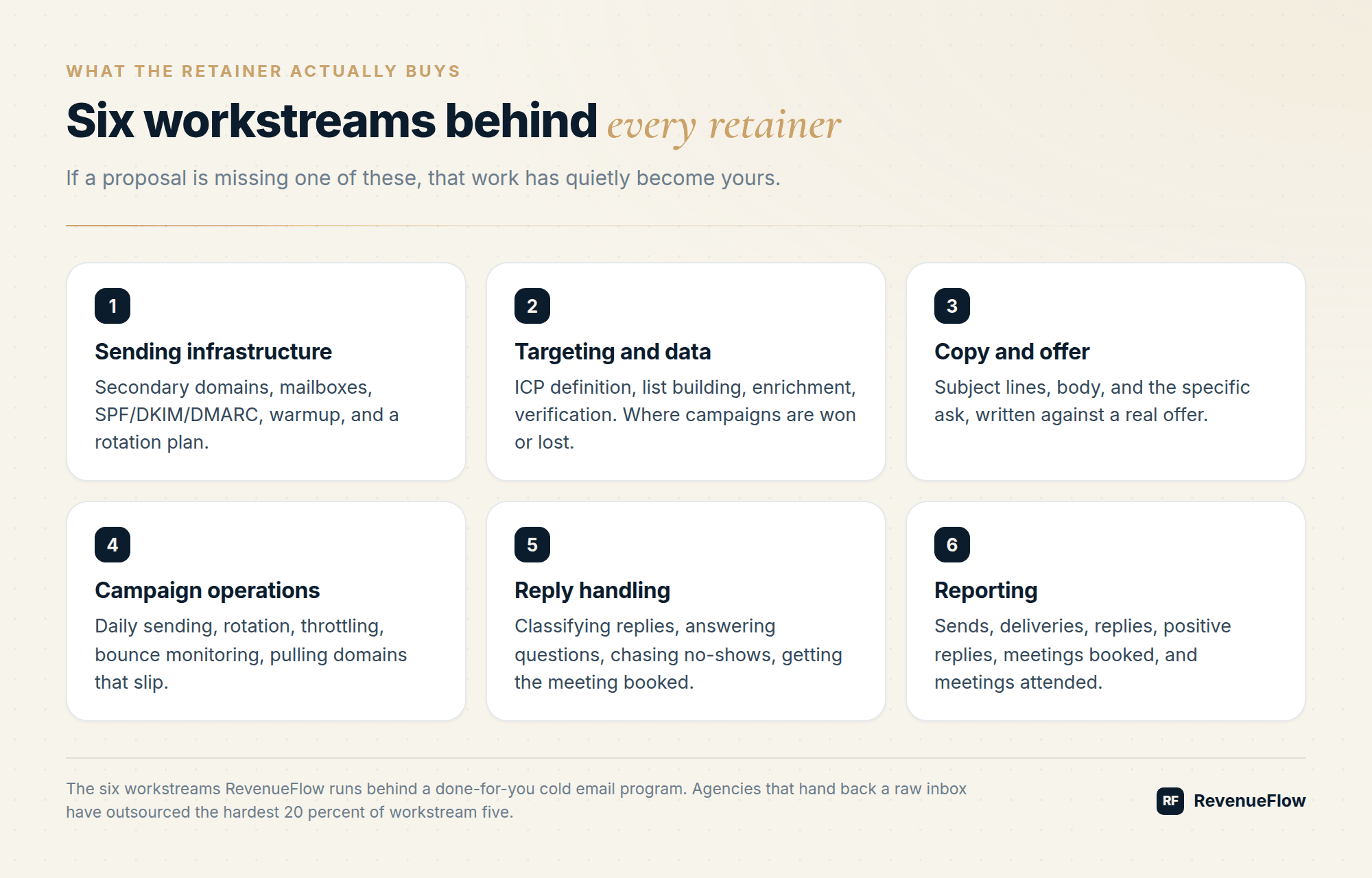
If a proposal is missing one of these, that work has quietly become yours.
- Yes: Sending infrastructure. Secondary domains, mailboxes, SPF/DKIM/DMARC records, warmup, and a rotation plan.
- Yes: Targeting and data. ICP definition, list building, enrichment, and email verification.
- Yes: Copy and offer. Subject lines, body, and the specific ask.
- Yes: Campaign operations. Daily sending, mailbox rotation, throttling, bounce monitoring, and pulling domains that start to slip.
- Yes: Reply handling. Classifying replies, answering questions, chasing no-shows, and getting the meeting on a calendar.
- Yes: Reporting. Sends, deliveries, replies, positive replies, meetings booked, meetings attended.
Sending infrastructure. Secondary domains, mailboxes, SPF/DKIM/DMARC records, warmup, and a rotation plan. A serious operator buys more capacity than the send plan needs so no single mailbox carries too much volume. We explain why in why we buy 3x more email infrastructure than we need.
Targeting and data. ICP definition, list building, enrichment, and email verification. This is where most campaigns are actually won or lost, and it is the workstream clients most often assume is included when it is billed separately.
Copy and offer. Subject lines, body, and the specific ask. Good agencies write against a real offer. Weak ones rewrite your website in the second person.
Campaign operations. Daily sending, mailbox rotation, throttling, bounce monitoring, and pulling domains that start to slip. This is a daily job, not a monthly one.
Reply handling. Classifying replies, answering questions, chasing no-shows, and getting the meeting on a calendar. Agencies that hand you a raw inbox have outsourced the hardest 20 percent back to you.
Reporting. Sends, deliveries, replies, positive replies, meetings booked, meetings attended. Insist that the last number appears. Reply rate alone is easy to flatter, which is why we argue for reply volume over reply rate.
What a cold email agency costs in 2026
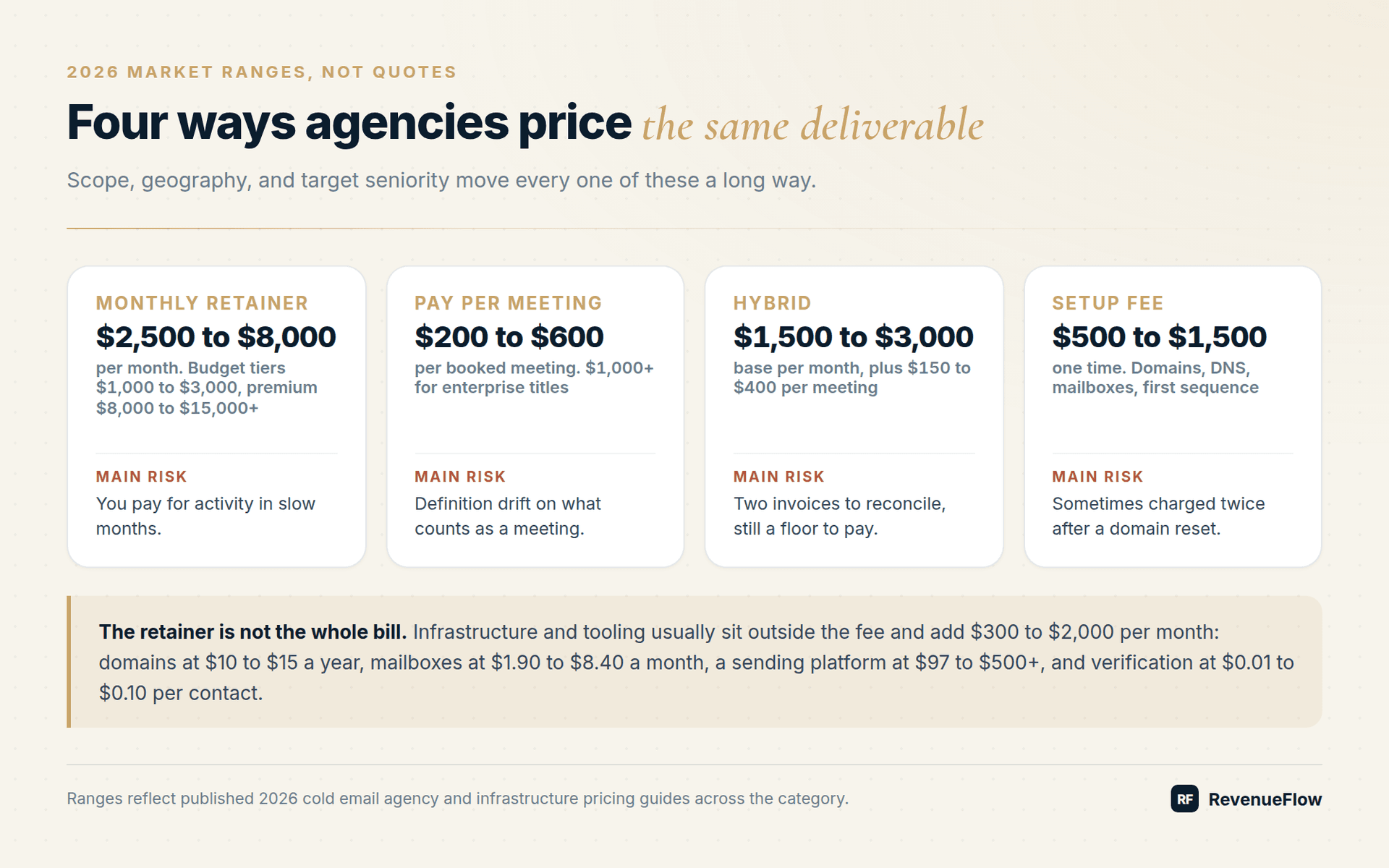
Published 2026 pricing guides across the category cluster into four models. Treat these as market ranges rather than quotes: scope, geography, and target seniority move them a long way.
| Model | Typical 2026 range | What it buys | Best fit | Main risk |
|---|---|---|---|---|
| Monthly retainer | $2,500 to $8,000/mo (budget tiers $1,000 to $3,000, premium $8,000 to $15,000+) | Full done-for-you program, fixed fee | Teams that want capacity regardless of month-to-month results | You pay for activity in slow months |
| Pay per meeting | $200 to $600 per booked meeting, $1,000+ for enterprise titles | Only booked meetings | Teams with a working sales process and no appetite for fixed cost | Definition drift on what counts as a meeting |
| Hybrid | $1,500 to $3,000 base plus $150 to $400 per meeting | Reduced fixed fee, shared upside | Most mid-market programs | Two invoices to reconcile, still a floor to pay |
| Setup fee | $500 to $1,500 one time | Domains, DNS, mailbox provisioning, first sequence | Almost universal | Sometimes charged twice after a domain reset |
The retainer is not the whole bill
Infrastructure and tooling usually sit outside the fee, and they add $300 to $2,000 per month depending on volume.
| Line item | 2026 market range | Note |
|---|---|---|
| Secondary domains | $10 to $15 per domain per year | 1,000 sends/day typically needs 12 to 25 domains |
| Mailboxes | $1.90 to $4.50 each per month at cold-email resellers, $7 to $8.40 at Google Workspace direct | Largest single swing factor in the stack |
| Sending platform | $97 to $500+ per month | Priced by contacts or sending volume |
| Verification and enrichment | $0.01 to $0.10 per contact | Scales with list size, not with mailbox count |
For the tool-by-tool version of that stack, see the cold email pricing guide for 2026. One published breakdown puts a single-rep stack at roughly $105 to $150 per month all in, which is the honest floor for anyone considering the do-it-yourself route.
Agency versus in-house
The comparison people run is fee versus software, and software wins every time. That comparison is wrong, because it omits the operator. Here is the version with the operator included.
| Agency | In-house | |
|---|---|---|
| Time to first send | 2 to 4 weeks (warmup is the gate) | 6 to 12 weeks including hiring |
| Fixed monthly cost | $2,500 to $8,000 plus infrastructure | Salary plus $300 to $2,000 infrastructure |
| Who operates it daily | Their team | A person you hire and manage |
| Deliverability risk | Sits on their domains, not your primary | Sits on domains you own and must monitor |
| Knowledge retention | Leaves when the contract ends | Stays, if the person stays |
| Speed to change angle | Days, if they are good | Same day, if the operator is good |
| Typical failure mode | Slow, generic, under-resourced account | Silent breakage nobody notices for two weeks |
The strongest argument for in-house is not cost. It is that the feedback loop between what the market says and what you build is shorter when the loop runs inside your own company. The strongest argument for an agency is that outbound infrastructure is a specialised operational job with a genuine learning curve, and paying for the curve is often cheaper than climbing it.
Five questions that separate good agencies from bad ones
- How many meetings attended, not booked, did your last three clients get in month two? Booked is a vanity number. Attended is the one you can bank.
- Whose domains do we send from, and what happens to them if we leave? The right answer involves secondary domains that never touch your primary.
- Who writes the reply? If the answer is you, price your own time into the deal.
- What is your kill rule? An agency with no rule for shutting off a losing angle will run it for the length of the contract.
- Show me the list logic. Ask for the filters, not the count. A vague ICP produces a big list and no meetings.
When an agency like us is the wrong choice
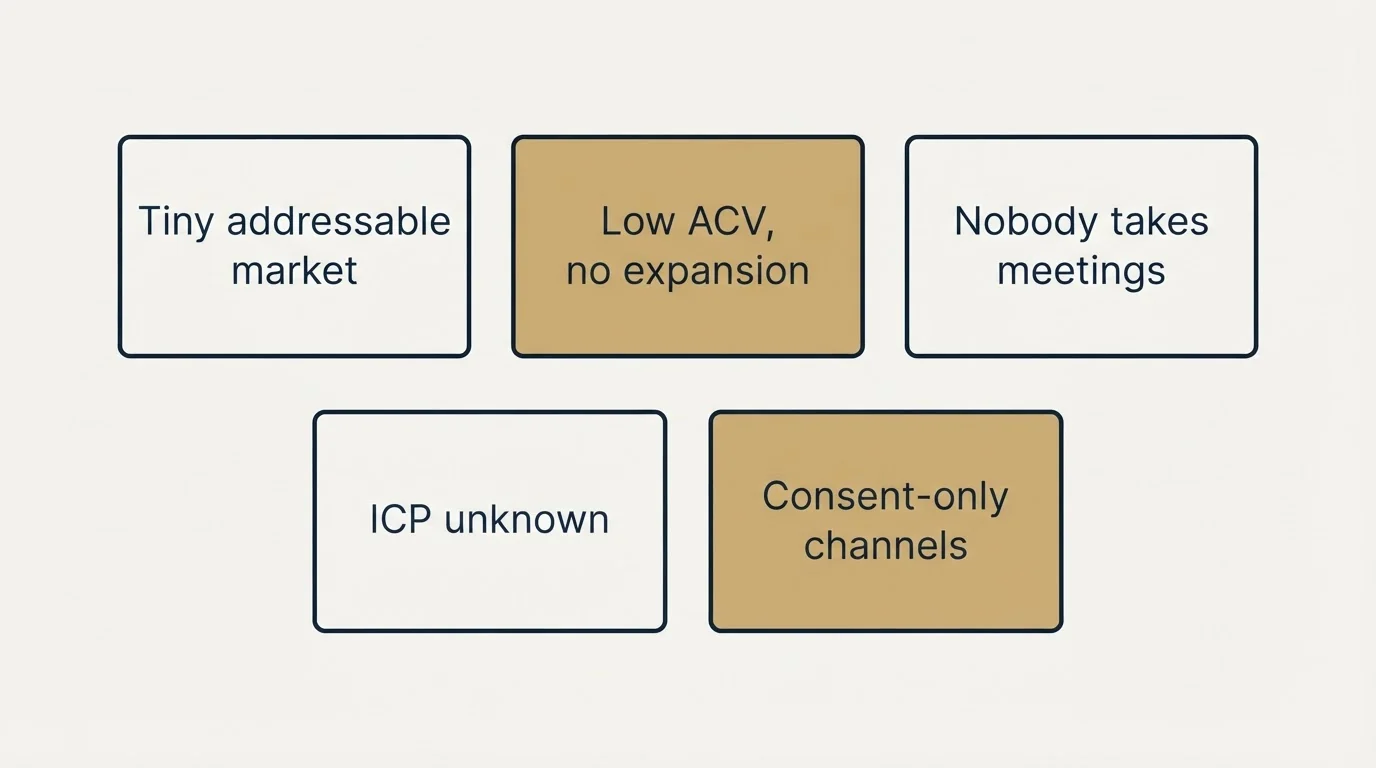
We sell done-for-you cold email and LinkedIn outbound and we charge only for qualified meetings that are attended. That model is a poor fit in five situations, and saying so up front saves everyone a quarter.
- Your total addressable market is under about 1,500 accounts. At that size, outbound at volume burns the list in weeks. Named-account selling by a human beats a program.
- Your average contract value is under roughly $3,000 with no expansion path. The arithmetic stops working once you price a realistic cost per meeting against your close rate.
- Nobody is free to take the meetings. Booked meetings with no one to run them is the most expensive failure in this category.
- Your ICP is genuinely unknown. An agency can test angles. It cannot invent the market for you, and testing on someone else's clock is slow and costly.
- You sell into consent-only channels or heavily regulated buyers where unsolicited contact is restricted. Get the compliance answer before the pricing answer.
If you are choosing between outbound and building category awareness first, the split we lay out in demand generation agency vs cold outbound is the faster way to decide.
The arithmetic that actually decides it
Run this before you take a call with anyone, including us.
Take your close rate from a first meeting. Take your average contract value including realistic expansion. Multiply them to get revenue per meeting. Divide your fully loaded monthly outbound cost by that number, and you have the meetings per month you need to break even.
A worked example: a 20 percent close rate on a $24,000 annual contract produces $4,800 of expected revenue per meeting. A $6,000 monthly program plus $800 of infrastructure needs 1.42 attended meetings a month to break even. If a vendor is projecting 12, ask what happens at 4, because that is the number that decides whether you renew.
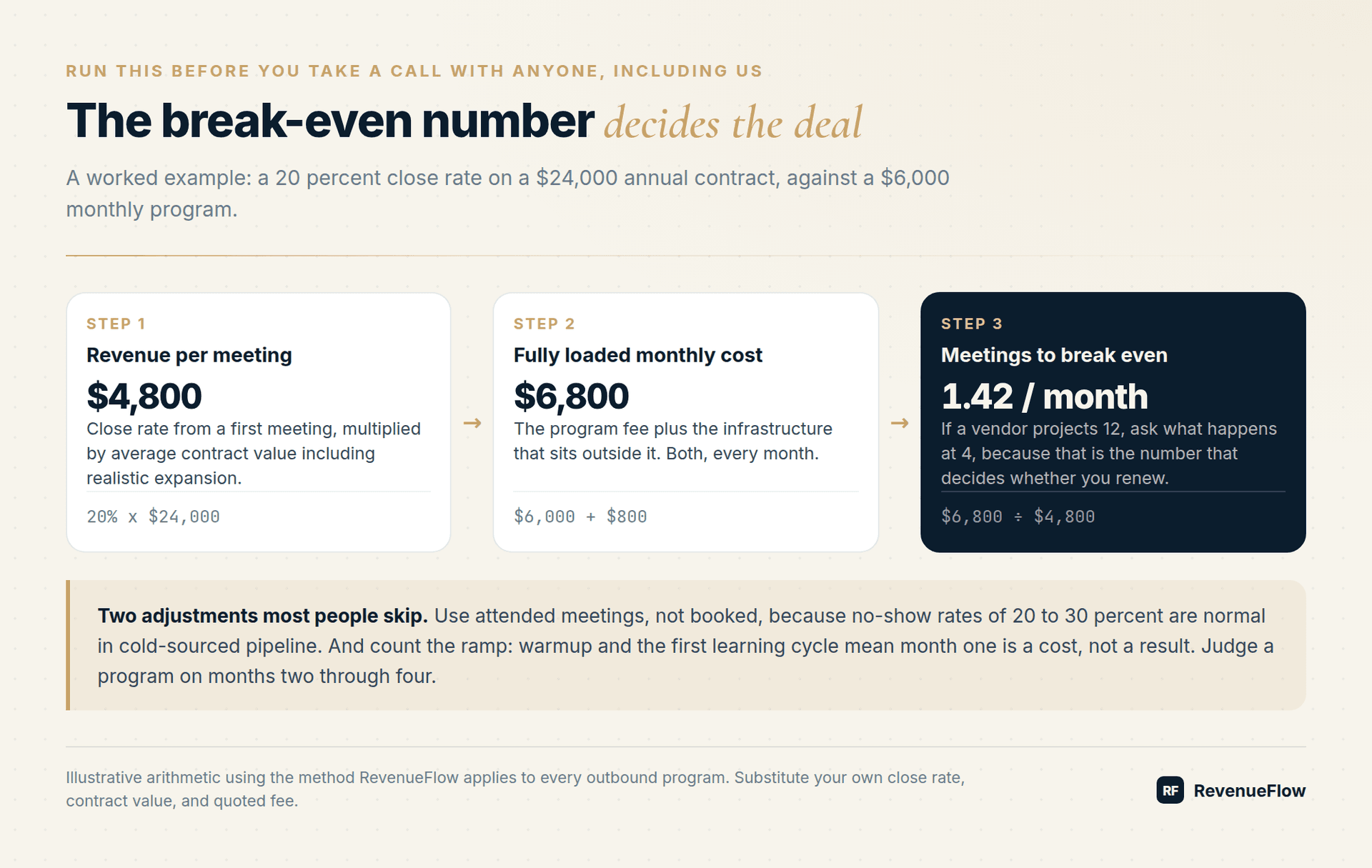
Two adjustments most people skip. First, use attended meetings, not booked, because no-show rates of 20 to 30 percent are normal in cold-sourced pipeline. Second, count the ramp: warmup and the first learning cycle mean month one is a cost, not a result. Judge a program on months two through four.
If the comparison you are really running is agency versus hiring a rep, the numbers are laid out in outsourced SDR vs in-house and in what a B2B lead generation agency actually costs. If it is agency versus software, most sales teams spend $180K a year on SDRs has the stack version. And if you want to know what normal looks like before you set targets, agency cold email benchmarks has the reply-rate distribution.
Where to start
Get two quotes in different models, one retainer and one performance based, and put both through the break-even calculation above. The spread between them tells you exactly how much risk each vendor is willing to carry, which is the most honest signal you will get in a sales process.
We run cold email and LinkedIn outbound end to end and charge only for qualified meetings that are attended. No fee for activity, no charge for a meeting you did not agree counts. See if you qualify for a free campaign.
Pricing ranges reflect published 2026 agency and infrastructure pricing guides across the category and vary widely by scope, geography, and buyer seniority.
Frequently asked questions.
Frequently asked questions- How much does a cold email agency cost per month?
- Most 2026 retainers land between $2,500 and $8,000 per month, with budget providers at $1,000 to $3,000 and premium done-for-you programs above $8,000. Setup fees of $500 to $1,500 are standard. Domains, mailboxes, sending platform, and data usually sit outside the retainer and add another $300 to $2,000 monthly depending on send volume.
- Is it cheaper to hire a cold email agency or do it in-house?
- In-house software costs less than an agency fee, but the comparison has to include the person operating it. A do-it-yourself stack starts near $105 to $150 per month for one rep, plus the salary of whoever runs it daily. Agencies win on speed to launch and on keeping deliverability risk off your primary domain.
- What should a cold email agency actually deliver?
- Six things: sending infrastructure with authenticated secondary domains, targeting and verified data, copy tied to a real offer, daily campaign operations, reply handling through to a booked calendar slot, and reporting that shows meetings attended rather than only replies. Anything missing from that list becomes your job.
- How do I know if a cold email agency is any good?
- Ask for attended meetings from their last three clients in month two, ask whose domains you send from, ask who writes replies, ask for their rule for killing a losing angle, and ask to see the list filters rather than the list size. Vague answers on any of those five predict a slow account.
- When should you not hire a cold email agency?
- Skip outbound at volume when your addressable market is under roughly 1,500 accounts, when average contract value is under roughly $3,000 with no expansion, when nobody is free to take the meetings, when your ICP is genuinely unproven, or when your buyers sit in consent-only or heavily regulated channels.
About the author.

Ben Carden is CRO at RevenueFlow, which builds and operates outbound revenue engines for B2B companies. Previously at Gartner Enterprise. Studied at London School of Economics.
Ben Carden · CRO
Connect on LinkedIn →Explore more.
Ready to scale your outreach?
We build GTM engines that book real meetings. See the receipts.
Related articles.
Demand Generation Agency vs Cold Outbound: Which You Need
Demand gen builds awareness, outbound harvests it. 2026 pricing for both, a three-test decision rule, and the market conditions where each one fails.
Outsourced SDR vs In-House: The Cost Math on Your Numbers
The comparison most teams run is a salary against a retainer. Here is how to build both sides fully loaded, divide by meetings held, and adjust for ramp.
The ROI of Cold Email: Revenue Per Dollar Spent by Industry
Cold email delivers 36-44x ROI on average. This analysis breaks down revenue per dollar spent across 10 industries, with cost models and ROI calculators for different team sizes.
Cold Email Pricing Guide 2026: What Every Tool Costs
Side-by-side pricing for all 48 B2B sales tools. Total cost of ownership calculations by team size and budget recommendations by company stage.
Email Deliverability in 2026: What Actually Works
A technical guide to email deliverability for cold outreach. SPF, DKIM, DMARC explained, warmup strategies that work, and the metrics that matter for inbox placement.
Cross-Sell vs Upsell: Different Trigger, Different Owner
An upsell has a trigger that arrives on its own. A cross-sell has none and needs a diagnosis somebody funds. That is the difference that decides the work.