Sales Teams Spend $180K/Year on SDRs for What 48 Tools Do
Six stages, three channels, and a stack that covers what two SDRs were hired for, plus the honest version of the cost comparison most people get wrong.
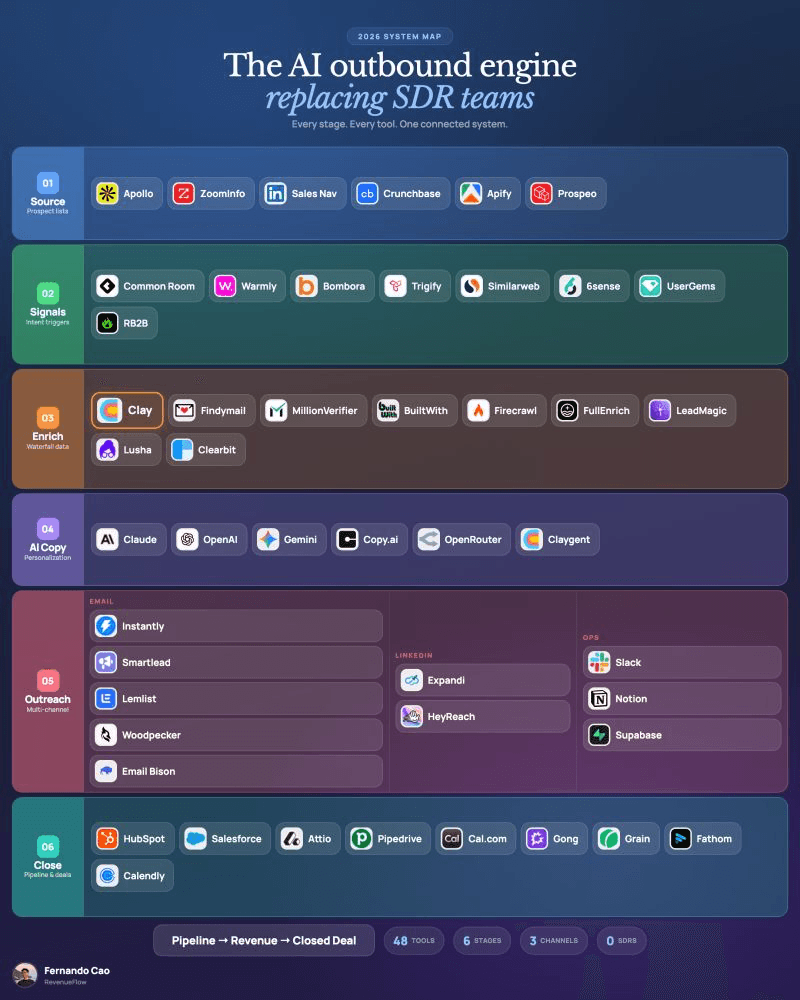
A six-stage system covering sourcing, signals, enrichment, AI copy, outreach and close replaces most SDR prospecting work. The honest comparison is headcount against software plus an operator, and the system wins on the slope rather than the intercept: one operator serves the whole team while SDR cost scales with pipeline targets.
Key takeaways
- The correct comparison is headcount against software plus an operator, never headcount against software alone, and the system wins in year two because the operator line does not scale with pipeline targets.
- Signals is the stage teams skip most often and the one that produces timing, without which the send date is decided by cadence position rather than by anything happening at the account.
- System failures are silent where human failures are visible, so build the monitoring, a daily count that must be non-zero and a bounce rate that must stay under a line, before building the volume.
- A vague ICP and a market small enough to work by hand are the two disqualifiers, and no amount of tooling supplies the judgment a precise ICP requires.
Reviewed and updated September 5, 2026
The System the Fastest B2B Teams Run Instead
Most sales teams spend six figures a year on SDRs to perform work that a well-built stack does faster and more consistently.
Here is the system that replaces it. Six stages, three channels.
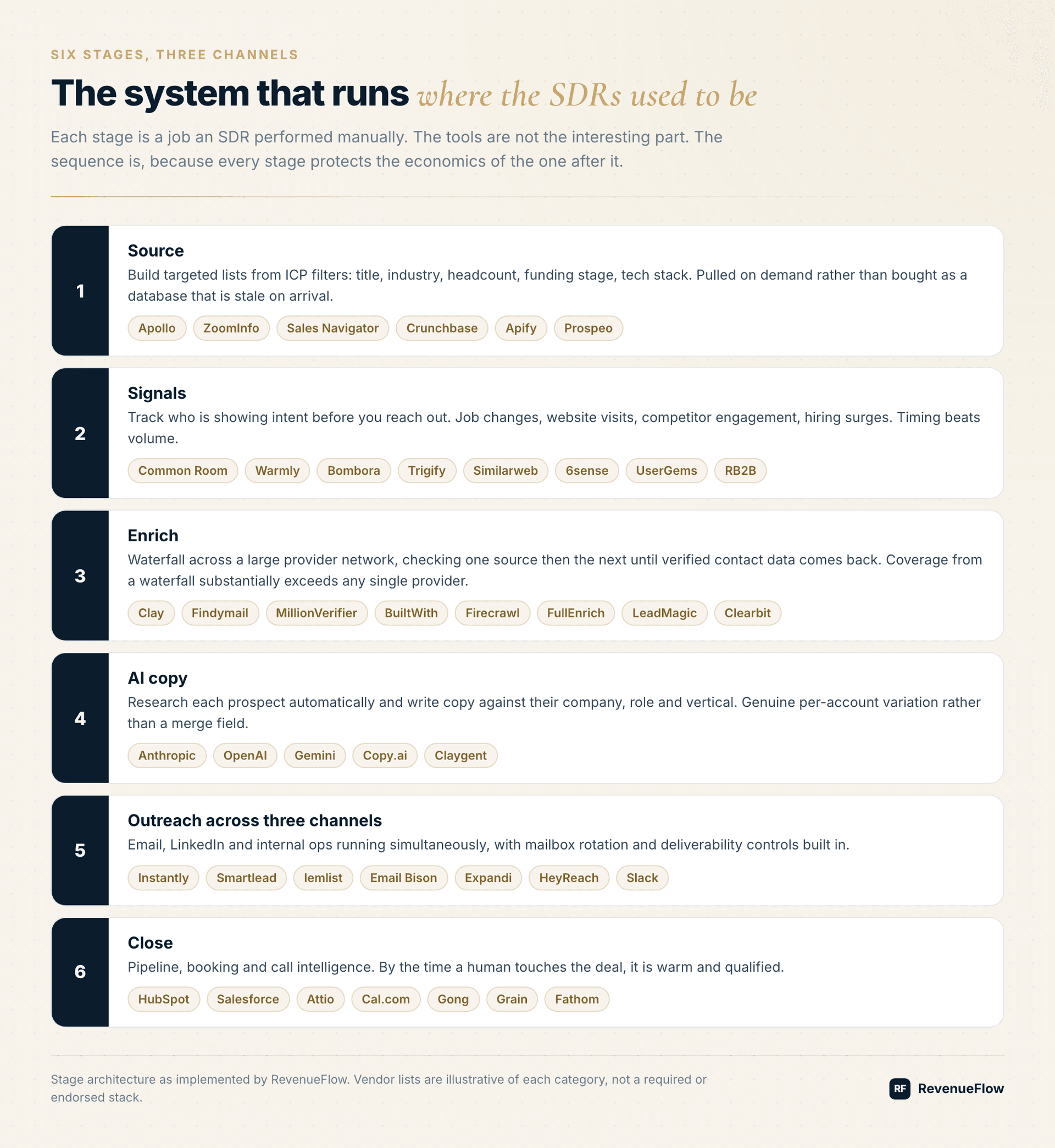
Stage 1: Source
Apollo, ZoomInfo, LinkedIn Sales Navigator, Crunchbase, Apify, and Prospeo.
Build targeted prospect lists from ICP filters: title, industry, headcount, funding stage, tech stack. Pulled on demand rather than bought as a static database that begins decaying on delivery.
Stage 2: Signals
Common Room, Warmly, Bombora, Trigify, Similarweb, 6sense, UserGems, and RB2B.
Track who is showing intent before you reach out. Job changes. Website visits. Competitor engagement. Hiring surges.
Timing beats volume, and this is the stage that produces timing. It is also the stage most teams skip, which is why their outbound is a function of the calendar rather than of anything happening at the account.
Stage 3: Enrich
Clay sits at the centre, waterfalling across a large provider network including Findymail, MillionVerifier, BuiltWith, Firecrawl, FullEnrich, LeadMagic, Lusha, and Clearbit.
It checks one source, then the next, until it finds verified contact data. Waterfall coverage substantially exceeds any single provider, because no database has complete coverage and the gaps cluster in predictable places: smaller companies, non-US geographies, and recently changed roles.
Stage 4: AI Copy
Anthropic Claude, OpenAI, Google Gemini, Copy.ai, OpenRouter, and Claygent research each prospect automatically and write copy against their company, role, and vertical.
Genuine per-account variation rather than a mail merge with a company name dropped in.
Worth a caveat: this is more expensive per contact than a template, and at very high volume the return on deep personalisation is smaller than people expect. Use it where account value justifies it.
Stage 5: Outreach
Three channels running simultaneously.
Email through Instantly, Smartlead, lemlist, Woodpecker, or Email Bison. LinkedIn through Expandi or HeyReach. Internal ops through Slack, Notion, and Supabase.
Multi-channel sequences with mailbox rotation and deliverability controls built in.
Stage 6: Close
HubSpot, Salesforce, Attio, or Pipedrive for pipeline. Cal.com and Calendly for booking. Gong, Grain, and Fathom for call intelligence.
By the time a human touches the deal, it is warm and qualified.
Where the 48 Sits
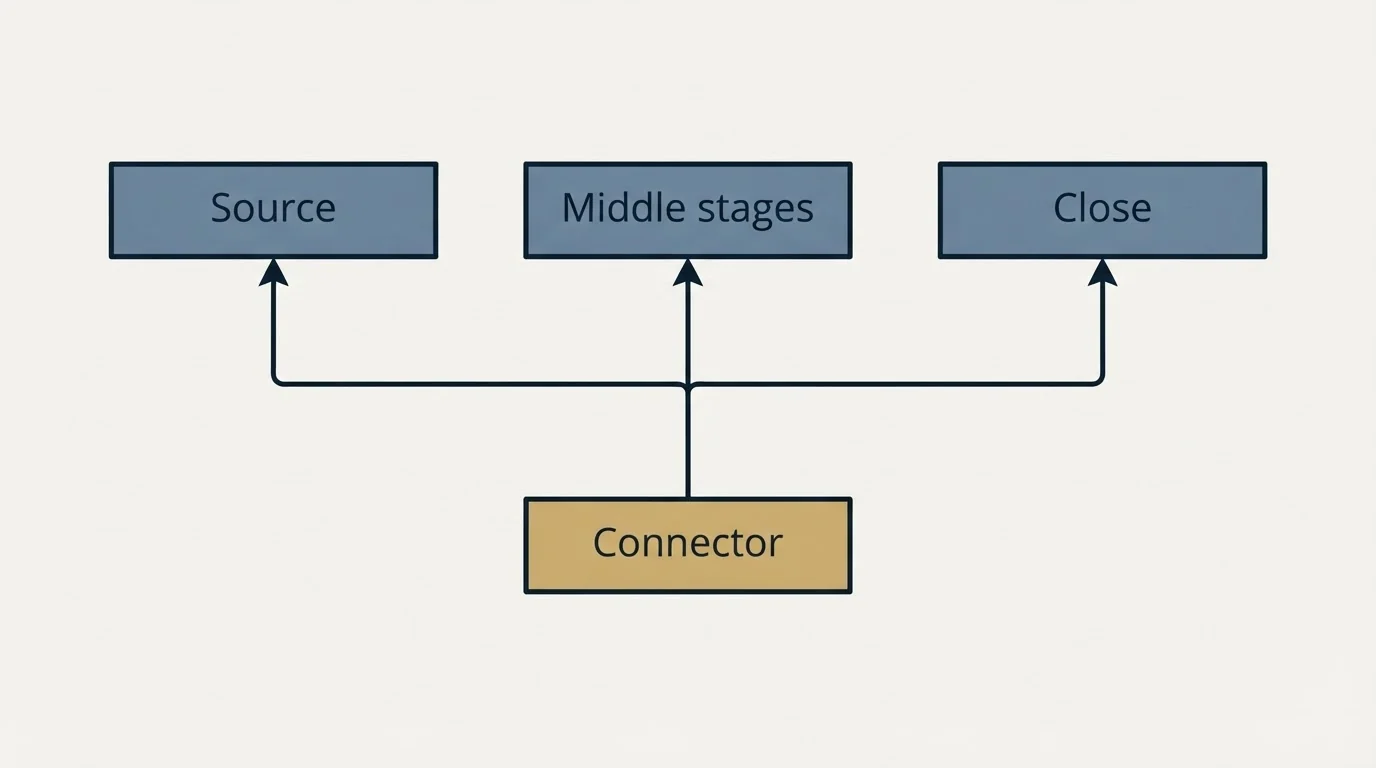
The count in the headline is an enumeration of the six lists above rather than a market survey, and the distribution is the interesting part.
list building
the stage most teams skip
waterfall providers
models and research agents
three channels plus internal ops
CRM, booking, call intelligence
Thirty-three of the 48 sit in the middle four stages, which is where the work actually is. Sourcing and closing are the stages a team usually has some version of already. Signals, enrichment and copy are the parts that get skipped, and skipping them is what turns a stack into an expensive mail merge.
None of this is a shopping list. One working tool per stage plus something connecting them beats nine tools in one stage and nothing in the next.
The Cost Comparison, Honestly
This is where most versions of this argument get sloppy, so here is the uncomfortable version.
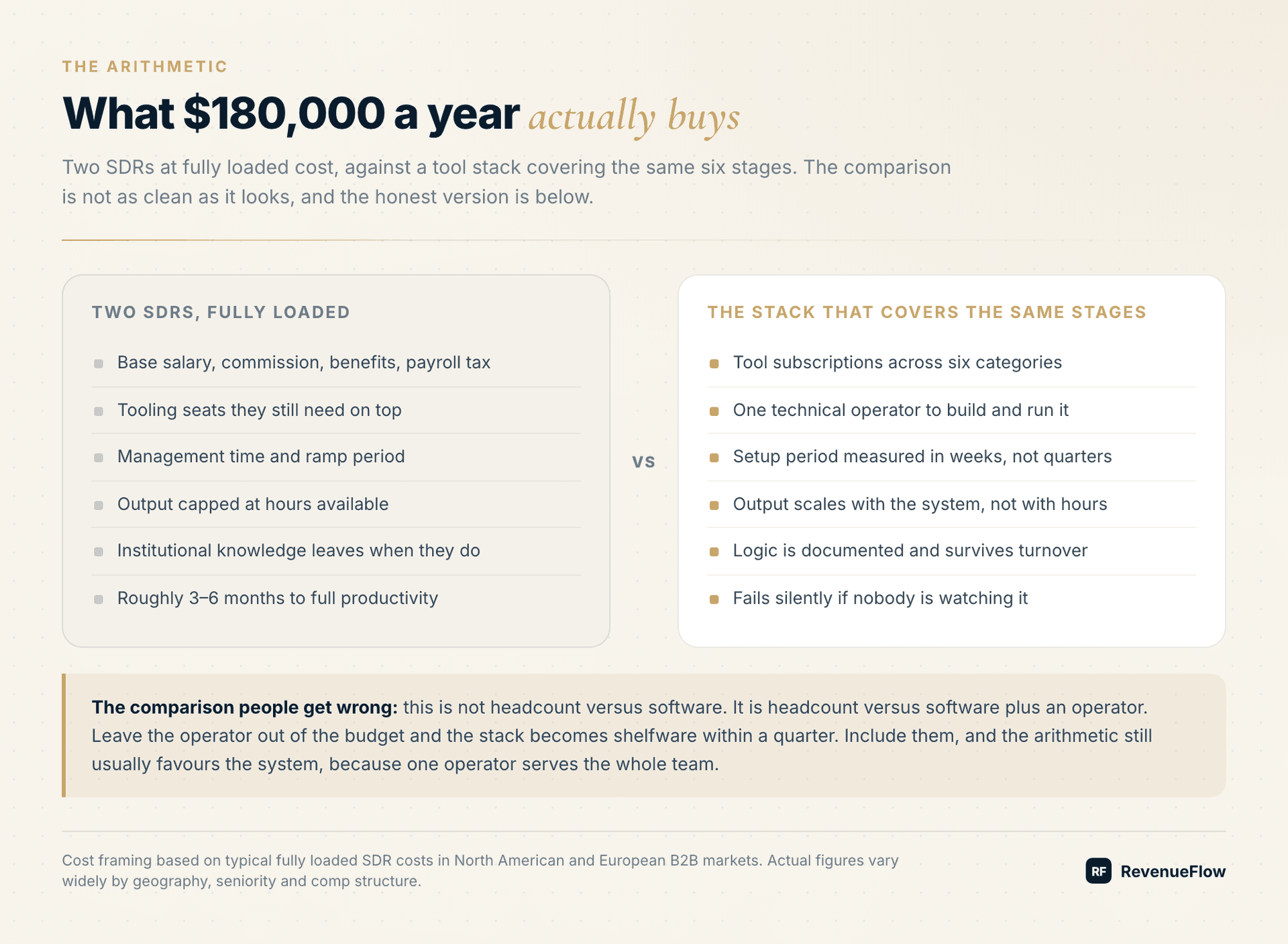
The naive comparison is headcount versus software, and software wins easily. That comparison is wrong.
The correct comparison is headcount versus software plus an operator. Someone has to build these workflows, connect six categories of tooling, and notice when a silent failure has been running for two weeks. That person is not free, and they are harder to hire than an SDR.
Include them and the arithmetic usually still favours the system, for one reason: one operator serves the entire sales team, while SDR cost scales linearly with pipeline targets.
The Arithmetic, With Invented Figures
Every number in this section is invented. Fully loaded SDR cost varies enormously by geography and comp structure, and no single figure is true across markets, so these are a shape for your own spreadsheet rather than a benchmark.
Suppose an SDR costs $90,000 a year fully loaded, meaning salary, commission, tooling, management time and the ramp period before they produce anything. Two of them is $180,000, and that number is a headline rather than a measurement.
Against that, put the stack. Suppose the tools across the six stages come to $2,500 a month, or $30,000 a year, and one operator at $120,000 fully loaded. That is $150,000, against $180,000 for the two SDRs, which looks like a narrow win and is the wrong way to read it.
The right way to read it is the second year. Doubling pipeline targets doubles the SDR line to $360,000. It adds usage to the tooling line and nothing at all to the operator line, because the same person runs the same workflows against a larger list. The system wins on the slope rather than on the intercept, and any comparison that stops at year one is measuring the least interesting number.
Two caveats keep this honest. An operator who leaves mid-build is more expensive than an SDR who leaves, because the work is less legible. And the first six months of a build produce less pipeline than two SDRs would, so the comparison only makes sense over a horizon long enough for that to wash out.
What Breaks, and How You Find Out
Two other differences matter more than the money.
Failure modes are different. An underperforming SDR is visible in a weekly pipeline review. A broken enrichment step fails silently and you find out when the month closes short. Systems need monitoring that people do not.
Knowledge persistence flips. When an SDR leaves, their understanding of what works leaves with them. When a workflow is documented in code, it does not. That is a real and underrated advantage.
- An underperforming SDR is visible in a weekly pipeline review
- When an SDR leaves, their understanding of what works leaves with them
- SDR cost scales linearly with pipeline targets
- A broken enrichment step fails silently and you find out when the month closes short
- A workflow documented in code does not leave
- One operator serves the entire sales team
The monitoring point deserves more than a bullet, because it is what sinks a build that is otherwise correct. A silent failure has no symptom until the number it feeds comes in short, and by then a month of sending has gone out against a broken list. Build the alerting before the volume: a daily count that has to be non-zero, a bounce rate that has to stay under a line, and a person whose job it is to look. That is unglamorous work and it is the difference between a system and a science project.
Deliverability belongs in the same category. A stack that sources and writes beautifully still fails if the mail lands in spam, and that failure is equally silent. The infrastructure side of it is covered in the cold email deliverability guide.
When an SDR Is Still the Right Answer
The honest version of this argument has to include the cases where it does not apply.
- Yes: You can state your ICP precisely enough to filter on
- Yes: Someone will own the build and the monitoring
- Yes: The offer already converts when it reaches the right person
- No: Your market is small enough to work by hand
- No: Deals need heavy human qualification before a meeting
- Depends: You need pipeline inside eight weeks
A vague ICP is the common disqualifier. Volume outbound tolerates a fuzzy definition because the maths carries it; a system does not work at all if you cannot say which accounts and which events matter, and no amount of tooling supplies that judgment.
A market of two hundred accounts is the other one. At that size a good salesperson working the list by hand beats any stack, and the build cost buys nothing.
What This Does Not Replace
The stack does not decide who to sell to. It does not write your offer. It does not handle a difficult conversation on a call, and it does not know when your market has shifted.
48 tools, 6 stages, 3 channels, and zero SDRs is an accurate description of the mechanical layer. It is not a description of a sales organisation.
The teams that get this right treat the system as the thing that produces qualified conversations, and keep humans firmly in charge of what happens inside them. That includes the definition of a good conversation: a meeting counts because it met criteria agreed in writing before launch, never because a dashboard says a stage advanced.
One more thing the stack does not change: how many times you touch someone. We send one message per campaign and run no bump sequences, because a second message under one somebody ignored reads as a bump whatever the automation behind it. The reasoning is in why we stopped using follow-ups.
Frequently Asked Questions
Is the cost comparison really this favourable?
Only if you include the operator. The naive comparison is headcount versus software, and that version is wrong. The correct one is headcount versus software plus the person who builds and maintains it. It usually still favours the system, because one operator serves the whole team while SDR cost scales with pipeline targets.
Which of the six stages produces the most value?
Signals, and it is the stage teams most often skip. Without it, the send date is decided by a cadence position rather than by something that happened at the account, which is the model that stopped working.
Why does waterfall enrichment beat a single provider?
Because no single database has complete coverage and the gaps are not random. They cluster around smaller companies, non-US geographies, and recently changed roles. Checking one source then the next until something returns finds contacts that any individual provider would have reported as unavailable.
What is different about how systems fail versus how people fail?
An underperforming SDR is visible in a weekly pipeline review. A broken enrichment step fails silently and you discover it when the month closes short. Systems need monitoring that people do not, and building it is not optional.
Are all 48 tools necessary?
No. The list illustrates each category rather than prescribing a stack. What you need is one working tool per stage and something connecting them. Most teams over-buy within stages and under-invest in the connections between them.
Related Reading
- Most B2B Companies Hire SDRs to Do 5 Things. Every One Can Be Automated.
- The Traditional SDR Function Is Dying. Meet the GTM Engineer.
- Why Most Sales Teams Are Still Stuck in 2015 (And the Restructure That Fixes It)
- How to build an outbound engine from scratch
We build AI-native pipeline systems and you pay per qualified meeting, not a retainer. No paying for activity. You only pay when we book you a qualified sales meeting. See if you qualify.
SDR cost figures reflect typical fully loaded costs in North American and European B2B markets and vary widely by geography and comp structure.
Frequently asked questions.
Frequently asked questions- Does automation really cost less than hiring SDRs?
- Only when the operator is included, and mainly over more than one year. Someone has to build the workflows and notice silent failures, and that person is harder to hire than an SDR. The system wins because doubling pipeline targets doubles the headcount line and adds nothing to the operator line.
- Which stage of the system delivers the most value?
- Signals, and it is the stage teams skip most often. It tracks job changes, website visits, competitor engagement and hiring surges. Without it, outreach timing is set by a cadence position rather than by account activity, which is the model that stopped working when inboxes filled up.
- Why does waterfall enrichment beat a single provider?
- No single database has complete contact coverage, and the gaps are not randomly distributed. They cluster around smaller companies, non-US geographies and people in recently changed roles. Checking one source, then the next, until verified data returns finds contacts any individual provider would have reported as unavailable.
- What are the main risks of replacing SDRs with automation?
- Systems fail silently. An underperforming SDR shows up in a weekly pipeline review, while a broken enrichment step can run undetected until the month closes short. Deliverability fails the same quiet way. Both need alerting built before the volume, and an operator who leaves mid-build is costlier than an SDR who leaves.
About the author.

Fernando Cao is CEO at RevenueFlow, which builds and operates outbound revenue engines for B2B companies. Previously at Accenture Strategy. Studied at University of Bath.
Fernando Cao · CEO
Connect on LinkedIn →Explore more.
Ready to scale your outreach?
We build GTM engines that book real meetings. See the receipts.
Related articles.
Outsourced SDR vs In-House: The Cost Math on Your Numbers
The comparison most teams run is a salary against a retainer. Here is how to build both sides fully loaded, divide by meetings held, and adjust for ramp.
Demand Generation Agency vs Cold Outbound: Which You Need
Demand gen builds awareness, outbound harvests it. 2026 pricing for both, a three-test decision rule, and the market conditions where each one fails.
Cold Email Agency: What You Get and What It Costs
What a cold email agency delivers, 2026 pricing across retainer, per-meeting and hybrid models, the in-house comparison, and when hiring one is wrong.
Cross-Sell vs Upsell: Different Trigger, Different Owner
An upsell has a trigger that arrives on its own. A cross-sell has none and needs a diagnosis somebody funds. That is the difference that decides the work.
PartnerStack Alternatives, Priced Five Ways
Every page ranking for a PartnerStack alternative sells one. These five are grouped by how they charge, with each rate read off the vendor's own page.
Monthly Sales Meeting Agenda: What the Month Decides
The weekly meeting triages deals in flight. The monthly one closes a period and changes the list. Six blocks, ninety minutes, one output each.