PartnerStack Alternatives, Priced Five Ways
Every page ranking for a PartnerStack alternative sells one. These five are grouped by how they charge, with each rate read off the vendor's own page.

The real PartnerStack alternatives divide by billing axis rather than by feature list. Partnero and Introw charge per programme and per seat, Kiflo charges per active partner, PartnerTap publishes no rate and no limits, and Crossbeam prices a platform fee plus seat and usage meters for a different job entirely.
Key takeaways
- The billing axis decides the bill: per programme and seat, per active partner, or as a share of the commissions a programme actually pays out.
- Partnero publishes the fullest ladder, from $49 a month billed annually with additional seats at $29 a month and an Enterprise tier its answers place at $599 a month.
- Kiflo publishes $399 a month for twenty five partners and states that the rate scales with active partners up to a fifty partner cap.
- Crossbeam appears in most roundups for this query and is not a substitute, because it maps partner account overlap rather than running commissions and payouts.
Reviewed and updated September 2, 2026
Nearly every page ranking for a PartnerStack alternative was written by a company that sells one. That is the shape of the result set rather than a grievance about it. On 2 September 2026 the first page returned five partner platform vendors, an analyst review property, a Reddit thread and PartnerStack's own comparison page. Each of those vendors is free to choose which contract it quotes and which capability it measures on, and none of them is going to tell you that the anchor is fine.
So this is built the other way round. Every figure below was read off the vendor's own pricing page on 2 September 2026, and the platforms are grouped by how they charge rather than by who ranks. That turns out to be the useful axis, because the five real options price a partner programme in five genuinely different ways, and the cheapest one on paper is the most expensive one for a large share of the programmes reading this.
First, what you are replacing
PartnerStack quotes its three platform plans and publishes the whole model for a separate self serve product. Launch, Growth and Enterprise each sit behind a demo request with no rate attached, and its own answers state that "Pricing is based on your partner program size, feature needs, and level of support". A separate product called Spark publishes its commercial model in two lines: "$0 per month subscription fee" plus a "10% processing fee on commissions you pay out", with the page adding "You only pay when your partners make you money".
Two published details decide whether a replacement is even the right move. The Launch plan's feature list opens with "Affiliate link tracking or lead and deal registration", followed by the instruction "Select one that best suits your program needs". The Enterprise list resolves that with "Full access to link tracking, lead, and deal registration". So the capability a mixed programme needs is a top tier feature, which our read of the PartnerStack ladder covers in full. And its answers state that "Spark does not include access to the PartnerStack Network of more than 117,000 B2B partners", so the free entry point is a tool rather than a recruitment channel.
Those two facts explain most of the traffic on this query. Teams do not usually leave because the platform is bad. They leave because they hit the either or at the entry tier, or because they wanted the network and bought the product without it.
The five ways this category charges

Group the alternatives by billing axis and the comparison stops being a feature checklist.
A subscription per programme and per seat. Partnero publishes the most complete ladder of the group. Its own answers state that "Starter is $49/mo billed annually or $59/mo billed monthly", covering one programme and one team member, with Partner at $159 a month billed annually or $199 billed monthly for three programmes and three team members. It states that "Additional seats cost $29/month per user" on any plan and that "Enterprise starts at $599/mo and scales based on the number of programs", team members and integrations. It also states that "All plans include unlimited partners, transactions, and revenue with no overage fees", alongside a thirty day free trial and annual billing described as two months free.
A subscription per active partner. Kiflo publishes a single entry rate and then scales it on the thing that actually grows. Core is $399 a month for twenty five partners, and the card states directly that "Price scales with active partners, up to a 50-partner cap", with a Plus tier above that. Yearly billing is labelled on the same page as saving ten percent. Its own answers position it against enterprise partner relationship management suites, saying "it deploys in days, starts at $399/mo".
A published free tier and quotes above it. Introw publishes a free Starter plan described as "Best for people who want to try out Introw for free", with one seat and a partner portal for one partner, including customer relationship manager integration, deal and lead registration and Slack integration. Pro, Scale and Enterprise carry no rate and route to a demo. Its comparison table publishes the tier contents anyway, which is where the useful detail sits: marketing development funds, configure price quote and affiliate functionality are add ons at every paid tier rather than tier features, and the commission payout fee is marked absent on Starter and Pro, percentage based on Scale and custom on Enterprise.
No published rate, and no published limits either. PartnerTap's pricing page, fetched the same day, publishes neither a price nor a ladder. What it publishes instead is a position: "No hidden data consumption fees. No pricing surprises at renewals", above the line "Every paid edition includes UNLIMITED USERS, UNLIMITED PARTNERS, UNLIMITED DATA, and UNLIMITED REPORT DOWNLOADS". That is the opposite kind of opacity from PartnerStack's, which publishes every feature limit and no rate.
A platform fee plus metered seats and usage. Crossbeam publishes a free tier with up to three full access seats, a Connector plan at $4,800 a year including one full access seat, further seats at $1,800 per user per year, and sales seats at $40 per user per month on Supernode and Enterprise, the two tiers Crossbeam prices on request. It also runs a credit meter for artificial intelligence access at a published rate its page gives as "Flat $0.10 per credit".
- A tier grants a number of programmes and a number of team members
- Extra seats have their own published or quoted rate
- Partner counts are unlimited or unstated
- Add-on modules sit outside the tier
- The entry rate covers a stated partner count
- The rate rises as active partners rise, up to a published cap
- Seats are not the variable that moves the bill
- A higher tier takes over above the cap
- Spark charges a share of commissions actually paid out
- No subscription fee on that product at all
- Crossbeam charges a platform fee plus per seat and per credit meters
- Both make the bill follow activity rather than headcount
Crossbeam is on this list for the wrong reason, and that matters
Crossbeam appears in most alternative roundups for this query and it is not a substitute. PartnerStack runs the programme: recruitment, tiering, commission structures and payouts. Crossbeam maps accounts, telling you which of your prospects your partners already sell to. A team that swaps one for the other loses the payout engine or loses the overlap data, depending on the direction.
The clearest evidence for that is on a third vendor's page. Introw lists a Crossbeam integration on its own paid tier rather than a Crossbeam replacement, which is what a company does with an adjacent product rather than a rival one. Read the roundups accordingly: a list that puts account mapping and commission payouts in the same table is answering a category question, not a replacement one.
If overlap data is genuinely what you were missing, the account mapping layer inside a partner programme is a separate purchase to plan rather than a cheaper version of the one you have.
Which axis suits which programme
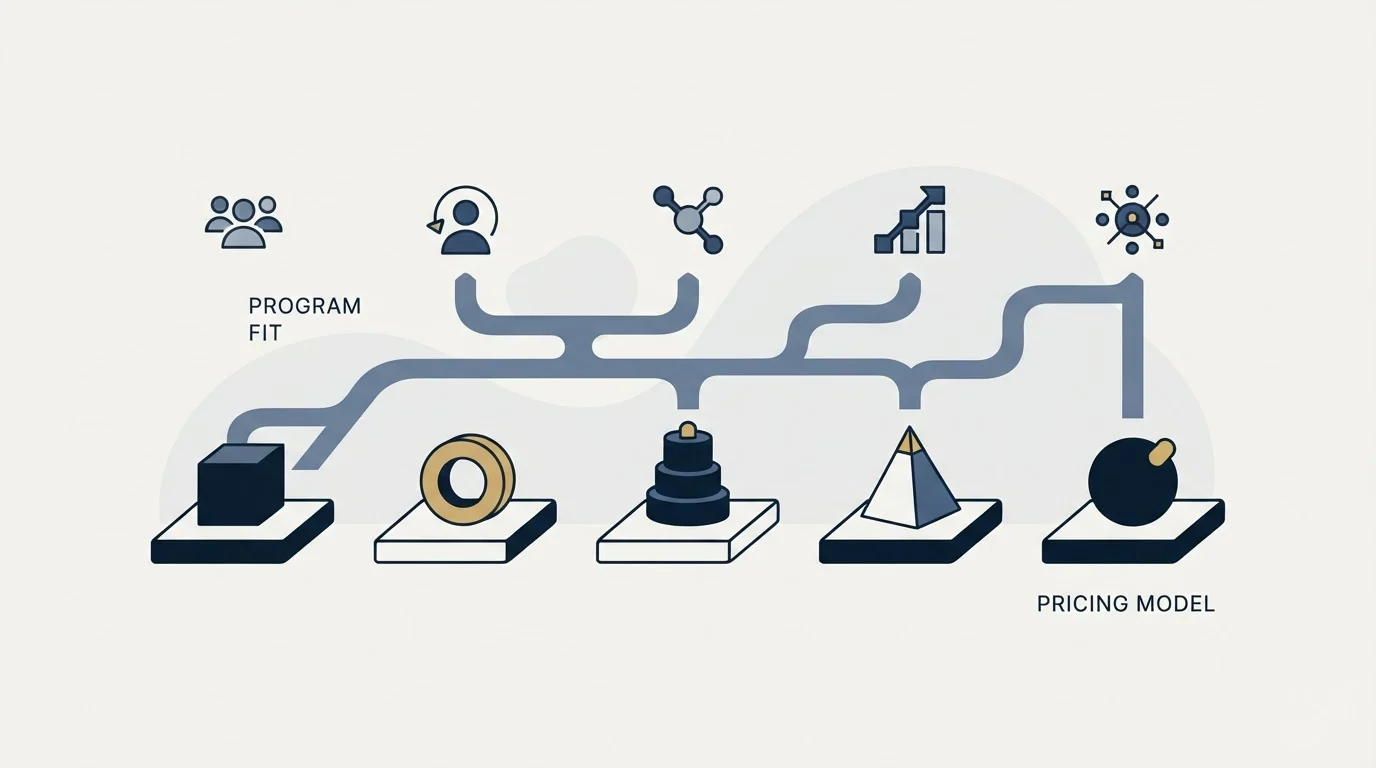
The billing axis, not the feature list, is what determines whether a platform gets cheaper or more expensive as your programme works.
A programme with a handful of high value reseller partners and a long sales cycle is punished by per partner pricing and served well by per seat pricing. A programme with hundreds of affiliates and a self serve product is the reverse: per partner pricing at scale is painful, and a share of paid commissions tracks the value of the channel exactly. A programme still deciding which of those it is should not be buying a subscription in either shape, which is what makes the outcome priced entry points genuinely useful rather than merely cheap.
The trap in the outcome priced model is a share of commissions on a channel that works. A programme paying out substantial commissions is paying a percentage of a growing number forever, and at some point a fixed subscription is cheaper. That crossover is arithmetic you can do in advance from your own payout forecast, and it is the single most useful thing to compute before signing anything in this category. The same crossover governs pay per lead affiliate structures that need no platform at all.
- Yes: Whether the programme runs affiliate links, registered deals, or both at once
- Yes: How many active partners the programme will carry in twelve months
- Yes: Whether partner recruitment needs a marketplace or only existing relationships
- Yes: The forecast commission payout, which is what an outcome priced model charges against
- Yes: How many internal people need to operate the platform rather than see its output
- Depends: Whether marketing development funds and quoting are needed, since several vendors sell them as add-ons
What each one publishes about the awkward parts
Three details are worth reading on every vendor page in this category, because they are where a comparison built on headline rates goes wrong.
Payout mechanics. Partnero publishes two routes: automate payouts through your own PayPal or Wise account with no additional platform fee, or take a single invoice carrying a payout processing fee it states as seven percent. PartnerStack's Spark publishes a single route, a "10% processing fee on commissions you pay out". Introw lists a commission payout fee on its Scale tier as percentage based without publishing the percentage. That is three different answers to the same question and it moves real money.
Add ons versus inclusions. Introw's own comparison table marks marketing development funds, configure price quote and affiliate functionality as add ons at every paid tier. PartnerStack places marketing development fund management and its learning system at its middle tier and above. Kiflo lists account mapping, lead and deal registration and commission automation inside its entry rate. A feature that is a tier boundary at one vendor is an add on at another and included at a third.
Seat and partner counts. Partnero includes one team member on its entry plan and prices additions. Introw includes one seat free and three on its first paid tier. Crossbeam includes three seats free and one on its entry paid plan. PartnerStack's own answers go the other way entirely: "You can invite as many internal users as you need", and on partners, "We don't want to limit your program potential". That range is wide enough that a five person partner team gets a different answer from every vendor here.
One vendor could not be read. Allbound's pricing path, fetched on 2 September 2026, returned a security challenge redirect rather than a page, so nothing about its current terms is stated here. An unfetchable page is a fact we do not have rather than evidence that a rate is unpublished.
- Step 1Name the motion
Affiliate links, registered deals, or both. The anchor platform makes you pick one at its entry tier, and that boundary is why most of this traffic exists.
- Step 2Forecast partners and payouts
Active partner count prices one group of vendors and commission payout prices another. Both numbers come from your own plan, not from a demo.
- Step 3Match the axis, then read features
Pick the vendors whose billing axis suits the forecast, then compare capability inside that shortlist rather than across all of them.
- Step 4Read payout mechanics last and hardest
Processing routes and fees differ across every vendor here, and they are the line item that grows with the channel's success.
The short version

The alternatives that matter divide by how they charge. Partnero publishes a full ladder priced on programmes and seats, its answers giving "Starter is $49/mo billed annually or $59/mo billed monthly", additional seats at $29 a month and an Enterprise tier it places at $599 a month. Kiflo publishes $399 a month for twenty five partners and states that "Price scales with active partners, up to a 50-partner cap". Introw publishes a free tier and quotes everything above it, with several capabilities sold as add ons. PartnerTap, on the page fetched here, publishes no rate and no limits, stating "Every paid edition includes UNLIMITED USERS, UNLIMITED PARTNERS, UNLIMITED DATA, and UNLIMITED REPORT DOWNLOADS". Crossbeam is a different category and belongs on a shortlist only when account mapping was the missing piece.
The anchor itself publishes nothing for its three platform tiers and everything for its outcome priced entry product, whose whole model is "$0 per month subscription fee" plus a "10% processing fee on commissions you pay out". Which means the real comparison is not PartnerStack against a rival. It is a subscription against a share of what your partners earn you, and that crossover is computable from your own payout forecast before a single demo is booked.
Partner programmes are slow assets, and recruiting partners is an outbound problem before it is a software one. RevenueFlow runs cold email and LinkedIn against a named list and charges per attended qualified meeting, one message per campaign with no bumps and no thread replies, against criteria agreed in writing before launch. Where the quarter needs pipeline while the channel is being built, you can see what a first campaign produces, and deal registration is the mechanism that keeps partner sourced and directly sourced opportunities from colliding once both are running.
Rates, tier contents, payout mechanics and add-on positions above are taken from partnerstack.com, partnero.com, kiflo.com, introw.io, partnertap.com and crossbeam.com, each fetched 2 September 2026, with dated snapshots retained. Allbound's pricing path was not reachable at that fetch and no term of its is stated. Verify current terms with each vendor before relying on them.
Frequently asked questions.
Frequently asked questions- What is the closest alternative to PartnerStack?
- It depends on the motion. For an affiliate or referral programme priced on a subscription, Partnero publishes the fullest comparable ladder. For a reseller programme where partner count is the variable, Kiflo prices on active partners. For a customer relationship manager first partner portal, Introw publishes a free tier and quotes everything above it.
- Is there a free PartnerStack alternative?
- Introw publishes a free Starter plan with one seat and a partner portal for a single partner, including CRM integration and deal and lead registration, read from its own pricing page on 2 September 2026. PartnerStack's own Spark product also carries no subscription fee and charges a share of commissions paid out instead, though it excludes access to the partner network.
- Is Crossbeam a PartnerStack alternative?
- Not really. PartnerStack runs the programme itself, covering recruitment, tiering, commissions and payouts. Crossbeam maps which accounts your partners already sell to. They are adjacent rather than interchangeable, and one indication is that Introw lists a Crossbeam integration on its own paid tier rather than positioning itself as a Crossbeam replacement.
- How do payout fees differ between these platforms?
- Widely, and it is the line that grows with the channel. Partnero publishes two routes, automating through your own PayPal or Wise account with no extra platform fee, or a single invoice carrying a stated processing fee. PartnerStack's Spark charges a share of commissions paid out. Introw lists a commission payout fee on its Scale tier as percentage based without publishing the percentage.
About the author.

Ben Carden is CRO at RevenueFlow, which builds and operates outbound revenue engines for B2B companies. Previously at Gartner Enterprise. Studied at London School of Economics.
Ben Carden · CRO
Connect on LinkedIn →Explore more.
Ready to scale your outreach?
We build GTM engines that book real meetings. See the receipts.
Related articles.
Sales Process Mapping: Draw What Happens, Not What Should
Every company has two processes: the one people describe and the one the records show. Mapping is worth the days it takes when it captures the gap between them.
The Complete B2B Sales Tool Stack: How 47 Tools Connect
A visual guide to the B2B sales tool ecosystem. See how email sending, data enrichment, warmup, CRM, and sales engagement tools fit together in an outbound workflow.
The ROI of Cold Email: Revenue Per Dollar Spent by Industry
Cold email delivers 36-44x ROI on average. This analysis breaks down revenue per dollar spent across 10 industries, with cost models and ROI calculators for different team sizes.
Cold Email Pricing Guide 2026: What Every Tool Costs
Side-by-side pricing for all 48 B2B sales tools. Total cost of ownership calculations by team size and budget recommendations by company stage.
Email Deliverability in 2026: What Actually Works
A technical guide to email deliverability for cold outreach. SPF, DKIM, DMARC explained, warmup strategies that work, and the metrics that matter for inbox placement.
Cross-Sell vs Upsell: Different Trigger, Different Owner
An upsell has a trigger that arrives on its own. A cross-sell has none and needs a diagnosis somebody funds. That is the difference that decides the work.