Sales Teams Stuck in 2015: The Restructure That Fixes It
A $30M fintech was closing deals while its SDRs scraped LinkedIn by hand. The problem was not effort or tooling. It was that every rep owned the entire chain, from list building to closing.
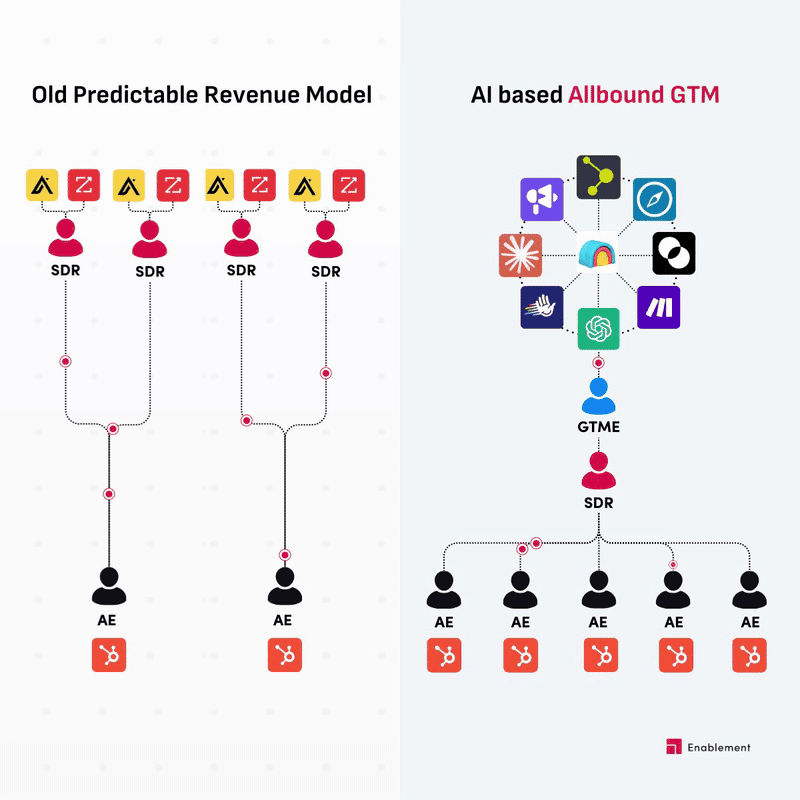
Most sales teams waste expensive selling time on low-leverage data work because every rep owns the entire prospecting chain. The fix is structural: split the chain into two roles. A technical owner centralizes list building, enrichment, deduplication, and sequence automation for the entire team. Sales reps focus exclusively on high-leverage activities: calling, discovery, objection handling, and closing. This structure became viable in 2026 because enrichment waterfalls, AI qualification, and deliverability monitoring matured into reliable product categories.
Key takeaways
- A $30M fintech had SDRs spending half their week on data entry and list building, with multiple reps hitting the same prospects due to lack of coordination.
- An $80,000-per-year SDR doing manual list work is performing $15-per-hour tasks with $40-per-hour time, creating significant hidden cost at scale.
- Centralizing lead sourcing under one technical owner removes duplicate outreach as a structural side effect, because there is now one source of lists instead of multiple reps building overlapping targets.
- The restructure became viable in 2026 because enrichment waterfalls, AI qualification, sequence generation, and deliverability monitoring matured into reliable product categories that one person can operate.
- Teams implementing this split can reach similar pipeline numbers with meaningfully smaller SDR headcount, though the exact reduction depends on how much rep time currently goes to data work.
Reviewed and updated September 5, 2026
Why Most Sales Teams Are Still Stuck in 2015
I spoke with the sales leader of a $30M fintech recently, and the conversation clarified something I had been circling for months.
They were closing deals. Revenue was growing. By any outcome measure the team was performing.
Their SDRs were also manually scraping LinkedIn like it was a full-time job. Which, functionally, it was.
The Situation
Four things stood out from that conversation:
- Around 60% of their leads came from outbound sales effort
- Multiple reps were hitting the same prospects, with no coordination between them
- SDRs were spending most of their day on data entry rather than selling
- There was essentially no AI leverage anywhere in the go-to-market motion
That third point is the one that should bother you. Not because data entry is beneath anyone, but because of what it costs.
An $80,000-a-year SDR spending half their week on list building and enrichment is doing roughly $15-an-hour work with $40-an-hour time. Multiply that across a team and the number gets serious quickly.
The Structural Problem
Teams who report that manual lead generation is not effective have usually measured the output rather than the input, and the input is the finding: the work is being done by the most expensive people available, in the hours they were hired to sell in.
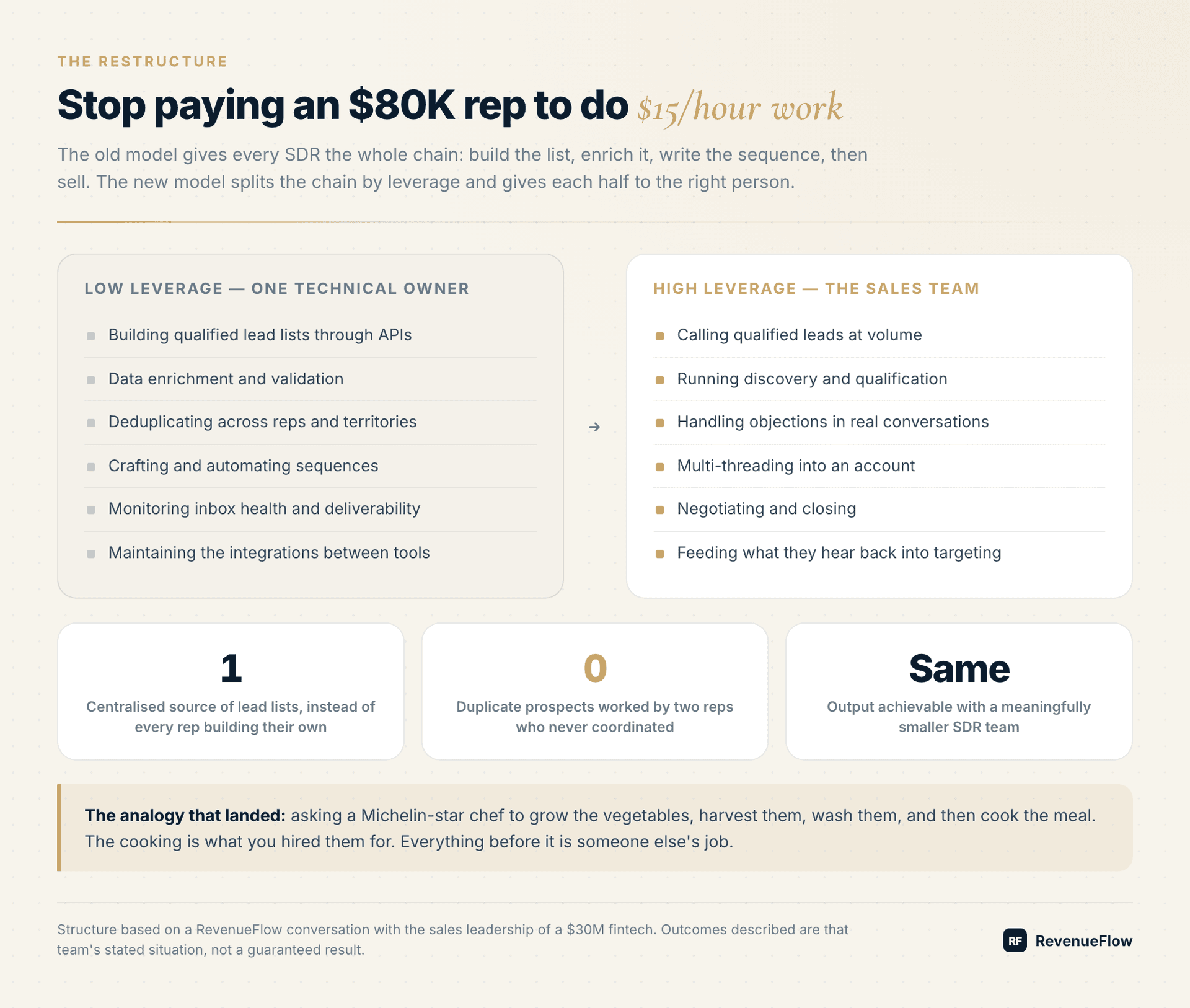
The old model hands every SDR the entire chain. Build the list. Enrich it. Write the sequences. Send them. Then, if there is time left, actually sell.
It is like asking a Michelin-star chef to grow their own vegetables, harvest them, wash them, and then cook the meal. Every step is necessary. Only one of them is what you hired the chef for.
The coordination failure follows directly from this. When every rep builds their own list, multiple reps inevitably build overlapping lists. The sales leader put it plainly: they had not really thought about centralising lead sourcing, and they were guilty of everyone hitting similar people.
That is not a discipline problem. It is what the structure produces.
The Restructure
Advice on how to build a high-performing sales team almost always means hiring more of the same shape, and the restructure below is the alternative: change what the existing people spend their week on before you change how many of them there are.
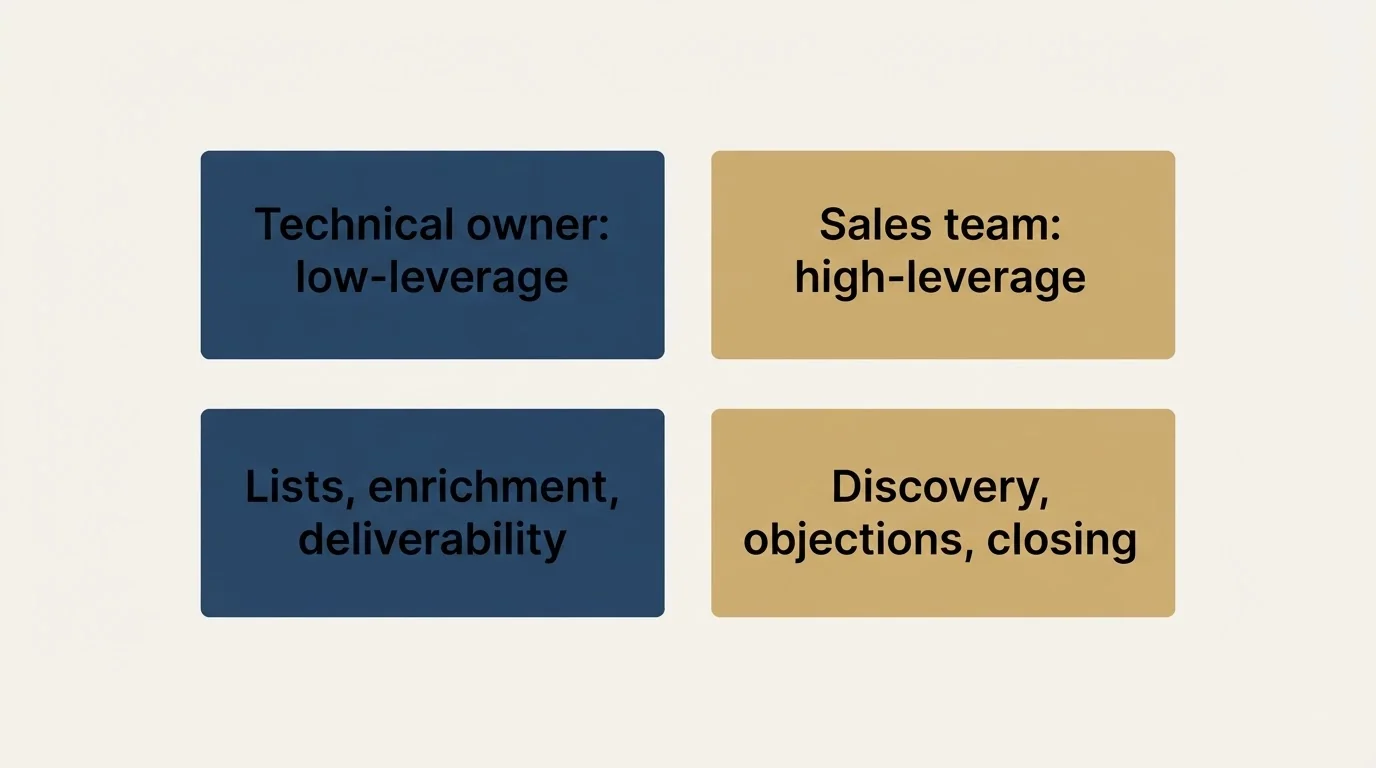
Separate the chain by leverage, then give each half to the right person.
A technical owner handles the low-leverage half. Building qualified lead lists through APIs. Data enrichment and validation. Deduplication across the whole team. Crafting and automating message sequences. Monitoring deliverability. Maintaining the connections between tools.
This is one person, or one person's partial capacity, serving the entire sales team. Centralising it removes the duplicate-outreach problem as a side effect, because there is now one source of lists rather than six.
The sales team handles the high-leverage half. Calling qualified leads at volume. Discovery. Objections. Multi-threading. Closing. Feeding what they hear on calls back into the targeting.
The output claim I would make carefully: teams that do this can hit similar pipeline numbers with a meaningfully smaller SDR headcount. The specific reduction depends entirely on how much of your reps' time is currently going to data work, which varies enormously between companies.
What Makes This Hard In Practice
Three things, and they are worth knowing before you start.
- No: You need to hire a profile you probably do not have
- No: Reps lose the context that list building gave them
- No: Centralisation creates a single point of failure
You need to hire a profile you probably do not have. The technical owner is not a senior SDR with an automation certificate. They need to be comfortable with APIs, data, and debugging. That role sits awkwardly between sales and engineering in most org charts, and it reports to a sales leader who cannot evaluate the work directly.
Reps lose the context that list building gave them. Building your own list teaches you what a good account looks like. Take it away and reps can end up dialling numbers they do not understand. The fix is deliberate: the technical owner has to share why accounts were selected, not just hand over rows.
Centralisation creates a single point of failure. When one person owns lead flow for the whole team, their absence stops the team. Document the workflows early, and make sure at least one other person can run them.
Why Now Rather Than Five Years Ago
The reason this restructure works in 2026 and would not have in 2018 is that the low-leverage half became genuinely automatable.
Enrichment waterfalls, AI qualification, sequence generation, and deliverability monitoring are all mature product categories now. One technical person with those tools can produce more qualified list volume than a room of people doing it manually.
That changes the arithmetic. You are not moving work from expensive people to cheap people. You are moving work from people to software, and keeping one person to operate the software.
The Question Worth Asking
Look at what your highest-paid sales people did last week. Not what their job description says. What they actually did with their hours.
If a meaningful share of it was work that a script could do, you are not paying for selling. You are paying for data processing at a sales salary.
In 2026, if your SDRs are still manually scraping LinkedIn, that is a structural choice, not a tooling constraint.
Splitting The Chain
| Task | Old model | New model | Why it moves |
|---|---|---|---|
| List building | Every rep, individually | One technical owner | Removes duplicate outreach entirely |
| Enrichment | Every rep, manually | One technical owner | Waterfall coverage beats manual lookup |
| Sequence writing | Every rep | One technical owner | Components get tested, not guessed |
| Deliverability | Nobody | One technical owner | Currently invisible until it breaks |
| Calling | Reps, when there is time | Reps, all day | The job you actually hired for |
| Discovery and closing | Reps | Reps | Never automatable |
Frequently Asked Questions
Who should own the centralised lead sourcing?
Someone comfortable with APIs and data who also understands what makes a sales message land. That combination is rare, which is why promoting a curious SDR who has already been automating parts of their own job usually beats hiring externally for technical skill alone.
Will this reduce headcount?
It can, and the honest answer is that the reduction depends entirely on how much of your reps' current time goes to data work. Teams where that is half the week see large changes. Teams where it is 10% see very little. Audit before you plan around a number.
What is the risk of centralising list building?
A single point of failure, and reps losing the context that building their own lists gave them. Fix the first with documentation and a backup operator. Fix the second by having the technical owner explain why accounts were selected, not just hand over rows.
How is this different from just buying better tools?
Tools do not change who does the work. A team where every rep owns the whole chain will use a better tool to do the same low-leverage tasks slightly faster. The restructure is the change; the tooling is what makes it possible.
Where do I start?
Look at what your highest-paid sales people actually did last week, not what their job description says. If a meaningful share was work a script could do, you have found both the problem and the business case.
Related Reading
- The Traditional SDR Function Is Dying. Meet the GTM Engineer.
- Most B2B Companies Hire SDRs to Do 5 Things. Every One Can Be Automated.
- What Is a GTM Engineer? The Role, the Stack, and What They Actually Get Paid
We build AI-native pipeline systems and you pay per qualified meeting, not a retainer. No paying for activity. You only pay when we book you a qualified sales meeting. See if you qualify.
Frequently asked questions.
Frequently asked questions- Why are sales reps still doing manual data work in 2026?
- The traditional model assigns every SDR the entire prospecting chain: list building, enrichment, sequence writing, and selling. This structure treats data work as individual rep responsibility rather than a technical function. When each rep builds their own lists manually, they inevitably spend half their week on tasks that cost $15 per hour while being paid $40 per hour. The problem is structural, not a lack of effort or awareness, because the old org chart produces this outcome by default.
- How does centralizing lead sourcing stop duplicate outreach?
- When every rep builds their own prospect list, multiple reps inevitably target the same accounts with no coordination. Centralizing list building under one technical owner creates a single source of lead flow for the entire team. Deduplication happens automatically because there is only one person generating lists, not six reps working in parallel. This is a structural side effect of the reorganization, not a discipline intervention or additional tooling layer.
- What skills does the technical owner role actually require?
- The technical owner must be comfortable with APIs, data pipelines, and debugging, not just sales automation tools. They handle enrichment waterfalls, data validation, sequence automation, deliverability monitoring, and tool integrations for the entire sales team. This profile sits awkwardly between sales and engineering in most org charts. The role is not a senior SDR with certifications; it requires genuine technical fluency. Many companies succeed by promoting a curious SDR who has already been automating their own workflows.
- What breaks when you take list building away from sales reps?
- Reps lose the context that building their own lists provided. Manually researching accounts teaches pattern recognition: what good targets look like and why they matter. When reps only receive finished lists, they can end up calling numbers they do not understand. The fix is deliberate knowledge transfer: the technical owner must share why accounts were selected and what signals qualified them, not just hand over spreadsheet rows. Without this, reps dial blindly.
- Why does this restructure work now but would not have worked in 2018?
- The low-leverage half of the sales chain became genuinely automatable. Enrichment waterfalls, AI-powered qualification, sequence generation, and deliverability monitoring are now mature, reliable product categories. One technical person operating these tools can produce more qualified lead volume than a room of people working manually. The arithmetic changed: you are not moving work from expensive people to cheaper people, but from people to software, with one operator managing the system. That shift was not viable five years ago.
About the author.

Ben Carden is CRO at RevenueFlow, which builds and operates outbound revenue engines for B2B companies. Previously at Gartner Enterprise. Studied at London School of Economics.
Ben Carden · CRO
Connect on LinkedIn →Explore more.
Ready to scale your outreach?
We build GTM engines that book real meetings. See the receipts.
Related articles.
Outsourced SDR vs In-House: The Cost Math on Your Numbers
The comparison most teams run is a salary against a retainer. Here is how to build both sides fully loaded, divide by meetings held, and adjust for ramp.
Demand Generation Agency vs Cold Outbound: Which You Need
Demand gen builds awareness, outbound harvests it. 2026 pricing for both, a three-test decision rule, and the market conditions where each one fails.
Cold Email Agency: What You Get and What It Costs
What a cold email agency delivers, 2026 pricing across retainer, per-meeting and hybrid models, the in-house comparison, and when hiring one is wrong.
Cross-Sell vs Upsell: Different Trigger, Different Owner
An upsell has a trigger that arrives on its own. A cross-sell has none and needs a diagnosis somebody funds. That is the difference that decides the work.
Xactly Competitors: Nobody Publishes a Price
Five sales compensation platforms, none publishing a rate. What their own pages say about the unit each bills on, the setup fee, and what sits outside the subscription.
PartnerStack Alternatives, Priced Five Ways
Every page ranking for a PartnerStack alternative sells one. These five are grouped by how they charge, with each rate read off the vendor's own page.