Demand Generation Agency vs Cold Outbound: Which You Need
Demand gen builds awareness, outbound harvests it. 2026 pricing for both, a three-test decision rule, and the market conditions where each one fails.
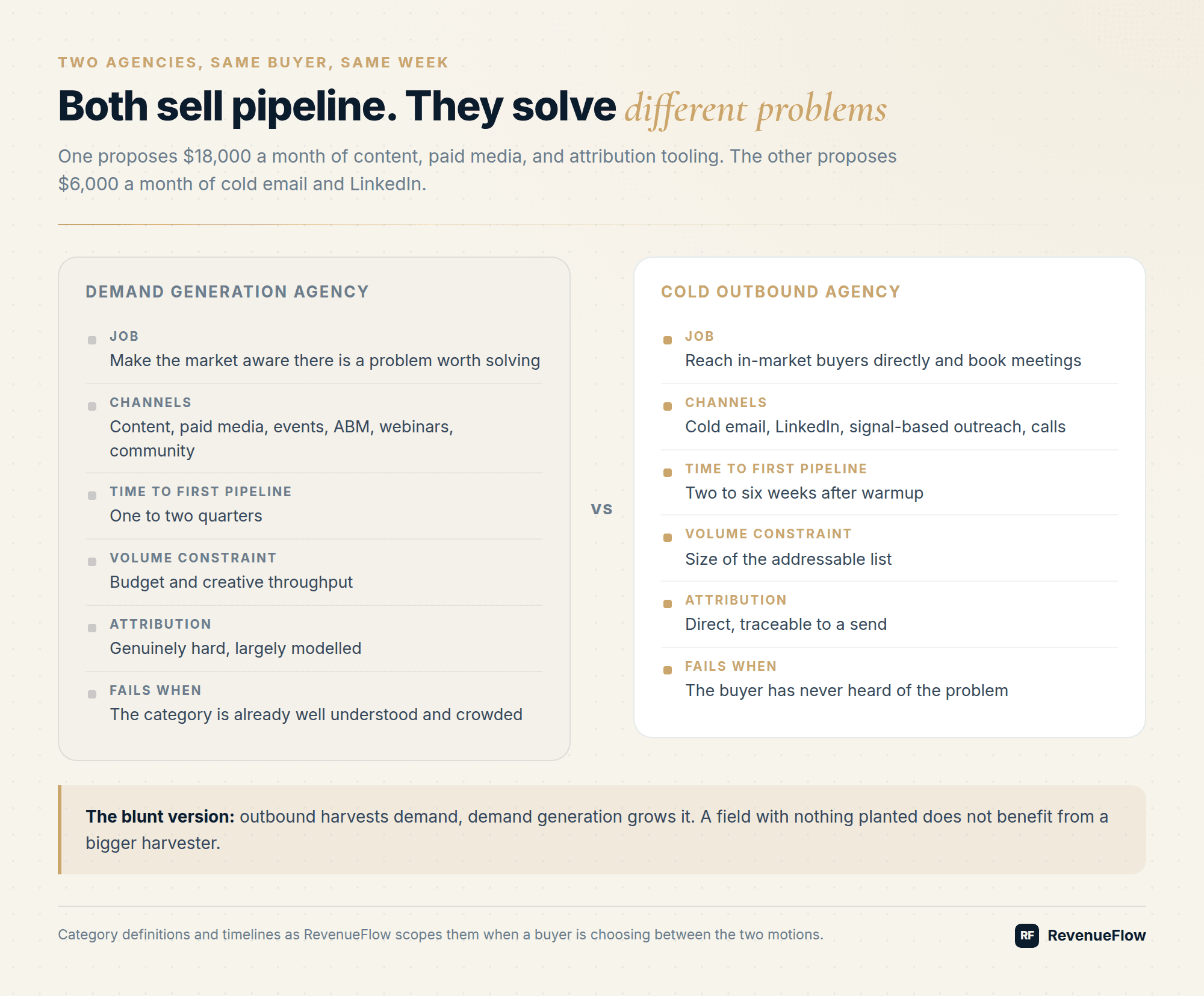
Demand generation builds awareness among buyers who are not yet shopping, and cold outbound reaches buyers who already are. Outbound produces pipeline in weeks and demand generation in quarters. The deciding question is whether your buyer already knows they have the problem, tested by search volume, named competitors and reply content.
Key takeaways
- Outbound harvests existing demand and demand generation grows it, which changes the mechanism, the time to first pipeline and how each is measured.
- Demand generation retainers commonly run several times an outbound retainer and usually carry media spend on top plus a three-month minimum.
- Three tests decide it: search volume on the category term, whether buyers can name five funded competitors, and what the negative replies actually say.
- Outbound fails in unformed categories, in markets under roughly 1,500 accounts, and where meetings arrive but do not close.
Reviewed and updated September 5, 2026
Demand Generation Agency vs Cold Outbound: Which One You Actually Need
Two agencies pitch the same buyer in the same week. One proposes $18,000 a month of content, paid media, and attribution tooling. The other proposes $6,000 a month of cold email and LinkedIn. Both are selling pipeline. They are solving different problems, and picking the wrong one wastes two quarters.
This page defines the difference precisely, prices both, and gives a decision rule that does not depend on which agency you happen to be talking to.
The actual difference
The question is usually put as the difference between lead generation and demand generation, and it is worth answering in the terms that decide a budget rather than as a pair of definitions.
Demand generation creates awareness and interest in a category among buyers who are not yet shopping. Lead generation and outbound capture interest that already exists and convert it into a conversation.
Demand generation in digital marketing is the same practice under a wider label, covering the paid, content, event and social work that builds awareness before anybody is shopping, and the boundary above holds whichever channel is doing the building.
That is not a semantic distinction. It changes the mechanism, the time to first revenue, and the way you measure success.
| Demand generation agency | Cold outbound agency | |
|---|---|---|
| Job | Make the market aware there is a problem worth solving | Reach in-market buyers directly and book meetings |
| Channels | Content, paid media, events, ABM, webinars, community | Cold email, LinkedIn, signal-based outreach, calls |
| Time to first pipeline | One to two quarters | Two to six weeks after warmup |
| Volume constraint | Budget and creative throughput | Size of the addressable list |
| Attribution | Genuinely hard, largely modelled | Direct, traceable to a send |
| Fails when | The category is already well understood and crowded | The buyer has never heard of the problem |
The blunt version: outbound harvests demand, demand generation grows it. A field with nothing planted does not benefit from a bigger harvester.
Planting and harvesting are genuinely different jobs, and the demand generation definition draws that boundary before any agency conversation starts.
What a demand generation agency costs in 2026
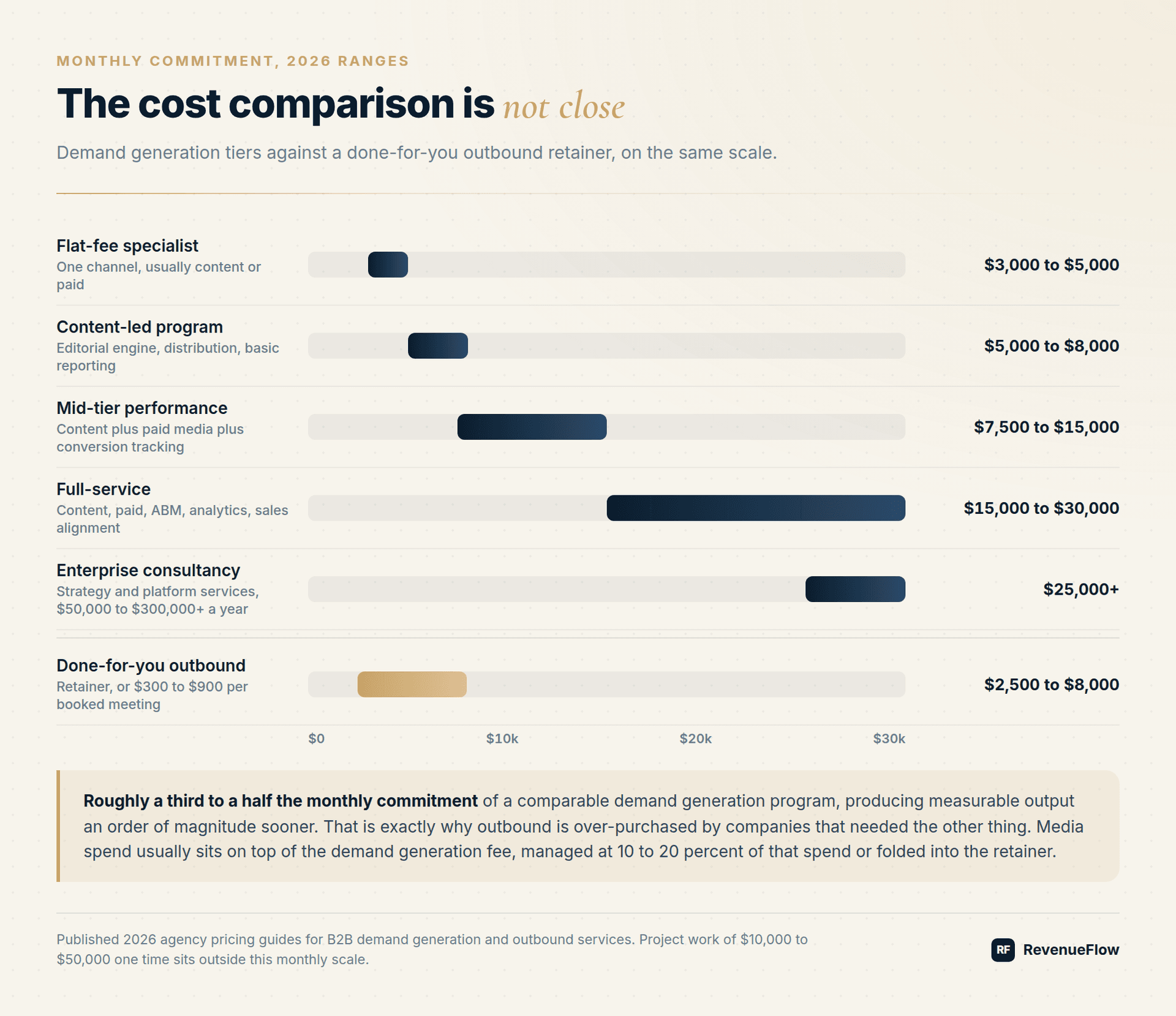
| Tier | Typical range | Scope |
|---|---|---|
| Flat-fee specialist | $3,000 to $5,000/mo | One channel, usually content or paid |
| Content-led program | $5,000 to $8,000/mo | Editorial engine, distribution, basic reporting |
| Mid-tier performance | $7,500 to $15,000/mo | Content plus paid media plus conversion tracking |
| Full-service | $15,000 to $30,000/mo | Content, paid, ABM, analytics, sales alignment |
| Enterprise consultancy | $25,000+/mo | Strategy, platform services, $50,000 to $300,000+ annually |
| Project work | $10,000 to $50,000 one time | Positioning, campaign build, site rebuild |
Two things get missed. First, media spend usually sits on top of the fee, and management is charged at 10 to 20 percent of that spend or folded into the retainer. Second, retainers almost always carry a three-month minimum with a paid ramp month.
For comparison, a done-for-you outbound program runs $2,500 to $8,000 a month on retainer or $300 to $900 per booked meeting. Full ranges are in what a B2B lead generation agency actually costs and cold email agency pricing.
So the honest cost comparison is not close: outbound is roughly a third to a half the monthly commitment of a comparable demand generation program, and it produces measurable output an order of magnitude sooner. That is exactly why outbound is over-purchased by companies that needed the other thing.
What each retainer actually buys
Two retainers of similar size can deliver very different amounts of work, and the line item that separates them is human hours against media spend.
A demand generation retainer is mostly people: strategists, writers, designers, paid media managers. Media spend usually sits on top, and management is charged either at 10 to 20 percent of that spend or folded into the fee. Ask for the split before signing, because a retainer whose budget is mostly media management is a paid media engagement wearing a demand generation label, and it has a much shorter feedback loop than the awareness work the pitch described.
An outbound retainer is mostly infrastructure and list: sending domains and mailboxes, data and verification, copy, and the operator running it. The tell of a serious one is that the sending capacity is discussed at all. A programme that plans to send from three mailboxes is a programme that will stall on deliverability in month two, whatever the copy is like.
The other question to ask both is what happens in month one. Demand generation almost always carries a paid ramp month before anything ships. Outbound carries a warmup period where sending is deliberately slow, which is not the same thing as a ramp fee and should not be billed as one.
The decision rule
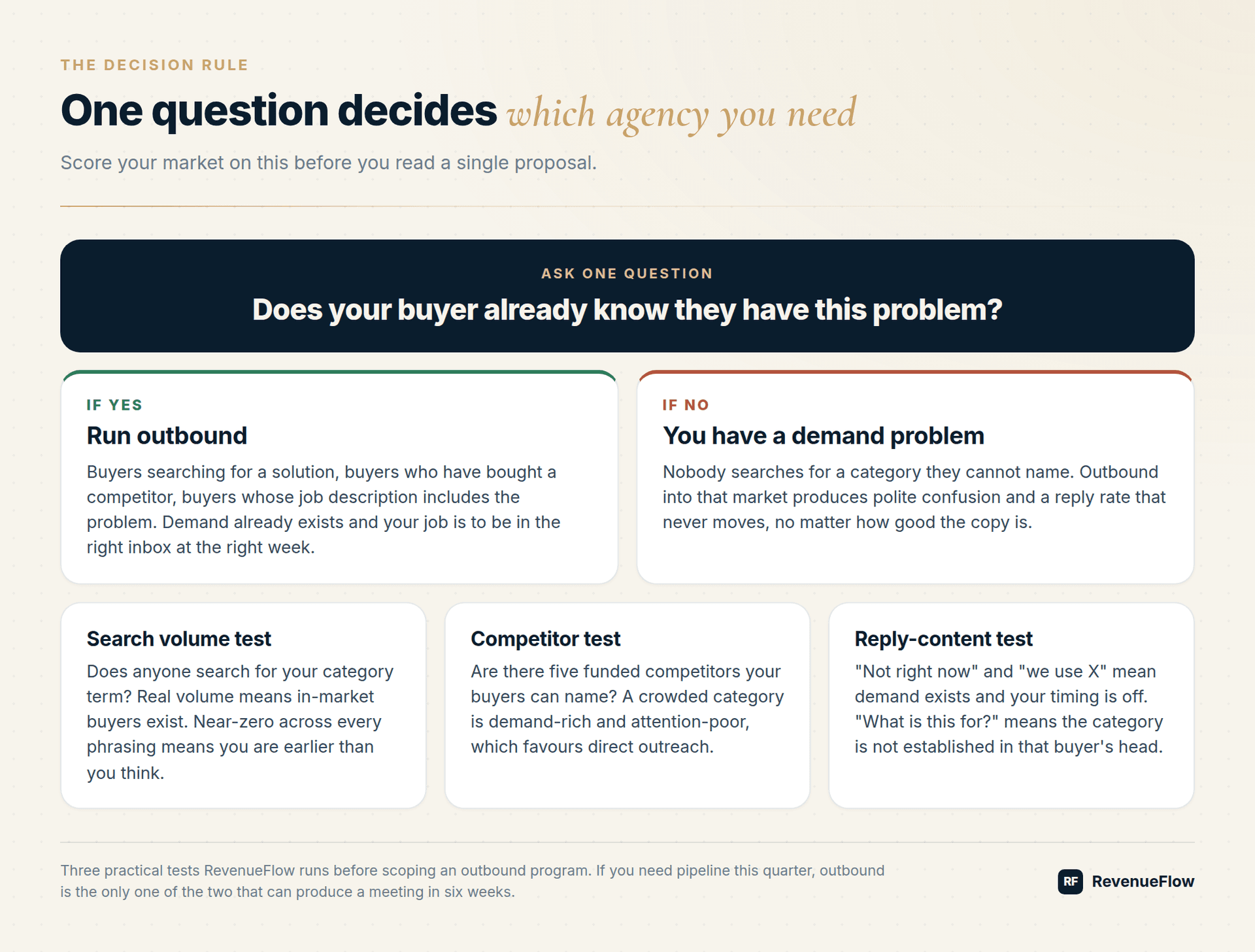
Ask one question: does your buyer already know they have this problem?
If yes, run outbound. Buyers searching for a solution, buyers who have bought a competitor, buyers whose job description includes the problem. Reach them directly. Demand already exists and your job is to be in the right inbox at the right week. Signal-based targeting sharpens the timing, which is the argument in old GTM vs new GTM.
If no, you have a demand problem. Nobody searches for a category they cannot name. Outbound into that market produces polite confusion and a reply rate that never moves, no matter how good the copy is.
- Step 1Search volume test
Pull monthly volume on the category term. Real volume means in-market buyers exist
- Step 2Competitor test
Can buyers name five funded competitors? A crowded category favours direct outreach
- Step 3Reply-content test
Read the negative replies. What is this for means the category is not established
- Step 4Route the budget
Demand exists, run outbound. Demand does not, build it first
Three practical tests that make this concrete.
- Search volume test. Does anyone search for your category term? Pull the monthly volume. Real volume means in-market buyers exist and outbound will find them. Near-zero volume across every phrasing means you are earlier than you think.
- Competitor test. Are there five funded competitors your buyers can name? A crowded category is a demand-rich, attention-poor market, which favours direct outreach and sharp differentiation.
- Reply-content test. If you have already run outbound, read the negative replies. "Not right now" and "we use X" mean demand exists and your timing or offer is off. "What is this for?" means the category is not established in that buyer's head.
Where the answer is both
Most companies past their first million in revenue need both, and the failure mode is running them as two disconnected budgets. Published guidance commonly suggests a 60/40 split favouring demand generation. That is a reasonable default for a category with an awareness problem, and a bad default for a company in a crowded, well-understood market where the whole game is getting in front of an in-market buyer first.
The mechanism that makes both work together is simpler than most attribution decks suggest. Content gives outbound something credible to point at, and outbound gives content a distribution channel that does not depend on an algorithm. That loop is the subject of content-led outbound.
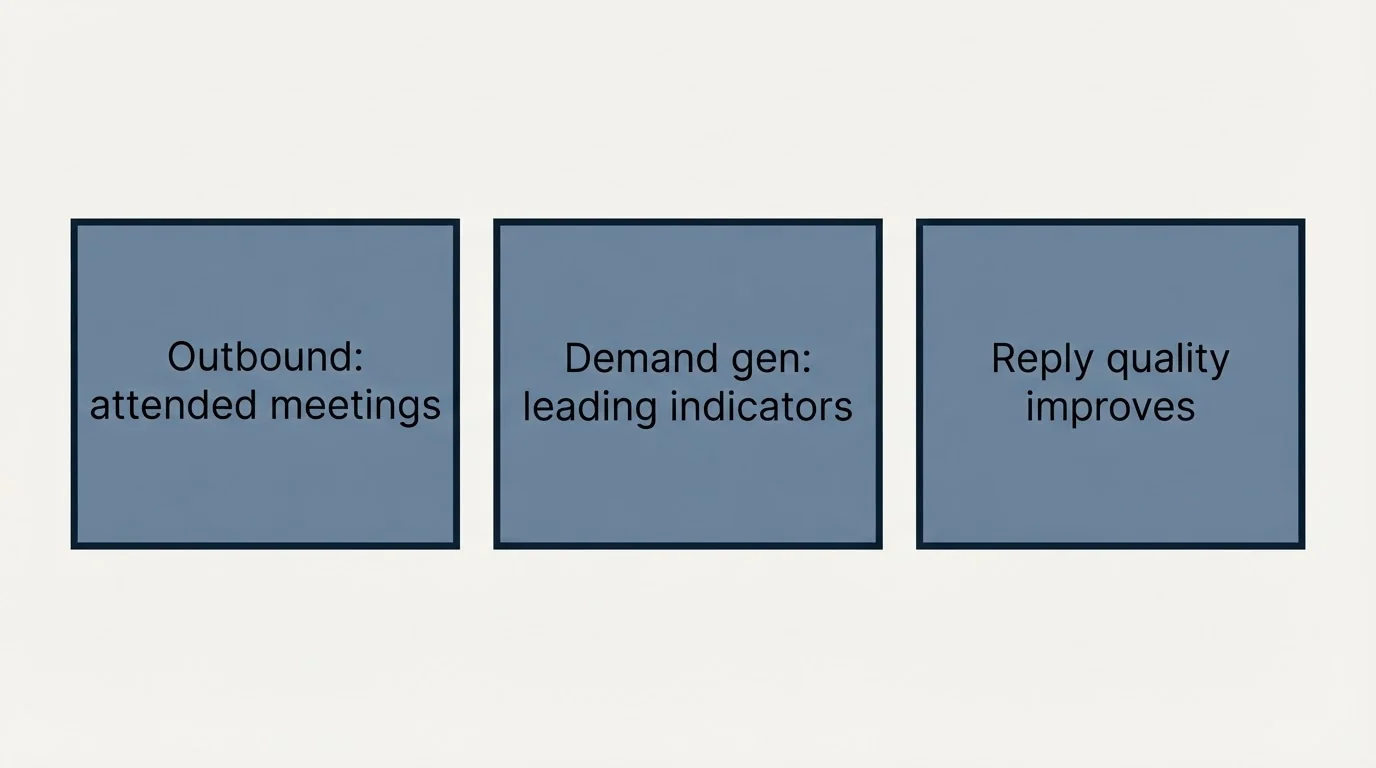
A pragmatic sequencing rule: if you need pipeline this quarter, start with outbound because it is the only one of the two that can produce a meeting in six weeks. Run demand generation as the compounding layer underneath, and expect to judge it on leading indicators (branded search, direct traffic, reply quality) rather than on last-touch attribution.
Measuring each one honestly
The two motions fail differently under the same dashboard, and judging both on last-touch attribution flatters outbound and buries demand generation.
Judge outbound on booked and attended meetings, against criteria agreed in writing before launch. That definition is the whole measurement: which company profile counts, which roles count, and what constitutes a real conversation. Budget, timing and decision authority are not part of it, because they describe how ready a buyer is rather than whether the meeting was the one you asked for. Agree the definition first and the monthly review is arithmetic instead of an argument.
Judge demand generation on leading indicators, and give it two quarters. Branded search volume, direct traffic, the quality of inbound replies, and how often prospects arrive already knowing what the category is. These move before pipeline does, and they move slowly. An agency that offers clean last-touch ROI on the awareness layer is measuring the wrong thing confidently.
Watch the interaction rather than the two columns. The most common real effect of running both is that outbound reply quality improves: prospects who have seen the content answer differently from prospects who have not. That shows up in the outbound numbers and belongs to the demand generation budget, and no attribution model will assign it correctly. Read it as a directional signal and resist building a model that pretends to more precision than the data has.
What each one is bad at
- Urgency. It cannot fill a quarter that is already behind.
- Attribution. The credit shows up as an unattributed inbound six months later.
- Markets that do not exist yet. Reply rates in an unformed category stay flat regardless of copy quality.
- Small markets. Under roughly 1,500 accounts, volume outbound burns the list faster than the list regenerates.
- Fixing a conversion problem. If meetings arrive and do not close, more meetings makes the leak bigger.
Demand generation is bad at urgency. It cannot fill a quarter that is already behind. Agencies that promise otherwise are quietly running paid lead capture and calling it demand gen. Ask what percentage of the proposed budget is paid media, because that is the part with a short feedback loop.
Demand generation is bad at attribution. Reaching people before they are in market means the credit shows up as an unattributed inbound six months later. That is a real effect and a genuine measurement problem, and any agency claiming clean ROI on the awareness layer is overselling.
Outbound is bad at markets that do not exist yet. Reply rates in an unformed category stay flat regardless of copy quality, and the temptation is to blame the sender rather than the premise.
Outbound is bad at small markets. Under roughly 1,500 accounts, volume outbound burns the list faster than the list regenerates. Named-account selling by a human is the right answer.
Outbound is bad at fixing a conversion problem. If meetings arrive and do not close, more meetings makes the leak bigger. Start with the four frameworks that fix broken lead generation.
When an outbound agency like us is the wrong hire
We build and run cold email and LinkedIn outbound and charge only for qualified meetings that are attended. Do not hire us if:
- your category needs to be explained before anyone will care, in which case a demand generation or content partner comes first;
- your addressable market is under roughly 1,500 accounts;
- your average contract value is under roughly $3,000 with no expansion path;
- nobody on your team is free to run the meetings;
- your buyers sit in consent-only or heavily regulated channels where unsolicited contact is restricted.
The overlap case worth naming: companies that need demand generation strategically and pipeline immediately. Running a lean outbound program while a content engine builds is a legitimate answer, provided you budget for both properly rather than half-funding each.
Getting the sequence right
Score your market on the three tests above before you read a single proposal. Established category with named competitors means outbound first, demand generation as the compounding layer. Unnamed category with no search volume means demand generation first, and outbound reserved for the handful of accounts sophisticated enough to already be looking.
Whichever way that lands, resist buying the whole apparatus at once. The most common expensive mistake in this category is a $20,000 monthly program bought before anyone has proven a single repeatable message, which is the argument for not overengineering a GTM motion before it has proven a message. If outbound is the answer, the seven-stage system for building an outbound engine is what a well-built version looks like.
If you land on outbound, we run it end to end and you pay only for qualified meetings that are actually attended. See if you qualify for a free campaign.
Pricing ranges reflect published 2026 agency pricing guides for B2B demand generation and outbound services and vary by scope, channel mix, and media spend.
Frequently asked questions.
Frequently asked questions- What is the difference between demand generation and lead generation?
- Demand generation creates awareness and interest among buyers who are not yet shopping. Lead generation and outbound capture interest that already exists and turn it into a conversation. That changes the channels, the time to first pipeline, and how you measure success, so the two are not interchangeable budget lines.
- Which one produces pipeline faster?
- Outbound, by a wide margin. A cold email and LinkedIn programme can produce meetings within weeks of warmup finishing, while demand generation typically takes one to two quarters to show up in pipeline and shows up as unattributed inbound when it does. If the quarter is already behind, outbound is the only one of the two that can help.
- How do I know whether my market needs demand generation?
- Run three tests. Pull the monthly search volume on your category term: near-zero across every phrasing means you are earlier than you think. Ask whether buyers can name five funded competitors. And read your negative replies, because what is this for means the category is not established while not right now means timing.
- Should I run both at once?
- Most companies past their first million in revenue eventually need both, and the failure mode is running them as two disconnected budgets. A pragmatic sequence is outbound first when you need pipeline this quarter, with demand generation underneath as the compounding layer, judged on leading indicators rather than last-touch attribution.
About the author.

Ben Carden is CRO at RevenueFlow, which builds and operates outbound revenue engines for B2B companies. Previously at Gartner Enterprise. Studied at London School of Economics.
Ben Carden · CRO
Connect on LinkedIn →Explore more.
Ready to scale your outreach?
We build GTM engines that book real meetings. See the receipts.
Related articles.
Cold Email Agency: What You Get and What It Costs
What a cold email agency delivers, 2026 pricing across retainer, per-meeting and hybrid models, the in-house comparison, and when hiring one is wrong.
Demand Gen Strategy: Diagnose the Constraint Before Funding
Fourteen initiatives across six channels, funded evenly, is the output of not making a decision. Three constraints, one afternoon of testing, and one thing to fund.
Outsourced SDR vs In-House: The Cost Math on Your Numbers
The comparison most teams run is a salary against a retainer. Here is how to build both sides fully loaded, divide by meetings held, and adjust for ramp.
Sales Kickoff Meeting: The Decisions It Has to Leave With
A kickoff is the one moment a whole sales organisation can change at once. The four decisions it has to publish, and the week-six check that tests them.
Sales Funnel vs Customer Journey: Accounting vs Behaviour
A funnel is a seller-side accounting model built to be counted. A journey is a buyer-side behaviour model built to be understood. Keeping them separate is the point.
Cross-Sell vs Upsell: Different Trigger, Different Owner
An upsell has a trigger that arrives on its own. A cross-sell has none and needs a diagnosis somebody funds. That is the difference that decides the work.