Sales Funnel vs Customer Journey: Accounting vs Behaviour
A funnel is a seller-side accounting model built to be counted. A journey is a buyer-side behaviour model built to be understood. Keeping them separate is the point.
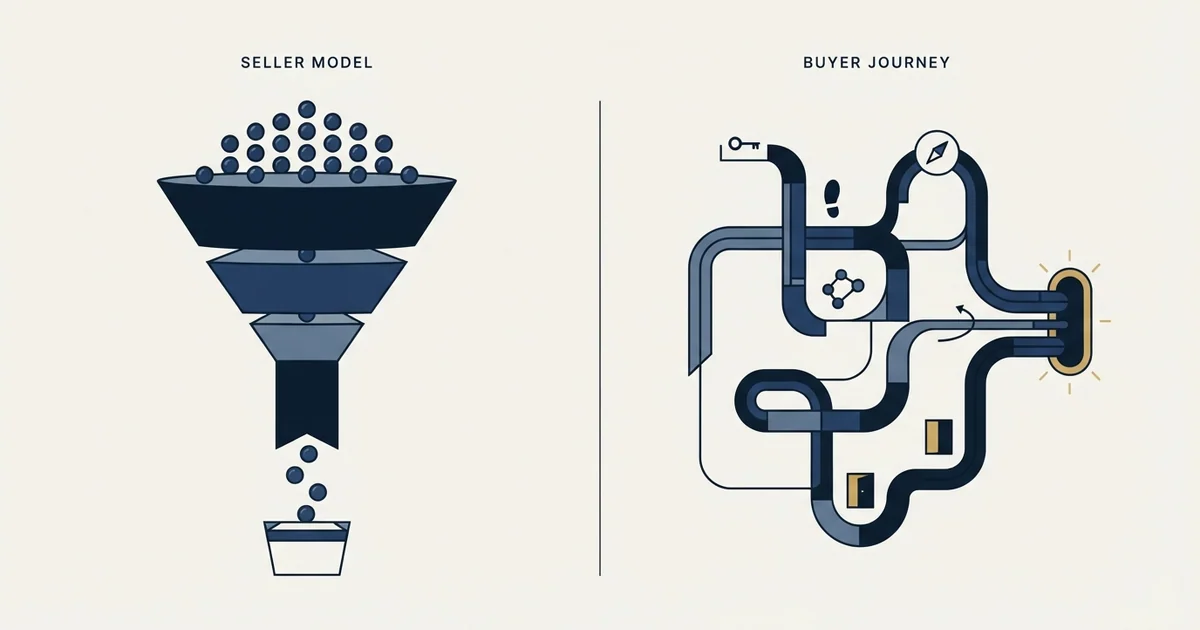
A sales funnel is a seller-side accounting model whose stages are states in your own system, built so the pipeline can be counted and forecast. A customer journey is a buyer-side behaviour model, mostly invisible to you, built to explain why buyers act as they do. Keep them as separate documents with one explicit link.
Key takeaways
- If you can compute a conversion rate between two stages it is a funnel; if you cannot, because the stage is a mental state, it is a journey.
- Importing journey stages such as Awareness and Consideration into a pipeline produces stages nobody can enter or exit on evidence.
- The journey begins before the funnel does and continues after it ends, which is why funnel-only attribution credits whatever happened last.
- A conversion rate is only interpretable when both of its ends are recorded events rather than one event and one opinion.
Reviewed and updated September 1, 2026
Two documents sit in most go-to-market folders. One is a funnel with five stages and a conversion rate between each. The other is a journey map with personas, emotions, touchpoints and a wavy line that doubles back on itself. They describe the same buyers, they disagree constantly, and the usual resolution is to declare the funnel outdated and put the journey map on a wall where nobody reads it.
The disagreement is real and it is not about which model is better. The two are built from different vantage points, and each one is close to useless at the job the other does.
What each model is actually a model of
A sales funnel is a seller-side accounting model. Its stages are states in your system, its transitions are events you record, and its purpose is to let you count. That is why it narrows: the shape encodes the fact that fewer things survive each step, which is the arithmetic a forecast needs.
That counting requirement is exactly why the Salesforce implementation matters, and tracking history for funnel reporting explains why it must be switched on before anyone asks for the numbers.
A customer journey is a buyer-side behaviour model. Its stages are things happening to a person, most of which you cannot see, and its purpose is to explain why people do what they do. That is why it loops: buyers genuinely go backwards, leave for four months, and return with a different problem.
- Stages are states in your CRM
- Transitions are events you can record
- Built to count and to forecast
- Assumes forward motion
- Blind to everything before first contact
- Stages are things happening to a person
- Most of it is invisible to you
- Built to explain and to design against
- Assumes loops, pauses and reversals
- Cannot be summed into a number
The practical test for which one you are holding: if you can compute a conversion rate between two stages, it is a funnel. If you cannot, because the stage is a mental state rather than a recorded event, it is a journey. Documents that mix the two produce stages like Consideration sitting next to stages like Proposal Sent, and the resulting conversion rates are not comparable to anything.
The failure that follows from confusing them
The common failure runs in one direction. A team notices that buyers are not behaving linearly, concludes the funnel is broken, and fixes it by adding stages that describe buyer mental states. Awareness goes in at the top. Consideration goes in the middle. Now the pipeline has stages nobody can enter or exit on evidence, and every deal sits in whichever one the rep feels is right.
The live piece on sales pipeline stages puts the test plainly: a stage needs an exit criterion someone other than the deal owner could check. Journey stages fail that test by construction, because they are defined by what the buyer is thinking. Importing them into the funnel does not make the funnel more realistic. It makes it unmeasurable while leaving it exactly as linear as before.
The reverse failure is quieter. A team builds a journey map, discovers it cannot be reported on, and quietly re-labels its funnel stages with journey language so the deck matches. Nothing changes operationally and the vocabulary gets worse.
Where the models genuinely diverge
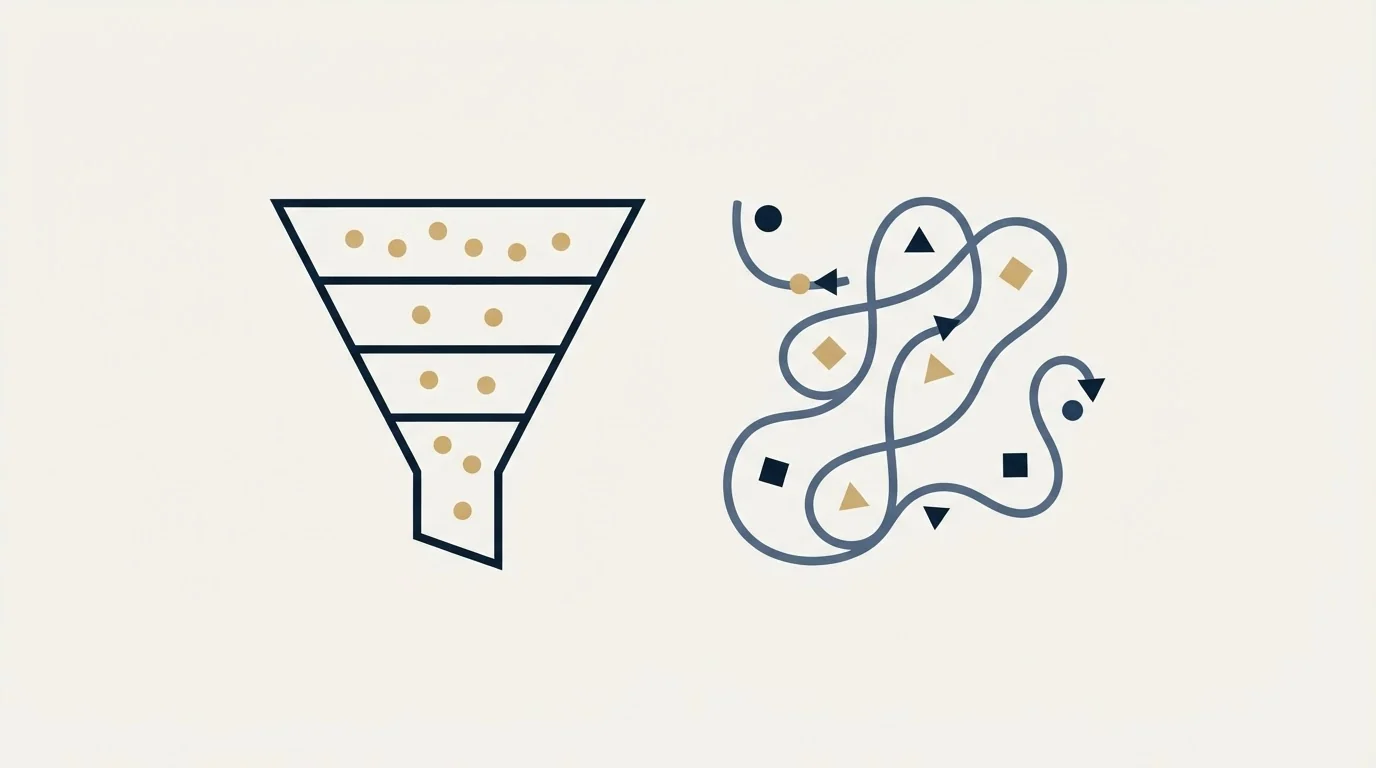
Three divergences do real damage when they are not named.
The journey starts before the funnel does. Most of a B2B buying process happens before any seller is contacted, in conversations you are not in. The funnel has no representation for that period at all, so any attribution built purely on funnel entry assigns all the credit to whatever happened last. This is not a flaw in the funnel; it is the funnel being asked a question about a period it does not cover.
The journey has no end and the funnel does. A funnel closes at the sale. A journey continues into onboarding, usage, renewal and expansion, where a large share of the revenue actually lives. Teams that manage only the funnel treat the sale as the finish line and hand a customer to whoever is next with none of the context the journey collected. The article on the inbound marketing sales funnel covers the same seam from the other side, in the stage most models label delight and nobody staffs.
Buyers reverse and pipelines usually forbid it. A deal that moves from Proposal back to Discovery is telling you something specific and useful: a new stakeholder arrived, or the problem changed. Most CRM configurations either block the backwards move or record it silently, and the reporting that results shows a smooth forward march that did not happen.
- Step 1How many will close, and when
Funnel. Stage counts, conversion rates, cycle time by stage.
- Step 2Why do we lose at this point
Journey. What the buyer is doing and who else is involved.
- Step 3Where should the next hire go
Funnel first to find the narrow step, journey to explain it.
- Step 4What should this asset say
Journey. The funnel knows the stage but not the concern.
How to hold both without merging them
The workable arrangement keeps them as separate documents with one explicit link between them.
The funnel stays strictly operational: few stages, each with an exit criterion defined as an action the buyer took, each one countable. Six is usually the ceiling before the definitions start overlapping, and the discipline that makes it work is the one in the SaaS sales funnel: every stage exit defined as an action a third party could verify, rather than as a stage of the buyer's thinking.
Exit criteria that hold up under scrutiny are shown stage by stage in a sales funnel template, clarifying what a checkable exit condition looks like.
The journey stays strictly descriptive and is used for the decisions the funnel cannot inform: what an asset should address, which objection recurs, who else needs to be in the room, and where the process is painful for reasons that have nothing to do with your product.
The link between them is a single annotation. For each funnel stage, name the journey moment it corresponds to and the evidence you have that the buyer is in it. Where the annotation is easy, the stage is well defined. Where it is impossible, either the stage is measuring your own activity rather than the buyer's, or you are guessing about something you could ask.
Where the two models actually meet
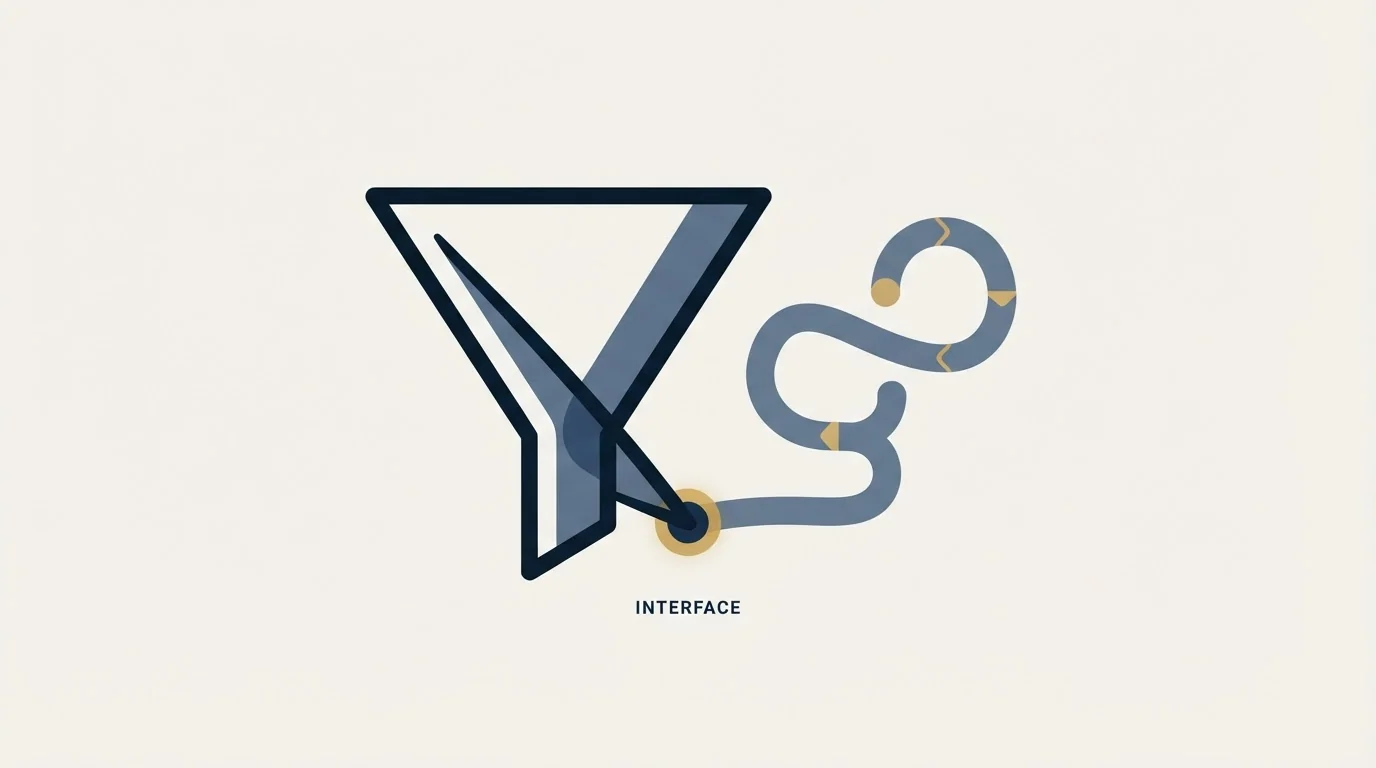
There is one place the documents genuinely have to reconcile, and it is the handoff between the team that owns the journey and the team that owns the funnel.
Marketing typically holds the journey and sells the funnel short. Sales typically holds the funnel and treats everything before first contact as weather. The consequence is that the buyer's experience is discontinuous at exactly the point where continuity would help most: a person who has spent two months reading about a problem arrives in a conversation that begins by asking what their problem is.
The reconciliation is not a merged document. It is a small set of facts that travel with the person across the boundary: what they engaged with, which topic, and how recently. Three fields, carried forward, close most of the visible seam. Attempts to carry the whole journey across fail because the receiving team has no time to read it, and attempts to carry nothing produce the discontinuity above.
The second meeting point is loss analysis, and it is the one worth investing in. The funnel records that a deal was lost at a stage. Only the journey explains it, and the explanation is not available from your own systems, because the decision happened in a room you were not in. That is an argument for asking, in the form of a short conversation with buyers who chose otherwise. It is the cheapest research available to any go-to-market team and it is skipped nearly everywhere, because the funnel has already recorded the outcome and a recorded outcome feels like an answer.
The number this changes
Conversion rate between funnel stages is the figure most affected by getting this wrong, because a rate is only interpretable when both of its ends are recorded events. The entry on conversion rate makes the general case that a rate needs both ends named. The journey-contaminated version of the problem is narrower and worse: one end is an event and the other is an opinion, so the rate moves whenever the team's optimism moves and nobody can tell that from a real change.
An illustrative case, with figures invented to show the mechanism rather than drawn from any programme. Suppose a stage-two-to-three rate reads 40 percent one quarter and 25 percent the next. If stage three requires a scheduled meeting with a second stakeholder, that fall is information: something changed in how buying groups are forming. If stage three means the rep believes there is interest, the fall may be a new manager asking harder questions in pipeline review. Same number, and only the first version is worth acting on.
A last note on which document to build first, since most teams have neither in a usable state. Build the funnel, because it is the one that constrains a decision this quarter and the one whose absence produces immediately wrong numbers. The journey map is more interesting and less urgent, and it is considerably better built after a few dozen loss conversations than before them, when it is mostly a record of what the team assumed.
The short version
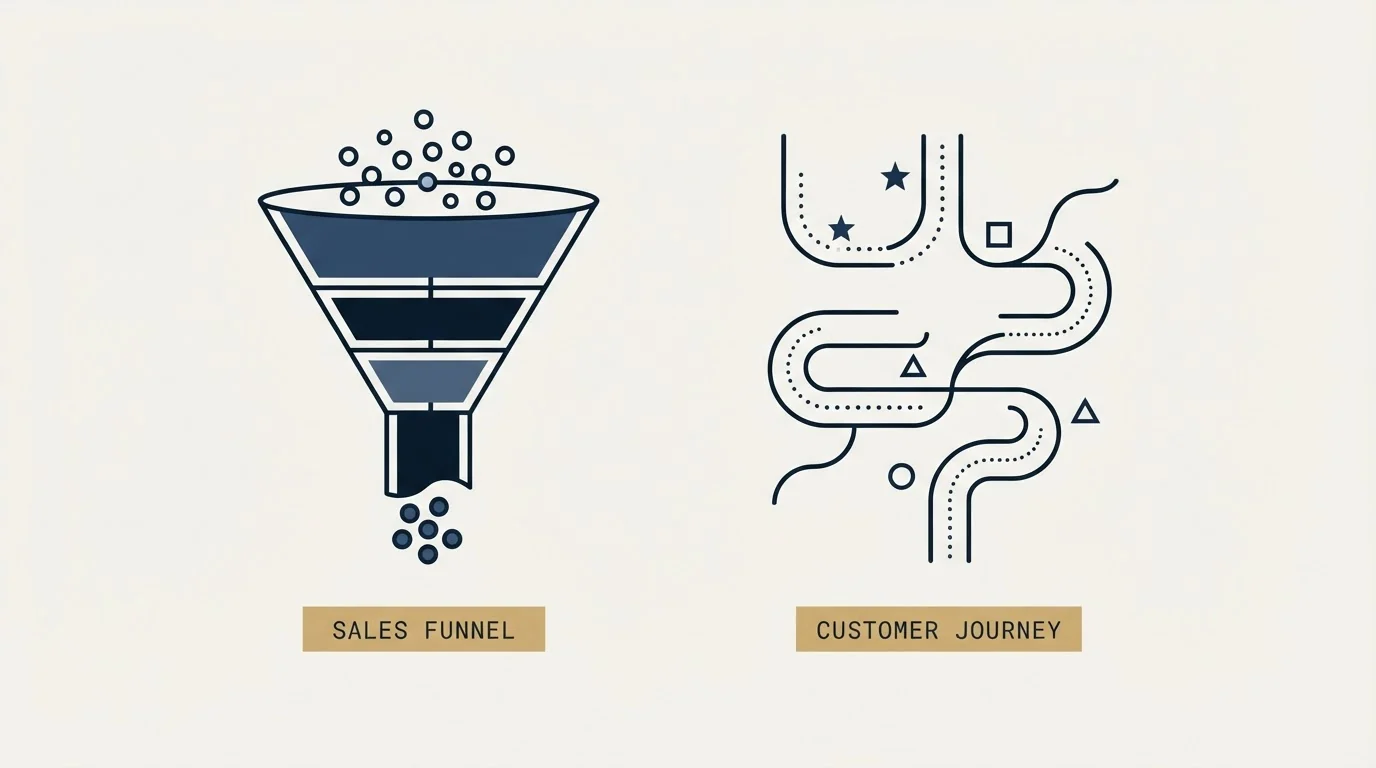
The funnel is your accounting of the buyers you can see, and it exists to be counted. The journey is a description of what buyers actually do, most of which you cannot see, and it exists to be understood. Keep them as separate documents, define every funnel stage by an action a third party could verify, and use the journey for the design questions the funnel has no vocabulary for. The failure to avoid is importing journey stages into the pipeline, which makes the funnel unmeasurable without making it any more true.
Building the first stage of the funnel against criteria agreed before launch rather than argued about later is what a test campaign sets up.
Frequently asked questions.
Frequently asked questions- What is the difference between a sales funnel and a customer journey?
- The funnel describes your process from your side: stages are states in your CRM, transitions are events you record, and the purpose is to count and forecast. The journey describes the buyer's experience from their side, including the large part you cannot see, and its purpose is to explain behaviour. One narrows because things drop out. The other loops because buyers genuinely go backwards.
- Should we replace our funnel with a customer journey map?
- No, because they answer different questions. You cannot forecast from a journey map, since its stages are mental states with no recordable entry or exit. You cannot design an asset from a funnel, since it knows which stage a deal is in but nothing about the concern the buyer has. Teams that replace one with the other lose the capability the replaced model provided.
- Which one should we build first?
- The funnel, because its absence produces immediately wrong numbers and it constrains decisions this quarter. A journey map is more interesting and less urgent. It is also substantially better built after several dozen conversations with buyers who chose otherwise, because a journey map written beforehand is mostly a record of what the team already assumed.
- How many stages should a sales funnel have?
- Few enough that every stage has a distinct exit criterion someone other than the deal owner could verify. Six is a common ceiling before definitions start overlapping and reps place the same deal differently. The count matters less than the criteria: a five-stage funnel with vague exits produces worse data than a seven-stage one where every transition is a recorded buyer action.
About the author.

Ben Carden is CRO at RevenueFlow, which builds and operates outbound revenue engines for B2B companies. Previously at Gartner Enterprise. Studied at London School of Economics.
Ben Carden · CRO
Connect on LinkedIn →Explore more.
Ready to scale your outreach?
We build GTM engines that book real meetings. See the receipts.
Related articles.
Is Sales Commission a Period Cost Under ASC 340-40?
The classroom answer is yes, and current filings show commissions capitalised as assets instead. Both are right, and the benefit period decides which applies.
Incentive Plan for a Sales Team: Design It Backwards
A plan is a written specification of the behaviour you will pay for. The design order that produces a defensible one, and the four ways good arithmetic still fails.
Monthly Sales Meeting Agenda: What the Month Decides
The weekly meeting triages deals in flight. The monthly one closes a period and changes the list. Six blocks, ninety minutes, one output each.
Sales Activity Tracking: What the Record Has to Say
Most activity tracking fails at capture rather than analysis. The unit you count decides what every later number can mean, and no tool fixes a wrong choice.
Sales Kickoff Meeting: The Decisions It Has to Leave With
A kickoff is the one moment a whole sales organisation can change at once. The four decisions it has to publish, and the week-six check that tests them.
Sales Call Planning: The Plan a Booked Call Needs
A call cannot produce a commitment nobody named in advance. The four fields a call plan carries, and why the ask has to be decided before the meeting opens.