Incentive Plan for a Sales Team: Design It Backwards
A plan is a written specification of the behaviour you will pay for. The design order that produces a defensible one, and the four ways good arithmetic still fails.

A sales incentive plan should be designed backwards from behaviour. Name the few behaviours worth paying for, sort them by what the individual genuinely controls, name the distortion each incentive creates and add a guardrail, then set base against variable, thresholds and accelerators last.
Key takeaways
- Pay heavily on what the seller controls, lightly on what they influence, and never on an outcome they only experience, because that converts compensation into a lottery.
- Every incentive has a shadow it rewards unintentionally, so the design step that matters is choosing which distortion you can manage and writing an explicit guardrail against it.
- Anything entirely within the seller's control can be produced on demand, which is why paying on raw activity stops carrying information almost immediately.
- Changing a plan retroactively inside a live period costs more than the quarter it fixes, because a provisional plan cannot change behaviour that depends on believing it.
Reviewed and updated September 1, 2026
A sales incentive plan is a written specification of the behaviour you are willing to pay for. Everything else about it, the tier structure, the accelerators, the quarterly kickers, is implementation detail sitting on top of that one sentence. Teams that design the implementation first end up with plans that are internally elegant and reward the wrong week's work.
The practical consequence is that the design starts by naming the behaviour, not by picking a number. What follows is the order that produces a plan you can defend in a room, and the four ways plans fail even when the arithmetic is sound.
This page covers plans for the people selling. The manager's own plan is a structurally different problem, because a manager is paid on a team's output rather than their own, and it is handled separately.
Start from the behaviour, then work backwards
Structuring compensation so that different segments get different attention is a step-three decision rather than a rate decision: paying more on large deals makes small ones somebody else problem, so the guardrail against that has to be named at the same time as the accelerator.
The first question is which behaviours you would pay extra for, in order, and the honest answer is usually shorter than the plan that gets written. Most B2B sales teams want three things: more of the right kind of deal, deals that do not fall apart after signature, and effort spread across the territory rather than concentrated on whichever accounts are easiest to reach.
Teams often describe the gap as having no metrics to drive team behaviour toward the accounts worth winning, and the third item on that list is usually the one they mean: effort follows whatever the plan measures, so an account tier the plan never names is a tier nobody is paid to work.
The second question is which of those the individual actually controls. This distinction does most of the work in plan design and it gets skipped constantly. A rep controls how many conversations they open and how well they run them. A rep partly controls close rate, since the deal also depends on the product, the price and the competition. A rep does not control what marketing sourced this quarter, or whether a strategic account had a hiring freeze.
Pay heavily on what the person controls, lightly on what they influence, and not at all on what they merely experience. A plan that pays on an uncontrollable outcome does not motivate; it converts compensation into a lottery and teaches the team that the plan is noise.
The third question is what the plan makes worse. Every incentive has a shadow. Paying on new logos makes renewals somebody else's problem. Paying on revenue makes discounting attractive. Paying on meetings booked makes a meeting with anybody who answers the phone valuable. There is no shadow free design, so choose the shadow you can manage and put a guardrail against it rather than pretending it does not exist.
The published procedures for sales compensation plan design, and which of their ratios carry a stated population, are compared in sales comp plan design.
- Step 1Name the behaviours worth paying for
Usually three at most. Write them as sentences about what somebody does, not as metric names.
- Step 2Sort them by what the person controls
Heavy weighting on controlled behaviours, light on influenced ones, none on outcomes the individual only experiences.
- Step 3Name the shadow and the guardrail
Every incentive rewards something you did not intend. Choose which distortion you can live with and put an explicit limit against it.
- Step 4Set the split and the mechanics
Base against variable, thresholds, accelerators, the earning event and the payment schedule. This is the easy part once the first three are settled.
The components, and what each one is actually for

Base salary. Buys the time and the willingness to do work that does not pay this month: territory research, account planning, a long qualification conversation that ends in a no. A base too low relative to the market pushes reps toward whatever pays fastest, which is rarely the best deal available.
Variable at target. The part contingent on performance. The ratio between base and variable is a statement about how much of the outcome you believe the individual controls. High variable suits transactional selling where the rep's own effort dominates. Low variable suits complex sales with long cycles and large buying committees, where an individual quarter says more about the pipeline they inherited than about their work. Whichever ratio you pick, budget the full on target variable when you cost the seat, because a strong year will cost you all of it, and build the rest of the seat cost the same way as in SDR salary and the fully loaded cost.
Sales teams whose variable pay assumes a single decision maker and a short cycle should examine the five-step sales process to see what it quietly stops checking.
The threshold. The point at which variable starts paying. A threshold set too high produces a demotivated bottom half who write the quarter off in week three. A threshold at zero pays for outcomes that would have happened anyway. Where the threshold sits is a judgement about how much of baseline performance is the plan's doing.
Accelerators. Higher rates above target. Their purpose is to make the last deal of a strong quarter worth chasing rather than parking for next quarter. That is a real behaviour and accelerators genuinely change it.
Guardrails. Minimum deal terms, discount approval limits, clawbacks on early churn, qualification standards that a paid meeting must meet. These are the counterweight to the shadow named in step three, and a plan without them is relying on goodwill to prevent an outcome it is paying for.
The four ways plans fail
Paying for activity the rep fully controls. Calls made, emails sent, meetings booked. The attraction is that the metric is clean and reports weekly. The problem is that anything entirely within the seller's control can be produced on demand, so the number always hits and it stops carrying information. The general principle is that the further down the chain the paid event sits, the harder it is to manufacture, which is the same logic that makes cost per held meeting a better commercial unit than cost per lead, worked through in cost per lead B2B.
Once activity metrics lose meaning, the fix often lies in redefining the stages themselves around verifiable buyer actions, a shift covered in the customer-centric sales process.
Capping the top. A cap tells your best rep to stop selling, usually in the quarter you most need the revenue, and it is almost always introduced after somebody earned more than a leader was comfortable with. The uncomfortable payout was a pricing error in the plan, and the fix belongs in next year's design rather than in a mid year cap.
Changing the plan mid period. This is the most damaging of the four, because it does not just cost the affected quarter. It teaches the team that the plan is provisional, and a provisional plan cannot change behaviour, since the rational response to an unreliable promise is to ignore it. Where a plan is genuinely broken, the cheapest honest fix is a one off adjustment outside the plan rather than a retroactive rewrite of it. It is also worth knowing that in some jurisdictions the ability to change a plan is constrained by law. California Labor Code section 2751, for one, requires a commission agreement to be in writing with the computation method set out, and presumes expired terms continue in force while both sides keep working under them.
Designing against last year's constraint. Plans accumulate. A kicker introduced three years ago to push a product that no longer exists is still paying out, and nobody has audited it because each individual clause looks harmless. Read the whole plan once a year against the current strategy rather than editing the last one.
- Yes: Each paid component maps to a behaviour the individual genuinely controls or influences
- Yes: The earning event is named precisely: signature, invoice, cash or another point
- Yes: Cancellation, refund and early churn treatment is written, not understood
- Yes: A guardrail exists against the distortion each incentive creates
- Yes: The quota the plan pays against was set by a method somebody can explain
- Yes: The plan is legible enough that a rep can calculate their own number
- No: A cap on upside introduced because a payout felt uncomfortable
- No: Any retroactive change to a component within a live plan period
The quota underneath the plan decides whether it works
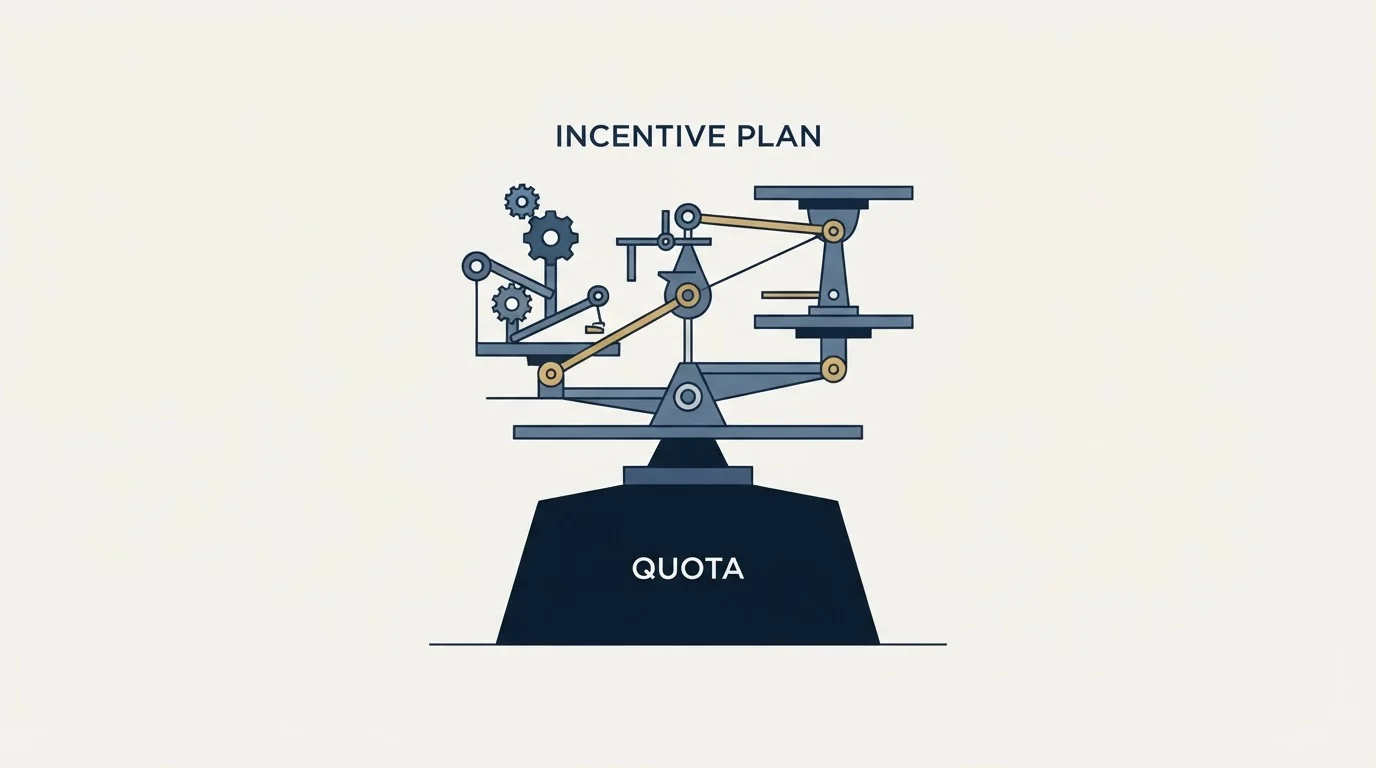
An incentive plan is a function applied to a quota, and a plan cannot be better than the number it pays against. If quotas are set by dividing a board target across the headcount, the plan will pay well in a good market and pay nothing in a bad one, and neither outcome will say anything about the sellers. Attainment measured across a team is as much a measure of the planning process as of the people, which is the argument set out in quota attainment.
Two practical implications follow. Set quotas from a bottom up view of what the territory can actually produce, then reconcile with the top down target and treat any large gap as information rather than as a stretch. And check the distribution rather than the average. Take an invented example, chosen only to show the shape and drawn from no team's real results: a team whose mean attainment looks acceptable because two people are at double their target and six are at less than half of theirs has a plan problem and a territory problem at once, and the average conceals both.
Ramping sellers need an explicit policy for the same reason. A new rep on a full quota in month one is being paid on a number the calendar makes impossible, and the plan teaches them within a quarter that the plan does not describe reality. Whatever ramp schedule you use, write it into the plan document rather than handling it case by case.
What the plan cannot fix
Compensation is a weak instrument for problems that are not compensation problems. If the pipeline is empty, no plan design fills it, and paying more for meetings that do not exist produces frustration rather than meetings. If the product loses to a competitor on a specific capability, an accelerator does not change the outcome of those deals. If reps are leaving because management is poor, a richer plan buys a few months.
The honest sequence is to find the constraint first and then decide whether money moves it. Where the constraint is the top of the funnel rather than the selling, the question is whether to hire into it at all, which is the argument in sales hiring and, from the other direction, in the hire more reps playbook.
The short version
Design the plan by naming the behaviours worth paying for, sorting them by what the individual controls, naming the distortion each incentive creates and putting a guardrail against it, and only then setting the split and mechanics. Base buys the work that does not pay this month; variable pays for the part the seller drives; the base to variable ratio states how much of the outcome you think they control.
Avoid paying for activity that can be produced on demand, avoid caps introduced because a payout felt uncomfortable, and never change a plan retroactively inside a live period, because a provisional plan cannot change behaviour. Audit the whole plan annually rather than editing last year's.
The plan sits on top of a quota, and it cannot be better than that number. Set quotas bottom up, read the distribution rather than the average, and write the ramp policy into the document.
We are paid on attended meetings that meet criteria agreed in writing before launch, which is the same principle applied to a supplier relationship rather than an employment one: the definition that decides payment is settled before the work starts. You can see what a campaign would look like for your market.
Frequently asked questions.
Frequently asked questions- How do you structure a sales team incentive plan?
- Name the two or three behaviours worth paying for, decide how much of each the individual actually controls, then weight accordingly. Add a guardrail against the distortion each component creates. Only then set base against variable, the threshold where variable starts, and any accelerators above target.
- Should sales incentives be capped?
- Generally no. A cap tells your strongest seller to stop in the quarter you most need the revenue. Caps are usually introduced after a payout felt uncomfortable, which means the plan was priced wrong rather than the rep earning too much. Fix the pricing in the next design cycle instead.
- What is the right base to variable split?
- It is a statement about how much of the outcome the individual drives. A high variable share suits transactional selling where personal effort dominates. A lower share suits long complex cycles with large buying committees, where a single quarter reflects inherited pipeline more than current work.
- Why do sales incentive plans stop working?
- Four common causes: paying for activity the rep can manufacture, capping upside, changing the plan inside a live period, and accumulating clauses that were designed against a constraint which no longer exists. The last one hides well, because each individual clause looks harmless.
About the author.

Ben Carden is CRO at RevenueFlow, which builds and operates outbound revenue engines for B2B companies. Previously at Gartner Enterprise. Studied at London School of Economics.
Ben Carden · CRO
Connect on LinkedIn →Explore more.
Ready to scale your outreach?
We build GTM engines that book real meetings. See the receipts.
Related articles.
Is Sales Commission a Period Cost Under ASC 340-40?
The classroom answer is yes, and current filings show commissions capitalised as assets instead. Both are right, and the benefit period decides which applies.
Sales Manager Compensation Plans: Paying for a Team
A manager is paid on other people work, so the aggregate team number hides the job. Which components to weight beside the override, and the player coach trap.
California Sales Commission Law: What Section 2751 Requires
Section 2751 asks for a written method rather than a rate, a signed copy to the employee and a receipt back. What that means for a real commission plan.
Sales Call Planning: The Plan a Booked Call Needs
A call cannot produce a commitment nobody named in advance. The four fields a call plan carries, and why the ask has to be decided before the meeting opens.
The Seven-Step Sales Process: What Each Step Assumes
Prospecting through follow-up, walked one box at a time. Each of the seven steps carries an assumption about the buyer, and most of them have quietly stopped holding.
The Five-Step Sales Process: What You Stop Checking
Cutting a process to five steps is a decision about which checks you drop. Which deals the short version fits, and the two loss patterns that say it does not.