Sales Manager Compensation Plans: Paying for a Team
A manager is paid on other people work, so the aggregate team number hides the job. Which components to weight beside the override, and the player coach trap.

A sales manager compensation plan usually pays an override on aggregate team attainment, which measures only one of the four things the job contains. Weight at least one further component for capacity and retention, the proportion of the team at target, or forecast accuracy, because the aggregate hides the distribution underneath it.
Key takeaways
- Aggregate team attainment can look healthy while describing a team in trouble, because one or two strong performers can carry a long tail of reps well below target.
- Paying only on the aggregate prices the highest leverage management work, raising the floor on weak performers, at zero, and managers respond to the price rather than the intention.
- In small teams a single resignation moves the aggregate more than any management action can, so the plan is measuring staffing luck rather than management.
- A blended player coach number reliably produces a strong individual seller and an unmanaged team, because the manager's own pipeline pays reliably and coaching pays through someone else.
Reviewed and updated September 1, 2026
A sales manager's compensation plan is not a rep plan with bigger numbers. The manager is paid on work performed by other people, which changes what the plan can honestly measure and introduces a set of failure modes a rep plan never encounters. The most consequential of them is that a team's average attainment can look healthy while describing a team in trouble.
Getting this plan right matters more than its size suggests, because it is the mechanism by which a company tells its front line managers which part of the job is real. A plan that pays only on the team number tells a manager that coaching, hiring and territory design are hobbies.
Teams that struggle to agree on whether a plan is even working may find the four causes of GTM misalignment explain why the same numbers tell different stories across functions.
What the manager is actually being paid to do
Four things sit in a front line sales manager's job, and only one of them shows up in the team's quarterly number.
Hitting the team target. The aggregate of the reps' results, which is the obvious component and the one every plan carries.
Building capacity. Hiring, ramping and retaining. A manager who leaves the quarter at target with two open seats and a resignation pending has borrowed from next quarter, and a plan that only reads the current number pays them fully for it.
Raising the floor. Moving the weakest performing rep to acceptable, or moving them out. This is the highest leverage work a manager does and it is invisible in a team average that a top performer is carrying.
Forecast accuracy. Telling the truth about what will close. Undervalued in most plans and expensive when it is absent, because the whole company plans against the manager's number.
A plan cannot pay meaningfully on all four without becoming unreadable. The design question is which of the other three you weight alongside the team number, and how you keep the answer legible enough that the manager can calculate their own compensation. What the manager is accountable for owning in the first place, and when the role is worth creating at all, is set out in the SDR manager role.
- Hit the team number
- Build and retain capacity
- Raise the floor on weak performers
- Forecast accurately
- Override on team attainment
- Rarely measured directly
- Rarely measured directly
- Occasionally an MBO component
- Quarter end pressure on reps
- Open seats carried into next quarter
- Weak reps managed around rather than fixed
- Optimistic forecasts that cost the company planning
The mean and median problem, and why the manager's plan creates it
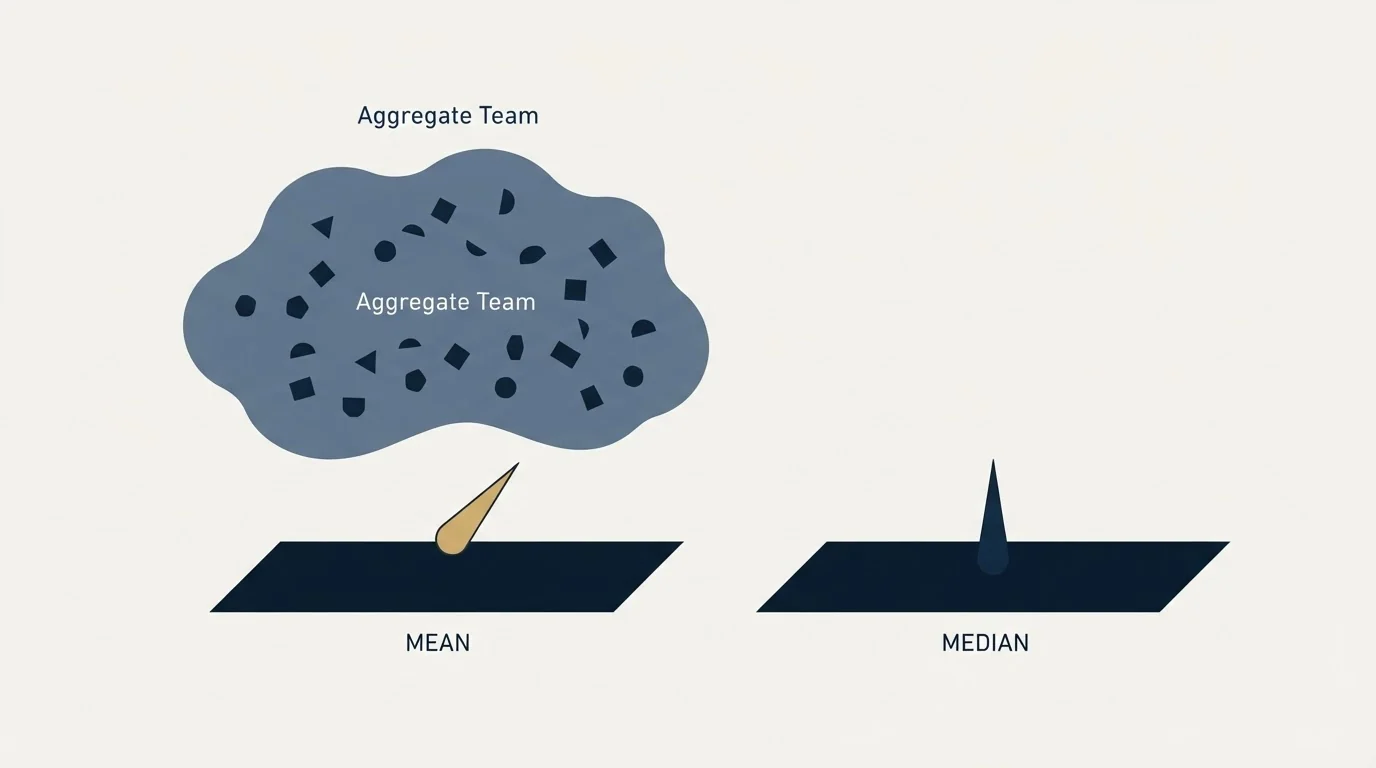
Team attainment is normally computed as the aggregate of the team's results against the aggregate of their quotas. That single number can hide almost anything, and the shape it hides is specific: a small number of high performers carrying a long tail.
Consider a team where the aggregate lands acceptably because two reps are far above target while most of the others are far below. Paying the manager on the aggregate alone rewards them for the two strong reps, who would likely have performed under any manager, and pays nothing for the far harder work of moving the tail. The manager's rational response is to spend their time with the reps closest to a deal, which is the tail's problem made worse. The general argument that attainment measures the planning process as much as the seller, and that the gap between mean and median is where the story sits, is set out in quota attainment.
Two design responses are available and they are not exclusive.
The first is to pay a component on the proportion of the team at or above target rather than on the aggregate alone. This directly values raising the floor, and it is legible. Its weakness is that it makes a manager reluctant to inherit a weak team, which has to be handled when people move roles.
The second is to read the distribution in the review rather than in the formula, and to weight a discretionary or objective based component against it. This is more flexible and less credible, because a discretionary component is only as trustworthy as the person applying it.
Small teams complicate both. Where a manager runs four reps, one resignation moves the aggregate more than any management action could, and the plan is measuring staffing luck. At that size, a longer measurement period and a heavier objective based component usually describe the job better than a pure override does.
Components that work, and one that usually rots
The override on team attainment. The core component, and reasonable. Set the threshold and any accelerator against the team quota rather than against an individual one, and decide explicitly whether an overachieving rep's excess pulls the manager's number up without limit.
A capacity or retention component. Paying against seats filled, ramp milestones reached, or regretted attrition avoided. This is the direct fix for the borrowing problem, and it works best when the target is a small number of specific, dated outcomes rather than a rate. The reason it matters is arithmetic rather than sentiment: a vacant seat costs a full quarter of ramp before it produces, and the recruiting and onboarding cost returns with every replacement, which is the same compounding described in SDR salary and the fully loaded cost.
A forecast accuracy component. Small, and worth having. The measurement is straightforward once you fix the submission date and the tolerance band in advance. Watch one thing: an accuracy component paid symmetrically rewards sandbagging exactly as much as it rewards precision, so it needs a floor on the committed number or a rule that under calling is penalised alongside over calling.
Management by objectives. The component that rots. MBOs start as three specific outcomes for the quarter and become a list of activities that are marked complete by whoever wrote them. They work when each objective is a dated, binary, externally verifiable event, and they decay into a participation payment when they are not. Audit them every cycle and retire the ones that have become descriptions of the job rather than changes to it.
- Yes: The plan pays for at least one thing besides the aggregate team number
- Yes: Team size is large enough that the aggregate measures management rather than staffing luck
- Yes: The distribution of attainment is read somewhere in the plan or the review
- Yes: Ramping reps have an explicit policy for how their quota counts to the manager
- Yes: Objective based components are dated, binary and verifiable by someone else
- Yes: The earning event and any clawback are stated as precisely as in a rep plan
- No: A player coach arrangement where the manager also carries an individual quota
- No: Paying the override on aggregate attainment alone in a team of four or fewer
The player coach trap

A common design has the manager carrying a personal quota alongside the team override, usually because the team is small or the company wants senior selling capacity without another headcount. The arrangement is understandable and it is a trap, for a reason that is structural rather than motivational.
The manager's own deals are within their direct control and pay reliably. Coaching a struggling rep is slow, uncertain and pays through somebody else's number. Faced with a difficult Thursday, any rational person works their own pipeline. The plan has not asked them to choose; it has priced the choice, and it has priced coaching lower.
A related limitation shows up in the sales process itself: the five-step sales process compresses checks that assume a single decider and a short cycle, hiding gaps on committee purchases.
Where a player coach arrangement is genuinely necessary, the honest version separates the two roles in the plan rather than blending them, states the expected split of time, and sets a personal quota low enough that it cannot dominate the manager's earnings. Blending them into one number reliably produces a strong individual seller and an unmanaged team.
Ramping reps and inherited teams
Two policies belong in the document rather than in a conversation each time.
The first is how a ramping rep's quota counts toward the manager's number. If a new hire carries a reduced quota during ramp, decide whether the manager's target reduces with it. If it does not, the manager is penalised for hiring, which is precisely the behaviour the capacity component was meant to encourage. The two components have to be reconciled or they cancel.
The second is what happens when a manager inherits a team mid year. Any component that pays on the proportion of reps at target penalises whoever takes on a struggling team, which discourages exactly the move a company most needs someone to make. A defensible answer is to measure improvement from the inherited baseline for the first two quarters, with the baseline recorded at handover rather than reconstructed afterwards.
The sequencing question underneath all of this is whether the management layer should exist yet at all. A manager added before there is a repeatable motion has nothing to manage toward, which is the argument in sales hiring and, from the cost side, in the hire more reps playbook.
The short version

A sales manager plan pays for work done by other people, so it needs to read more than the aggregate. Weight at least one component alongside the team override: capacity and retention, the proportion of the team at target, or a small forecast accuracy element.
The aggregate hides distribution, and the shape it hides is a strong performer carrying a long tail. Paying on the aggregate alone rewards the reps who would have hit anyway and prices the harder work of raising the floor at zero. Read the distribution somewhere, whether in the formula or in the review.
Write the ramping rep policy and the inherited team policy into the document. Keep objective based components dated, binary and verifiable, and retire them when they become descriptions of the job. Avoid a blended player coach number, because it prices coaching below the manager's own pipeline and the manager will respond to the price.
We are paid on attended meetings that meet criteria agreed in writing before launch, which puts the definition that decides payment in the agreement rather than in a review conversation. You can see what a campaign would look like for your market.
Frequently asked questions.
Frequently asked questions- How should a sales manager be compensated?
- Usually a base plus an override on team attainment, weighted alongside at least one other component. Capacity and retention targets address the manager who hits the quarter with open seats. A proportion at target component values raising the floor. A small forecast accuracy element pays for telling the truth.
- What is wrong with paying a manager on team attainment alone?
- It reads an aggregate, and aggregates hide distribution. A team where two reps are far above target and six are far below can produce an acceptable total. Paying on that total rewards the performers who would have hit anyway and pays nothing for moving the tail, which is the harder work.
- Should a sales manager carry their own quota?
- Avoid it where you can. The manager's own deals are within their control and pay reliably, while coaching is slow and pays through someone else's number, so the plan prices coaching lower. Where it is necessary, separate the two roles in the plan and keep the personal quota small.
- How do ramping reps affect a manager compensation plan?
- They need an explicit policy. If a new hire carries a reduced quota during ramp but the manager's target does not reduce with it, the manager is penalised for hiring, which cancels out any capacity component the plan also carries. Write the reconciliation into the document.
About the author.

Ben Carden is CRO at RevenueFlow, which builds and operates outbound revenue engines for B2B companies. Previously at Gartner Enterprise. Studied at London School of Economics.
Ben Carden · CRO
Connect on LinkedIn →Explore more.
Ready to scale your outreach?
We build GTM engines that book real meetings. See the receipts.
Related articles.
Is Sales Commission a Period Cost Under ASC 340-40?
The classroom answer is yes, and current filings show commissions capitalised as assets instead. Both are right, and the benefit period decides which applies.
Incentive Plan for a Sales Team: Design It Backwards
A plan is a written specification of the behaviour you will pay for. The design order that produces a defensible one, and the four ways good arithmetic still fails.
California Sales Commission Law: What Section 2751 Requires
Section 2751 asks for a written method rather than a rate, a signed copy to the employee and a receipt back. What that means for a real commission plan.
OTE in Sales: What Decides Whether the Number Arrives
On-target earnings is a forecast written in the grammar of a salary. Pay mix, quota and last year's attainment decide whether the number on the letter arrives.
Cross-Sell vs Upsell: Different Trigger, Different Owner
An upsell has a trigger that arrives on its own. A cross-sell has none and needs a diagnosis somebody funds. That is the difference that decides the work.
Sales Activity Tracking: What the Record Has to Say
Most activity tracking fails at capture rather than analysis. The unit you count decides what every later number can mean, and no tool fixes a wrong choice.