Sales Hiring: Prove the Motion Before You Hire
Sales hiring goes wrong through sequencing rather than selection. The precondition almost nobody meets, the order that works, and what to test in the interview.
Before hiring into sales, somebody should be able to answer four questions from evidence: who buys, why they buy, what they say no to, and roughly how long the decision takes. That evidence comes from selling, which at the start only a founder can produce, and it cannot be delegated before it exists.
Key takeaways
- A useful readiness test is whether you can write the pattern across your last ten wins on one page, since a thin page means the next hire is an expensive way to write it.
- Hiring a senior leader first to build the function inverts the sequence, because good leaders build on a motion that already works.
- Given both jobs, a full-cycle rep does the one with the nearer reward, so prospecting stops and the pipeline empties a quarter later.
- Hitting a percentage of quota means nothing without the quota, the deal size and the inbound-versus-outbound split behind it.
Reviewed and updated September 1, 2026
The most expensive sales hire is the one made to fix a problem hiring cannot fix. A founder who cannot yet describe why people buy hires a rep to find out, and eighteen months later has spent a salary, burned a segment of the market, and learned that the rep could not sell something nobody had worked out how to sell.
Sales hiring is mostly a sequencing problem. Get the order right and ordinary hires perform; get it wrong and strong hires churn.
The precondition almost nobody meets
Before hiring anyone into sales, someone should be able to answer four questions from evidence rather than belief: who buys, why they buy, what they say no to, and roughly how long the decision takes.
That evidence comes from selling, and at the start the only person who can produce it is a founder. This is the unglamorous reason founder-led selling exists as advice. It is not that founders are better at closing; it is that the answers to those four questions are the actual product being built during the first fifty conversations, and they cannot be delegated before they exist.
A useful test: can you write down, in one page, the pattern across your last ten wins. Not the pitch, the pattern. If that page is thin, the next hire will be an expensive way to write it.
- Yes: You can describe the pattern across your last ten wins
- Yes: Someone has closed deals without the founder in the room, or the founder can articulate exactly what they do
- Yes: You know the three most common reasons prospects say no
- Yes: There is enough pipeline for a new person to work on day one
- No: You are hiring to discover why people buy
- Depends: Whether the motion is repeatable or still founder-dependent
The order to hire in
The sequence matters more than the titles, and the common instinct gets it backwards.
First, capacity for what already works. If the founder is closing but cannot generate enough conversations, the gap is top of funnel and the first hire creates conversations. If conversations exist and the founder cannot run them all, the gap is closing capacity.
Second, the other half of the same motion. Once the first hire is productive, the constraint moves to whichever half they are not doing.
Third, management, at around three to five reps. Below that, a sales leader manages nobody in particular. Above it, three reps with three different standards produce a pipeline nobody trusts. The role and the timing are covered in the SDR manager role.
Only then, specialists. Enablement, operations, a dedicated leader. Hiring these early feels like building a real function and mostly builds overhead around a motion that has not been proven.
The expensive inversion is hiring a senior leader first, in the hope that they will build the function. Good leaders build functions on top of a motion that works. Asked to invent the motion as well, most will hire reps to find it, which returns you to the first mistake with an extra salary attached.
Which role you are actually hiring for

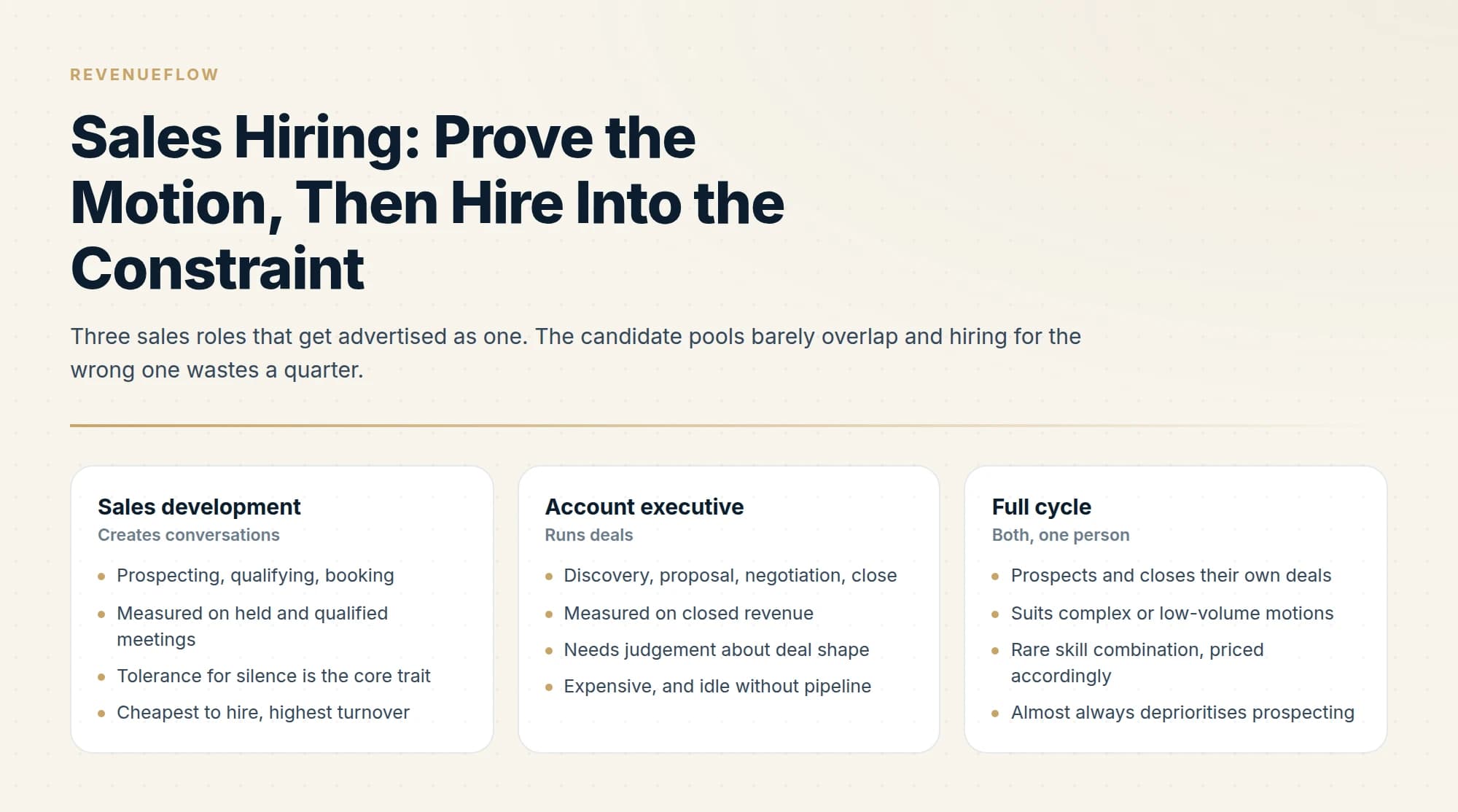
"Salesperson" covers jobs that share almost nothing, and job adverts routinely fuse them.
- Prospecting, qualifying, booking
- Measured on held and qualified meetings
- Tolerance for silence is the core trait
- Cheapest to hire, highest turnover
- Discovery, proposal, negotiation, close
- Measured on closed revenue
- Needs judgement about deal shape
- Expensive, and idle without pipeline
- Prospects and closes their own deals
- Suits complex or low-volume motions
- Rare skill combination, priced accordingly
- Almost always deprioritises prospecting
The full-cycle warning is worth stating plainly, because it is the arrangement most small companies default into. Given both jobs, a rep does the one with the nearer reward, which is always the live deal rather than the cold list. Prospecting stops, the pipeline empties a quarter later, and the diagnosis arrives too late. If you hire full cycle, protect prospecting time structurally or expect it to disappear.
What to test in the interview
Sales interviews are the easiest interview to pass and among the hardest to run, because the candidate's skill is persuasion and the format rewards it.
Give them something real to prepare. A genuine target account and thirty minutes. Ask what they would say and why. This tests research, judgement and writing at once, and it cannot be rehearsed from an interview guide.
Make them sell something they do not know. Hand over an unfamiliar product and let them ask questions for ten minutes. You are watching the questions, not the pitch. Strong candidates diagnose; weak ones present.
Ask about a deal they lost and why. Candidates who attribute every loss to price, timing or product have not examined their own performance.
Check the arithmetic of their track record. "I hit 120% of quota" means nothing without the quota, the deal size and the inbound-versus-outbound split. A rep who hit target on inbound leads has not demonstrated they can prospect.
Ramp, and the cost nobody budgets
New sales hires are unproductive for a period, and the salary during that time is the smallest part of the cost.
The larger parts are the accounts they handle badly while learning, which on a finite target list are spent rather than paused, and the management time that goes into coaching instead of everything else. This is why structured onboarding with a competence gate before live contact pays for itself, a case made in full in SDR training and ramp.
Budget the ramp honestly when you plan the hire. A rep who takes a quarter to become productive, in a business where the sales cycle is another quarter, is six months from contributing revenue. That is not a reason to avoid hiring; it is a reason to start before the pipeline is desperate, because hiring under pressure produces both bad hires and unrealistic expectations of them.
- Step 1Prove the motion
Founder-led selling until the pattern across wins can be written down.
- Step 2Hire into the actual constraint
Conversations or closing, whichever the founder cannot supply. Not both at once.
- Step 3Add the other half
Once the first hire is productive and the bottleneck has moved.
- Step 4Add management at three to five reps
When consistency across reps becomes the binding problem.
- Step 5Specialise last
Enablement and operations once there is a working function to support.
Compensation, and the two things it must not do

Sales comp is where hiring decisions get locked in, because a plan is far harder to change than a job description.
Two failure modes are worth designing against specifically.
It must not pay for something the person does not control. Paying an SDR on closed revenue is the standard example: the deal is run by someone else, the cycle outlasts the feedback loop, and the rep is rewarded or punished for another person's performance. Pay each role on the nearest outcome it genuinely controls, which for sales development is held meetings meeting written criteria.
It must not move under pressure. A variable component judged against a standard that tightens when the number is short is worse for retention than a lower number honestly paid. If qualification criteria decide pay, they have to be written down beforehand and applied consistently, including in the months when applying them costs you.
Beyond that, keep the plan simple enough to explain in two sentences. Multi-component plans with accelerators, kickers and modifiers optimise for finance and produce reps who cannot tell you what behaviour earns them the most money, which is the only question a comp plan exists to answer.
One structural point for early teams: a heavily variable plan asks the rep to carry risk on a motion you have not yet proven. Until the pattern is established, a higher base with a simpler bonus buys better candidates and fewer surprises, and it is the honest reflection of who is actually taking the risk.
When not to hire at all
Three situations where the answer is something other than a person.
The constraint is reach, not effort. If the gap is that not enough of the right companies have heard from you, buying that capacity can be faster and more reversible than hiring, and the comparison is set out in outsourced SDR versus in-house.
Existing reps are doing non-selling work. Adding selling capacity when current capacity is on admin is expensive. Recover the time first; outsourced sales support covers that route.
Nobody has defined the process. Hiring reps into an undefined process produces churn that looks like bad hiring. That is a fractional sales leadership problem.
Deciding it is not working, before it costs a year
The hardest part of sales hiring is not the hire, it is the review. A rep who is not performing at month four is a decision most managers postpone, and the postponement is expensive in both directions.
Set the review point at hire time, and write down what will be true if it is working. For a sales development hire that is usually held qualified meetings at some level by a stated month, accounting for ramp. For a closer it is pipeline created and progressed rather than closed revenue, since the cycle will outlast any fair review window.
A related limitation shows up in forecasting itself: what AI forecasting tools can and cannot see depends entirely on what was ever recorded in the CRM.
Then, at the review, ask the diagnostic question before the performance one: were the inputs there. Did the rep have a list with measured contact coverage, written qualification criteria, functioning infrastructure and someone answering replies quickly. If any of those was missing, you have learned something about your operation rather than about the person, and replacing them will reproduce the result.
Where the inputs were sound and the output was not, act sooner rather than later. The cost of a slow decision is not only the salary; it is the accounts consumed, the manager's attention, and the signal to the rest of the team about what standard applies.
The short version
Sales hiring goes wrong through sequencing rather than through selection. Prove the motion before hiring into it, hire into the single constraint rather than building a team shape, add management at three to five reps, and specialise last. Interview by making candidates prepare something real and diagnose an unfamiliar product, and interrogate the arithmetic behind any quota claim. Budget ramp as accounts consumed and management hours, not just salary, and start before the pipeline is desperate.
If the constraint is conversations rather than headcount, we run outbound on a pay-per-qualified-meeting basis with the criteria agreed in writing first, and you can see what a campaign would look like for your market.
Frequently asked questions.
Frequently asked questions- What has to be true before the first sales hire?
- You can describe the pattern across your last ten wins rather than the pitch. Somebody has closed deals without the founder in the room, or the founder can articulate exactly what they do. You know the three most common reasons prospects say no. And there is enough pipeline for a new person to work on day one. Hiring to discover why people buy is the failure case.
- What order should sales hires go in?
- First, capacity for whatever already works, meaning conversations if the founder cannot generate enough and closing if they cannot run them all. Second, the other half of the same motion once the first hire is productive and the bottleneck has moved. Third, management at around three to five reps, when consistency becomes the binding problem. Specialists such as enablement and operations last.
- What should you test in a sales interview?
- Give them something real to prepare, such as a genuine target account and thirty minutes, then ask what they would say and why. Make them sell something unfamiliar and watch the questions rather than the pitch. Ask about a deal they lost and why. And check the arithmetic behind any quota claim, because a rep who hit target on inbound has not demonstrated prospecting.
- What must a sales comp plan avoid?
- Paying for something the person does not control, such as an SDR on closed revenue where the deal is run by somebody else over a cycle that outlasts the feedback loop. And moving under pressure, since a standard that tightens when the number is short damages retention more than a lower number honestly paid. Keep the plan explainable in two sentences.
About the author.

Ben Carden is CRO at RevenueFlow, which builds and operates outbound revenue engines for B2B companies. Previously at Gartner Enterprise. Studied at London School of Economics.
Ben Carden · CRO
Connect on LinkedIn →Explore more.
Ready to scale your outreach?
We build GTM engines that book real meetings. See the receipts.
Related articles.
Xactly Competitors: Nobody Publishes a Price
Five sales compensation platforms, none publishing a rate. What their own pages say about the unit each bills on, the setup fee, and what sits outside the subscription.
Sales Commission: A Plan That Survives a Bad Quarter
The headline rate is the last decision, not the first. How to derive a commission plan from contract value and margin, and the clauses that decide a bad quarter.
Sales Crediting: Who Gets Paid on a Four-Person Deal
Crediting decides who is recorded as earning a sale, and it is a separate decision from the rate. Settle the rule before the quarter, not after the close.
Is Sales Commission a Period Cost Under ASC 340-40?
The classroom answer is yes, and current filings show commissions capitalised as assets instead. Both are right, and the benefit period decides which applies.
Sales Manager Compensation Plans: Paying for a Team
A manager is paid on other people work, so the aggregate team number hides the job. Which components to weight beside the override, and the player coach trap.
Incentive Plan for a Sales Team: Design It Backwards
A plan is a written specification of the behaviour you will pay for. The design order that produces a defensible one, and the four ways good arithmetic still fails.