Sales Commission: A Plan That Survives a Bad Quarter
The headline rate is the last decision, not the first. How to derive a commission plan from contract value and margin, and the clauses that decide a bad quarter.
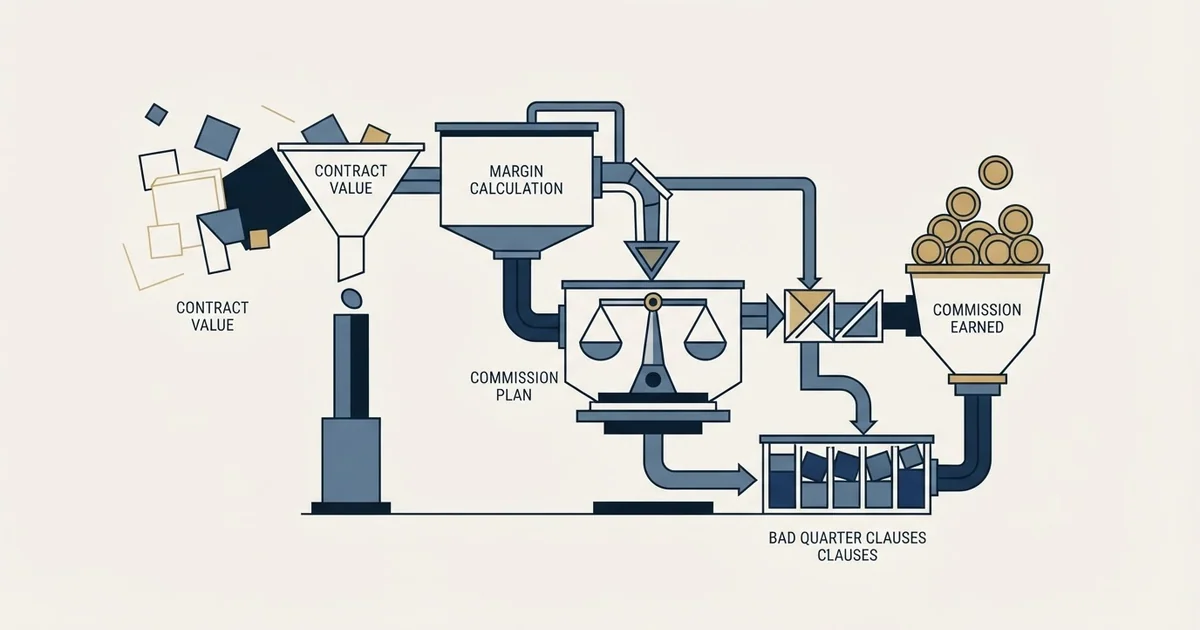
A sales commission plan is five decisions: the fixed and variable split, what the commission is measured on, the rate and its shape, the event at which commission is earned, and what happens on cancellation or departure. The rate is derived from contract value, gross margin and the acquisition budget rather than from a published average.
Key takeaways
- The headline rate is the last of five decisions. The split between fixed and variable pay, the measure the commission sits on, the earning event and the after-the-fact clauses all constrain it, and settling them first makes the rate close to arithmetic.
- Derive the rate from annual contract value, gross margin and the share of that margin the business will spend to acquire a customer. A rate borrowed from a published average describes companies whose economics, contract sizes and cycle lengths you cannot see.
- Commission is a variable cost until a draw, a ramp guarantee or an accelerator changes its behaviour. A non-recoverable draw is fixed cost wearing a variable label, and accelerators make the cost rise faster than the revenue it is attached to.
- For employees who are not exempt from overtime, 29 CFR 778.117 requires commissions to be included in the regular rate regardless of how or when they are computed and paid. When a commission becomes an earned wage is governed by state law and varies.
Reviewed and updated September 1, 2026
Most commission plans are written in a quarter that went well. The rates get set against a pipeline that was already there, the accelerators get designed around the seller who was already winning, and nobody writes down what happens when a customer cancels in month two or when a deal that closed in March gets paid in September. Then a bad quarter arrives and every one of those unwritten cases turns into an argument, usually with the person you least want to lose.
A commission plan is a contract about behaviour that also happens to be a cost line. Both halves are worth designing on purpose, and the design work that matters is mostly not the headline rate.
Readers arriving mid-argument can start with the commission plan definition, which lists the decisions that come before the rate and explains why they bind harder.
Salesman commission, salesperson commission and sales commission all name the same thing, the variable part of pay that a plan ties to booked or collected revenue, and the wording differs by industry rather than by mechanism.
A sales commission structure template is a table with the decisions already made, so the useful version is the list of parts above: fill those in and the structure is whatever they add up to.
A commission clawback is the clause that recovers pay already issued when the business behind it does not survive, and it is the one place in a plan where a company risk can quietly be moved onto a person who never controlled it. A commission accelerator is that second shape written as a rule, a higher rate applied to business above target, and it is the feature that makes a good year cost more than a revenue multiple predicts. Worked sales compensation plan examples circulate widely and every figure in them was invented by whoever published it, so the five decisions below are the part worth copying and the rate is the part to derive from your own economics. A commission cap, a hard ceiling on what a seller may earn in a period, is the blunt form of this clause, and it removes the incentive at exactly the moment the business most wants it working, which is why a windfall clause scoped to the deal nobody sized for is the instrument to reach for first. A tiered commission structure example borrowed from a vendor post is a ladder of rates fitted to somebody else's contract value and margin, which is why the derivation above replaces it rather than sitting beside it.
A sales clawback is the same clause under the shorter name, and the questions it has to answer are the ones above: what event triggers recovery, over what window, and whether the seller had any influence over the thing being recovered against.
The commission equation itself is the trivial half: commission equals the measured amount multiplied by the rate. A flat plan pays contract value times one percentage. A tiered plan applies a different percentage to each band and adds them, so the arithmetic is a sum rather than a product. Everything difficult sits in what the measured amount is and when it is earned, which is why the rate is the last decision on this list rather than the first. Commission payouts are that second event, and three things decide them: the frequency, monthly or quarterly; the lag, counted in days after the earning event; and the trigger, which is signature, invoice or collected cash. A plan that fixes the rate and leaves the payout schedule unstated has still decided it, in whatever the payroll team happened to do last quarter, and that is the version nobody agreed to.
The parts a plan is actually made of
A plan is five decisions, and only one of them is the number people ask about first.
The split between fixed and variable pay. How much of on-target earnings arrives whatever happens, and how much depends on results. A heavier variable share moves risk onto the seller and buys sharper short-term behaviour. A heavier fixed share buys stability, and it is the honest shape wherever the seller does not control the outcome being measured.
What the commission is measured on. Booked contract value, invoiced revenue, recognised revenue, gross margin, or units. Each choice creates a different set of deals the seller wants to bring you. Measuring on booked value rewards signature; measuring on margin rewards discipline about discounting; measuring on collected cash makes the seller care about the customer's finance department, which is either useful or unfair depending on how much influence they have over it.
The rate and its shape. A flat percentage, a tier that steps up at thresholds, or an accelerator past target. This is the visible part of the plan and it is downstream of the two decisions above.
When the commission is earned, and when it is paid. These are separate events and treating them as one is the single most common defect. Earned is a legal state. Paid is a date on a payroll run.
What happens afterwards. Clawbacks, cancellations, refunds, non-payment by the customer, the seller leaving before the money arrives. The plan that does not name these has still decided them, just later and in a worse mood.
- Simplest to model and to explain
- Cost scales linearly with revenue, which finance likes
- No extra pull at the top, so the strongest sellers are not held
- Every deal is equally attractive, including the small ones
- The default worth beating before anything more complicated is added
- Holds high performers who would otherwise cap out
- Creates a hard incentive to land deals on one side of a boundary
- Pull-forward and push-back both cluster at period ends
- Costs most in exactly the quarters that went best
- Needs a windfall clause or one very large deal rewrites the year
- Protects cost when performance is poor
- Produces a cliff, and behaviour near a cliff is not rational
- A seller far below the gate has no incentive left at all
- Reads as punitive in a quarter with a demand problem
- Defensible only where the gate is genuinely achievable
Where the rate should come from
So the answer to how much the commission should be is that no published average can supply it, and the four steps below can, from numbers you already hold.
There is no average commission rate in this article. The figures that circulate under that heading come from vendor blog posts and unscoped surveys, they are not comparable across contract sizes or sales cycles, and a rate borrowed from a company with different unit economics is a number with no argument behind it. The same reasoning is set out at length in the cost comparison between an outsourced and an in-house sales development seat, which refuses published salary figures for the same reason.
That applies to the average SaaS commission rate specifically, which circulates as one figure drawn from surveys mixing enterprise and inside-sales roles, new business and renewals, and companies whose contract values differ by an order of magnitude.
Readers arriving from a search for sales commission rates by industry are looking for a published benchmark catalogue, and the honest answer is that the by industry figures in circulation come from compensation software blogs that state no survey, no sample and no method, so the derivation below is the version that can be defended.
The rate you can defend is derived, and the derivation is short. Start from what a customer is worth in a year, take the gross margin on it, decide what share of that margin the business is willing to spend acquiring the customer, and then split that acquisition budget across everything that does the acquiring. Commission is one claimant on that budget. Marketing, tooling, and the cost of the seller's fixed pay are the others.
Unlike the rate math above, quantifying what a deal is actually worth to the buyer is the subject of the value-based selling method, the arithmetic step that precedes any commission calculation.
- Step 1Annual contract value
What one new customer is contracted to pay in a year, on a definition you have written down
- Step 2Gross margin
The share of that which survives delivery cost, since acquisition is paid out of margin rather than revenue
- Step 3Acquisition budget
How much of that margin the business will spend to win the customer, set by the payback period the balance sheet can finance
- Step 4The variable slice
What is left for commission once fixed pay, marketing and tooling have taken their share of the same budget
Working that through with invented inputs makes the constraint visible. Take a company whose average annual contract value is twenty thousand dollars at a seventy percent gross margin, which leaves fourteen thousand dollars of first-year gross profit per customer. Every figure in that sentence is invented for the illustration and describes no real company. If the business will spend a full year of gross profit to acquire a customer, the entire acquisition budget is that fourteen thousand, and everything comes out of it: the seller's base pay amortised across their deals, the cost of generating the conversation, the tooling, and the commission. A plan that pays ten percent of contract value, two thousand dollars, has taken about a seventh of the budget before a single conversation has been generated. Whether that is generous or thin is not a question a benchmark can answer, and it is a question the arithmetic answers immediately.
What the acquisition number includes and where it misleads covers the numerator problem underneath that calculation, which is where most of these models quietly break.
Commission is a variable cost, until the plan makes it something else
Sellers adjusting pricing to account for deal commission costs are treating the plan as a fixed input, and the useful move is the other way round: the rate is derived from the price and the margin, so a price set to absorb an existing rate compounds whatever was wrong with it.
The accounting answer is the one people expect: commission paid as a percentage of what sells is a variable cost, because it moves with volume rather than with time. That is the treatment most plans start from and it is why finance teams like commission as a cost shape. Revenue falls, the cost falls with it, and nobody has to make a decision for that to happen.
Three ordinary plan features break that cleanly variable behaviour, and they are worth naming because they are all common.
A draw advances commission against future earnings. A non-recoverable draw is a fixed cost wearing a variable label, since the money does not come back if the sales do not arrive. A recoverable draw is a loan, and it produces a seller carrying a negative balance who behaves like someone with nothing to gain, which is rarely what was intended.
A guarantee during ramp does the same thing for a defined window, deliberately, and that is usually the right call. It should be modelled as fixed cost for its duration rather than as commission that happens to be certain.
Accelerators make the cost rise faster than revenue past the threshold, so the cost line is not linear. It is still variable, and it is no longer proportional, and a model built by multiplying revenue by an average rate will understate the cost of a good year.
There is also a timing point that catches teams out. Commission earned in one period and paid in a later one is a variable cost in one set of books and a cash outflow in another. When the plan pays on collection rather than on signature, the seller is carrying the customer's payment terms in their personal cash flow, which is a design decision worth making consciously rather than by inheritance.
The clauses that decide what a bad quarter looks like
Every plan is fine while the numbers are good. What separates a plan that survives a bad quarter from one that produces a dispute is a short list of cases written down in advance.
- Yes: The event at which commission is earned, named precisely: signature, invoice, first payment, or collection
- Yes: The payment date relative to that event, and the payroll run it lands on
- Yes: What happens if the customer cancels, refunds, or never pays
- Yes: Whether commission on earned but unpaid deals survives the seller's departure
- Yes: How mid-term expansions, renewals and downgrades are credited, and to whom
- Depends: A windfall clause for a deal far outside the distribution the plan assumed
- Depends: Whether and when quotas or rates can be changed mid-period, and with what notice
- Depends: How deals with more than one contributor are split, decided before the deal rather than after
The clawback line deserves particular care, because it is where a plan can quietly transfer a business risk onto a person who could not have controlled it. Recovering commission on a customer who cancelled in the first thirty days is defensible if the seller had influence over fit. Recovering it eighteen months later, on a churn caused by a product decision, is a retention problem being solved out of someone's pay.
The legal floor, which is narrower than most people assume

Commission plans are largely a matter of contract, with two edges worth knowing.
For employees who are not exempt from overtime, commissions are not separable from the overtime calculation. The federal regulation is explicit: 29 CFR 778.117 states that commissions, "whether based on a percentage of total sales or of sales in excess of a specified amount, or on some other formula", are payments for hours worked and must be included in the regular rate, regardless of whether the commission is the sole source of compensation and regardless of the interval at which it is computed or paid. That text is published on eCFR at 29 CFR 778.117, verified 2026-08-16. Plans that treat a commission cheque as sitting outside the wage calculation have made an assumption the regulation does not support.
The second edge is that when a commission becomes an earned wage, and what may be deducted from it afterwards, is largely governed by state law rather than federal law, and it varies. That is the point at which a plan needs an employment lawyer in the relevant jurisdictions rather than a template, and it is worth doing before the plan is published rather than during the first dispute.
What the plan will do to behaviour
A commission plan is the most reliable instruction a sales organisation ever issues, and it is obeyed literally.
Whatever sits in the measure gets optimised, including the parts nobody intended. A plan paying on booked value produces discounting at period ends, because a discounted deal signed this quarter pays the seller more than a full-price deal signed next quarter. A plan paying on margin produces resistance to discounting and, at the edges, resistance to the deals that genuinely warrant one. A threshold produces deals bunched on the profitable side of it. An accelerator that resets each quarter produces sellers who hold a signature for eleven days.
None of that is dishonesty. It is people responding to the arithmetic they were handed, which is what the arithmetic was for. The useful question when a behaviour looks wrong is which line of the plan is paying for it.
Two adjacent numbers are worth reading beside the plan rather than after it. Quota attainment tells you whether the plan the commission sits on was set at a level people can reach, and a team missing it broadly is usually evidence about the plan rather than about the people. Win rate tells you whether the deals being chased are the right shape, and it moves when a commission design pushes sellers down-market toward volume.
Once quota attainment and win rate are stable, the same rigor applies to sales process bottleneck analysis, which measures conversion, time in step, and loss reason at each stage.
The cost of the seat itself belongs in the same view. The fully loaded cost of a sales development seat is the worksheet for the fixed half of the same equation, and it is the figure that decides whether a plan is affordable before any commission is paid at all.
Reviewing it without rewriting it every quarter

A plan that changes every quarter teaches sellers that the plan is not real, and the rational response to an unstable plan is to optimise for the current period only. A plan that never changes eventually pays for behaviour the business no longer wants.
The workable rhythm is an annual redesign with a written change log, plus a standing rule for the cases that arrive mid-year: a new product, a segment nobody planned for, or a deal outside the distribution. Handling those under a named clause is calmer than renegotiating the plan, and it protects the credibility of everything else in it.
Where the constraint turns out to be the number of qualified conversations rather than the incentive on them, no commission design will fix it, and raising rates against a thin pipeline is an expensive way to discover that. We are paid on attended meetings that meet criteria agreed in writing before launch, which prices the supply side against the same unit a quota is written in. See what a first campaign produces before rebuilding a plan that may not be the binding constraint.
The short version
Design the split, the measure, the earning event and the after-the-fact clauses first. The headline rate is the last decision and the easiest one once the others are settled.
Derive the rate from contract value, margin and the acquisition budget rather than from a published average, because the average describes companies whose economics you cannot see. Treat commission as variable cost, and model draws, ramp guarantees and accelerators separately, because each one breaks the proportionality the variable label implies. Write down what happens on cancellation, on departure and on a deal nobody sized for, in advance. And read the plan beside attainment and win rate, since a plan is a set of instructions and behaviour is the evidence about what those instructions actually said.
Frequently asked questions.
Frequently asked questions- What is a typical sales commission rate?
- No defensible single figure exists, and the averages that circulate come from vendor blog posts covering companies with different contract sizes, margins and cycle lengths. The rate you can argue for is derived: take annual contract value, apply gross margin, decide what share of that margin the business will spend acquiring a customer, and split the result across commission, fixed pay, marketing and tooling.
- Is sales commission a fixed or variable cost?
- Commission paid as a percentage of what sells is a variable cost, because it moves with volume rather than with time. Three ordinary plan features break that. A non-recoverable draw does not come back if the sales do not arrive, a ramp guarantee is fixed cost for its duration, and accelerators make cost rise faster than revenue past the threshold.
- When is a sales commission actually earned?
- Whenever the plan says, which is why the plan has to say. Signature, invoice, first payment and full collection are all used, and each moves risk to a different party. Earned and paid are separate events, and a plan that pays on collection puts the customer payment terms into the seller personal cash flow, which is a decision worth making consciously.
- Should a commission plan include clawbacks?
- A narrow one is defensible where the seller had influence over fit, such as a customer cancelling inside the first weeks. A broad clawback reaching back many months transfers a retention risk onto a person who could not control it. Write the window, the triggering events and the recovery mechanism before the plan ships rather than during the first dispute.
About the author.

Ben Carden is CRO at RevenueFlow, which builds and operates outbound revenue engines for B2B companies. Previously at Gartner Enterprise. Studied at London School of Economics.
Ben Carden · CRO
Connect on LinkedIn →Explore more.
Ready to scale your outreach?
We build GTM engines that book real meetings. See the receipts.
Related articles.
Sales Crediting: Who Gets Paid on a Four-Person Deal
Crediting decides who is recorded as earning a sale, and it is a separate decision from the rate. Settle the rule before the quarter, not after the close.
OTE in Sales: What Decides Whether the Number Arrives
On-target earnings is a forecast written in the grammar of a salary. Pay mix, quota and last year's attainment decide whether the number on the letter arrives.
Sales Rep Incentive Programs: What a Short-Term One Moves
An incentive moves behaviour inside the rep control that completes inside the window. Design rules, the failure modes, and the problems a contest cannot fix.
Sales Kickoff Meeting: The Decisions It Has to Leave With
A kickoff is the one moment a whole sales organisation can change at once. The four decisions it has to publish, and the week-six check that tests them.
Value-Based Selling: The Arithmetic Step After the Diagnosis
Diagnosis establishes that a problem hurts. Value-based selling is the step that turns it into a figure the buyer's own finance function will defend for you.
The Seven-Step Sales Process: What Each Step Assumes
Prospecting through follow-up, walked one box at a time. Each of the seven steps carries an assumption about the buyer, and most of them have quietly stopped holding.