Commission Plan: The Five Decisions the Rate Is the Last Of
A commission plan sets how much of a seller's pay depends on results, what those results are measured on, the rate and its shape, when commission is earned as distinct from when it is paid, and what is recovered if the business behind a payment does not survive. The rate is the most visible decision and the least consequential.
Key takeaways
- A commission plan is five decisions, and the headline rate is the last of them to settle rather than the first.
- Earned and paid are separate events, and collapsing them is the defect that surfaces exactly when a customer signs and then does not pay.
- Whatever the plan measures selects the deals a team brings you, so changing the measurement changes the pipeline before it changes anybody's pay.
- In sales development the plan reduces to one definition, which is what counts as a qualified meeting, and it has to exist in writing before launch.
A commission plan is the written agreement that decides how much of a seller's pay depends on results, what those results are measured on, and when the money is earned and paid. It is a contract about behaviour that also happens to be a cost line, and the headline percentage everybody asks about first is the last of five decisions rather than the first.
The word plan is doing real work in that sentence. A rate is a number. A plan is the rate plus the measurement, the timing and the rules for what happens when a deal that already paid somebody turns out not to survive.
The five decisions a plan is made of
The split between fixed and variable pay. How much of on-target earnings arrives whatever happens, and how much depends on results. A heavier variable share moves risk onto the seller and sharpens short-term behaviour. A heavier fixed share buys stability, and it is the honest shape wherever the seller does not control the outcome being measured.
What the commission is measured on. Booked contract value, invoiced revenue, recognised revenue, gross margin, or units. Each choice quietly selects the deals a seller wants to bring you. Measuring on booked value rewards signature. Measuring on margin makes discounting expensive for the person doing the discounting. Measuring on collected cash makes the seller care about the buyer's finance department, which is either useful or unfair depending on how much influence they have over it.
The rate and its shape. A flat percentage on everything, a tiered rate that steps up at thresholds, or an accelerator past target. This is the visible part of the plan, and it is downstream of the two decisions above rather than independent of them.
When the commission is earned, and when it is paid. These are two separate events, and treating them as one is the single most common defect. Earned is a state the agreement defines. Paid is a date on a payroll run. A plan that fixes the rate and leaves the payout trigger unstated has still decided it, in whatever the payroll team happened to do last quarter, which is the version nobody agreed to.
What happens afterwards. Cancellations, refunds, non-payment by the customer, a seller leaving before the money arrives. A plan that does not name these has still decided them, later and in a worse mood.
- Depends: The share of on-target earnings that is fixed, and the share that is variable
- Depends: The quantity commission is measured on, named precisely enough to compute
- Depends: The rate and its shape: flat, tiered, or accelerated past target
- Depends: The event that makes commission EARNED, stated separately from the payout date
- Depends: What is recovered, over what window, when the business behind a payment does not survive
- Depends: Who owns a disputed credit, and how it is settled
Why it matters
A commission plan is the only document in a sales organisation that converts an intention into a behaviour without anybody being told. Whatever it measures is what the team will produce, including the parts nobody wanted.
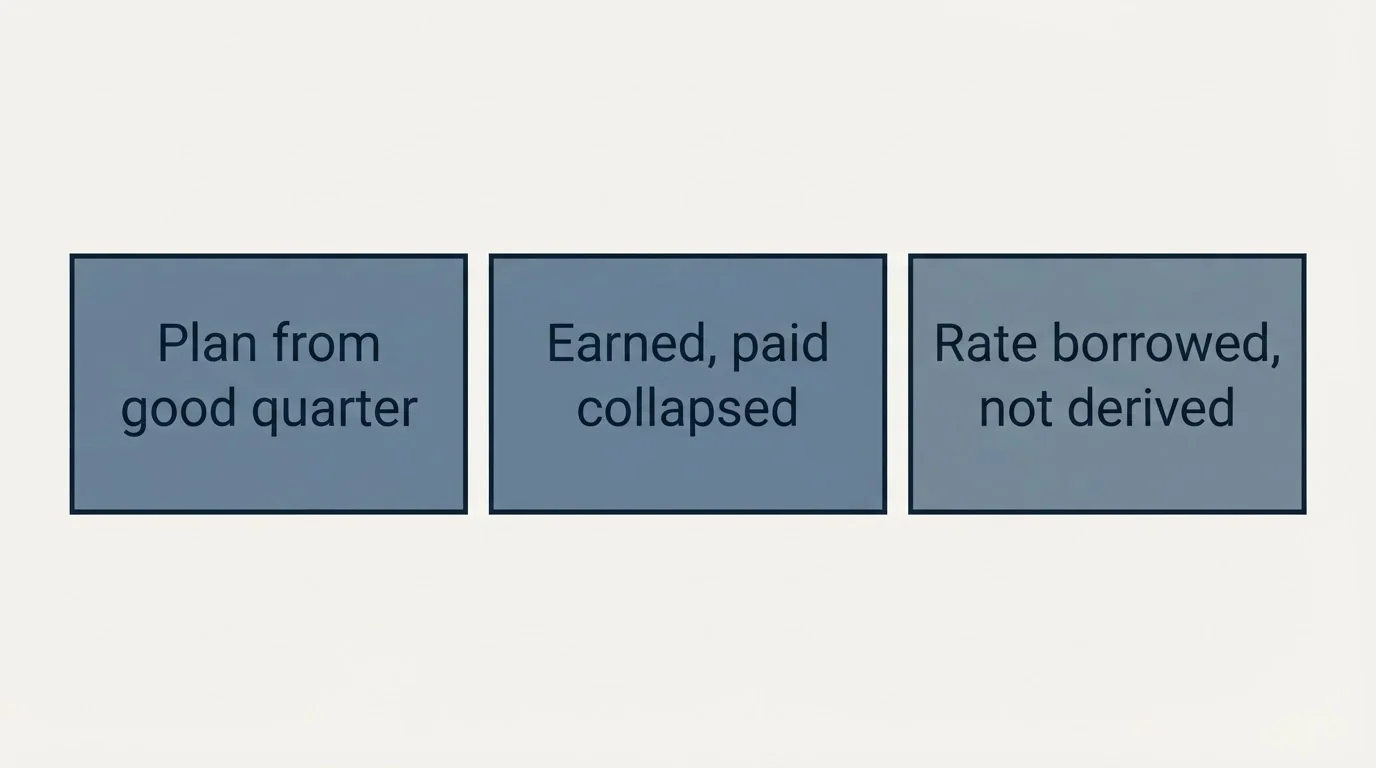
Three failure modes recur, and each one is a decision that was skipped rather than made badly.
The plan is written in a quarter that went well. Rates get set against a pipeline that was already there, accelerators get designed around the seller who was already winning, and nothing is written down about the deal that cancels in month two. Then a bad quarter arrives and every unwritten case becomes an argument, usually with the person you least want to lose.
Earned and paid get collapsed. A seller who believes they earned commission at signature and a finance team that pays on collected cash are describing the same deal and different obligations. The gap surfaces on the one occasion it is expensive: a customer who signs and then does not pay.
A rate is borrowed rather than derived. Published average rates come from posts and unscoped surveys, they are not comparable across contract sizes or cycle lengths, and a rate lifted from a company with different unit economics is a number with no argument behind it. A defensible rate comes from your own gross margin, your own deal size and your own quota arithmetic. The worked derivation, plus the clause-by-clause detail this entry summarises, is in building a sales commission plan that survives a bad quarter.
- Simplest to model and to explain
- Cost scales linearly with revenue
- No extra pull at the top, so the strongest sellers are not held
- Every deal is equally attractive, including the small ones
- Holds high performers who would otherwise cap out
- Creates a hard incentive to land deals on one side of a boundary
- Costs most in exactly the quarters that went best
- Needs a windfall clause or one very large deal rewrites the year
- Protects cost when performance is poor
- Produces a cliff, and behaviour near a cliff is not rational
- A seller far below the gate has no incentive left at all
- Defensible only where the gate is genuinely achievable
How it shows up in outbound
This is where a commission plan stops being a compensation question and becomes a targeting one.
Sales development is usually paid on meetings rather than on revenue, because a seller who only opens conversations does not control what happens in them. That is the right instinct and it moves the entire weight of the plan onto one definition: what counts as a meeting. A plan that pays per meeting without a written standard for a qualified one is a plan that will be argued about after every meeting, and the argument will be retrospective, which is the expensive kind.
Whatever the definition contains becomes a pay condition, so it decides behaviour upstream of itself. Write company size and buyer responsibility into it and the team targets the right companies. Write budget, timing or purchase authority into it and something worse happens: a genuine conversation with exactly the right person at exactly the right company can be rejected afterwards because that person said the money is not in this year's plan. The meeting happened, the person was right, and the outcome turned on a fact that changes every quarter.
Our own position on that is deliberately narrow and it is a policy rather than a result. A meeting qualifies when the company matches the audience agreed in writing before launch, the person has real responsibility for or influence over the relevant area, they agreed to a business conversation, they attended and took part, and they were not on the suppression list handed over at the start. Budget, timing, authority and immediate intent are outside it on purpose. They are useful things for a seller to learn on a call and poor things for anybody's invoice to depend on. The same reasoning applies whether the person being paid is an employee on a commission plan or an outside provider, which is why the pricing shapes in outsourced sales turn on the same definition, and why the published rate cards behind per-seat, per-meeting and per-qualified-meeting arrangements are compared on it in outsourced SDR pricing.
The rejection mechanics belong in the plan, not in a conversation. A window short enough that the assessment happens while everybody remembers the meeting, a named reviewer, and a valid-reason standard that points at something in the agreed definition. Without that last part the definition is decorative, because any meeting can be declined after the fact on grounds nobody wrote down.
- Step 1Define
Write what makes a meeting qualified, before launch, in terms somebody uninvolved could check
- Step 2Target
The definition selects the list, because the team will build toward whatever it pays
- Step 3Book
The meeting happens, or it does not, against criteria that existed beforehand
- Step 4Review
A named reviewer, a stated window, and a rejection reason that points at the definition
Where the textbook definition misleads

It treats the plan as a pay document. A commission plan is a targeting instrument that arrives disguised as payroll. The measurement decides which deals get worked, so changing it changes the pipeline before it changes anybody's pay.
It presents the rate as the decision. The rate is the most visible number and the least consequential of the five. Two teams on identical rates behave completely differently if one measures booked value and the other measures margin.
It assumes one plan. Sales development, account executives and account management are paid for different things on different timescales, and a single plan applied across them will underpay somebody for work that takes a quarter to show up. Ramp time is the specific case: a seller in their first months has no pipeline yet, so a plan that measures them on outcomes is measuring the calendar.
It leaves recovery clauses to be discovered. What gets recovered when a customer cancels, over what window, and whether the seller had any influence over the thing being recovered against. That last clause is the one place in a plan where a company risk can quietly be moved onto a person who never controlled it.
It gets read as a motivation tool. A plan cannot create effort that the market does not reward. Where a team is missing plan with healthy conversion, the constraint is the number of qualified conversations reaching them, which is a supply problem and not an incentive one, and what a booked meeting actually costs is the arithmetic that says whether buying that supply makes sense at your deal size. Reading that correctly means holding the plan beside quota attainment and win rate rather than beside a pay survey, and how the quota number itself gets set and gamed is the other half of the same argument.
Related terms
Quota attainment is the measurement a commission plan pays against, and it is a statement about the plan as much as about the seller. Win rate and sales cycle are the two inputs that decide whether a rate is affordable. Ramp time is why a new seller needs a different plan for a stated period. And account executive is the seat whose plan this usually is.
The short version
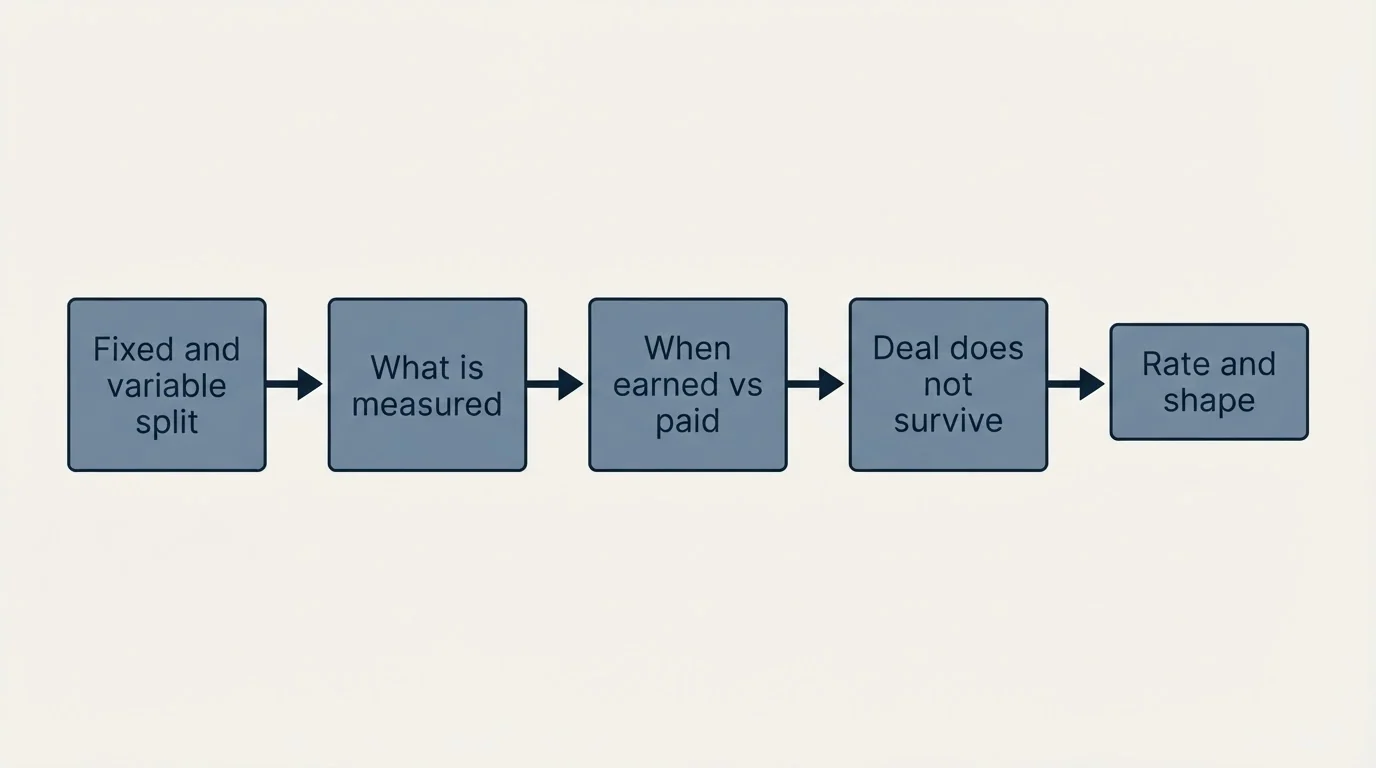
A commission plan is five decisions: the fixed and variable split, what commission is measured on, the rate and its shape, when it is earned as distinct from when it is paid, and what happens when the business behind a payment does not survive. The rate is the one people argue about and the one that matters least.
In outbound the plan reduces to a single definition, which is what counts as a qualified meeting. Write it before launch, keep budget, timing and authority out of it, give it a rejection window and a named reviewer, and accept that the team will build toward whatever it says.
If the constraint is the supply of qualified conversations rather than the incentive to chase them, that is the part we run, priced against the meeting rather than the activity: see what a first campaign produces.
Frequently asked questions.
Frequently asked questions- What is the difference between a commission plan and a commission structure?
- The structure is the rate and its shape, meaning flat, tiered or accelerated. The plan is the structure plus everything around it: what commission is measured on, the fixed and variable split, the event that makes it earned, the payout schedule, and the recovery clauses. Most published structure templates answer one of the five decisions and leave the other four open.
- When is sales commission earned rather than paid?
- Earned is the state the agreement defines, usually at signature, at invoice, or on collected cash. Paid is a date on a payroll run some days or weeks later. They are separate events and a plan should name both. Leaving the earning trigger unstated does not avoid the decision, it delegates it to whatever the payroll team did last quarter.
- How should a sales development rep be paid?
- Usually on meetings rather than on revenue, because somebody who only opens conversations does not control what happens in them. That instinct is right and it moves the entire weight of the plan onto the definition of a qualified meeting. Without a written standard agreed before launch, every meeting becomes a retrospective argument, which is the expensive kind.
- Should budget and timing be part of a qualified meeting definition?
- No. Both change quarter to quarter, so making them pay conditions means a genuine conversation with exactly the right person can be rejected afterwards because that person said the money is not in this year's plan. Company fit, the person's responsibility for the area, their agreement to the conversation, and their attendance are checkable against criteria that existed beforehand.