Sales Quota: How the Number Gets Set, and How It Gets Gamed
A quota is an assignment, not a measurement. The two ways the number gets built, the adjustments that have to be explicit, and the five ways it gets gamed.

A sales quota is an assigned target for a period, built either top down by dividing a company plan across sellers or bottom up from addressable accounts, coverage capacity, conversion rates and median deal value. The reconciliation between the two methods is the useful output, because the gap quantifies what the plan assumes will change.
Key takeaways
- A quota is a management assignment rather than a measurement, so the method that produced it decides how much it is worth arguing with. Top-down division guarantees the numbers add up to the plan and guarantees nothing about whether a territory can produce them.
- Build bottom up from addressable accounts, coverage capacity, historical conversion and median deal value, then reconcile against the company plan. The gap is a quantified statement about capacity, conversion or targeting, and dividing it away converts a structural finding into a personal failure.
- Ramp, territory quality, seasonality and cycle length all have to be adjusted for explicitly. A quota covering a period shorter than the sales cycle is substantially a measure of work done before the period began.
- Sandbagging, pull-forward discounting, activity satisfaction, definition drift and relief negotiation are rational responses to the instruction as written rather than dishonesty. Each one is designed in, and each is cheaper to prevent than to police.
Reviewed and updated September 2, 2026
A sales quota arrives as a number in a cell, and the number carries none of the reasoning that produced it. It might be a company target divided by the count of people available to carry it. It might be a bottom-up estimate of what a territory can support. The two methods routinely produce figures far apart on the same team, and which one was used is almost never written next to the result.
That gap matters more than the figure does, because everything downstream treats the quota as a fact: pay, headcount planning, forecast credibility, and whether a seller is judged to be performing.
A quota setting procedure worth writing down is these two passes run in order, top down for the arithmetic and bottom up for the capacity, with the reconciliation named as a required output rather than left to whoever happens to notice the gap.
Benchmarks borrowed from the trade press make poor anchors here, and what a quoted sales figure has to carry starts with the date of the survey rather than the date on the article.
What a quota is, and what it is not
A quota is an assigned target for a defined period, given to a person or a team, against which performance is measured. It is a management instrument rather than an accounting one, so nothing outside the company governs how it is built.
What is a sales quota, put as briefly as it can be: a number one person or team is expected to deliver in a period, assigned rather than predicted, and separate from both the forecast and the company plan.
It is not a forecast. A forecast is an estimate of what will happen; a quota is a statement of what somebody is expected to deliver, and the two are deliberately different numbers in most companies. It is also not the company target. Total assigned quota usually exceeds the company plan on purpose, so the plan still lands when some sellers miss.
The measurement side of the relationship, including what that deliberate over-assignment does to the average, is covered in quota attainment. This page is about the number before it is measured: where it comes from, what shape it takes, and what it does to behaviour once it is assigned.
The shapes a quota takes
- Revenue quota: contracted or booked money in the period
- Unit quota: count of deals, logos or seats, which protects against one large deal carrying a year
- Both measure the outcome the business wants
- Both are heavily influenced by territory quality
- Neither is readable for a seller in their first quarter
- Gross-margin quota, which makes discounting expensive for the seller
- Product-weighted quota, which pulls effort toward a strategic line
- Harder to compute and slower to report
- Rewards the deals the business actually wants
- Requires margin data the sales team can see and trust
- Counts of calls, meetings booked or accounts worked
- The only quota a ramping seller can meaningfully hit
- Measures effort rather than result, and is the easiest to satisfy without progress
- Useful as a leading indicator, weak as a performance judgement
- Becomes theatre the moment it is the number that decides pay
Most teams run a combination, and the combination is where the design work sits. An outcome quota with an activity floor underneath it is common and reasonable. An activity quota that pays the same as an outcome quota is a decision to buy motion.
Whether that floor counts calls or conversations is the design choice, and the activity quota entry separates what such a number counts from what it instructs.
Sales quota examples are worth reading as one per type rather than as a list, because a revenue quota, a unit quota, a margin quota and an activity quota answer different questions and break in different places.
The two ways the number gets built
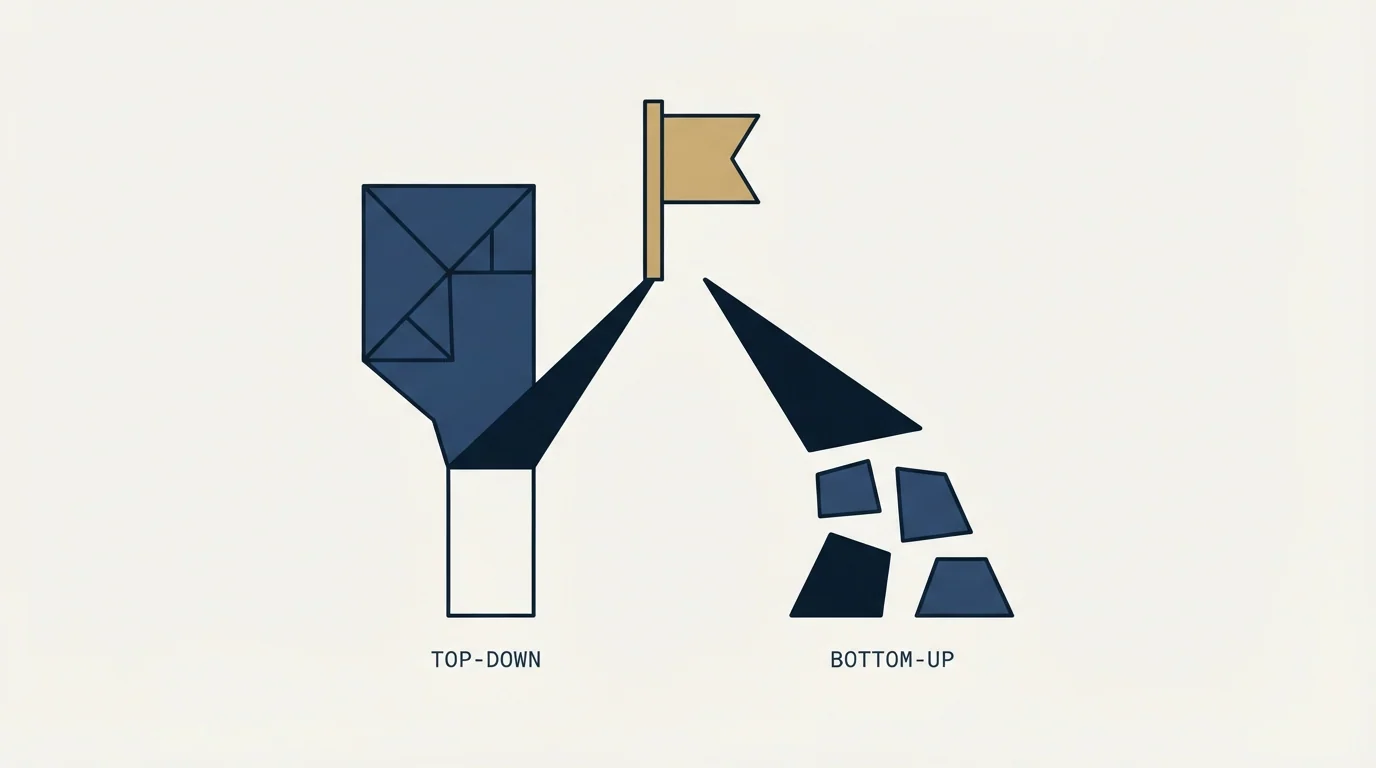
Top down starts with the company plan, subtracts what is expected from other sources, and divides the remainder across the sellers available. Its advantage is arithmetic: the numbers add up to the plan by construction. Its weakness is that division is not a measurement, so it can assign a number to a territory that has never produced anything like it and will not produce it this year either.
Bottom up starts from capacity. It estimates what each seller can actually work given the accounts in front of them, their conversion history, and the length of the cycle, and then adds the estimates together.
- Step 1Addressable accounts
How many accounts of the right shape sit in the territory, counted rather than assumed
- Step 2Coverage capacity
How many of those one seller can genuinely work in a period, given cycle length and meeting load
- Step 3Conversion
The rate at which worked accounts have historically become opportunities, and opportunities have become wins
- Step 4Deal value
Median rather than mean, since one outsized deal in the history will otherwise set everyone's number
- Step 5Reconcile
Compare the sum against the company plan, and treat the gap as the finding rather than as an error to be divided away
The reconciliation step is the one that gets skipped, and it is the one worth protecting. When the bottom-up total lands well below the company plan, that difference is the most useful number the exercise produces. It is a quantified statement that the plan requires something the current team, territories and conversion rates cannot deliver, and the honest responses are to add capacity, improve conversion, change the target list, or change the plan. Dividing the gap across the sellers instead converts a structural finding into a personal failure, quarter by quarter, until people leave.
Most lists of quota setting best practices reduce to that discipline: run both passes, reconcile them, and write down which adjustments were applied and to whom.
Working it through with invented inputs shows how quickly the two methods diverge. Suppose a seller's territory holds four hundred accounts of the right shape, they can genuinely work eighty in a quarter, historically one in eight of those becomes an opportunity, one in three of those opportunities closes, and the median deal is worth eighteen thousand dollars. Every figure here is invented for the illustration and describes no real team. That produces ten opportunities, a bit over three wins, and roughly sixty thousand dollars in the quarter. If the top-down division handed the same seller a hundred thousand, the plan is not asking for more effort. It is asking for a different conversion rate, a different territory, or a different deal size, and naming which one is a solvable problem in a way that a missed number is not.
The comparison between two quota methods only holds if their inputs match, a principle behind comparing sales performance across periods.
The adjustments that have to be made explicitly
Ramp. A seller in their first months has no pipeline yet, so a full quota measures the calendar rather than the person. Reduced quotas during ramp are the fairest treatment and they tend to outlive the ramp unless the step-up dates are written down in advance.
Territory. Two sellers doing identical work in unequal patches will produce unequal results. Where quotas are equal and territories are not, the quota is measuring the territory. Either balance the patches or vary the numbers, and say which was done.
Seasonality. Businesses whose buyers disappear for a month should not carry a quota that assumes they did not. An evenly divided annual number guarantees one quarter that reads as a crisis and another that reads as heroics, and neither reading is about the sellers.
Cycle length. A quota for a period shorter than the sales cycle is substantially a measure of work done before the period began. That is the mechanism behind most first-quarter panics on a new plan.
How quotas get gamed, without anybody lying
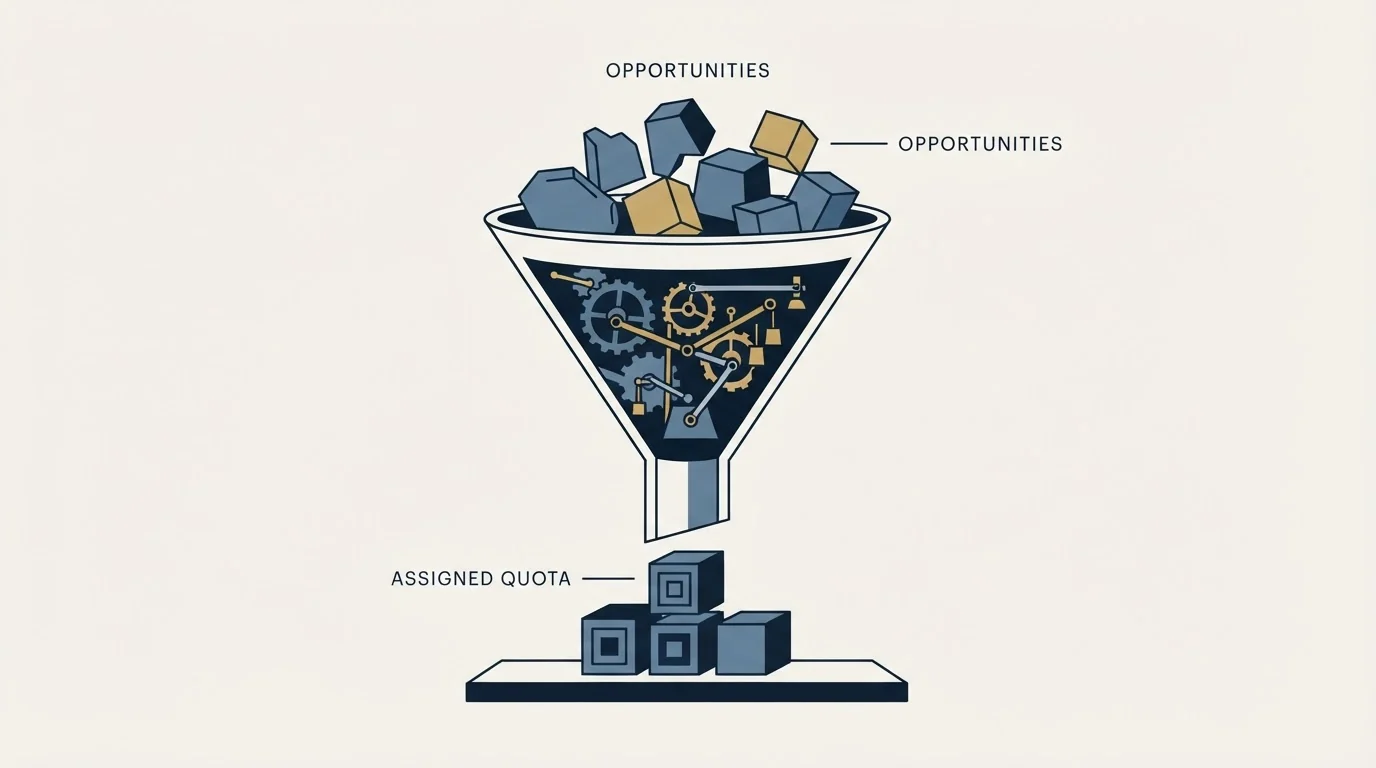
Every one of these is a rational response to the instruction as written.
Sandbagging. A seller who has comfortably passed their number has an incentive to hold the next signature until the following period, particularly under accelerators that reset. The behaviour is invisible in the attainment figure and produces a lumpier revenue line than the underlying business has.
Pull-forward. The same mechanism in reverse, with discounts as the lever. A seller short of the line will trade price for timing, and the cost lands in margin rather than in the quota report.
Activity satisfaction. Where the quota counts attempts, attempts are what arrive. Counting repeated approaches to the same accounts is the version that does most damage, because it manufactures volume out of a list that has already been worked rather than out of new coverage. Our own practice removes that option deliberately: one message per campaign, and a later approach is a new campaign built on a new reason to make contact rather than a follow-up on the old one. A quota written against attempts on the same account is an instruction to do the thing we do not do.
Definition drift. What counts toward the quota is a boundary, and boundaries move. Whether a renewal counts, whether an expansion counts, whether a deal booked by two people counts once or twice: each is a rule, and changing one changes attainment across the team without anything happening in the market.
Relief negotiation. In organisations where quota relief is granted case by case, arguing for relief is a skill that pays, and it competes for time with selling. Written rules for the cases that recur are cheaper than a standing negotiation.
Reading the number honestly
The diagnostic question when a team misses is not who missed but how many. One seller in twelve short of the number is plausibly about that seller. Ten of twelve short is a statement about the number, and treating it as twelve separate performance conversations is a decision to keep the plan and change the people.
Two companion figures do most of the work. Win rate separates a volume problem from a conversion problem, and the two have opposite remedies: more activity against a poor conversion rate produces more losses at greater cost. Sales velocity holds deal count, value, win rate and cycle length in one expression, which is the cleanest way to see which input a quota increase is actually assuming will change.
The capacity side deserves the same scrutiny before headcount is added, since a new seller carries a ramp and a fully loaded cost long before they carry a number. The fully loaded cost of a sales development seat is the arithmetic for that, and proving the motion before hiring into it is the version of the argument at team-design level. Where the shortfall traces back to the number of qualified conversations reaching the team, the pricing models in outsourced sales development describe how that capacity is bought and which shapes carry the risk, and what a qualified meeting costs is the figure to hold against the quota arithmetic before adding either seats or spend.
The sales efficiency ratio explains why revenue growth stalls when headcount is added faster than production can follow.
Where the constraint is supply rather than effort, that is the half we run, and it is priced against attended meetings that meet criteria agreed in writing before launch. See what a first campaign produces.
The short version
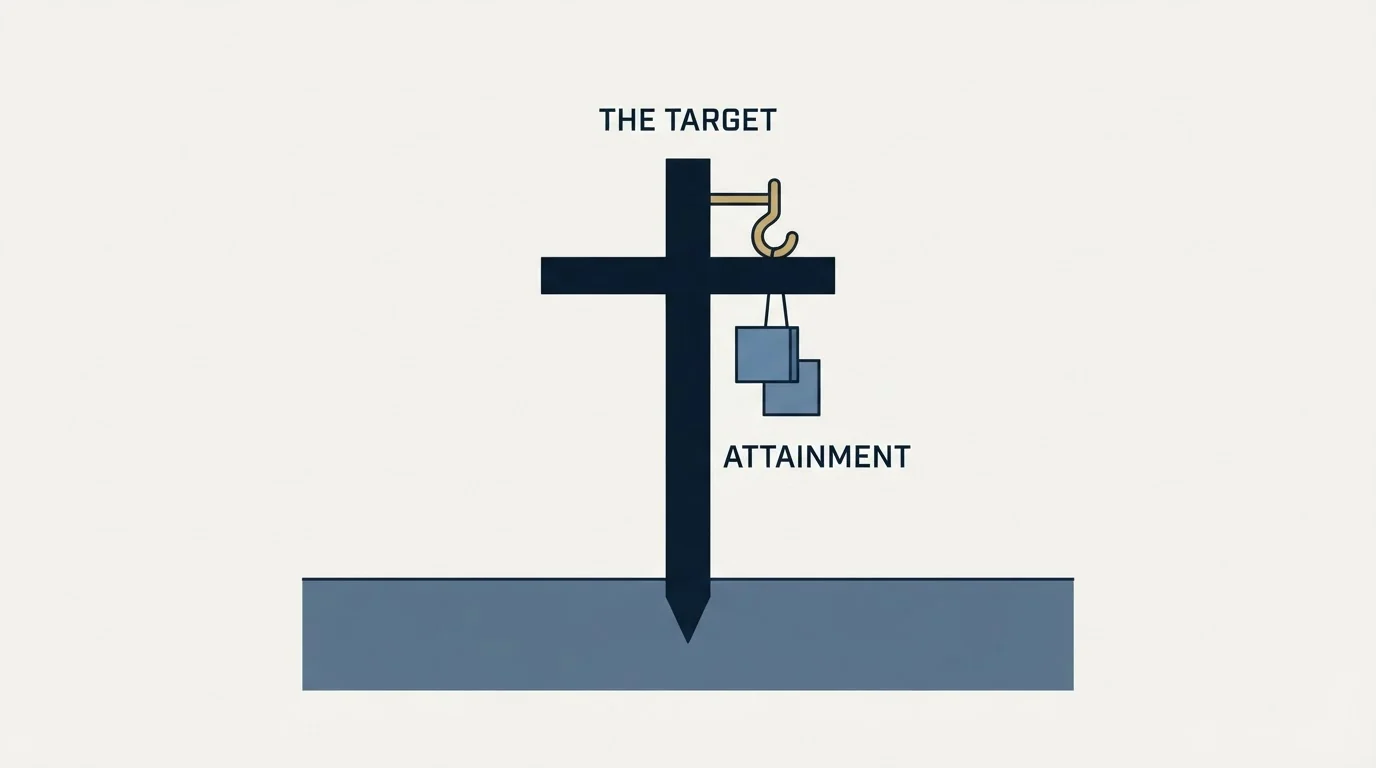
A quota is an assignment, not a measurement, and the method that produced it decides how much it is worth arguing with. Build it bottom up from accounts, coverage, conversion and median deal value, then reconcile against the company plan and treat the gap as the finding.
Pick the type deliberately: outcome quotas measure the thing the business wants, activity quotas measure effort and become theatre when they decide pay, margin quotas price discounting into the seller's own maths. Adjust for ramp, territory, seasonality and cycle length explicitly, and write the adjustments down. Expect sandbagging, pull-forward and definition drift, because each is a rational reading of the instruction. And when most of a team misses, read the miss as evidence about the plan first.
Frequently asked questions.
Frequently asked questions- What is the difference between a sales quota and a forecast?
- A forecast estimates what will happen. A quota states what somebody is expected to deliver, and it is deliberately a different number in most companies. Total assigned quota also usually exceeds the company plan on purpose, so the plan still lands when some sellers miss, which means quotas do not sum to the forecast either.
- How do you set a sales quota for a new rep?
- Reduce it for the ramp period and write the step-up dates in advance, because a full quota on a seller with no pipeline measures the calendar rather than the person. Activity targets are the only meaningful measure in the first weeks. The common failure is leaving the ramp allowance in place long after the ramp has finished.
- Should quotas be the same across a sales team?
- Only where the territories are genuinely comparable. Two sellers doing identical work in unequal patches produce unequal results, so an equal quota on unequal territories is measuring the territory. Either balance the patches or vary the numbers, and state which was done, because the alternative is a performance conversation about geography.
- What does it mean when most of the team misses quota?
- It is evidence about the plan before it is evidence about the people. One seller in twelve missing is plausibly about that seller. Ten of twelve missing is implausible as ten independent underperformances, and the reasonable first hypothesis is that the number was set above what the territories and conversion rates support.
About the author.

B2B cold email experts helping companies generate qualified leads through done-for-you outreach campaigns.
RevenueFlow Team
Explore more.
Ready to scale your outreach?
We build GTM engines that book real meetings. See the receipts.
Related articles.
Win Rate Benchmarks: Which Figures State a Population
A catalogue of the published average sales win rates, sorted by whether the page names the population behind its own number. Most do not.
Sales Cycle Length Benchmarks: What Each Figure Counts
The published B2B sales cycle benchmarks, sorted by what each page says it counted. The same number means two different things in two of them.
Sales Enablement Charters: What the Published Ones Ask For
Six publishers set out what a sales enablement charter should contain. Five describe a document nobody can check, and one writes a definition with inspection in it.
Sales Kickoff Agendas: Five Published, Session by Session
Five publishers print a sales kickoff agenda. They agree on four blocks and disagree on session length, rehearsal and where the agenda comes from.
Sales Comp Plan Design: What the Publishers Prescribe
Four publishers set out how to design a sales compensation plan. Here are their procedures, their components, and which of their ratios carry a population.
The Bow Tie Model: The Funnel Extended Past the Sale
The bow tie extends the sales funnel past the close into onboarding, adoption and expansion. The stages, the numbered metrics and the fit, from the author's standard.