The Bow Tie Model: The Funnel Extended Past the Sale
The bow tie extends the sales funnel past the close into onboarding, adoption and expansion. The stages, the numbered metrics and the fit, from the author's standard.
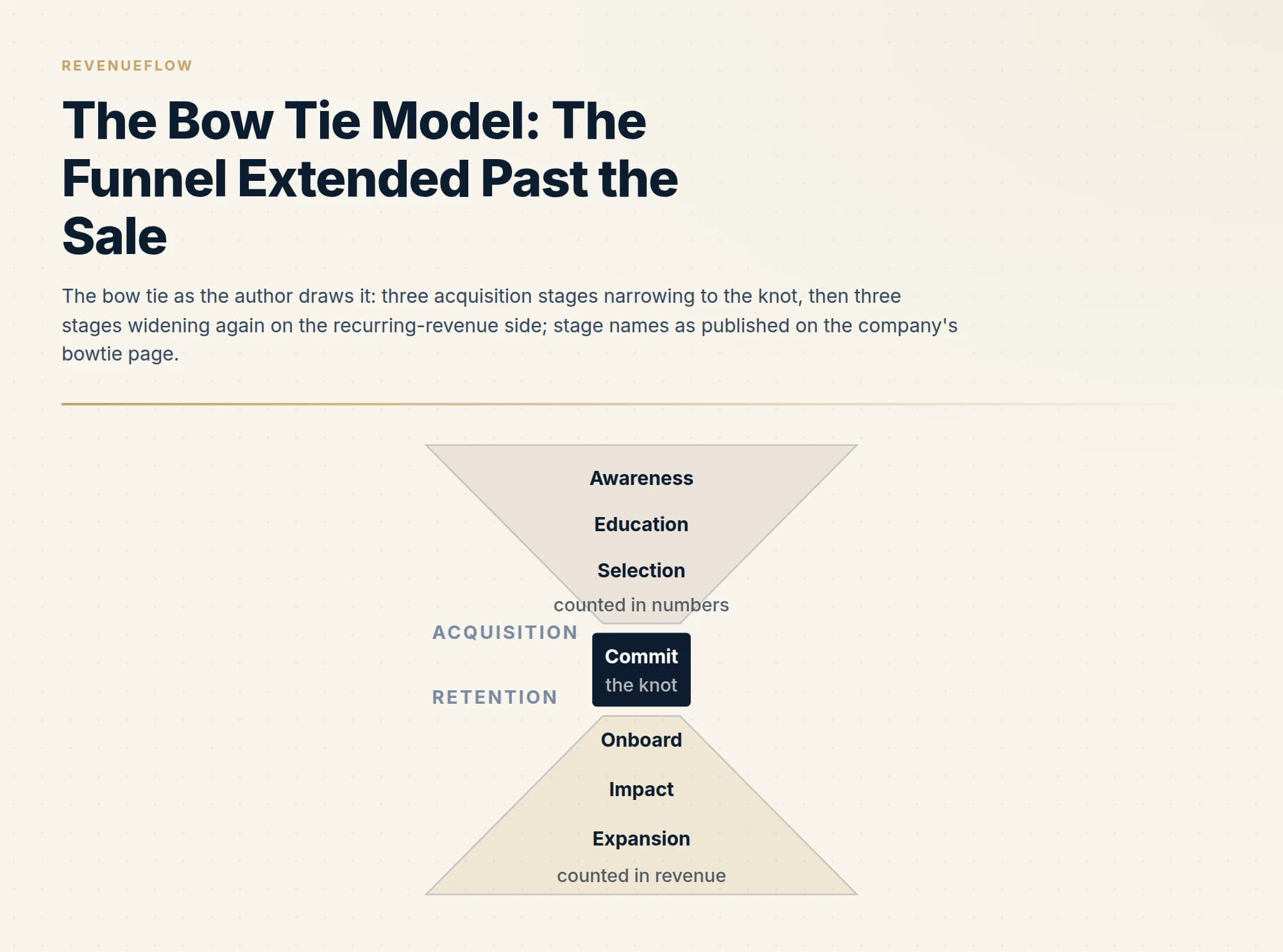
The bow tie is Winning by Design's model of a recurring revenue business. It keeps the funnel's Awareness, Education and Selection stages, puts Commit at the knot, and adds Onboard, Impact and Expansion on the right, with numbered volume, conversion and time metrics laid over every stage so that different motions can be compared on one axis.
Key takeaways
- The author's standard names four constraints in the classic funnel, chief among them that two of three revenue growth engines, retention and expansion, take place outside it: the funnel stops where recurring revenue begins.
- The company's bowtie page names seven stages, Awareness, Education, Selection, Commit, Onboard, Impact and Expansion; the standard calls the right side Mutual Commit, Onboarding, Adoption and Expansion and inserts a Prioritization phase before Selection.
- Over the shape the standard lays volume metrics VM1 to VM9, counted in numbers on the left and revenue on the right, conversion rates as output divided by input, and time metrics defined as the wait between actions rather than the duration of them.
- Expansion takes four forms in the standard, upsell, cross-sell, renewal and resell, and the model assumes customer relationships that extend beyond the first sale; for an outbound programme it fixes what the first two volume metrics mean and says nothing about how a message is sent.
Reviewed and updated September 19, 2026
A revenue leader draws the sales funnel on a whiteboard, narrows it to a signed contract, and stops. Everything the company will actually be paid for happens after that line. The bow tie is the model that keeps drawing. Winning by Design published it as a proposed standard, and the argument inside the shape is that a business paid over years cannot be run on a model that ends at the signature.
This page is about the model itself, taken from the author's own standard and bowtie page: the four constraints it names in the classic funnel, the stages it adds and what each one is called, the data structure it lays over the whole shape, the four forms of expansion, and where the model does and does not fit an outbound programme. The firm behind it, its SPICED framework and what it sells are covered in Winning by Design's sales methodology and are not restated here.
Why the author says the funnel had to be extended
Winning by Design's standard, a 44-page PDF titled The Bowtie, A Proposed Standard, version 1.0 by its own header, fetched on 19 September 2026, opens by describing the classic funnel as a revenue acquisition system with three sub-systems, Awareness, Education and Selection, plus a fourth, the acquisition system as a whole, whose "metrics of the acquisition system are ARR growth, the rate of Growth, acquisition cost (CAC), and CAC payback period, for example." Then it lists four numbered constraints.
The first is the one the whole model rests on. In the author's words, "2 out of 3 revenue growth engines (retention and expansion) are taking place outside the purview of the funnel." and, in one line: "The funnel stops where recurring revenue begins." The second constraint is that the funnel is seller-centric, built to close deals by promising value where recurring revenue depends on what the product does after the close. The third, headed "Operators act as if the funnel functions linearly", is the habit of answering a demand to double revenue by demanding twice the leads. The fourth is headed "The funnel does not consider closed loops": a one-directional shape shows no feedback from customers back into the top.
The standard's account of what changed is revenue recognition: under subscription only a small part is booked at the close and the rest takes years to arrive. The response, in the author's sentence: "Enter the Bowtie model, which extends the funnel to four additional stages to capture growth from acquisition, retention, and expansion."
The stages, with the names the author uses
The company's bowtie page, published 4 March 2026 and modified 31 August 2026 by its own metadata, fetched on 19 September 2026, headlines the model as "The seven stages that define the full customer journey" and defines each in a sentence. Awareness is "The stage where potential customers first recognize a problem or opportunity and become aware your solution exists." Education is "The stage where buyers learn about their problem, explore possible solutions, and deepen their understanding of what they need." Selection is "The evaluation stage where buyers compare options, validate fit, and decide which solution to purchase." Commit, the knot, is "The stage where prospects become customers, where the deal is one and delivery is set to begin." (the spelling is the page's). Onboard is "The stage where new customers are activated, trained, and guided toward achieving their first meaningful outcomes." Impact is "The stage where customers experience measurable value and results from your product or service." Expansion is "The stage where satisfied customers grow through increased usage, additional products, or renewals."
The standard uses slightly different names for the right side, and both are reported here because they are both the author's. It numbers the added stages as sub-systems four to seven: Mutual Commit, Onboarding, Adoption and Expansion, and adds an eighth, the GTM system as a whole. Where the web page says Impact, the standard says Adoption, and defines it: "During Adoption, the customer integrates the product into their daily routines." Where the page says Commit, the standard says Mutual Commit and explains the adjective: "Both parties commit to working together: one to continue delivering the promised impact and the other to keep paying for the product's usage to achieve that impact."
One more stage exists in the standard that the web page does not list. "Between the Education and Selection stages, we introduce a vital phase called Prioritization." Its job is to have buyer and seller agree the impact to be achieved before the expensive part of selection begins; in a product-led motion, the standard says, "In PLG this takes mere seconds as users sample the product."
The data structure laid over the shape
This is the part of the standard the explainers leave out, and it is the part that makes the model usable rather than decorative. The standard defines three kinds of metric: "Volume metrics (VM [n]) measure the quantity of leads, deals, meetings, and wins.", "Conversion metrics (CR [n]) measure how many inputs are needed to generate desired outputs.", and time metrics, which measure how long an input takes to become an output.
The rule that ties them together is mechanical. Every stage is treated as a function with an input and an output, both volume metrics, and "Dividing the output by the input provides a conversion metric." The standard's own worked case is the win rate: "sales is a sub-system of the acquisition process." whose input is qualified opportunities and whose output is commits, so the win rate is commits divided by qualified opportunities, and the sales cycle is the time between the two. Why the denominator matters is set out in win rate; a standard that fixes it makes two teams' win rates comparable.
The volume metrics are numbered so that they stop depending on any one team's vocabulary. The standard's table names nine: VM1 is a match to the target profile, a prospect; VM2 has expressed interest and given contact details, the marketing qualified lead or MQL; VM3 feels enough pain to consider acting, the sales qualified lead or SQL; VM4 has verified that this is a priority with a consequence for inaction, the sales accepted lead or SAL; VM5 is the number of mutual commitments, the wins; VM6 is revenue committed, the MRR committed; VM7 is committed revenue minus onboarding churn; VM8 is the recurring revenue itself, MRR; VM9 is lifetime revenue, LTV. The point of the numbering: an MQL in an inbound motion and a product qualified lead in a product-led one are both VM2, so two motions with different words can be compared on one axis.
The left and right halves count different things, and the standard says so: "the metrics on the left side of the Bowtie (VM1 to VM5) are commonly measured in numbers, such as the number of leads, opportunities, discovery calls, seats sold, etc." while the right side is measured in revenue, and the crossing point is VM5 multiplied by the average contract value. Conversion metrics follow the same numbering, CR1 to CR9, one per stage: the standard's table names them Awareness, Education, Prioritization, Selling, Commit, Onboarding, Retention, Expansion and a ninth reserved for closed loops, with CR4 being the win rate, CR7 gross revenue retention and CR8 expansion measured against the cohort's revenue after churn.
| Metric | What it counts | Familiar name |
|---|---|---|
| VM1 | A match to the target profile on situation, pain and impact potential | Prospect |
| VM2 | Expressed interest and gave a form of contact information | MQL |
| VM3 | Feels enough pain to be considering action | SQL |
| VM4 | Verified as a priority, with a consequence for doing nothing | SAL |
| VM5 | The number of mutual commitments | Wins |
| VM6 | The revenue committed | MRR committed |
| VM7 | Committed revenue less the onboarding churn | MRR at start |
| VM8 | The recurring revenue, monthly or annual | MRR |
| VM9 | Total revenue over the customer's whole lifetime | LTV |
Time metrics are defined in a way worth quoting, because it is not the obvious one. "They are not determined by the actual duration of an activity but rather by the waiting time between various actions." Writing an invitation takes minutes; the metric is the days before the reply. The two halves want opposite things from time, the standard adds: acquisition wants the cycle shorter, expansion wants the customer's lifetime longer.
Value, impact and the four forms of expansion
The reason the model is described as customer-centric is a distinction the standard draws between two words. "Value represents a promise of future Impact." Impact is the delivered result, measurable in the customer's business. Value belongs to the acquisition side; impact belongs to retention and expansion, where the customer keeps paying only if the promise keeps being kept. "The Bowtie model illustrates this by viewing each stage from the customer's perspective." Awareness, in that reading, is the customer realising they have a problem, not the customer noticing the vendor.
On the right side the standard is specific about how growth happens. "Expansion can take four forms:" upselling, cross-selling, renewal and extension, and reselling. "Upselling involves selling additional products, features, or higher-tier plans to existing customers." Cross-selling is selling to a different set of stakeholders inside the same customer, which the standard treats as the hardest sale of the four: "A cross-sell should never be handled by a CSM, as this is the most complicated sale." Renewal and extension are the anniversary events: "Renewals typically occur automatically on or right before the anniversary of the contract." Reselling is the one the author says is overlooked: "Reselling occurs when the current Champion, alpha user or decision-maker leaves their role, say, to accept a job elsewhere." The new person has no attachment to the product, so the account has to be sold again.
The closed loops the fourth constraint asked for are then listed, renewals first: "The most apparent closed loop is when customers renew and expand their business with you, contributing to compound growth.", a customer naming another team during onboarding, advocacy, an ideal customer profile updated from the best customers, referrals during the sales process, and nurturing. The retention number that the right side is ultimately read against is worked through in net revenue retention.
Where the model fits an outbound programme, and where it does not
The company's own page is candid about the model's home. Asked whether it is only for SaaS, the page answers: "While it was developed within SaaS and recurring revenue environments, the Bowtie can apply to any business model where customer relationships extend beyond the initial sale". A company paid once, at delivery, has no right-hand side to measure, and a bow tie drawn for it is a funnel with an empty half.
For a team that runs outbound, the useful part is the left edge and the numbering. Cold email and LinkedIn prospecting produce VM1 and VM2: a list of people matching the profile, and replies that turn some of them into expressed interest. Everything the standard says about qualified opportunities, prioritisation and commits happens in the conversations after that, and the model is honest that the top of the funnel is not where recurring revenue is made. What outbound gains from the standard is a fixed definition of what it hands over. A reply is not VM3; a booked and held conversation with a person who owns the problem is, and stating that in writing before a campaign launches is the same discipline the standard applies to every stage boundary. That is how qualified meetings are defined on this site, with budget, timing and authority never billing conditions, and the sales funnel template shows what an exit criterion written that way looks like.
Where the model does not help is the send itself. The standard measures time as the wait between actions, and a cadence of touches is the market's usual answer to a long wait. This site runs one message per campaign, with no bumps and no thread replies, and a later approach to the same audience is a new campaign on a new premise; the argument and its cost are in why we stopped using follow-ups. The bow tie has nothing to say about that choice either way, because its first volume metric starts counting after the message has done its work.
- Yes: Customers keep paying after the close, so the right side has revenue to measure
- Yes: Someone owns onboarding and adoption as stages with their own conversion rates
- Yes: Wins can be counted and multiplied by a contract value to cross from numbers to revenue
- Depends: The vocabulary differs by motion, so numbering the volume metrics buys comparability
- No: Revenue is recognised once, at delivery, with no renewal to model
- No: Doubling leads is the plan for doubling revenue
The short version
The bow tie is Winning by Design's model of a recurring revenue business. Its standard names four constraints in the classic funnel, chief among them that the funnel stops where recurring revenue begins, and extends the shape past the knot with stages the author calls Mutual Commit, Onboarding, Adoption and Expansion in the standard, and Commit, Onboard, Impact and Expansion on the company's bowtie page, plus a Prioritization phase inserted before Selection.
Over the shape it lays a data structure: numbered volume metrics VM1 to VM9 counted in numbers on the left and revenue on the right, conversion rates as output divided by input, and time as the wait between actions. Expansion takes four forms, upsell, cross-sell, renewal and resell, and the shape closes into loops through renewals, referrals and advocacy.
The model assumes relationships that extend beyond the first sale. For an outbound programme it fixes what the first two volume metrics mean and where the handover to a qualified conversation sits; it says nothing about how the message that starts the count should be sent. If the constraint is that not enough conversations are entering the left side, we plan the first campaign for free.
The constraints, stage names, sub-system definitions, data structure, volume and conversion tables, time metric definition, value and impact distinction, expansion forms and closed loops are taken from Winning by Design's The Bowtie, A Proposed Standard (v.1.0, PDF), fetched 19 September 2026; the 2026/02 upload of the same file on the company's site is byte-identical to the 2024/05 one cited here. The seven stage definitions, the FAQ answers and the data model description are from the company's bowtie page, published 4 March 2026 and modified 31 August 2026 by its own metadata, fetched the same day. Verify current wording with the author before relying on it.
Sources: The Bowtie, A Proposed Standard (Winning by Design, PDF), The Bowtie (winningbydesign.com)
Frequently asked questions.
Frequently asked questions- What is the bow tie model in sales?
- A model of the full customer journey published by Winning by Design, in which the classic funnel narrows to a knot at the commit and then widens again through onboarding, impact and expansion. Its argument is that a recurring revenue business earns most of its revenue after the close, so a model that ends at the signature cannot locate where growth is won or lost.
- How is the bow tie different from a sales funnel?
- The company's own page puts it in one sentence: traditional funnels focus primarily on converting prospects into customers, while the bow tie extends beyond the sale to include onboarding, adoption, retention and expansion. The standard adds a second difference: a data structure of numbered volume, conversion and time metrics that treats every stage as a function with an input and an output.
- What are the stages of the bow tie?
- On the company's bowtie page, read on 19 September 2026: Awareness, Education and Selection on the left, Commit at the knot, then Onboard, Impact and Expansion on the right. The proposed standard names the right side Mutual Commit, Onboarding, Adoption and Expansion, adds the GTM system as a whole as an eighth sub-system, and inserts a Prioritization phase between Education and Selection.
- Does the bow tie model apply to a business without recurring revenue?
- The company's page says the model was developed within SaaS and recurring revenue environments and can apply to any business where customer relationships extend beyond the initial sale. Read literally, a company paid once at delivery has no right-hand side to measure. What transfers regardless is the numbering of volume metrics, which fixes what a lead, an opportunity and a win each mean before anyone counts them.
About the author.

B2B cold email experts helping companies generate qualified leads through done-for-you outreach campaigns.
RevenueFlow Team
Explore more.
Ready to scale your outreach?
We build GTM engines that book real meetings. See the receipts.
Related articles.
The Columbo Close: One More Thing, and Where It Works
The Columbo close is the question asked from the door once the buyer thinks the selling is over. Its two readings, the buyer it suits, and where it fails.
B2B Sales for Financial Services Companies: Regulated Seller
For the bank, agency, broker-dealer or adviser selling to businesses: the buying group, the credit and renewal windows, and the rules that bind the seller's own message.
Command of the Sale: Force Management's Process Programme
Command of the Sale is Force Management's sales process and qualification programme, not its messaging one. What the vendor says it is, delivers and how it runs.
The Urgency Close: Real Deadlines and Manufactured Ones
The urgency close from the publishers who teach it, the test that separates a real deadline from a manufactured one, the structure, and why we never invent one.
Cold Calling Scripts for 3PL Companies: One Lane at a Time
Six call scripts for brokers and 3PLs calling shippers: the front office line, the one-lane opener, the incumbent answer, the email brush-off and the voicemail.
Sales Strategy for Manufacturing Companies: Direct or Reps
How a manufacturer decides whose salespeople carry its line: the published definition of a representative, MANA's agreement clauses and the split commission problem.