B2B Sales for Financial Services Companies: Regulated Seller
For the bank, agency, broker-dealer or adviser selling to businesses: the buying group, the credit and renewal windows, and the rules that bind the seller's own message.
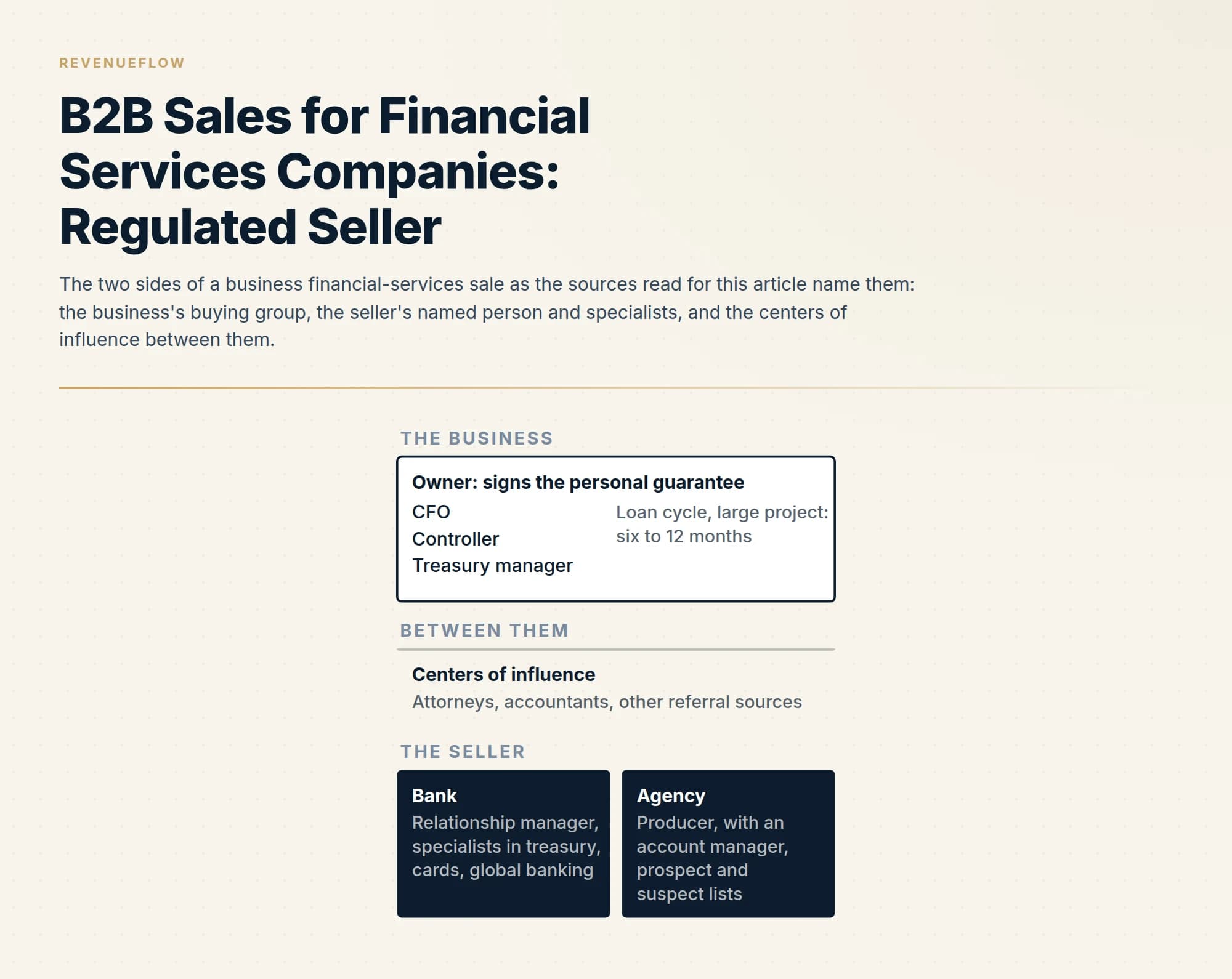
A financial services company selling to businesses writes in a named relationship manager's or producer's voice, to the owner who signs the guarantee and the CFO, controller and treasury manager behind it, timed to the business's own event or the policy renewal. Every message is read first by the person the rule names.
Key takeaways
- The Federal Reserve Banks' 2026 Report on Employer Firms says 60 percent of small employer firms applied for financing in the prior year, most often at large banks, then online lenders, then small banks, and that most non-applicants already had sufficient funding.
- Regulation B's own pages say the Equal Credit Opportunity Act applies to all credit, commercial as well as personal, and that a creditor may make no statement, in advertising or otherwise, that would discourage an application on a prohibited basis.
- FINRA Rule 2210 makes any written communication to more than 25 retail investors in 30 days a retail communication a registered principal approves before use, and a company that is not an institutional investor is a retail investor whether or not it has an account.
- Public job postings define the seller: a commercial relationship manager who brings the bank to the customer and builds centers of influence, and a producer who prospects, quotes and renews accounts annually, which makes the referral the incumbent channel.
Reviewed and updated September 19, 2026
Sixty percent of small employer firms applied for financing in the twelve months before the Federal Reserve Banks' 2025 Small Business Credit Survey, and those that applied for a loan, a line of credit or a cash advance most often sought it at large banks, then at online lenders, then at small banks, per the 2026 Report on Employer Firms published on 3 March 2026 and read on 18 September 2026. That is the market a financial services company sells into when it sells to businesses. This page is written for the regulated seller in that market: a bank's commercial banking or treasury team, a business insurance agency or carrier, a broker-dealer or a registered adviser with business clients, deciding how to write to companies that have not asked to hear from it. If you sell software or services to banks and want to reach them, the cold email for banking guide is written for that direction, and cold email for insurance and cold email for wealth management cover the other two houses from the same side.
Only two of the ten pages that answer a search for this phrase, read the same day, are written from inside a financial services company, and none reads the rules under which a bank, an insurer or a broker-dealer is allowed to write to a prospect, which is the layer this page is about. Fintech lead generation is the neighbouring page: a fintech selling financial products to ordinary companies, where the seller's marketing is not itself a regulated act. Here it is one. The generic play, one message per campaign on email and LinkedIn, is in the outbound sales playbook.
Who is on each side of the table
The Federal Reserve's report says that of firms with debt, 59 percent used a personal guarantee to secure it, so the owner is in the room for any credit conversation whether or not the owner takes the meeting. Adobe's post on financial services B2B experiences, published 11 September 2024 and read on 18 September 2026, names the rest of the buying group as CFO, treasury manager, controller, and says that "a company applying for a loan for a large real estate development project may have a sales cycle of six to 12 months". The Association for Financial Professionals describes itself on its site, read the same day, as "the certifying body in treasury and finance" and administers the Certified Treasury Professional credential.
The seller's side is defined by public job postings, two of them read on 18 September 2026 on Built In. A commercial relationship manager posting from a Nebraska-based bank's community banking division describes a role that will "bring the bank to the customer" with commercial loans, lines of credit, deposits, payment products, treasury services, global banking and commercial cards, and asks the holder to "Build centers of influence (attorney, accountants, and other needed referral sources)". A commercial lines producer posting from a New England agency says the producer "is responsible for prospecting, soliciting, quoting, and successfully acquiring new and retaining renewal accounts", "Creates and maintains prospect and suspect lists", and "Pre-qualifies insurance prospects for insurability and quality of risk". The Independent Community Bankers of America's about page, read the same day, calls the model a "relationship-based business model".
Two things follow. The seller is a named person with a licence or a portfolio, so the message is written in that person's name. And the centre of influence, the accountant or attorney the bank posting names, is a second audience, because in this vertical the referral is the incumbent channel.
The windows a business buys in
The credit window is the one the Federal Reserve's survey describes. The report says the most common reasons firms sought financing were to meet operating expenses, at 56 percent, or to pursue an expansion or a new opportunity, at 46 percent, and "Among the firms that did not seek financing, most said that they did not apply because they already had sufficient funding". The window opens when a firm's own plan changes and is closed for the firm that says it is already funded, so the trigger a bank writes against is the business's own public event, a lease, a permit, a hire, an acquisition, and not a season.
The insurance window is the renewal. The producer posting describes an account executive who will "Work with Account Manager to service and renew clients annually", which is the shape of the market from the other side: every commercial account has a policy that expires on a date, and the incumbent agent's renewal review is the moment a competing quote is either on the table or absent. Insurance Journal reported on 23 June 2026, from the Big I's 2026 Market Share Report, that "independent agents (IAs) wrote 87.7% of commercial lines written premiums in 2025", so on the commercial side the competitor at renewal is almost always another independent agency.
The rules that bind the seller's own words
Every rule below is stated from the regulator's own page, read on 18 September 2026, as what it requires of the seller. None of this is legal advice, and a seller that describes a message as compliant is making a claim only its own compliance function can make.
Lending. The Consumer Financial Protection Bureau's Regulation B page for section 1002.1 states that the Equal Credit Opportunity Act and Regulation B "apply to all credit - commercial as well as personal - without regard to the nature or type of the credit or the creditor". Its page for section 1002.4 carries the discouragement rule that touches marketing directly: "A creditor shall not make any oral or written statement, in advertising or otherwise, directed at applicants or prospective applicants" that would lead a reasonable person to believe the creditor would deny or grant on less favorable terms because of a prohibited basis characteristic. For a commercial lender the list, the message and the script are all under that rule.
Broker-dealers. FINRA Rule 2210, on FINRA's site with its latest amendment effective 16 August 2019, defines a retail communication as "any written (including electronic) communication that is distributed or made available to more than 25 retail investors within any 30 calendar-day period", defines a retail investor as any person other than an institutional investor whether or not it holds an account, and states that "An appropriately qualified registered principal of the member must approve each retail communication before the earlier of its use or filing". Its content standards require that communications "must be fair and balanced" and that "No member may make any false, exaggerated, unwarranted, promissory or misleading statement or claim in any communication". A company that is not an institutional investor under the rule is a retail investor, so a campaign to more than 25 such companies in 30 days is a retail communication a registered principal approves before the first send, and a smaller run is correspondence under the firm's supervision rules.
Advisers. The Securities and Exchange Commission's press release of 22 December 2020 on its marketing rule says the amended Rule 206(4)-1 defines an advertisement to include a communication that offers advisory services with regard to securities to prospective clients, that "The first prong of the definition excludes most one-on-one communications", that its prohibitions include a material statement of fact the adviser has no reasonable basis to believe it can substantiate on demand, and that testimonials and endorsements are permitted only under disclosure, oversight and disqualification conditions. A one-to-one message and a campaign are therefore different objects under the rule, and a client's name used as proof is a testimonial with conditions attached.
Insurance. Producer licensing is a state matter. The Texas Department of Insurance's agent and adjuster licensing page, last updated 13 April 2026, lists the licence types and says "Most licenses renew every two years". What that requires of the seller is that the person soliciting a business account holds the licence for that line in that state, settled before any message goes out in a producer's name.
Every seller. The Federal Trade Commission's CAN-SPAM guide states that the law makes no exception for business-to-business email, and says that "even if you hire another company to handle your email marketing, you can't contract away your legal responsibility to comply with the law". Email and LinkedIn are the channels this page describes; the phone, where the vertical uses it, is the vertical's own practice.
| Seller | Rule on the message | What it turns on |
|---|---|---|
| Commercial lender | Regulation B, section 1002.4 | No statement, in advertising or otherwise, that would discourage an application on a prohibited basis |
| Broker-dealer | FINRA Rule 2210 | More than 25 retail investors in 30 days makes a retail communication a principal approves first |
| Registered adviser | SEC marketing rule | An offer of advisory services is an advertisement; most one-on-one messages are excluded; every fact substantiated |
| Insurance producer | State producer licensing | The person soliciting holds the licence for the line and the state |
| Every seller | CAN-SPAM | No business-to-business exception for email; responsibility cannot be contracted away |
The 25-recipient line, drawn
The rule's institutional investor list includes a person described in Rule 4512(c), a governmental entity, an employee benefit plan or qualified plan with at least 100 participants, and a member or registered person; everyone else is a retail investor whether or not they hold an account, and no member may treat a communication as institutional if it has reason to believe it will be forwarded to a retail investor.
What the vertical says against it
The objections are in the vertical's own numbers. On the buyer's side, the Federal Reserve's report says most firms that did not seek financing already had sufficient funding, the plain version of the objection every relationship manager hears, and that "Credit union and bank applicants were more satisfied with their experiences than were online lender and finance company applicants". The report also says of its 6,525 firms that "The SBCS is not a random sample; results should be analyzed with awareness of potential biases that are associated with convenience samples", a caveat any seller quoting it carries.
On the seller's side, the same report says "Reaching customers and growing sales was the most commonly reported operational challenge", and the Big I's Agency Universe Study page, read on 18 September 2026 ahead of the 2026 study it dates to 23 September, states that 57 percent "of agencies state finding new markets as their top challenge", among 39,000 independent property and casualty agencies; the page does not date the figure, so it is the association's latest published reading rather than a 2026 measurement.
The objection the compliance function raises is the one this page exists for: an outbound message is an advertisement, a communication or a solicitation under one of the rules above, and it goes out only after the person the rule names has read it. That is the order of operations.
Channel reality, and when outbound is the wrong play
The relationship manager and the producer already have a channel, and it is the referral. The bank posting's centers of influence and the agency posting's referrals from the existing client base are the incumbent route; outbound is how a seller reaches the business no accountant has introduced. One message per campaign, on email and LinkedIn, with no bump.
Outbound is the wrong play in four cases. The product is a consumer product, a personal account, a personal policy, an individual's investments, in which case the consumer rules govern and this page does not apply. The firm has no one who can approve the message under the rule that binds it: a broker-dealer without a registered principal available, an adviser without a substantiation file, an agency whose producer is not licensed for the line in the target state. The message would need a performance figure or a client's name to work. And the market is fully referred: a bank whose relationship managers are at capacity on centre-of-influence introductions gains nothing from a list.
Three openers, each on a fetched fact
Three illustrative openers follow, each built on a page read on 18 September 2026; each is one message to one person, sent once, on email and LinkedIn, with no follow-up bump, after the compliance owner named above has read it. They name no real recipient, make no claim about results, and the institution that speaks in each is invented.
The first illustrative opener is for the owner of a regional manufacturer after a public expansion announcement, from a commercial relationship manager, and it rests on the Federal Reserve report's two most common reasons firms sought financing, operating expenses and expansion.
Your second plant was announced this month, and a plant of that size usually brings a working-capital question before the equipment question. We are a community bank whose commercial team banks four manufacturers in the county, and we underwrite locally. If the expansion is being financed in the next two quarters, would twenty minutes with our relationship manager, before you have a term sheet from anyone, be useful? Nothing in this note is an offer or a decision on any application.
The second illustrative opener is for a controller at a professional services firm, from a treasury services specialist, and it rests on the buying group Adobe's post names, CFO, treasury manager and controller.
Your firm has grown to three offices this year, per your own site, and three offices usually means three sets of receivables landing in one account. We run receivables and payments for two firms of your size in the region, and the person who would work with you holds the treasury credential your controller's peers hold. If cash application is taking more of your close each month, would a thirty-minute walk-through of how those two firms set it up be worth your time before your fiscal year closes?
The third illustrative opener is for the owner of a logistics company, from a commercial lines producer, and it rests on the producer posting's annual renewal cycle and its pre-qualification of prospects for insurability and quality of risk.
Your fleet policy renews in the spring, on the date your current agent reviews it with you. We place commercial auto for six carriers in the state and would like to be on the table at that review with a quote, not after it. If you can share the current schedule of vehicles and the loss runs in the two months before the date, we can tell you within a week whether a quote is worth your time.
To: Owner, regional manufacturer. From: Commercial relationship manager. Subject: the second plant
Your second plant was announced this month, and a plant of that size usually brings a working-capital question before the equipment question. 1
We are a community bank whose commercial team banks four manufacturers in the county, and we underwrite locally. 2
If the expansion is being financed in the next two quarters, would twenty minutes with our relationship manager, before you have a term sheet from anyone, be useful? Nothing in this note is an offer or a decision on any application. 3
- 1The business's own public event, and the reason it opens a credit window: expansion is one of the two most common reasons firms seek financing.
- 2Who is writing, in the relationship manager's own name, and what the bank does locally. No rate, no promise.
- 3A time-boxed ask, and a closing line that makes no statement about the outcome of any application.
What to agree in writing
The rule that binds the message for your seller type, and the person who reads every template before it is sent. The list, built on the business's own public events and the renewal dates the agency already keeps, with the centers of influence as a second audience. The qualification bar: a named event, a person on the buying group, and a window still open. One message per campaign, no bumps, no performance figure, no client's name without the conditions the rule attaches. A financial services company that wants to see the shape run against its own list before committing a relationship manager's calendar can start with a free campaign and count the replies its compliance owner has read.
Frequently asked questions.
Frequently asked questions- Who is in the buying group when a financial services company sells to a business?
- The owner, first, because the Federal Reserve's report says 59 percent of firms with debt secured it with a personal guarantee. Adobe's post on financial services B2B experiences names the rest as CFO, treasury manager and controller, and says a company applying for a loan on a large project may take six to twelve months. The Association for Financial Professionals certifies the treasury professionals on that side of the table, so the pitch is read with a professional's vocabulary.
- Which rules bind a bank's or broker-dealer's outbound message to businesses?
- For a lender, Regulation B, which the Bureau's page says applies to commercial as well as personal credit, and whose section 1002.4 forbids any statement in advertising or otherwise that would discourage an application on a prohibited basis. For a broker-dealer, FINRA Rule 2210: a campaign to more than 25 retail investors in 30 days is a retail communication a registered principal approves before use, and every communication must be fair and balanced. None of this is legal advice.
- What does the SEC marketing rule mean for an adviser writing to business owners?
- The SEC's press release of 22 December 2020 says the amended Rule 206(4)-1 defines an advertisement to include a communication offering advisory services to prospective clients, that the first prong excludes most one-on-one communications, that a material statement of fact must be one the adviser can substantiate on demand, and that testimonials and endorsements need disclosure, oversight and disqualification conditions. A one-to-one message and a campaign are different objects under the rule.
- When is outbound the wrong play for a financial services company?
- When the product is a consumer product, a personal account, policy or investment, because the consumer rules govern and this page does not apply. When nobody can approve the message under the rule that binds it: no registered principal, no substantiation file, no producer licensed for the line in the state. When the message would need a performance figure or a client's name to work. And when the market is fully referred and relationship managers are at capacity.
About the author.

B2B cold email experts helping companies generate qualified leads through done-for-you outreach campaigns.
RevenueFlow Team
Explore more.
Ready to scale your outreach?
We build GTM engines that book real meetings. See the receipts.
Related articles.
LinkedIn Outreach for Automotive Companies: Who It Reaches
LinkedIn outreach into automotive, split by buyer: what it can open at manufacturers, parts suppliers and dealer groups, and the cases where it is the wrong channel.
Outbound Sales for Food and Beverage Companies: Who to Reach
Outbound sales for food and beverage brands: the four buyers behind a yes, the public show calendar, what a message may claim, and when outbound is the wrong play.
B2B Sales for Hardware Companies: Sell Inside the Rules
B2B hardware sales differ from software: FCC authorization limits when a radio device may be offered, pilots cost a unit each, and distributors share compliance.
Commission Tracking: The Record That Settles a Dispute
What a commissionable line has to hold, the four dates that never agree, and how to run a period close with a dispute window inside it.
Managing a Remote Sales Team: What Replaces Line of Sight
A shared floor supplied four things nobody costed: an effort signal, ambient coaching, early escalation and a read on the person. What replaces each one.
Presales vs Sales: Who Owns the Technical Win
Sales owns the commercial outcome and presales owns the technical case. The boundary is an event, and four decisions on it need an owner in writing.