B2B Sales for Hardware Companies: Sell Inside the Rules
B2B hardware sales differ from software: FCC authorization limits when a radio device may be offered, pilots cost a unit each, and distributors share compliance.
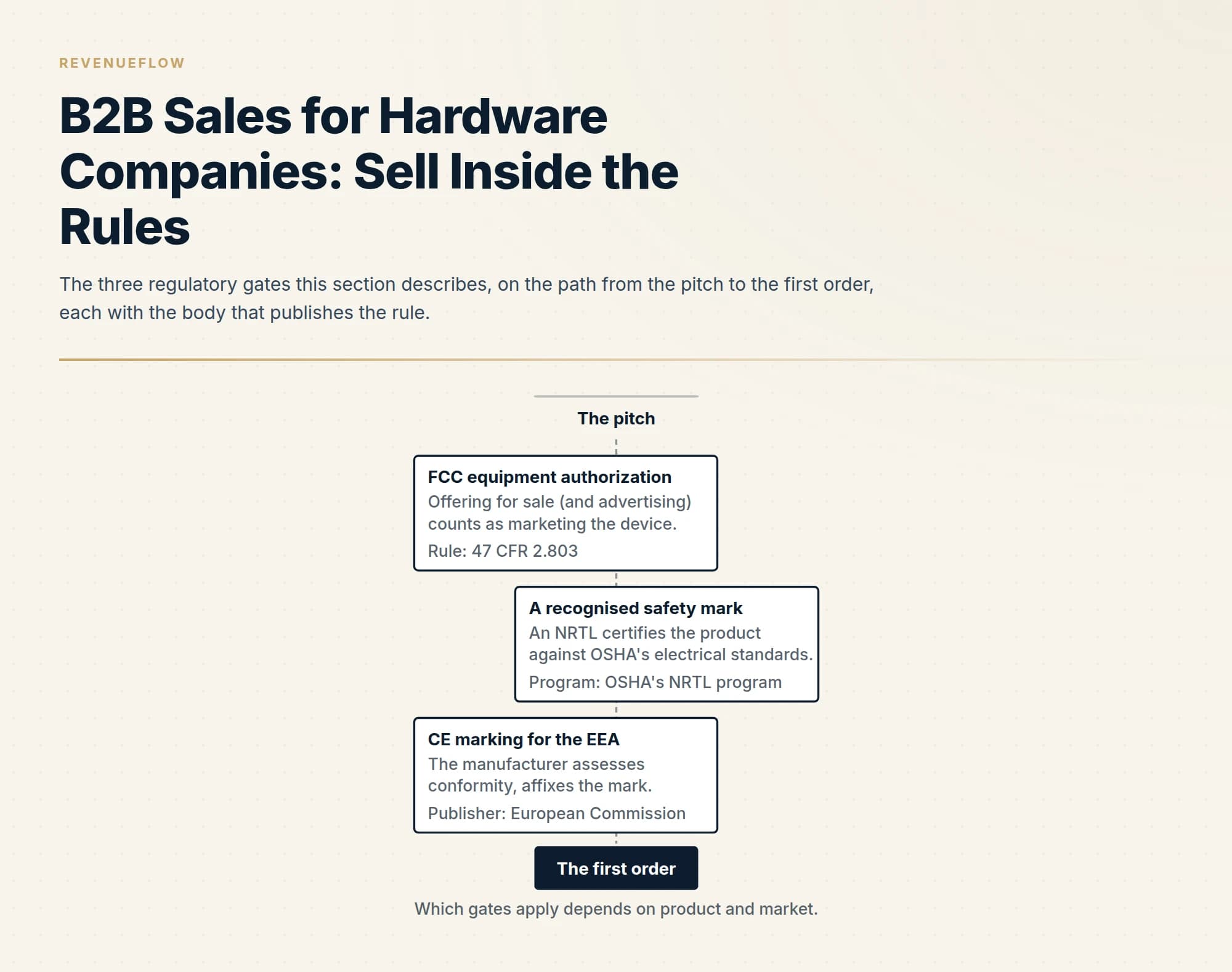
B2B sales for hardware companies starts from the certification calendar. In the United States a radio device may not be marketed before FCC authorization, and marketing includes offering it for sale, though 47 CFR 2.803 permits conditional contracts, noticed displays and evaluation kits. Treat pilot units as the capacity limit, and sell direct to design partners before the channel.
Key takeaways
- Under 47 CFR 2.803, marketing a radio frequency device includes offering it for sale and advertising it, so outreach before authorization must fit the rule's exceptions.
- The rule permits conditional sales contracts with a prominent disclosure, displays with a conspicuous notice, and evaluation kits sold to developers and system integrators.
- A hardware pilot costs a built unit, so pilot criteria belong in writing before it ships and pilot capacity caps how much demand outbound should create.
- The European Commission gives importers and distributors their own duty to ensure products meet legal requirements, which is why the channel asks for paperwork first.
Reviewed and updated September 18, 2026
A twelve-person hardware company has a wireless vibration sensor, a working demo and a lab report due in six weeks. The founders decide to get ahead of it. They build a list of three hundred plant maintenance managers and send an email offering the sensor at an introductory price, with delivery next quarter. It is an ordinary piece of B2B outreach, and for this product the email itself may be the problem: under the FCC's rules, offering a radio frequency device for sale before it is authorized counts as marketing it.
This guide is for people who work in a hardware company and sell to other businesses: device makers, equipment startups and electronics firms building a sales motion for a physical product. Most B2B sales advice is written for software, where the product can be shown the day it compiles, shipped at no marginal cost and withdrawn without anyone driving to collect it. Hardware breaks each of those assumptions, and the differences decide when you may sell, what a first meeting is for and who else has to say yes.
Three gates stand between the pitch and the first order
A software seller can take an order for anything it can demonstrate. A hardware seller often cannot, because several bodies have a say in whether the product may be offered at all, and each publishes its rule.
In the United States, radio equipment needs FCC authorization before it is marketed. The general rule at 47 CFR 2.803 reads "No person may market a radio frequency device unless the radio frequency device is authorized pursuant to a valid FCC equipment authorization", and the same section defines the verb widely: "Marketing, as used in this section, includes sale or lease, or offering for sale or lease, including advertising for sale or lease". A product with a radio in it is inside that sentence.
In American workplaces, electrical equipment is expected to carry a recognised safety mark. OSHA describes its Nationally Recognized Testing Laboratory program as one that "Recognizes private sector organizations to perform certification for certain products to ensure that they meet the requirements of both the construction and general industry OSHA electrical standards." It adds "After certifying a product, the NRTL authorizes the manufacturer to apply a registered certification mark to the product." A buyer's safety or facilities lead looks for that mark, and OSHA publishes the current list of laboratories.
In the European Economic Area, the manufacturer carries the CE duty. The European Commission's CE marking page says of manufacturers "It is their responsibility to carry out the conformity assessment, set up the technical file, issue the EU declaration of conformity and affix the CE marking to a product."
Which gates apply depends on the product and the market, and nothing in this article is legal advice. The commercial point is simpler. Your sales calendar starts from your certification calendar, and a pipeline built ahead of it has to be built inside the exceptions the rules provide.
What the FCC rule lets you do before authorization
Section 2.803 does not tell a hardware company to stay silent until the grant arrives. It lists what is permitted first, and each item has a condition attached that a sales team needs to know.
Conditional sales contracts are permitted, provided the seller gives the prospective buyer a prominent disclosure that includes "Notification that the equipment is subject to the FCC rules and delivery to the end user is conditional upon successful completion of the applicable equipment authorization process". For devices subject to certification, "delivery to the end user prior to successful completion of the equipment authorization process is prohibited". The seller "must maintain, for a period of sixty (60) months, records of each conditional sale contract".
A device may be advertised or displayed, for example at a trade show, if it carries a conspicuous notice that begins "This device has not been authorized as required by the rules of the Federal Communications Commission." Units may be moved to distribution centres and retailers ahead of the grant under further conditions, but the rule is blunt about what that transfer is for: "Pre-sale activity does not include display or demonstration of devices."
Evaluation kits are the exception most useful to a B2B seller. The rule allows an evaluation kit to be sold provided that "Sales are limited to product developers, software developers, and system integrators", with a prescribed notice in the box.
| Row | Before authorization | Condition in the rule |
|---|---|---|
| Conditional sales contract | Yes | Prominent disclosure to the buyer; records kept for sixty months |
| Advertise or display, as at a trade show | Yes | Conspicuous notice that the device has not been authorized |
| Sell an evaluation kit | Yes | Only to product developers, software developers and system integrators |
| Deliver to the end user | No | Prohibited for devices subject to certification |
For outbound this changes the message rather than forbidding it. A first email about an unauthorized radio device is an offer with a condition on it, and the condition belongs in the email.
The pilot is a sales stage, and every one costs a unit
In software a trial is a login. In hardware it is a box that has to be built, shipped, installed, supported and possibly brought back, and where the FCC's conditional sale route applies the rule adds that the seller must have a process to retrieve the equipment if certification fails. That makes the evaluation unit the scarcest thing a hardware sales team controls.
Two habits follow. Qualify before the unit ships, in writing: what the pilot will measure, who at the buyer judges it, and what happens if it passes. Our guide to proof of concept sales sets out how those criteria decide the outcome. And count pilots as the capacity limit of the sales motion. A campaign that produces forty interested plants is a failure if the company can build six units this quarter, because thirty-four buyers learn that you could not deliver.
Software
- Can be shown the day it compiles
- A trial is a login
- Shipped at no marginal cost
- Withdrawn without anyone driving to collect it
Hardware
- The sales calendar starts from the certification calendar
- A trial is a box that is built, shipped, installed and supported
- Pilots are the capacity limit of the sales motion
- The seller may have to retrieve the equipment
Distributors and resellers are part of the compliance chain
Hardware companies usually frame the channel question as margin against reach. The regulators frame it differently. The European Commission's page gives importers and distributors their own duty: "As intermediaries between manufacturers and traders they must have knowledge of the legal requirements and ensure that products they distribute or import meet them."
A distributor that takes on your product is therefore taking on a share of your compliance, which is why its first questions are about the technical file and the declaration rather than about the feature list. It also explains the order of work for a young hardware company. Direct sales to a handful of design partners comes first, because those buyers tolerate a product that is still being certified and their results become the evidence a distributor asks for. The channel comes second, once the paperwork a distributor must rely on exists. Selling a regulated device class raises the same ordering problem in a stricter form, which our medical device go-to-market guide works through.
Large buyers add their own gate on top. Security questionnaires, supplier onboarding and procurement review run as separate processes, and the documents they ask for can be assembled before any deal needs them, as the enterprise go-to-market guide explains.
Three openers that respect the rules they cite
Each is an example of the shape, sent once, with no follow-up underneath. None names a real person or claims a result.
A radio device that is not yet authorized. Source: 47 CFR 2.803.
We make a wireless vibration sensor for gearbox monitoring. It has not yet been authorized as required by FCC rules, so any order would be conditional on that authorization and nothing would be delivered before it. We are choosing two plants to specify the first production run with. Would the reliability lead be the right person to ask?
An evaluation kit for an integrator. Source: the evaluation kit exception in the same section.
Your team builds condition monitoring systems for food plants. We sell an evaluation kit of our sensor module to system integrators, with the FCC's evaluation kit notice in the box. Would it be useful to have one on the bench before your next design review?
A certified product for a safety-conscious buyer. Source: OSHA's NRTL program page.
The charger cabinet we make carries a certification mark from a laboratory on OSHA's current NRTL list. If your facilities team keeps a file of those for new electrical equipment, we can send ours before anyone spends time on a call.
Message construction for technical buyers is covered in cold email for IoT and cold email for electronics companies, which are written for component and device sellers reaching engineers.
When outbound B2B sales is the wrong play for a hardware company
There are four situations in which a hardware company should hold back.
Before authorization, if it cannot meet the conditions. A team that is not ready to make the disclosure, keep the records and withhold delivery should wait for the grant.
When it cannot build the pilots it would win. Outbound creates demand on its own schedule, and demand that meets no units damages the next campaign.
When the product is bought from a catalogue. Low-priced items that buyers order from a distributor's site are won by being listed and in stock, and a sales conversation adds cost without adding a decision.
When the certification for the target market does not exist yet. A campaign into the EEA for a product with no declaration of conformity, or into American workplaces for a product with no recognised mark, books meetings that end at the first question.
- Yes: You know which gates apply to the product in the target market
- Yes: Any offer for an unauthorized radio device carries the disclosure the rule requires
- Yes: Pilot criteria are agreed in writing before a unit ships
- Yes: You can build the pilots the campaign would win
- No: Delivery to an end user is planned before authorization
- Depends: Whether the product is better bought from a distributor's catalogue
The short version
B2B sales for hardware companies differs from software sales in what has to be true before an order can be taken. In the United States a radio device may not be marketed before FCC authorization, and marketing includes offering it for sale, though 47 CFR 2.803 permits conditional contracts, displays with a notice and evaluation kits for developers and integrators. Workplaces look for an NRTL mark, and the EEA puts the CE duty on the manufacturer and a checking duty on distributors. Treat the pilot unit as the scarce resource, agree its criteria in writing, sell direct to design partners before approaching the channel, and write outreach that states its own conditions.
We run one message per campaign by email and LinkedIn. If you want to see what that looks like for a physical product with a certification date attached, you can see what a first campaign looks like.
Regulatory text was read from eCFR, OSHA and the European Commission on 18 September 2026, from stored snapshots; eCFR flagged a pending amendment to section 2.803 published on 11 September 2026. Rules change: read the current text before relying on any of it. Nothing in this article is legal advice.
Sources: eCFR, 47 CFR 2.803, OSHA, Nationally Recognized Testing Laboratory Program, European Commission, CE marking
Frequently asked questions.
Frequently asked questions- How is B2B hardware sales different from software sales?
- Three things change. Regulators decide when the product may be offered, so the sales calendar starts from the certification calendar. A trial is a physical unit that must be built, shipped, installed and possibly retrieved, which makes pilots the capacity limit. And distributors carry compliance duties of their own, so the channel asks for paperwork before it asks about features.
- Can a hardware startup take orders before FCC certification?
- The FCC's rule at 47 CFR 2.803 permits conditional sales contracts before authorization if the buyer receives a prominent disclosure that delivery depends on authorization, and it prohibits delivery to the end user before then for devices subject to certification. The seller must keep records of each conditional sale for sixty months. Read the current rule; this is not legal advice.
- Should a hardware company sell direct or through distributors?
- Usually direct first, then the channel. Early design partners tolerate a product that is still being certified, and their results become the evidence a distributor asks for. The European Commission says importers and distributors must ensure the products they handle meet legal requirements, so a distributor needs your technical file and declaration before it can take you on.
- When should a hardware company not run outbound sales?
- Hold back when you cannot meet the conditions for marketing before authorization, when you cannot build the pilot units a campaign would win, when the product is a low-priced item buyers order from a distributor's catalogue, or when the certification your target market expects does not exist yet, because those meetings end at the first question.
About the author.

B2B cold email experts helping companies generate qualified leads through done-for-you outreach campaigns.
RevenueFlow Team
Explore more.
Ready to scale your outreach?
We build GTM engines that book real meetings. See the receipts.
Related articles.
Outbound Sales for ERP Vendors: Follow the Support Clock
Outbound for ERP vendors and resellers works when lists follow published end-of-support dates, the first reader is the controller, and channel rules come first.
LinkedIn Outreach for Automotive Companies: Who It Reaches
LinkedIn outreach into automotive, split by buyer: what it can open at manufacturers, parts suppliers and dealer groups, and the cases where it is the wrong channel.
Outbound Sales for Food and Beverage Companies: Who to Reach
Outbound sales for food and beverage brands: the four buyers behind a yes, the public show calendar, what a message may claim, and when outbound is the wrong play.
Presales vs Sales: Who Owns the Technical Win
Sales owns the commercial outcome and presales owns the technical case. The boundary is an event, and four decisions on it need an owner in writing.
Sales Qualifying Questions, Sorted by What They Test
A numbered list of questions is not a method. Sorted by the five things they establish, the same questions become one, and the weak ones become visible.
Buyer Experience: The Part Outbound Decides First
Most buyer-experience work goes into the demo and the proposal. The chapter that runs first is a message the buyer never asked for, and three properties decide it.