Medical Device Go-to-Market Strategy: Gate and Committee
Clearance gates the selling and a committee makes the purchase. How a medtech launch plan changes once both are treated as structure rather than detail.
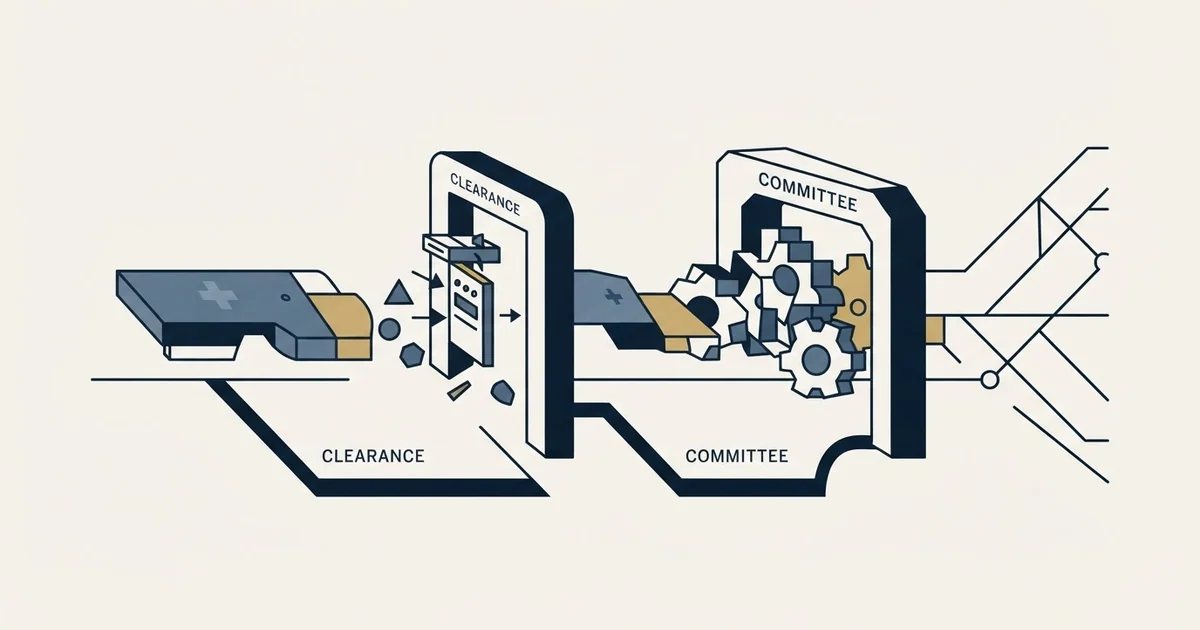
A medical device go-to-market strategy is organised around two constraints. Selling waits on a regulatory decision the company does not control, and the purchase is made by a committee rather than by the clinician who wants the device. The plan that works enumerates the accounts, maps each approval route, and prepares the written case first.
Key takeaways
- The FDA's 510(k) page states a submitter may not proceed to market until it receives the substantial equivalence order, usually determined within 90 days.
- A launch date should be expressed as a lag from clearance rather than as a fixed calendar date, because the gate has a typical duration and no guarantee.
- The clinical champion cannot approve spend, so the account plan is a map of clinical, value-analysis and contracting roles rather than a single named contact.
- A medtech market is usually countable, which makes coverage the strategy and makes the list exhaustible, so a second approach needs a stated justification.
Reviewed and updated September 1, 2026
A medical device company sets a launch date, hires two regional reps against it, and books a booth. The clearance letter arrives eleven weeks later than the plan assumed, the reps spend a quarter with nothing they are allowed to sell, and the launch that finally happens is aimed at the clinician who liked the device rather than at the committee that decides whether the hospital buys it. Nothing in the go-to-market document was wrong. It was written as though the two facts that govern medtech commercialisation were details.
Those two facts are that you may not sell until a regulator says so, and that the person who wants the device is rarely the person who can buy it. A medical device go-to-market strategy is mostly the work of arranging everything else around them.
The gate you do not control
For most devices entering the United States through premarket notification, the FDA's own description of the process is explicit about the order. Its 510(k) page states that "Until the submitter receives an order declaring a device SE, the submitter may not proceed to market the device", where SE is a finding of substantial equivalence to a legally marketed predicate device, and that the substantial equivalence determination "is usually made within 90 days" and is based on the information the submitter provides (FDA, Premarket Notification 510(k)).
Two planning consequences follow from that page alone. The launch date is downstream of an event with a stated typical duration and no guarantee, so a plan that treats it as a fixed date has converted a dependency into an assumption. And the commercial work that can legitimately happen before clearance is the work that does not require offering the device for sale: defining the account list, building relationships, running the evidence programme, and understanding how the target institutions actually approve purchases.
That last item is where the pre-clearance quarter earns its keep, because it is the part most teams start after the letter arrives, when it is the slowest thing in the chain.
- Before submissionAccount definition and evidence design
Name the institutions, the service lines and the committee structures. Decide what evidence the buyer will ask for, which is rarely the same evidence the submission needs.
- Under reviewRelationships and problem discovery
Clinician conversations, workflow observation, and the internal approval map for each target account. No offer for sale.
- At clearanceCommercial launch into a prepared list
The list, the premise and the committee map already exist, so the first quarter of selling is selling rather than research.
- First two quartersEvidence accumulation and reference building
Early accounts become the economic case the next tier of buyers will ask for.
The buying group is the strategy
In most B2B categories the buying committee is a complication. In medical devices it is the structure the whole plan has to be built around, because the roles have different questions and a plan that answers only one of them stalls at the first internal review.
Turning that committee map into a single slide forces the same five choices, from segment to stopping condition, as described in the five lines a go-to-market slide must carry.
The clinical user. The surgeon, nurse or technologist who will use the device. They care about outcomes, workflow and whether the thing behaves under pressure. They are the champion, and champions cannot approve spend.
Clinical leadership. The department head who carries the service line's results and its budget. Their question is what changes at the level of the department, not at the level of a case.
Value analysis. The committee that reviews new products in a hospital or system, usually with clinical, financial and supply-chain membership. Their question is whether the case holds against the current product and the current price, in writing, with evidence attached.
Supply chain and contracting. Where group purchasing agreements, existing vendor contracts and integrated delivery network standardisation decisions live. This function can rule a device out on contract grounds while every clinician in the building wants it.
Biomedical engineering and IT. For anything connected, the people who will ask about integration, data handling and maintenance, and whose objection arrives late and stops everything.
- Cares about the procedure and the workflow
- Asks who else uses it and what happened
- Champions internally, cannot approve spend
- Reached by problem-specific, clinical language
- Cares about evidence, comparison and total cost
- Asks what it displaces and what it saves
- Can stop a purchase every clinician supports
- Reached by a written, comparable case
- Cares about agreements, standardisation and terms
- Asks whether it fits an existing contract vehicle
- Decides on grounds unrelated to the device
- Reached early, or discovered late
The practical instruction is to write the account plan as a map of those roles rather than as a single named contact, and to accept that the first conversation with a clinical champion is the start of an internal process you cannot run yourself. What you can do is give the champion the written case that value analysis will demand, in the form they need it, rather than a brochure.
Why the market is countable, and what that changes

A medtech target market is usually small enough to enumerate. There is a finite number of hospitals, systems, ambulatory surgery centres or specialist clinics performing the procedure your device serves, and the number is knowable rather than estimable.
Deciding how narrowly to define that enumerable market is itself a strategic choice, and the vertical go-to-market approach explains what changes once a motion commits to a single sector.
That property changes the channel decision more than any preference does. When the addressable set runs to a few thousand institutions or fewer, volume stops being the lever and coverage becomes the plan: every account can be reached deliberately, researched individually, and revisited. The reasoning behind reading the company count rather than the revenue figure is set out under serviceable addressable market.
It also means the list is exhaustible, which is the discipline most launch plans miss. A market of 900 accounts contacted once is a market you have spent, and the plan has to say what the second approach is and what would justify it. Our own operating policy is one message per campaign, with no bumps and no thread replies, so a re-approach is a new campaign built on something that changed at that account: a new service line, a leadership change, a published outcome, a contract cycle reopening. In a countable market that constraint is a feature, because a second generic message to a finite list is how a company burns its own market.
The evidence question, answered honestly
Every medtech commercial plan runs into the same wall: the buyer wants evidence, and evidence takes time and money to produce. Three points are worth being precise about.
The evidence the regulator needed and the evidence the buyer wants are different documents. Clearance establishes a regulatory position. A value analysis committee is asking an economic and clinical-practice question about their institution, and the submission was not written to answer it.
Reference accounts are the currency, which makes the first ten customers a strategic choice rather than a sales result. An early account that will speak to peers, publish, or share outcome data is worth more than one that buys quietly at a higher price.
Nothing in the marketing plan may run ahead of what the evidence and the regulatory position support. That is both a compliance point and a commercial one, since a claim a clinician can puncture in a first meeting costs the champion their credibility as well as yours.
- Depends: The launch date is expressed as a lag from clearance, not as a fixed date
- Depends: The account list is enumerated, with a count rather than an estimate
- Depends: Each target account has a mapped approval route, not a single contact
- Depends: The written case value analysis will ask for exists before the first meeting
- Depends: Contract and group purchasing constraints are checked before a pursuit
- Depends: Early reference accounts are chosen deliberately, for what they will say
- Depends: The plan names what a second approach to a non-responding account requires
The two segments inside one device market
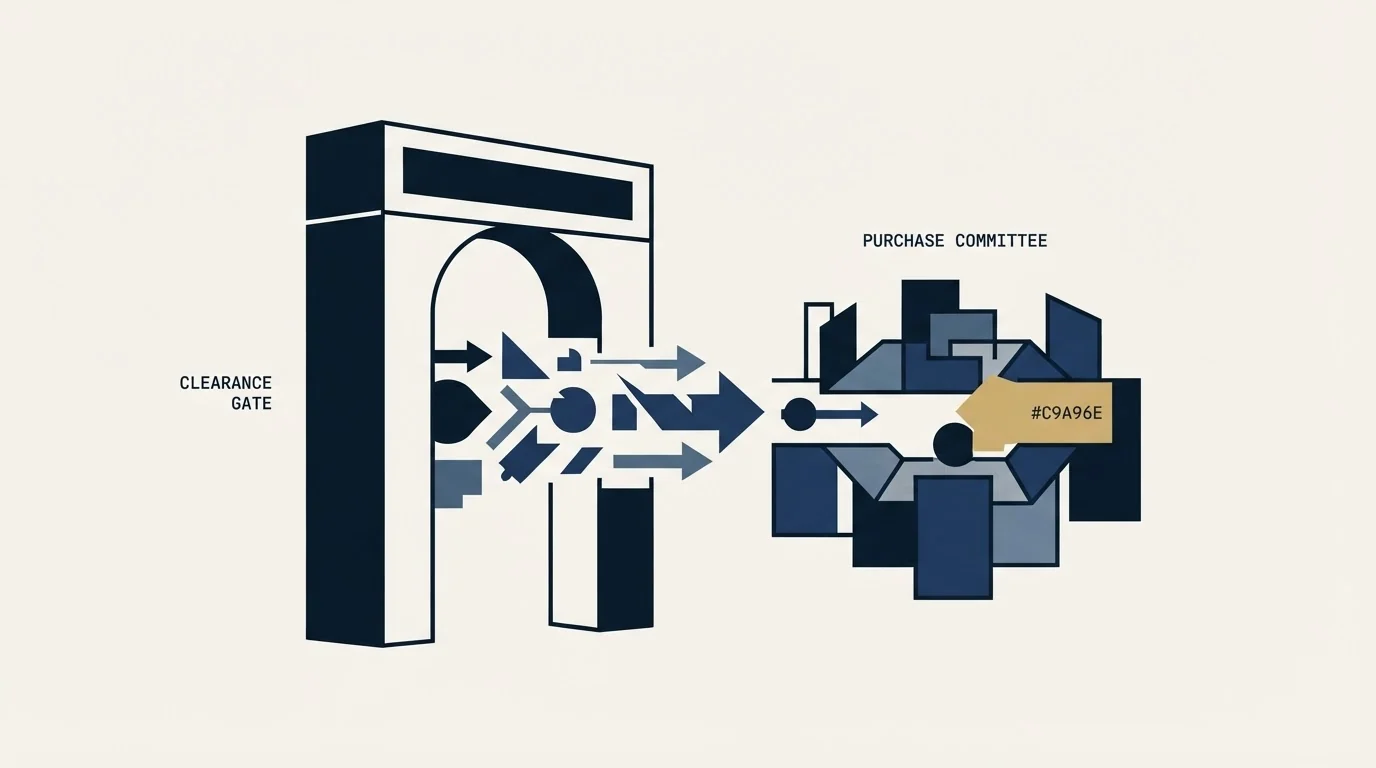
Most device launches quietly contain two markets with different economics, and treating them as one is the most common reason a plan that reads well produces uneven results.
The first is the greenfield case, where the institution does not currently perform the procedure or solve the problem at all. Here the sale includes building the service line, the cycle runs long, and the champion needs internal capital approval as well as product approval. The second is the displacement case, where an incumbent product is already in use under an existing contract. The clinical argument is easier because the workflow exists, and the commercial argument is harder because somebody has to be unwound.
Those two need different messages, different evidence and different timing, and the displacement half is usually governed by contract renewal dates that have nothing to do with your launch calendar. Sizing them separately, and deciding which one the first two quarters are aimed at, is a more consequential decision than the choice of channel.
Where the generic go-to-market advice still applies
The five decisions any plan has to make do not change: who you sell to, what problem you lead with, which channel reaches them, what the first conversation is for, and how you will know it is working. The general form of that page is set out in the go-to-market strategy guide, and the filter-writing method that turns the segment line into a list is in the ideal customer profile guide.
What medtech adds is a gate on the third line and a committee on the fourth. The channel cannot start selling before clearance, and the first conversation has to be defined as the start of an internal approval process rather than as a demonstration. The outbound mechanics against a defined institutional list are the same mechanics as anywhere else, and the sector-specific version of the messaging problem is covered in cold email for medical devices, with the wider demand-side picture in medical device lead generation.
Hardware outside medicine meets a milder version of the same gate, through FCC authorization and safety marks, which is covered in B2B sales for hardware companies.
The short version

Build the plan around the two facts that govern the sector. Clearance gates the selling, and the FDA's 510(k) page is explicit that a submitter may not proceed to market until it receives the substantial equivalence order, usually determined within 90 days, so the launch date is a lag rather than a date. The purchase is a committee decision, so the account plan is a map of clinical, financial and contracting roles with a written case aimed at the one that can stop it. The market is countable, which makes coverage the strategy and makes the list exhaustible, so decide in advance what a second approach requires.
If the definition is written and the constraint is running the outbound half against a named institutional list, see what one campaign against it produces, with qualification criteria agreed in writing before anything sends.
Regulatory details verified against the FDA's Premarket Notification 510(k) page as of mid-2026. Verify current requirements with the FDA before relying on them.
Frequently asked questions.
Frequently asked questions- When can a medical device company start selling?
- For devices entering through premarket notification, the FDA's 510(k) page states that until the submitter receives an order declaring the device substantially equivalent, it may not proceed to market the device, and that the determination is usually made within 90 days. Relationship building, account mapping and evidence work can run before that point.
- Who actually buys a medical device in a hospital?
- Several roles together. The clinical user champions it, clinical leadership carries the department budget, a value analysis committee reviews the written case against the incumbent product, and supply chain applies group purchasing and contract constraints. For connected devices, biomedical engineering and IT add integration and maintenance questions late in the process.
- How is a medtech go-to-market strategy different from a software one?
- Two structural differences. The commercial launch is gated by a regulatory decision with its own timetable, so the plan is a sequence of lags rather than dates. And the addressable market is usually countable, so coverage replaces volume as the lever and the account list can be exhausted, which changes what a channel is being asked to do.
- What evidence does a value analysis committee want?
- A written case comparing the device to what the institution uses today, covering clinical practice and economics at the level of their department. The regulatory submission does not answer that question, because it was built to establish a regulatory position. Early reference accounts willing to share outcomes are what later committees ask for most often.
About the author.

B2B cold email experts helping companies generate qualified leads through done-for-you outreach campaigns.
RevenueFlow Team
Explore more.
Ready to scale your outreach?
We build GTM engines that book real meetings. See the receipts.
Related articles.
Appointment Setting for Business Brokers: The Seller Meeting
What a bought meeting with a business owner has to be for a brokerage: the three-part qualification, the confidentiality rules, the licence line and the owner's reasons.
SDR Outsourcing for Logistics Companies: The Brokerage Line
What an outside sales development team may do in a freight company's name, the calling and email rules it inherits, and which arrangement survives a bid-shaped market.
SDR Outsourcing for Business Brokers: The Fee Timing
Whether a success-fee brokerage should rent sales development at all: the fee timing, the texts that limit what an outside person may say about value, and who signs.
LinkedIn Outreach for Banks: A Regulated Message
How a bank's relationship managers use LinkedIn to reach business owners: what the FFIEC guidance, FINRA's notices and LinkedIn's own rules require, and where to stop.
Cold Calling for PPC Agencies: What You Can See First
A paid media prospect is partly readable before the call and has already been told by the platform what to do when a stranger rings about its ads.
LinkedIn Lead Generation for Financial Services Firms
A LinkedIn message from a regulated firm is a communication the rulebook already defines, and the definition turns on how many people receive it within thirty days.