Go-to-Market Strategy: Five Decisions That Fit on One Page
Segment, problem, channel, first conversation and measurement. The five decisions that change behaviour, and the test that shows whether each line holds.
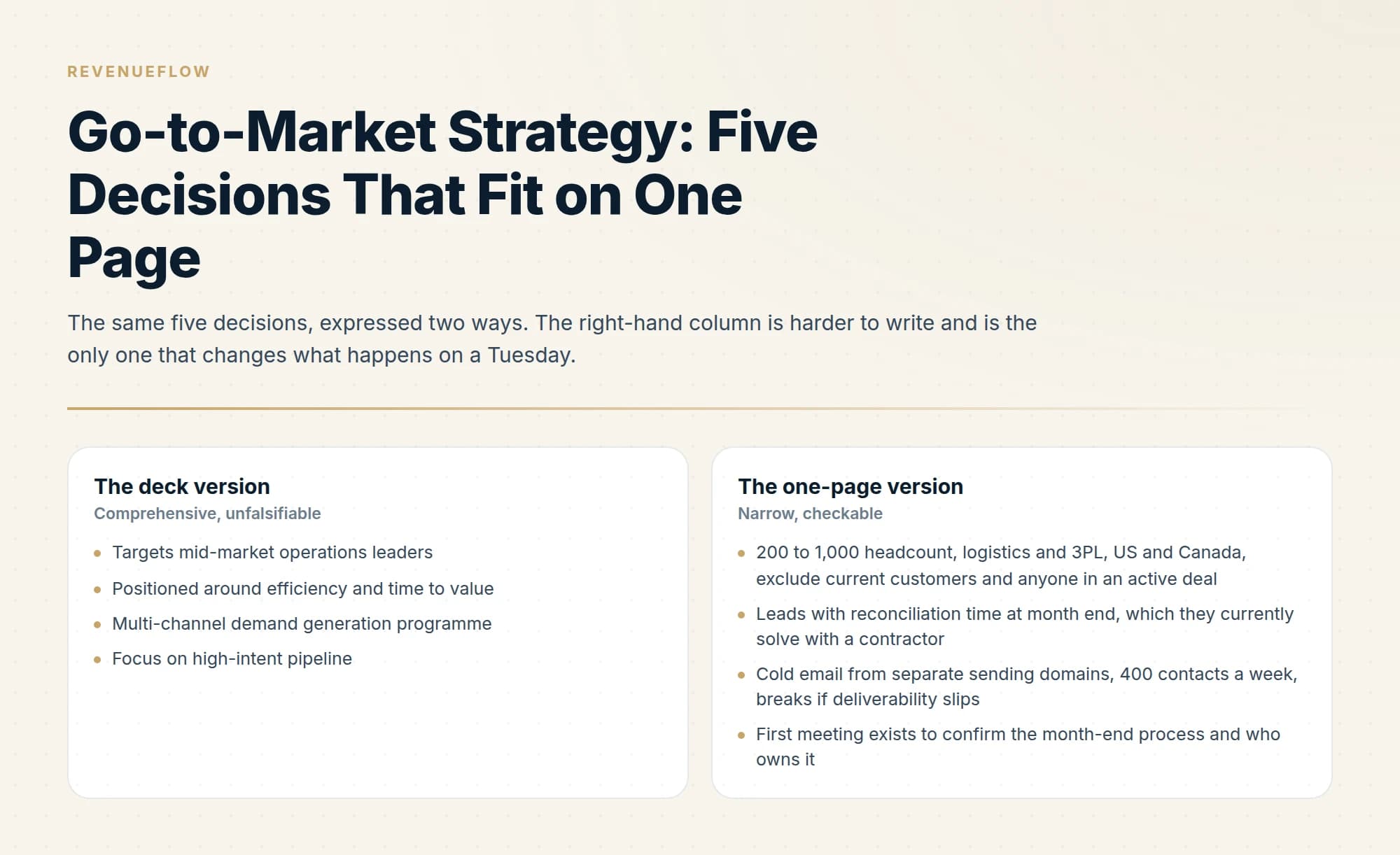
A go-to-market strategy makes five decisions: who you sell to, what problem you lead with, which channel reaches them, what the first conversation is for, and how you will know it is working. Each one closes off options, and a strategy that keeps every option open has decided nothing.
Key takeaways
- The segment definition is real when a stranger who was not in the room could build the target list from it alone.
- A channel is chosen on capacity, so that line has to carry the weekly volume you can run with the headcount you already have.
- The measurement line needs two leading indicators that move inside the quarter and one number that would make you stop.
- A page that has acquired a second segment has forked into two motions and needs two pages, because one message cannot serve two buyers.
Reviewed and updated September 2, 2026
A go-to-market strategy gets approved in January as thirty-eight slides and a spreadsheet. In March, ask the five people who approved it which decision on which slide changed what anyone actually did on a Tuesday. The room goes quiet, and then somebody says the market shifted.
The thinking in those decks is usually sound. The format is what fails. A document that decides thirty things gives nobody a rule they can apply under pressure, and the moment a rep has to choose between two accounts before a Tuesday standup, the strategy is whatever they happen to remember. A go-to-market strategy that survives a quarter is short enough to hold in your head, specific enough to rule things out, and written so that being wrong about it is visible to everyone.
Some searchers reach this topic as go-to-market marketing, which is the same discipline under a looser name: the marketing half of a go-to-market plan rather than a separate practice.
GTM stands for go-to-market. GTM marketing describes the same work this page covers: deciding which market you are entering, what you say to it, and how you reach it. It is narrower than marketing in general, which also owns brand and product marketing, and broader than sales, which executes against the segment the strategy names.
A GTM plan and a go-to-market strategy are the same document under two names, and the shorter name usually signals the reader wants the artefact rather than the essay: the five decisions below, written so somebody else could act on each one.
People search for this as go-to-market strategy, GTM strategy, go-to-market marketing strategy or simply GTM, and the five decisions below are what every one of those phrasings is asking for.
Anything sold as a go-to-market strategy framework is a way of reaching these same five decisions, and a framework that ends without them has produced a document rather than a plan.
People also search for this as a go-to-market framework, the components or elements of a go-to-market strategy, how to create a go-to-market strategy, a product go-to-market strategy, a go-to-market sales strategy, or by the name of a strategy house such as McKinsey. Every one of those is asking for the decisions a go-to-market document has to make, and the test that settles each one.
How to build a go-to-market strategy, reduced to its working parts: make the five decisions below, write each one so a stranger could act on it, and put one name and one review date on the page.
Teams asking how to develop a go-to-market strategy are asking for a process, and the process is these five decisions taken in this order.
Developing a go-to-market strategy is the same work under a different verb: five decisions, made in order, each with a test that would settle it.
A go-to-market campaign is what the channel line produces once these decisions exist, and it inherits every one of them.
Go-to-market analytics, in the only form that steers a quarter, is these two leading indicators plus the number that would make you stop.
The components of a go-to-market strategy are the five decisions a go-to-market document has to make, and the test that settles each one. Go-to-market is hyphenated when it modifies a noun, as in go-to-market strategy, and left open as go to market when it is the verb phrase; both spellings and the GTM abbreviation refer to the same work.
Go-to-market finance is the same page read from the budget side: the channel line states the weekly capacity being funded, and the measurement line states the two numbers finance can check inside the quarter.
Some searchers want a go-to-market strategy in five steps, and these five decisions are those steps: each one is a step only because it closes off an option.
A go-to-market launch is this page with a date on it: the same five decisions, plus the week the first message goes out and the number that would stop it.
Go-to-market strategy development is this exercise rather than a document phase: the five decisions get made, each line gets its test, and the version that survives a quarter is the one somebody had to argue for.
A go-to-market strategy example is only worth copying at the level of these five lines, so the worked page below fills each one for a single segment.
The five decisions a GTM strategy has to make
A sales development strategy is these five lines made operational for one team: the segment decides the list, the motion decides whether a rep or a campaign carries it, and everything an SDR does downstream inherits both.
Strip a go-to-market document down to the parts that change behaviour and five decisions are left. Everything else in it is evidence for one of those five or it is decoration.
- Step 1Who you sell to
A segment specific enough that someone who was not in the room could build the target list from the definition alone.
- Step 2What problem you lead with
The single problem your first message names, expressed in words the buyer already uses about their own situation.
- Step 3Which channel reaches them
One primary route to that segment that you can run at real volume this quarter with the people you currently have.
- Step 4What the first conversation is for
The defined outcome of a first meeting, and the written criteria that make it a meeting worth having.
- Step 5How you will know it is working
Two leading indicators that move inside the quarter, chosen before you start, with the number that would make you stop.
Each of those is a commitment that closes off options. That property is what makes the list useful. A strategy that keeps every option open has not decided anything, and a team reading it will keep doing what they were already doing while sincerely believing they are aligned.
The five decisions hold when the buyer is a large organisation, and what enterprise GTM adds to them is three constraints rather than a different list.
Why the long version does not survive contact with a quarter
Three things go wrong with the deck, and they are structural rather than a matter of effort.
It makes too many claims to be checkable. Forty slides contain dozens of implicit assertions about the market, the buyer, the competition and the sequencing. A document making that many claims cannot be falsified in any practical sense, so it never gets corrected. It gets replaced next January by a different forty slides.
It has no stated failure condition. Most GTM decks contain nothing that could be observed in twelve weeks and found to be false. "We will win mid-market by leading with speed to value" is a sentence no evidence can contradict. The one-page version forces a number and a date next to the claim, which converts an opinion into something the quarter can settle.
It is written for the approval meeting, and the audience shapes the artefact. A document produced to get a budget signed off optimises for looking comprehensive. A document produced to direct fifteen people's weeks optimises for being remembered. Those two goals pull in opposite directions, and the approval meeting usually wins because it happens first.
There is a fourth, smaller problem that does most of the day-to-day damage: the deck has no owner and no review date. Nobody is responsible for noticing that decision three is now known to be wrong.
Ownership gaps like this are often what create the deeper disagreements described in the disagreements behind GTM misalignment.
The one page

Here is the whole artefact. It fits on a single page because each line is a decision plus the evidence test that would settle it.
This one-page artefact has a fuller counterpart in the go-to-market template with tests, which breaks the strategy into seven checkable lines.
Segment. The definition, expressed as ranges, lists and exclusions. Company size band, industry list, geography, the disqualifiers, and the approximate count of companies that match. If you cannot state the count, the definition is not yet a definition.
Buyer. The title or role that owns the problem, the person who signs, and anyone who can veto. Three names for three jobs, and they are frequently three different people.
Problem. One sentence in the buyer's language, naming a situation they are already spending money or attention on. Underneath it, the current alternative: what they do today instead of buying from anybody.
Message. The first line of the first touch, written out in full. Not a theme, the actual sentence. If the strategy cannot produce one sentence, the problem statement is still too abstract.
Channel. The primary route, plus the weekly volume you can genuinely run with current headcount, plus the one thing that would break it.
When the primary route is a partner programme, the platforms that run one bill on different axes, set out in partner platform pricing compared by billing axis.
A B2B customer acquisition strategy is these same lines under a different name, and a document that lists channels without committing to one has not written the third line at all.
First conversation. What the meeting is for, who has to be in it, and the written criteria that make it count. Agreed before launch, in writing, by both the people sourcing meetings and the people taking them.
Measurement. Two leading indicators with a target and a date, and one number that would make you stop and rewrite the page.
Owner and review date. One name, one date, usually the end of the quarter.
- Targets mid-market operations leaders
- Positioned around efficiency and time to value
- Multi-channel demand generation programme
- Focus on high-intent pipeline
- Success measured by pipeline contribution
- Reviewed annually, owner implied
- 200 to 1,000 headcount, logistics and 3PL, US and Canada, exclude current customers and anyone in an active deal
- Leads with reconciliation time at month end, which they currently solve with a contractor
- Cold email from separate sending domains, 400 contacts a week, breaks if deliverability slips
- First meeting exists to confirm the month-end process and who owns it
- Replies per hundred sent, and meetings held per week, checked Fridays
- Owned by one named person, rewritten 31 March
Writing each line so that it holds up
The five lines are easy to list and hard to fill in honestly. Each has a test.
The segment is real when a stranger can build the list. Hand your definition to someone who was not part of the discussion and ask them to produce two hundred companies. If they come back with questions about what counts, the definition is a description rather than a specification. Ranges and lists beat adjectives every time, and the exclusions matter as much as the inclusions. The full method for pinning this down, including which attributes actually predict a good customer and which ones just feel true, is in the ideal customer profile guide.
The problem is real when the buyer would say it unprompted. The strongest test is whether they are already spending money, headcount or attention on the situation. Where they are, you are competing with an existing solution and the conversation is about displacement. Where they are not, you are asking someone to care about something new, which is a slower and more expensive motion with different content requirements. Deciding which of those you are doing is one of the most consequential choices on the page, and it is covered properly in demand creation versus capture versus conversion.
The channel is real when you can name its weekly capacity. Channel selection is mostly a capacity question, though it gets debated as a matter of preference. Any channel can work. The relevant issue is whether you can run this one at sufficient volume, every week, with the people and infrastructure you have, for long enough to read a result. A channel that needs four people when you have one is a hiring plan wearing a strategy's clothes, and it will be discovered as such in week three.
The first conversation is real when it has an exit criterion. "A good meeting" is not a specification. A specification names who has to be present, what has to be established during the call, and what state the deal is in when the call ends. Getting this in writing before launch is what stops the argument in month two about whether the meetings were any good. It matters even more when someone else is sourcing the meetings, because the definition becomes the contract. The distinction between buying meetings and buying leads, which is the same argument in commercial form, sits in appointment setting versus lead generation.
The measurement is real when it moves inside the quarter. Revenue is the honest measure and it arrives too late to steer with. Pick two indicators upstream of it that respond within weeks: replies per hundred contacted, meetings held per week, or the proportion of meetings that reach a second conversation. Write the target next to each one, and write the number that would make you stop.
That pair is what go-to-market metrics reduce to on a page somebody has to act on, and a longer dashboard of acquisition cost, lifetime value and retention rates measures the company rather than the plan.
What changes the page
A merger or consolidation is the clearest case of evidence contradicting a line, and it usually contradicts two: the segment may have changed and the name in the message certainly has. Change those lines, keep the rest, and resist the temptation to rewrite the page because the company is being rewritten around it.

The page changes when evidence contradicts a line on it. That sounds obvious and it is the discipline nobody keeps, because the usual trigger for rewriting a strategy is somebody having a new idea in a meeting.
A monthly read of ten minutes is enough. Take each of the five lines and ask what the last four weeks said about it. Most months the answer is nothing conclusive, which is a legitimate outcome and worth recording as such. When a line does get contradicted, change that line and leave the rest alone. Rewriting the whole page because one channel underperformed destroys the record of what you believed and when, which is the only thing that lets you tell a bad strategy from a strategy that was abandoned too early.
Two failure signals are worth watching for specifically. If the page has acquired a second segment, the motion has forked and it now needs two pages, because a single message, channel and meeting definition cannot serve two different buyers. And if the measurement line has quietly become a revenue number, the review has stopped being able to correct anything, because revenue tells you about decisions made two quarters ago.
- Yes: Someone outside the team could build the target list from the segment definition
- Yes: The problem sentence uses words the buyer would use about themselves
- Yes: The first line of the first message is written out in full
- Yes: The channel has a weekly volume figure you can hit with current headcount
- Yes: The meeting definition is agreed in writing by both sourcing and sales
- Yes: There is a number that would make you stop and rewrite the page
- Yes: One named owner and one review date
- No: It describes two segments or two motions
- No: The only measurement is revenue or pipeline value
The failure modes worth naming out loud
A list of tactics presented as a strategy. Six initiatives with owners is a plan. It becomes a strategy when it says who you are not selling to and which channels you are declining to run.
A channel chosen for its reputation rather than your capacity. Fashion moves faster than hiring. The right question is which channel you can staff and sustain, and the honest answer is often the boring one.
Positioning treated as a separate exercise. The problem line and the message line are the positioning. Doing them in a different workshop, in a different document, on a different timeline is how the message that goes out ends up unrelated to the strategy that was approved.
No suppression thinking. The segment definition has to say who is excluded, because the exclusions are what stop you contacting current customers, live deals and the accounts another team is already working. This is unglamorous and it is the difference between a clean launch and an awkward internal email in week two.
Nobody owns the page. A strategy with an implied owner has no owner. The name matters more than the seniority.
Once the page exists, the work becomes execution detail: list building, sending infrastructure, copy, reply handling and the operating rhythm around them. That layer has its own decisions, and a practical walkthrough of them is in the outbound sales playbook.
The short version

A go-to-market strategy is five decisions: who you sell to, what problem you lead with, which channel reaches them, what the first conversation is for, and how you will know it is working. Each one closes off options, which is what makes the set useful.
The deck version fails for structural reasons rather than through lack of thought. It makes too many claims to be checkable, it contains no condition under which it would be considered wrong, and it is optimised for an approval meeting rather than for a rep choosing between two accounts on a Tuesday. It also usually lacks an owner and a review date.
Write the five decisions on one page, with a segment specific enough for a stranger to build the list, a problem the buyer would name unprompted, a channel with a stated weekly capacity, a meeting definition agreed in writing before launch, and two leading indicators with a number that would make you stop. Review it monthly, change only the lines the evidence contradicts, and split the page the moment it acquires a second segment.
If the channel line is going to say cold outbound, the fastest way to test the segment and problem lines is to run one against real people. We are paid on attended meetings that meet criteria agreed in writing before launch, so the definition work above is the same work either way. You can see what a campaign would look like for your market.
Frequently asked questions.
Frequently asked questions- What is a go-to-market strategy?
- A set of five decisions about how you reach a market: the segment you sell to, the problem you lead with, the channel that reaches them, what the first conversation is for, and the leading indicators that tell you whether it is working. Anything else in a go-to-market document is evidence for one of those five, or decoration.
- Why do go-to-market decks fail?
- They make too many claims to be checkable, so nothing in them gets corrected during the quarter. They carry no stated failure condition, meaning no observation in twelve weeks could show them wrong. And they are written for an approval meeting rather than for a rep choosing between two accounts on a Tuesday. Most also lack an owner and a review date.
- What goes on a one-page GTM strategy?
- Segment with ranges, lists, exclusions and an approximate count of matching companies. Buyer, naming who owns the problem, who signs and who can veto. Problem in one sentence in their words, with the alternative they use today. The first line of the first message in full. Channel with weekly capacity. The first-conversation definition. Two measures. One owner and one review date.
- How often should a go-to-market strategy change?
- A ten-minute monthly read is enough. Take each of the five lines and ask what the last four weeks said about it, recording an inconclusive month as inconclusive. Change only the line the evidence contradicts, because rewriting the whole page destroys the record of what you believed and when, which is what separates a bad strategy from one abandoned too early.
About the author.

Ben Carden is CRO at RevenueFlow, which builds and operates outbound revenue engines for B2B companies. Previously at Gartner Enterprise. Studied at London School of Economics.
Ben Carden · CRO
Connect on LinkedIn →Explore more.
Ready to scale your outreach?
We build GTM engines that book real meetings. See the receipts.
Related articles.
Sales Kickoff Meeting: The Decisions It Has to Leave With
A kickoff is the one moment a whole sales organisation can change at once. The four decisions it has to publish, and the week-six check that tests them.
Cross-Sell vs Upsell: Different Trigger, Different Owner
An upsell has a trigger that arrives on its own. A cross-sell has none and needs a diagnosis somebody funds. That is the difference that decides the work.
Sales Call Planning: The Plan a Booked Call Needs
A call cannot produce a commitment nobody named in advance. The four fields a call plan carries, and why the ask has to be decided before the meeting opens.
Lifecycle Stage, Lead Status, Deal Stage: Three Fields
Lifecycle stage records position, lead status records activity, and deal stage lives on the deal. Merging them breaks funnel reporting in ways nobody notices for a year.
Time Decay Attribution: Setting the Half-Life
Time decay weights recent touches more heavily, and the half-life that controls how fast credit fades decides more than the choice of model does.
Position-Based Attribution: The U, the W and the Timestamp
U-shaped and W-shaped attribution are one model with a switch, and the switch is whether your CRM can be trusted to stamp lead creation.