Go-to-Market Strategy Template: Seven Lines, a Test Each
A grid of labelled boxes is a prompt, not a template. Seven lines that force decisions, the test that finishes each one, and the arithmetic that contradicts you.
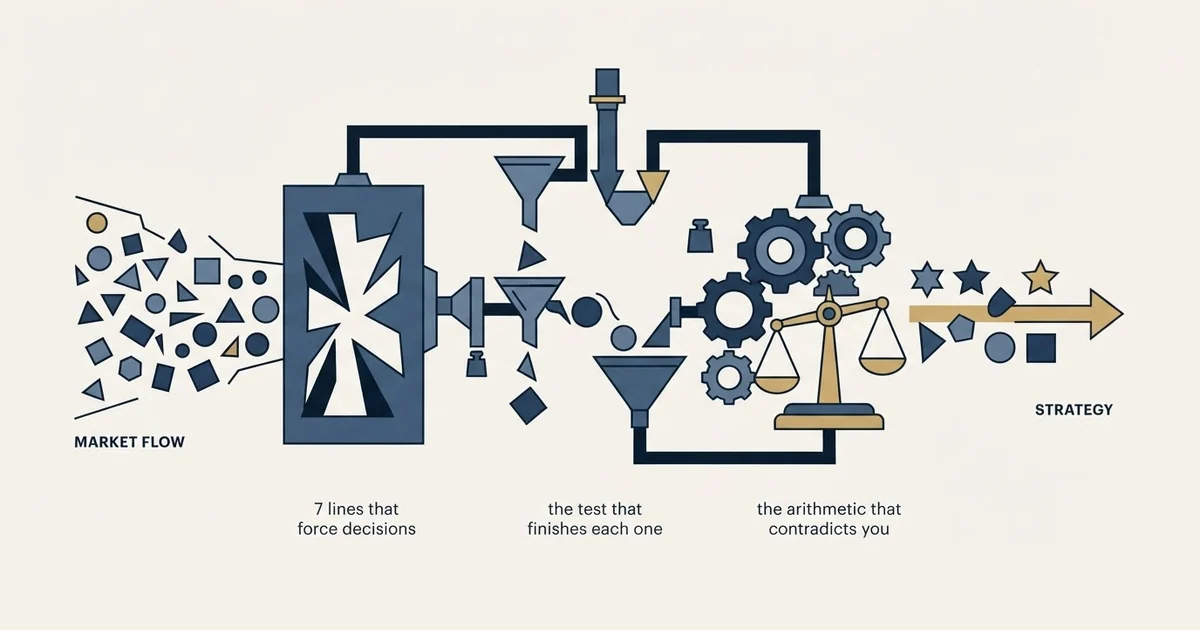
A usable go-to-market template is seven lines with a test attached to each: segment, problem, why now, first conversation, channel, exclusions and measurement. Each line has to be a decision someone downstream can act on without asking a follow-up question, which is what separates a template from a grid of labelled boxes.
Key takeaways
- Every line needs a test, because the common failure is filling each box with a description of the market rather than a decision about what to do in it.
- The exclusion line is the one most teams delete and the one that gives the others meaning: if what you excluded costs nothing, the segment was drawn too wide.
- Why now is the only line that cannot be written at a desk, has to be observed per company, and decays, so a rebuild interval belongs beside any trigger.
- Keeping segment, channel and target on one page lets the arithmetic between them contradict you, which is the most useful output the template produces.
Reviewed and updated September 1, 2026
Search for a go-to-market strategy template and the results split cleanly into two piles. One pile is whiteboard canvases and slide decks: a grid of empty boxes labelled Positioning, Pricing, Channels, Personas. The other pile is articles explaining what a go-to-market strategy is, with a template promised in the title and a form-fill gate at the bottom. Between the two sits the thing most people actually wanted, which is a page they can fill in on a Tuesday and hand to someone on Wednesday.
That page is below, in full, with what goes in each line and the test that tells you whether the line is finished. It fits on one page because a go-to-market document that runs to thirty slides gets read once, at the meeting where it is presented, and never opened again.
A go-to-market strategy plan is this same page with lines five and seven carrying owners, dates and a number rather than a paragraph.
Used as a go-to-market checklist, the seven tests above are the pre-launch list: any line that fails its test is a decision that has been deferred rather than made.
Why the empty-grid version fails
A grid of labelled boxes is a prompt, not a template. It tells you that Positioning is a thing you should have and gives no way of knowing whether what you wrote in the box is any good. Teams fill in all nine boxes, agree the document looks complete, and discover a quarter later that nothing anybody does differs from what they did before.
The failure is specific and it repeats. Every box gets filled with a description of the market rather than a decision about what to do in it. "Mid-market SaaS companies in North America" describes a population. It does not tell a rep who to call first, and it does not tell a writer what the first sentence of the message should reference.
A template earns its place by forcing decisions that constrain behaviour. Every field below has a test attached for exactly that reason: if the line you wrote passes the test, someone downstream can act on it without asking you a follow-up question.
The template
Copy this into a document and fill it in. Seven lines, one page.
GO-TO-MARKET PLAN: <product or motion>       Owner:        Date:

1. SEGMENT
   Who: ..............................................
   Count: ....... named companies
   Test: can someone produce the list of names without asking you a question?

2. PROBLEM
   The problem we solve for them, in their words: ......
   Test: would a buyer in this segment recognise it without translation?

3. WHY NOW
   What has changed that makes this the moment: .......
   Test: is it observable from outside the company?

4. FIRST CONVERSATION
   What we want the first conversation to be about: ...
   Test: is it something they would want the meeting for?

5. CHANNEL
   How the first conversation gets created: ...........
   Owner: .............  Volume per week: ...............
   Test: does one named person own the number?

6. WHAT WE WILL NOT DO
   Segments, channels and asks explicitly out of scope:
   Test: does this line cost you something real?

7. MEASUREMENT
   The one number reviewed weekly: ....................
   Current: .........  Target by <date>: .............
   Test: can it move without anyone lying?
Line six is the one most teams delete, and it is the line that makes the other six mean anything. A plan that excludes nothing has not chosen.
Filling each line so it holds

Segment. Write it so that a list can be built from it. "Companies with a warehouse operation and fewer than fifty office staff" is buildable. "Growth-stage companies who value efficiency" is not, because nobody publishes their values. The market segmentation entry covers which bases survive this test in B2B, and firmographic data covers what is available as a field.
A segment defined by industry rather than firmographics changes four things beyond the list, as vertical go-to-market strategy explains for sector-specific motions.
Problem. Use the words the buyer uses, not the words your category uses. A buyer says the quotes take too long to get out. Your category says quote-to-cash cycle time. The first version can be pasted into an email.
Why now. This is the line that decides whether the motion works at all, and it is the one most plans leave blank. A funding round, a new site, a regulatory date, a leadership change, visible hiring in a function. If nothing has changed, the message has no reason to arrive today, and no amount of copy quality substitutes for that.
First conversation. Most plans write the ask they want rather than the meeting the buyer wants. A demo is your goal. A twenty-minute look at how three similar companies handle the same problem is theirs.
Channel. One named owner and one weekly number. A channel with three owners has none.
What we will not do. If the exclusions cost nothing, the segment was drawn too wide to begin with.
Measurement. One number, reviewed weekly, that cannot be improved by reclassifying something. Meetings held is harder to fake than meetings booked, and both are harder to fake than pipeline created.
- Depends: Someone can build the target list from line one without asking a question
- Depends: Line two is phrased in the buyer's vocabulary, not the category's
- Depends: Line three names something observable from outside the company
- Depends: Line four is a meeting the buyer would want, not the one you want
- Depends: Line five has one owner and one weekly number
- Depends: Line six excludes something that costs you real revenue
- Depends: Line seven cannot be improved by reclassifying a record
Strategy, plan, and what a GTM strategy template has to add
The terms get used interchangeably and the distinction only matters in one place, which is what the document is expected to contain.
A go-to-market plan template is an execution artifact. It names owners, volumes, dates and a number, and its job is to be true or false by a specific week. The seven-line page above is a plan in that sense: every line is checkable and line seven expires.
A GTM strategy template asks the same seven questions and stops before the owners and dates, because the strategy question is which segment and which problem, not who is sending what on Thursday. In practice the strategy version is the same page with lines five and seven left as a paragraph rather than a number. Keeping them as one document with the operational lines filled in later avoids the common outcome where a strategy deck and an execution tracker drift apart until neither describes what the team is doing.
The layer underneath, where capacity, quota, coverage and a written entry standard decide whether the number is reachable by the team you have, is a separate page: the sales strategy template.
The reasoning behind each of the underlying decisions, rather than the artifact that records them, sits in the go-to-market strategy guide.
The line most plans skip
Line three, why now, is where go-to-market plans quietly fail, and the reason is that it is the only line you cannot write at the desk. Segment, problem and measurement can all be reasoned out in a room. Why now has to be observed, per company, and it decays.
A company that was hiring warehouse staff in March is not necessarily hiring in September, so a plan built on that trigger needs a rebuild interval written next to it. A plan that names a trigger without naming how often the list gets rebuilt has a shelf life nobody has agreed to.
- Mid-market SaaS in North America
- Growth-stage companies that value efficiency
- Innovative teams ready to scale
- No count attached
- Nobody can build a list from it
- Every campaign runs the same message
- B2B software firms, 50 to 250 staff, running HubSpot
- Named count: 340 companies
- Excludes: enterprise, agencies, non-US
- The list can be built today
- The first line of the message is implied by the cut
- A rebuild interval is written beside the trigger
Sizing the channel line, with the arithmetic shown
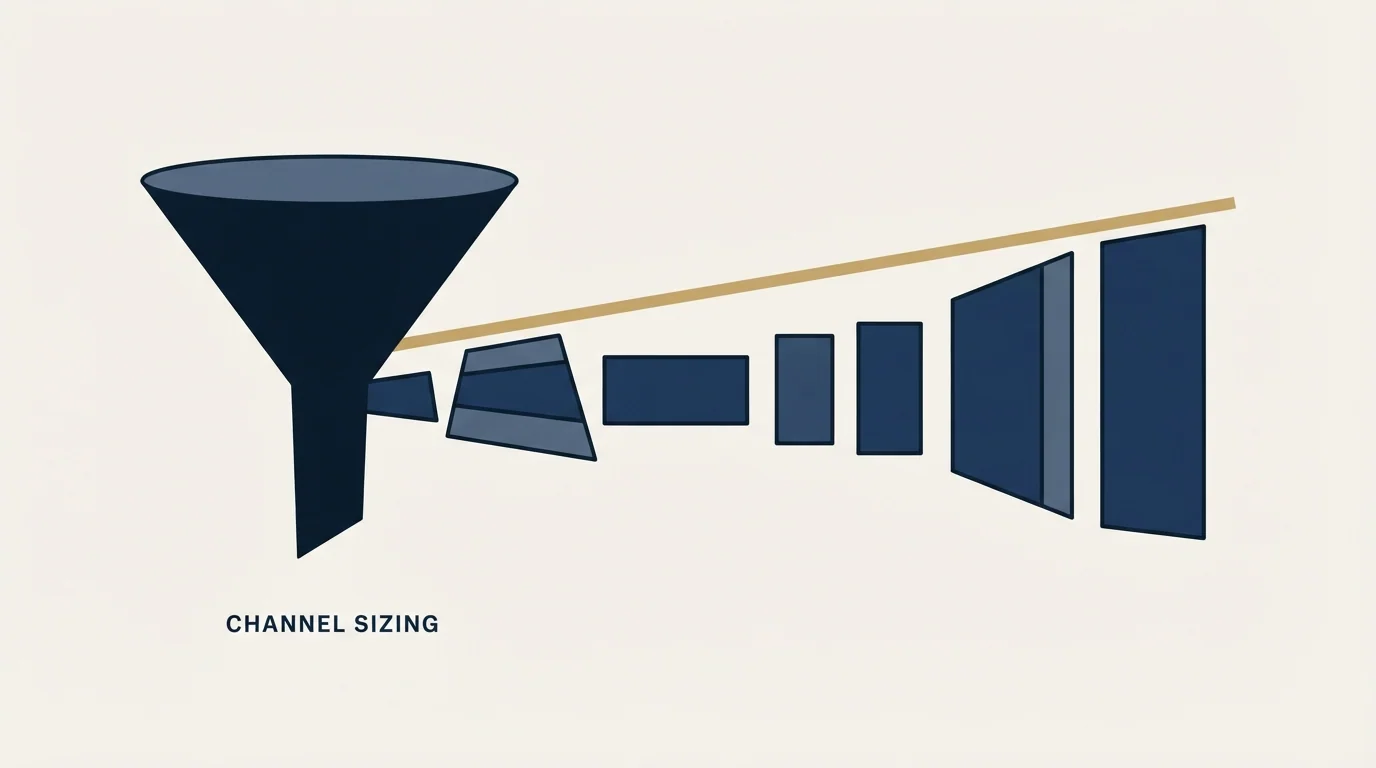
Line five needs a weekly number, and the number has to come from the target rather than from capacity. The following figures are invented for illustration and describe no real campaign.
Suppose the target on line seven is six qualified meetings a month. Working backwards with illustrative rates: if one in fifty contacted companies replies with interest, and two in three of those interested replies become a held meeting, then six held meetings needs about nine interested replies, which needs about 450 companies contacted in the month. Against a segment of 340 named companies, the plan is arithmetically impossible in month one, and the honest response is to widen the segment on line one or lower the target on line seven rather than to ask the channel owner to try harder.
That collision is the most useful thing the template produces, and it only appears because lines one, five and seven sit on the same page. Kept in separate documents, the segment looks reasonable and the target looks reasonable and the contradiction between them never surfaces.
What changes the page
A go-to-market plan is rewritten when a line stops being true, not on a calendar. Three triggers are worth naming: the segment stops producing replies at the rate line five assumed, a competitor changes the terms of line two, or line three stops being observable because the trigger you were watching dried up.
Rewriting on a quarterly schedule instead produces a document that changes when nothing has happened and stays fixed when something has.
Where the plan meets the list

The template above assumes that once line one is written, someone can produce those named companies with the contact detail attached. That step is where most plans stall, and it is a sourcing problem rather than a strategy problem. The ideal customer profile guide covers turning line one into a list with the count arithmetic shown, and technographic data covers the stack signals that make line one sharper than a size band alone.
Turning a written segment into companies someone can actually contact depends on work done before any conversation starts, which what happens before the first conversation covers in full.
For the messaging that comes out of lines two and three, how to write a cold email covers the order that work runs in, and pain point templates covers phrasing line two in the buyer's words.
If the list building and the sending are the part you would rather hand over, see what a campaign looks like.
The short version
A usable go-to-market template is seven lines with a test attached to each, not a grid of labelled boxes. Every line has to be a decision somebody downstream can act on without asking a question, the exclusion line has to cost you something, and the segment, channel and target lines have to sit on one page so the arithmetic between them can contradict you.
Frequently asked questions.
Frequently asked questions- What is the difference between a GTM strategy template and a go-to-market plan template?
- What the document is expected to contain. A plan names owners, volumes, dates and a number, so it can be true or false by a specific week. A strategy stops before the owners and dates and answers which segment and which problem. In practice they are the same seven questions, with the operational lines left as prose in the strategy version.
- How long should a go-to-market strategy document be?
- One page. A document that runs to thirty slides gets read once, at the meeting where it is presented, and is never opened again. The compression is doing real work too: forcing segment, channel and target onto the same page is what lets you notice when the numbers on them contradict each other.
- How often should the plan be rewritten?
- When a line stops being true, not on a calendar. Three triggers matter: the segment stops replying at the rate the channel line assumed, a competitor changes the terms of the problem line, or the trigger behind why now dries up. Rewriting quarterly instead produces a document that changes when nothing happened and holds still when something did.
- Why does the template ask for a named count of companies?
- Because a count is what makes the plan checkable against its own target. A segment described in words always sounds sufficient. Once the count sits next to the weekly volume the channel needs, an arithmetically impossible plan becomes visible in month one rather than at the quarterly review.
About the author.

B2B cold email experts helping companies generate qualified leads through done-for-you outreach campaigns.
RevenueFlow Team
Explore more.
Ready to scale your outreach?
We build GTM engines that book real meetings. See the receipts.
Related articles.
Sales Funnel Template: Six Stages and Exit Criteria
The exit criteria column carries all the value in a funnel template and is the one left blank. Six stages, what belongs in each, and the sizing arithmetic.
Sample Cold Emails: Six Written to Be the Only One You Send
Most sample cold emails are step one of five, so they underperform alone. Six complete messages, what to change in each, and why the middle is the part to cut.
The Tim Ferriss Cold Email Template: What the Original Says
The template is one email published on tim.blog in 2008 with five notes under it. What the five tenets say, which transfer to cold outbound, and which cannot.
Bad Email Examples: Six Shapes That Lose the Reader
A bad cold email is rarely bad throughout. It holds together for a line or two, then loses the reader at a specific word. Six failure shapes, and where each breaks.
Multi-Threading Email Templates: Ten Second-Person Emails
Ten multi-threading email templates for the second and third people in a live deal: the user, the blocker, the economic buyer, the sceptic and more.
Customer Check-In Email Templates: Nine Check-Ins by Moment
Nine customer check-in templates for the account owner, one per moment: a closed escalation, a usage drop, a new leader, a release, pre-renewal, news and bad news.