Sample Cold Emails: Six Written to Be the Only One You Send
Most sample cold emails are step one of five, so they underperform alone. Six complete messages, what to change in each, and why the middle is the part to cut.
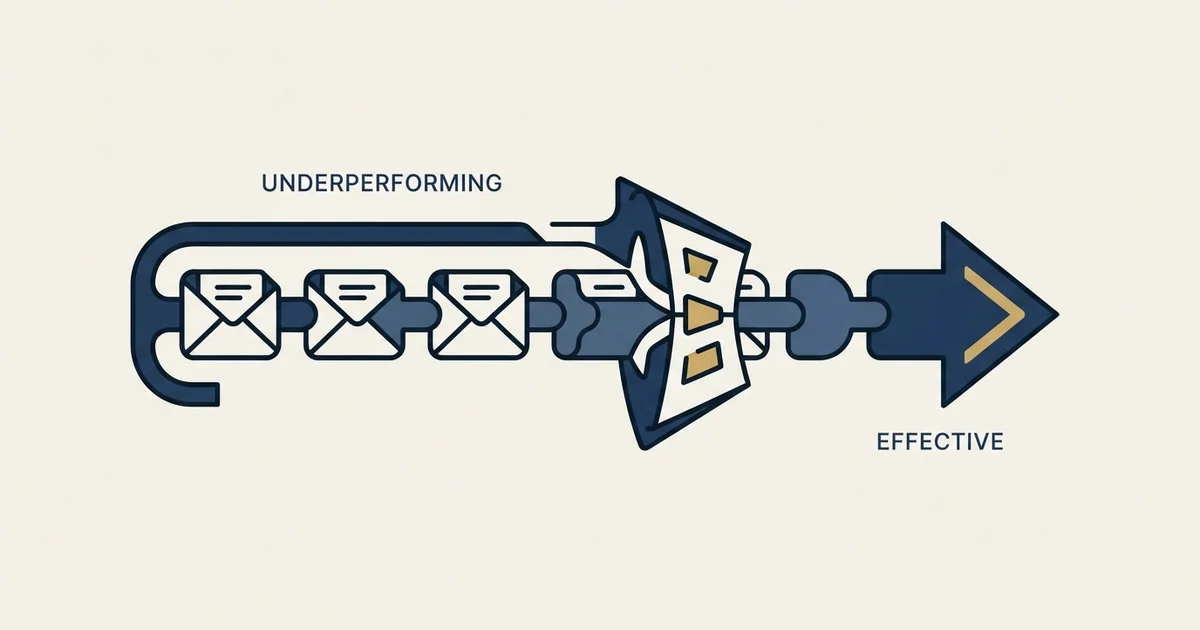
A sample cold email is a shape to replace the contents of rather than a form to fill in. The strongest samples rest on one verifiable fact about the recipient, make a single ask, and work as a complete message. Most published samples assume four more messages follow, which is why they underperform when sent alone.
Key takeaways
- Cover the personalised fragment with your thumb: if what remains would be equally true of four hundred other companies, the sample is filler around one researched detail.
- Samples collected online usually carry two asks, a meeting request and a softer alternative, and two asks convert worse than one because the reader must choose before answering.
- Technographic and situational details give the strongest openers because they are checkable from a public page, while a problem-first message with no researched fact is the honest fallback.
- RevenueFlow policy is one message per campaign, with no thread replies and no bump steps, so re-contacting an audience runs as a new campaign built on a different angle.
Reviewed and updated August 28, 2026
Most sample cold emails circulating online share a hidden assumption: that the sample is step one of five. Read the source pages closely and the structure gives it away: what those guides publish under a single heading is an opener followed by several further messages, each written to lean on the one before it. The sample you copied was never designed to work on its own, so when it goes out on its own and nothing comes back, the natural conclusion is that the copy failed. The copy was fine. It was carrying one fifth of the load it was built for.
Everything below is written the other way round. Each sample is a complete message, sent once, to one person, designed so that a reply is the only outcome it needs. That constraint changes the writing more than any subject line trick does, and it is worth seeing what it changes before reading a single template.
A cold call introduction email is the same message under an older name, and the six samples below are each written to be the only one that goes out.
A B2B sales email template is only worth having if it survives being the only message you send, which is the test every sample below is written against.
What a sample is actually for
A sample is a shape, not a script. The value sits in the order of the sentences and in what each sentence is allowed to do, and none of that is specific to the industry the sample was written in. The specifics are the part you replace.
A BDR customer sample email is the same object under a different job title, because the seat changes who is on the list rather than what the message has to do in six sentences.
This matters because the most common failure with a sample is using it as a fill-in-the-blanks form. The blanks get filled, the sentences around them stay, and the result reads like a document that has been through several other companies before arriving at this one. Recipients are unusually good at detecting that, because they receive the same document from six senders in a month.
The useful test on any sample: cover the personalised fragment with your thumb and read what is left. If the remainder would be equally true of four hundred other companies, the sample is doing nothing except surrounding one researched detail with filler.
Six samples, each a complete message
Each of these is one email. None of them refers to a previous message, none of them sets up a later one, and none of them contains a line that only makes sense as part of a sequence.
Searches for the best cold email pitch land on collections of openers, which is the wrong unit: the pitch is the whole message, and each sample below is complete because a pitch that needs a second email to make sense has not been written yet.
The same is true of searches for the best prospecting email ever, which return other people's inboxes rather than a shape you can reuse, because what made one message work was a fact about its recipient and that fact does not transfer.
1. A change at the company
Subject: your new Nairobi warehouse

Hi Priya,

Saw the Nairobi site went live last month. Opening a second
distribution point usually means the sales team is suddenly
quoting lead times they have never quoted before.

We build outbound lists for logistics companies and run the
sending, so a new region gets contacted properly in the first
quarter it exists rather than the third.

Worth fifteen minutes to see whether it applies to Nairobi?

Ben
The whole message rests on one verifiable event. The middle sentence is a guess about what that event causes internally, stated as a guess rather than as a fact about their business.
2. Something in their stack
Subject: Segment plus the new CRM

Hi Marcus,

Noticed you are running Segment alongside the HubSpot
migration. Those two usually disagree about what counts as a
lead for a few months, and outbound is where it shows up first.

We do the list building and the sending for B2B software
companies, and we keep the source of truth outside the CRM
while it settles.

Fifteen minutes next week?

Ben
Technographic detail is the strongest available cut in most B2B markets, because what a company already runs decides whether you are an addition or a migration. The technographic data entry covers where that signal comes from and how quickly it decays.
3. Replacing an incumbent
Subject: switching off Outreach

Hi Elena,

You have been on Outreach for a while. The teams that leave
usually leave over seat cost rather than features, and the
migration is the bit nobody budgets for.

We run outbound as a service instead of selling you seats, so
there is no per-rep maths to redo when the team changes size.

Fifteen minutes to compare the two shapes?

Ben
Naming a competitor is defensible when the fact is public and the comparison is on an axis the reader can check. Naming one to assert that their product is worse is neither.
4. Problem-first, to a named role
Subject: your two SDRs and the list

Hi Tom,

Two SDRs building their own lists usually spend about half the
week not selling. That is the part that never shows up in a
pipeline review, because the hours disappear into research
rather than into a stage.

We build the list and run the sending so the reps only work
replies.

Fifteen minutes?

Ben
This one carries no researched detail at all, which makes it the weakest of the six and the honest choice when there is genuinely nothing specific to say. The SDR role definition is the underlying reason it lands: the problem is structural to the role rather than particular to the company.
5. Asking for the right person
Subject: right person for outbound?

Hi Dana,

You are probably not the person who owns outbound at Kestrel,
and asking beats guessing at an org chart from the outside.

We build and run cold email for professional services firms.
If that sits with someone else, a name is all it takes.

Ben
Short, honest about its own uncertainty, and it asks for something cheaper than a meeting. It also fails cleanly: a wrong-person email that says so is easy to forward and easy to ignore.
Because brevity and an easy exit matter so much, the original Tim Ferriss email breakdown shows how those same tenets earned a reply from a busy stranger.
6. Reacting to something they published
Subject: your post on procurement cycles

Hi Sam,

Your piece on eighteen-month procurement cycles in public
sector IT was the first piece on that subject to treat the delay
as a design constraint rather than a complaint.

We run outbound for companies selling into that world, where
the first conversation has to happen long before a budget
exists.

Fifteen minutes?

Ben
A response to something they made is the only opener on this list the recipient can verify instantly. It is also the easiest to fake badly, and a summary that could have been generated from the title alone reads exactly like one.
- Depends: Cover the personalised fragment: does the remainder still say something specific
- Depends: Every factual claim about the recipient is checkable from a public page
- Depends: No sentence depends on a message that came before or comes after
- Depends: The ask is one thing, and it is the cheapest thing that moves this forward
- Depends: Nothing in it would embarrass you if forwarded to the person it describes
- Depends: A recipient who does nothing has not been set up for a second message
What to change in every one of them
Four edits apply to every sample above, and they are the edits most senders skip.
Replace the claim with a claim you can defend. Each sample contains a sentence asserting what usually happens inside a company in that situation. Yours has to be something you have actually seen, and it has to be phrased as a pattern rather than as a fact about them specifically.
Cut the second ask. Samples collected from around the web frequently contain two: a meeting request and a softer alternative. Two asks convert worse than one because the reader has to make a decision about which one to answer before deciding whether to answer at all.
Shorten the middle. The opening line and the ask survive editing. The explanation between them is where length accumulates, and it is almost always the part a reply never references.
Fix the signature. A signature carrying a phone number you do not answer, three social links and a banner image is a deliverability liability and a credibility one. Name, company, one link.
The single-message question, answered directly
Every sample listicle that ranks for this term embeds its samples in a sequence, so it is fair to ask why these do not.
Our documented policy is one message per campaign. We do not send thread replies and we do not add bump steps to a sequence. When an audience needs contacting again, that runs as a new campaign with a different angle, built on a new reason to be writing, and it stands or falls on its own.
The practical consequence for a sample is that the message has to carry a complete reason for existing. A first-of-five opener can afford to be vague, because the sender knows four more chances are queued behind it. A single message cannot, and writing under that constraint is what forces the specificity that makes the six samples above shorter than the ones they were modelled on.
Industry practice differs, and plenty of teams run multi-step sequences successfully. The samples here are simply not built for that, and using one as step one of a ladder wastes the part of it that does the work.
- Opener can be broad, later steps narrow it
- Ask can be soft because it repeats
- Personalisation can be thin
- Value is spread across the sequence
- Silence is treated as a cue to send again
- Opening line carries the entire reason for writing
- One ask, stated once
- One researched fact, load-bearing
- Complete argument in under a hundred words
- Silence ends this campaign, a new angle starts another
Subject lines get written last
A subject line written before the body describes what you hoped to say. Written afterwards, it describes what the email actually says, which is the only version that survives being opened.
Three of the six above use the recipient's own noun in the subject: their warehouse, their stack, their post. That is not a trick, it is a consequence of having written a body about a specific thing. Where the body has no specific thing in it, as in sample four, the subject is deliberately plain, because a clever line on a generic email sets up a disappointment.
Reading it back as the recipient
The final pass costs two minutes. Read the draft as though it arrived from a company you have never heard of, in a week where nine others also arrived.
The questions that matter: is it obvious within one line why this arrived today rather than any other day, is there anything in it that could not have been sent to a competitor unchanged, and is the ask something a busy person could say yes to without a second thought. Most drafts fail the second one, and the fix is usually deleting a paragraph rather than adding one.
Where samples stop helping
A sample cannot tell you whether the list is right, and list quality decides more outcomes than copy quality does. A perfectly written message to a company that will never buy produces the same result as a badly written one.
Samples also cannot tell you whether the messages are arriving. Copy is the last variable to tune, after the sending infrastructure is behaving and the audience is defined. Teams that rewrite templates for a month while a deliverability problem sits underneath are optimising the wrong layer, and the symptom looks identical from the outside.
For the surrounding decisions, how to write a cold email covers the order the work runs in, and the ideal customer profile guide covers the list definition these samples assume you already have. When the writing is the bottleneck rather than the targeting, the pain point templates and trigger event templates collections go deeper on two of the six shapes above.
If the shorter path is useful, we build the list, write the copy and run the sending: see what a campaign looks like.
The short version
A sample is a shape you replace the contents of, not a form you fill in. Six shapes cover most of what a first message needs to do, and the strongest three depend on a fact about the recipient that took a minute to find. Every one of them is a complete message, because a message written to stand alone has to say something, and that requirement is what makes it worth sending.
Frequently asked questions.
Frequently asked questions- How long should a cold email be?
- Short enough that the ask is visible without scrolling. The six samples here run between forty and eighty words, and the part that grows under editing is always the explanation in the middle. That middle section is also the part replies almost never reference, which makes it the first place to cut when a draft feels long.
- Can I just copy a sample cold email and send it?
- Not usefully. Recipients see the same circulated document from several senders a month and recognise it immediately. Keep the order of the sentences and what each one is allowed to do, then replace every specific, including the claim about what usually happens inside a company in that situation. That claim has to be one you can defend.
- Why do these samples have no follow-up email?
- Because RevenueFlow runs one message per campaign, with no bumps and no thread replies. A message written to stand alone has to carry a complete reason for existing, and that constraint is what forces the specificity. When an audience needs contacting again, it runs as a new campaign with a genuinely different angle.
- What should the subject line be?
- Whatever the body turned out to be about, which is why it gets written last. A subject written first describes what you hoped to say. Where the body names something specific to the recipient, use their own noun for it. Where the body is generic, keep the subject plain, because a clever line over a generic email creates a disappointment.
About the author.

B2B cold email experts helping companies generate qualified leads through done-for-you outreach campaigns.
RevenueFlow Team
Explore more.
Ready to scale your outreach?
We build GTM engines that book real meetings. See the receipts.
Related articles.
The Tim Ferriss Cold Email Template: What the Original Says
The template is one email published on tim.blog in 2008 with five notes under it. What the five tenets say, which transfer to cold outbound, and which cannot.
Bad Email Examples: Six Shapes That Lose the Reader
A bad cold email is rarely bad throughout. It holds together for a line or two, then loses the reader at a specific word. Six failure shapes, and where each breaks.
Value Proposition Statement Template for Cold Email
Most value proposition statements are agreed in a workshop and never used where a buyer can see them. Five slots, and the test that shows whether yours holds.
9 Bump Email Templates and When to Send Each
Nine bump email templates for threads where the other side owes you something, the three checks that make a bump correspondence, and what never to send.
Roundtable Invitation Email Templates: Eight Invitations
Eight roundtable invitation templates by seat: the cold first invite, the invite via a member, the seat confirmation, the waitlist reply and the guest expert.
Multi-Threading Email Templates: Ten Second-Person Emails
Ten multi-threading email templates for the second and third people in a live deal: the user, the blocker, the economic buyer, the sceptic and more.