The Tim Ferriss Cold Email Template: What the Original Says
The template is one email published on tim.blog in 2008 with five notes under it. What the five tenets say, which transfer to cold outbound, and which cannot.
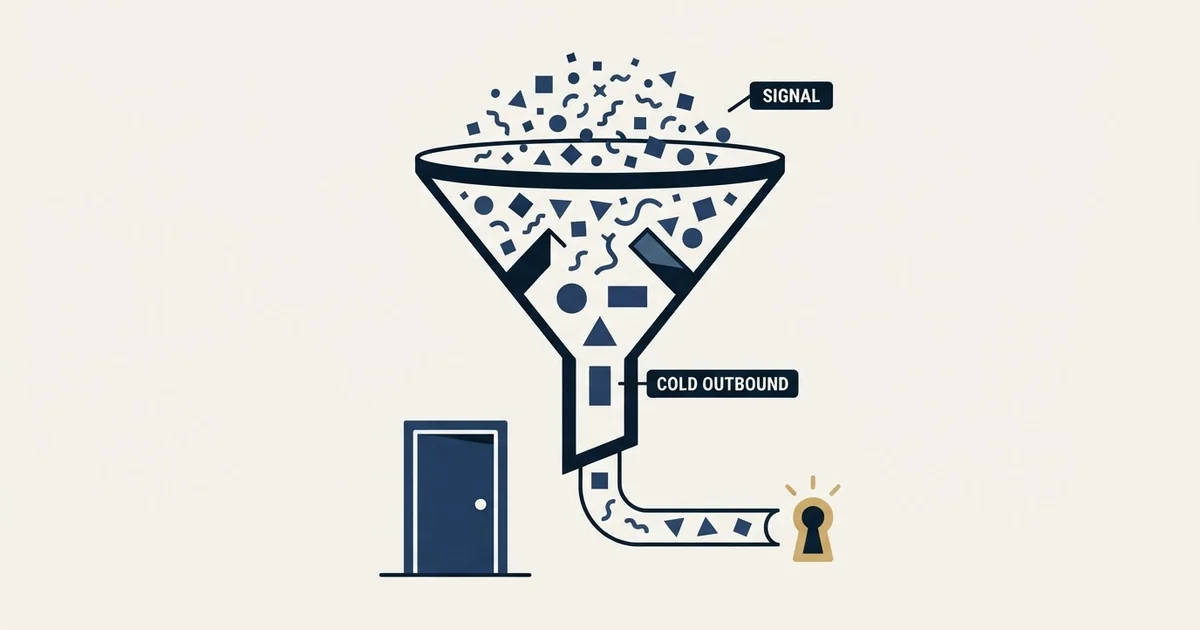
The Tim Ferriss cold email template is the set of phrases Ferriss bolded in an email Robert J. Moore sent him, published in his May 19, 2008 post 5 Tips for E-mailing Busy People. It promises brevity, frames one specific ask, shows the sender did his own work, and makes declining easy.
Key takeaways
- The template is the bolded phrases of one email from Robert J. Moore, published on tim.blog on May 19, 2008 with Ferriss's five notes beneath it.
- Ferriss bolded the reusable structure, from the promise to be brief to the permission to decline; everything between the bold is the sender's own situation.
- Four of the five notes transfer to cold outbound; the one that does not is the goodwill from an earlier meeting, which a cold email has no way to invoke.
- Permission to decline is the most underused device in the set, and Ferriss's own note credits it with making a response much more likely.
Reviewed and updated September 21, 2026
The template people mean by the Tim Ferriss cold email is a single email someone else wrote, published on Ferriss's own blog in May 2008 under the title "5 Tips for E-mailing Busy People", with the phrases he considered good template material in bold and five notes underneath explaining why it got a reply. Much of what has been written about it since is a paraphrase of a paraphrase.
That matters, because the original is short, public and specific, and the versions circulating in outbound content have quietly turned it into a formula for mass sending. It was never that. Reading what it actually says is worth more than any rewrite of it, and the gap between what it says and what cold outbound requires is the most useful part.
The Tim Ferriss cold email template, in the phrases he bolded
The Tim Ferriss cold email template is the set of phrases Ferriss put in bold inside an email Robert J. Moore sent him, published in his May 19, 2008 post "5 Tips for E-mailing Busy People". It opens with "I know you place tremendous value on your time so I'll be brief", frames the ask as "I was curious if your experience has taught you any lessons about", and ends by making a no acceptable.
Ferriss introduces the email as "an example of how to do it properly, with 5 tips and good template phrases bolded". The bold carries the reusable structure; everything between the bold is Moore's own situation, which is exactly the part a template cannot supply.
The bolded phrases in order, with the specifics Moore wrote as slots
"I know you place tremendous value on your time so I'll be brief." [Two sentences on what you are building.] 1
"Naturally, I'm [what you are already doing yourself]." 2
"I was curious if your experience has taught you any lessons about [the topic] and, more specifically, [the one specific request]." 3
"I've attached my [document] for some context."
"I understand if you're too busy to answer in depth or would prefer not to discuss the topic given our limited interactions in the past. However, if the professor in you has any pearls of wisdom or specific thoughts, they would be greatly appreciated." 4
"Thanks in advance and I hope we can connect."
- 1Brevity announced, then kept: the request follows within a paragraph.
- 2Evidence of doing his own part before asking, the third note.
- 3The referral framing: lessons and other people, which leaves a comfortable decline.
- 4Explicit permission not to help, the fifth note.
What the original actually is
The post reproduces an email sent to Ferriss by Robert J. Moore, who was raising a seed round and asking whether Ferriss knew anyone who invested at that stage. Ferriss publishes the email in full and follows it with "a few notes on this e-mail and what makes it more likely to get a response".
Read in his own words on tim.blog, the five notes are: the message is short and the request is clear, with no "let's jump on the phone for 10 minutes; it'll be worth your time"; the sender had made an impression at an earlier meeting and had not worn out his welcome with zero-content keeping-in-touch emails; he made it explicit that he had done his own work first, which Ferriss contrasts with people who ask busy strangers for answers that a short search would provide; he used what Ferriss calls the executive recruiter referral trick, asking who else might be interested rather than asking directly, which gives the recipient a comfortable decline; and he made it clear it was fine if Ferriss could not help, which Ferriss describes as paradoxically making a response more likely.
Ferriss closes with a scaling note worth quoting for its honesty about the odds: "If they appear in media regularly, assume that you are competing against at least 100 similar requests."
What transfers to cold outbound, and what does not
Three of the five transfer cleanly. Brevity with a specific ask transfers. Doing your own homework first transfers, and in a B2B context it becomes the difference between a message that shows you looked at the company and one that shows you found their address. The permission to decline transfers, and it is the single most underused device in cold email, because it lowers the cost of replying at all.
One transfers with a caveat. The referral framing is genuinely effective and it is also easy to abuse: asking who else might be interested when you know perfectly well you want the recipient is a trick the reader can see, and it reads worse than a direct ask. It works when it is true.
One does not transfer at all. The second tenet assumes an existing relationship, since Ferriss's whole point is that the sender "made an impression in our initial meeting" and had not since wasted his attention. A cold email has no such balance to draw on, and pretending otherwise is where a lot of derivative advice goes wrong: you cannot invoke a relationship you do not have.
| As written | As a cold template | |
|---|---|---|
| Relationship | A prior meeting to draw on | None to reference |
| The ask | Only this recipient can answer it | Many recipients must be able to answer it |
| Research | The sender can research one person in depth | It has to survive being done at scale |
The part outbound writers keep getting wrong
Derivative versions of this template tend to add something the original explicitly argues against. The first is a follow-up sequence, on the reasoning that a busy person needs several touches. Ferriss's second note says the opposite: "He hasn't worn out his inbox welcome."
The second is flattery, usually an opening line about how much the sender admires the recipient's work. The email does open by acknowledging Ferriss's visibility, in one clause ("I gather from your celebrity that it is"), then promises to be brief, describes the venture in two sentences and makes the request. The distance between one clause and a paragraph is the distance between context and grovelling.
The third is length. The original is a few short paragraphs carrying one request. A template built in its name that runs twice as long and carries three asks defeats the tenet the whole post is built on.
Where we differ from standard practice
That happens to line up with how we run campaigns, which is one message per campaign with no bumps and no thread replies. When we want to reach a non-replier again it is a new campaign with a genuinely different angle, not another message under the last one. The reasoning behind that position is set out in why we stopped using follow-ups, with the benchmark context in cold email follow-up benchmarks.
Why the "graceful decline" device does the heavy lifting
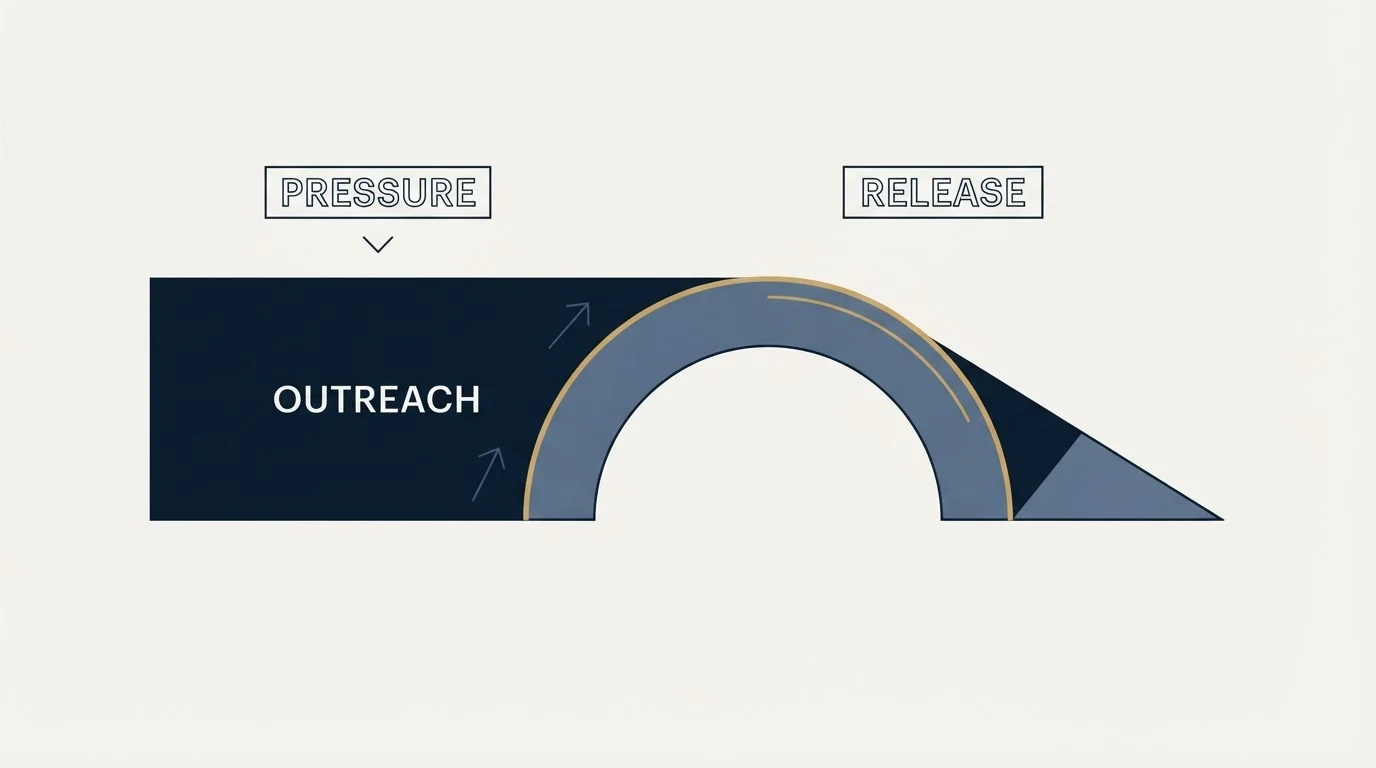
Of the five tenets, the two that deal with refusal are the ones that best survive translation into cold outbound, and they are usually the first ones cut.
The mechanism is simple enough to state. A message that demands a yes puts the recipient in the position of either committing or ignoring, and ignoring costs nothing while committing costs time they have not agreed to spend. Most people take the free option. A message that makes a no explicitly acceptable converts that binary into something cheaper: the recipient can answer without agreeing to anything, and once they have answered the conversation exists.
Ferriss's own note says the permission to decline paradoxically "makes it much more likely he'll get a response". Expect the replies it adds to include polite declines, which is a good trade rather than a bad one. A no arriving in week one is information; silence is not, and a list where the uninterested have identified themselves is a materially better list to work than one where everyone is theoretically still alive.
There is a competent version and an incompetent version. The competent one is a single closing sentence that names the specific reason a no might be right, such as the timing being wrong or another team owning the problem. The incompetent one apologises for having sent the message at all, which invites the recipient to agree that it should not have been sent.
The 2008 context, and what has changed since
Two things about the original are products of their moment. Ferriss was already famous when the email arrived, and the request was for an introduction rather than for a commercial conversation. Both facts make the email easier than a cold sales message, because the sender had a reason to be writing that the recipient could verify in a second.
What has not changed is the arithmetic behind those hundred competing requests. Cheap sending tools did not shrink the pile in anyone's inbox, and they made the competition worse for everyone sending. The tenets are more binding now than they were then, not less.
The one genuinely new consideration is that a message written to be cheap to read can now be produced at volume, which means the reader's filter has adjusted. Brevity alone no longer signals care, because brevity is free. What still signals care is the specific piece of evidence that you looked at their situation, which is the tenet that costs something to honour.
Writing the B2B version
The honest translation for outbound is not a copy of the email. It is the four transferable tenets applied to a message a stranger receives.
State the request in the first two lines and make it a single thing. Show one piece of evidence that you looked at their specific situation, which at volume means the research has to be something you can genuinely produce for every recipient rather than for the first ten. Make the ask answerable, which usually means asking whether the problem is real for them rather than asking for a meeting outright. And close by making it easy to say no.
Here is our own B2B version of those four tenets. It is written by us, not by Ferriss, and it is one message: there is no second email behind it.
Subject: [the specific thing we noticed]
Hi [First Name],
We will keep this short. [One sentence on the specific thing we noticed about your situation, true of this company alone.]
Before writing, we [what we already checked], so the question is narrow: is [the problem] real for your team this quarter?
If the timing is wrong, or [another team] owns this, a one-line no is genuinely useful, and we will not write again about it.
[Your Name]
Because a cold message only works within a larger plan, a practical go-to-market strategy template lays out the line-by-line tests that decide segment, channel and measurement before outreach begins.
The research constraint is the one that decides whether any of this survives contact with volume, and it is a list and enrichment problem rather than a copywriting problem. Our guide to writing a cold email covers the process end to end, and what personalisation is actually worth at scale is in cold email personalisation benchmarks.
What the post is good for, and what it is not
Read as a piece of thinking about attention, the 2008 post holds up completely: it is a clear argument that a request should be cheap to read, cheap to refuse, and evidently informed. Those three properties are what make any cold message work.
Read as a template to paste into a sending tool, it is misleading, because the specific email in it is a one-to-one ask built on a prior meeting and aimed at a person who was already famous. Copying its wording produces a message that sounds like a fan letter with a request attached.
The reasonable use is to take the tenets and write your own message, then check it against a simple test: would a stranger receiving a hundred similar messages this week find yours faster to read, easier to refuse, and more obviously informed than the other ninety-nine. That is the whole standard, and it is harder than any template. If you would rather have the machinery around that message built and run for you, our page on what a cold email agency actually operates sets out what is involved.
Source: Tim Ferriss, "5 Tips for E-mailing Busy People", tim.blog, 19 May 2008, https://tim.blog/2008/05/19/5-tips-for-e-mailing-busy-people/
Want a first message built on those tenets and sent from infrastructure that is already warmed? Start with a free campaign.
Frequently asked questions.
Frequently asked questions- What is the Tim Ferriss email template?
- It is an email Robert J. Moore sent to Ferriss, reproduced in his 2008 post 5 Tips for E-mailing Busy People with the good template phrases in bold and five notes on why it worked. The bold covers the promise to be brief, the ask framed as a request for lessons, the attached context and the explicit permission not to help.
- What are the five tips in the post?
- A short message with a clear request; a sender who made an impression at an earlier meeting and had not worn out his welcome with zero-content keeping-in-touch emails; a clear statement of what the sender had already tried; the executive recruiter referral trick, which offers a comfortable decline; and making it plainly acceptable not to help.
- Does the Tim Ferriss template work for cold outbound?
- Four of the five tenets transfer: brevity with one request, evident homework, a referral framing used only when true, and permission to decline. The one that does not is the goodwill from a prior meeting, which a cold email cannot invoke. Copying the wording produces a fan letter with a request attached; writing your own message on the tenets is what works.
- Should you follow up on a message written this way?
- The post itself argues against it, since the sender had credit to spend because he had not filled the inbox with contentless messages. Our own practice is one message per campaign with no bumps or thread replies, and a later attempt at the same person is a new campaign with a genuinely different angle rather than a nudge under the old one.
About the author.

B2B cold email experts helping companies generate qualified leads through done-for-you outreach campaigns.
RevenueFlow Team
Explore more.
Ready to scale your outreach?
We build GTM engines that book real meetings. See the receipts.
Related articles.
Sample Cold Emails: Six Written to Be the Only One You Send
Most sample cold emails are step one of five, so they underperform alone. Six complete messages, what to change in each, and why the middle is the part to cut.
Bad Email Examples: Six Shapes That Lose the Reader
A bad cold email is rarely bad throughout. It holds together for a line or two, then loses the reader at a specific word. Six failure shapes, and where each breaks.
Drip Campaign Examples: The Permission Behind Each One
Every drip campaign example is one template filled in. The six fields it needs, five examples that hold up, and the one we replace with a single message.
RFP Response Executive Summary Sample: One Page, Read First
The executive summary decides how carefully the rest of a response gets read, and is usually written last by whoever has least time. A worked sample and what to cut.
RFI Response Sample: The Document Only Has to Shortlist You
An RFI decides whether you make a list, not whether you win. A worked sample, and the three answers that get a response cut before the real competition starts.
Email Marketing Lead Generation: Two Motions, Two Domains
Permission-based email and cold outbound share a channel and almost nothing else. Running both through one domain is how teams quietly damage both at once.