RFP Response Executive Summary Sample: One Page, Read First
The executive summary decides how carefully the rest of a response gets read, and is usually written last by whoever has least time. A worked sample and what to cut.
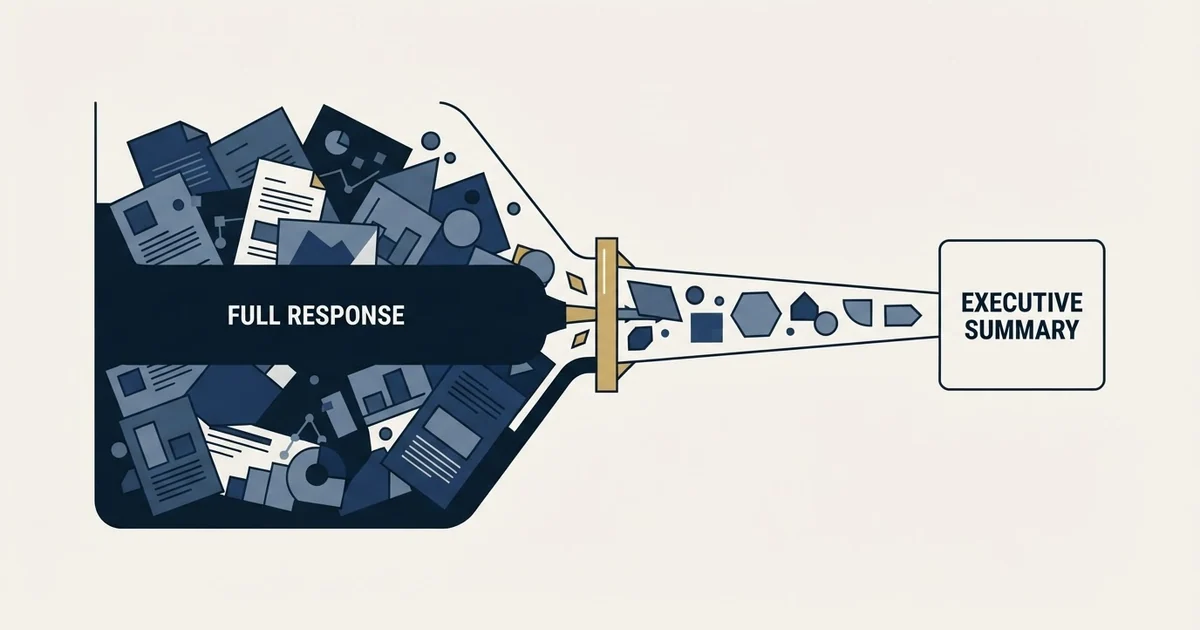
An RFP response executive summary is a one-page overview of your proposal, written last and read first. Order it needs, outcomes, solution, evidence, so the buyer's situation appears before your company does, and check it against the published evaluation criteria before submitting.
Key takeaways
- The executive summary and the cover letter are different documents. Responsive's guide calls the summary a high-level overview of your proposal and the cover letter more like a greeting and introduction, and its suggested running order places the summary ahead of the letter because it is the page a decision maker would pick.
- The four-section order carries the argument. Needs, outcomes, solution and evidence puts the buyer's situation on screen before your company, introduces the offer only after two paragraphs the reader agrees with, and attaches proof to a claim already made rather than presenting credentials in search of a use.
- Accept the success measure the buyer published rather than substituting one you score better on. An evaluator reading nine responses notices immediately which ones answered on their own terms, and naming their measure is the highest-value sentence available on the page.
- One proof point matched to the specific risk you just named beats three unmatched references. On a scored evaluation, logos that do not correspond to a stated criterion earn the same marks as no reference at all.
Reviewed and updated September 1, 2026
Nine responses land in a shared folder. An evaluator with a scoring sheet and a Thursday deadline opens each one and reads the first page before deciding which three to read properly. Six of the nine first pages open with a paragraph about the respondent's founding year, values and global footprint.
The executive summary is the page that decides how carefully the rest of the document gets read, and it is routinely the last thing written, by whoever has the least time left.
Attention earned on that first page has a parallel in outreach, where the subject line's real job is getting the first line of the body read, not the open.
What it is, and what the page next to it is
The two front-of-document pieces get conflated constantly. Responsive's guide separates them cleanly. Of the first: "To put it simply, the executive summary is a high-level overview of your proposal." Of the second: "On the other hand, the RFP cover letter is more like a greeting and introduction."
The same guide answers the question that follows, which is which one goes first. Its suggested running order for a full submission places the cover page, then the executive summary, then the cover letter, ahead of the response body, pricing, supporting documentation and terms. The reasoning it gives for putting the summary above the letter is the useful part, and it is a good test to apply to your own template: "One easy way to decide is to ask, 'If a decision maker only reads one of these two pages, which would you pick?' In most cases, we believe the answer is the executive summary."
The distinction matters because the two documents fail in opposite directions when merged. A summary written as a letter spends its space on courtesies and arrives at the substance below the fold. A letter written as a summary reads as though nobody is speaking to the evaluator at all. Where an RFP specifies which of the two it wants, that instruction wins over any house template.
The four sections, and the order they go in
Responsive's guide names a structure worth starting from: "One effective strategy for writing an executive summary breaks down the content into four sections: needs, outcomes, solution, and evidence."
The order is the whole argument. Needs first means the page opens with the buyer's situation stated back to them. Solution third means your product is introduced only after the reader has agreed with two paragraphs about their own organisation. Evidence last means proof is attached to a claim already made rather than presented as credentials in search of a use.
Most first drafts invert it, opening with the respondent and closing with the need, which is the running order of an introduction to a stranger rather than of an answer to a question that was asked.
- Opens with company history and scale
- Requirements restated in the seller's category language
- Solution described as a capability list
- Differentiators asserted rather than shown
- Proof points chosen for name recognition
- Reads as an introduction
- Opens with the buyer's stated situation, in their words
- Outcomes named in the buyer's own success terms
- Only the part of the offer that reaches those outcomes
- Differentiators tied to a stated evaluation criterion
- Proof chosen for a matching problem, not a matching logo
- Reads as an answer
A worked sample

Everything below is invented. The company, the people, the operational detail and every figure are illustrative and none of it is a measurement of any real client, ours or anybody else's. Read the structure and replace the content.
The situation. An invented county transport authority has issued an RFP for a scheduling and dispatch platform. Its published evaluation criteria weight service reliability highest and cost second. The invented respondent is a software supplier with a live comparable deployment.
Needs
The invented sample paragraph:
The authority's published objective is to reduce missed connections on the seventeen routes flagged in section 2.1, without increasing driver hours. Section 2.4 states that the current dispatch system cannot be modified during the school-term timetable, which constrains any cutover to the two summer windows.
Two things are doing work there. Every claim about the buyer's situation is cited to the section of their own document that states it, which makes the paragraph checkable rather than flattering. And it names the constraint, the timetable freeze, that most respondents will discover late and treat as an implementation detail.
Outcomes
Still the invented example, and the figures in it are illustrative arithmetic rather than a measurement of anything:
The outcome the authority has asked to be measured on is missed connections, not dispatch efficiency. This response is scoped to that measure. On the invented figures in section 2.1, the seventeen routes account for the large majority of the reported incidents, so the programme is deliberately narrow rather than authority-wide in year one.
Naming the measure the buyer chose, and accepting it, is the single highest-value sentence available on this page. Respondents routinely substitute a measure their product performs better on, and an evaluator reading nine responses notices immediately which ones answered on their own terms.
Solution
The invented example again, and the operational detail in it is illustrative rather than a description of any real deployment:
Dispatch runs on the existing vehicle telematics feed with no roadside hardware change. Cutover for the seventeen routes is scheduled inside one summer window. The remaining routes stay on the current system until the following summer, and both run in parallel during that period.
Scope written at the level of what changes, and when, and what stays the same. A summary that describes architecture at this point has changed audience mid-page.
Evidence
Still invented, and the reference described below is illustrative rather than a real one:
A comparable authority moved the same telematics feed within a single summer window. The reference is named in section 6 and is willing to take a call.
One proof point, matched to the specific risk the buyer has just been told about, with a route to verifying it. Three unmatched logos are weaker than one matched reference, and on a scored evaluation they earn the same marks as no reference at all.
- Step 1Needs
Their situation, cited to the sections of their own document that state it
- Step 2Outcomes
The measure they chose, accepted rather than substituted
- Step 3Solution
Only the part of the offer that reaches that measure, at the level of what changes
- Step 4Evidence
One proof point matched to the risk just named, with a way to check it
What to cut
Company history. Three sentences at most, and only where scale or longevity is itself an evaluation criterion. If it is one, it belongs against that criterion rather than at the top of the page.
Anything already scored elsewhere. The response body answers the requirements. Repeating those answers in the summary consumes the one page an evaluator reads attentively with material they are about to read anyway.
Adjectives applied to yourself. Innovative, trusted and market-leading are unfalsifiable, and an evaluator with a scoring sheet has no box for them. Where a claim of that kind is genuinely true it can be replaced by the fact that makes it true, which is shorter and scores.
The paragraph explaining your understanding of the sector. The buyer works in the sector. A summary of it reads as padding, and it is the most common way a page reaches its length limit without saying anything.
Write it last, and read it against the scoring criteria

The summary cannot be written first because it is a distillation of decisions the rest of the response has not made yet: what got scoped in, what got qualified, what the pricing narrative turned out to be. Drafted early it is a statement of intent, and it usually survives into the final document unrevised because nobody owns re-reading it.
The last pass is a specific one. Put the buyer's published evaluation criteria beside the page and check that each heavily weighted criterion is visible somewhere in the four sections. Criteria and weightings are frequently published, and where they are, a summary that does not track them is competing on a different scoring sheet from the one being used. The reasoning issuers apply when they set those weights, and what the format rewards, is set out in marketing RFPs.
- Yes: The first paragraph is about the buyer, not the respondent
- Yes: Claims about their situation cite sections of their own document
- Yes: The success measure is the one they named
- Yes: Every heavily weighted evaluation criterion appears somewhere
- Yes: One proof point, matched to the risk named on this page
- No: Requirements already answered in the body are repeated here
- Depends: It fits on one page at the format the RFP specifies
Where this sits next to the rest of the document
The summary is the front of a compliance-shaped document that answers somebody else's questions in their order. That is a different craft from a proposal you initiated, where you choose the running order and the reader is somebody the seller has met; the structure that survives that second case is in a worked sales proposal.
The sentence-level work of stating what you do in terms a stranger accepts is the same problem as writing a value proposition statement, and the same discipline applies: name the outcome rather than the category. Where an evaluator's concern shows up as a stated reservation rather than a criterion, the language for meeting it directly is in objection handling templates. And the email that delivers the finished submission is its own short document, covered in proposal email templates.
For an RFP specifically, the cover email that carries the submission and the cover letter inside it are taken line by line in how to write an RFP response cover email.
The short version

The executive summary is one page, written last, and read first by somebody deciding how much attention the rest deserves.
Keep it separate from the cover letter, and follow the RFP's own instruction where it names one. Order it needs, outcomes, solution, evidence, so the buyer's situation is on screen before your company is. Cite their document when describing their situation, accept the success measure they published rather than substituting one you score better on, write scope as what changes and when, and attach one proof point matched to the risk you just named. Cut company history, sector explanation, self-applied adjectives and anything the body already answers. Then read it once against the published evaluation criteria, which is the only test that matters.
If the deeper problem is that formal processes are the only way into new accounts, that is a supply question rather than a writing one. See what a first campaign produces for your market.
Definitions, running order and the four-section structure verified against Responsive's RFP executive summary guide as fetched on 23 August 2026. Publishers revise these pages; confirm current text before relying on it.
Frequently asked questions.
Frequently asked questions- What goes in an RFP response executive summary?
- Four things in order: the buyer's needs stated back to them and cited to their own document, the outcomes measured the way they chose to measure them, the part of your solution that reaches those outcomes, and one piece of evidence matched to the risk you just named. Everything else belongs in the response body or nowhere.
- How is it different from a cover letter?
- The summary carries the argument and the letter carries the greeting. Responsive's guide describes the summary as a high-level overview of the proposal and the cover letter as more like an introduction. Merged, they fail in opposite directions: a summary written as a letter buries the substance, and a letter written as a summary speaks to nobody.
- How long should it be?
- One page unless the RFP specifies otherwise, and the RFP's own instruction always wins over a house template. Length discipline comes from cutting rather than compressing: company history beyond three sentences, sector explanation the buyer does not need, self-applied adjectives, and anything the response body already answers.
- When should the executive summary be written?
- Last. It distils decisions the rest of the response has not made yet, including what got scoped in, what was qualified and how pricing was framed. Drafted first it becomes a statement of intent that usually survives into the final document unrevised, because nobody owns going back to re-read it.
About the author.

B2B cold email experts helping companies generate qualified leads through done-for-you outreach campaigns.
RevenueFlow Team
Explore more.
Ready to scale your outreach?
We build GTM engines that book real meetings. See the receipts.
Related articles.
RFI Response Sample: The Document Only Has to Shortlist You
An RFI decides whether you make a list, not whether you win. A worked sample, and the three answers that get a response cut before the real competition starts.
Meeting Reminder Emails: Six Templates
A reminder to someone who accepted a meeting is administration of an agreement, not a bump. Six complete messages, what each has to carry, and how many is too many.
Drip Campaign Examples: The Permission Behind Each One
Every drip campaign example is one template filled in. The six fields it needs, five examples that hold up, and the one we replace with a single message.
Email Marketing Lead Generation: Two Motions, Two Domains
Permission-based email and cold outbound share a channel and almost nothing else. Running both through one domain is how teams quietly damage both at once.
Sales Funnel Template: Six Stages and Exit Criteria
The exit criteria column carries all the value in a funnel template and is the one left blank. Six stages, what belongs in each, and the sizing arithmetic.
The Tim Ferriss Cold Email Template: What the Original Says
The template is one email published on tim.blog in 2008 with five notes under it. What the five tenets say, which transfer to cold outbound, and which cannot.