How to Write an RFP Response Cover Email, Line by Line
An RFP cover email is a receipt request with attachments, and the cover letter is a page inside the submission. How to write both, line by line.
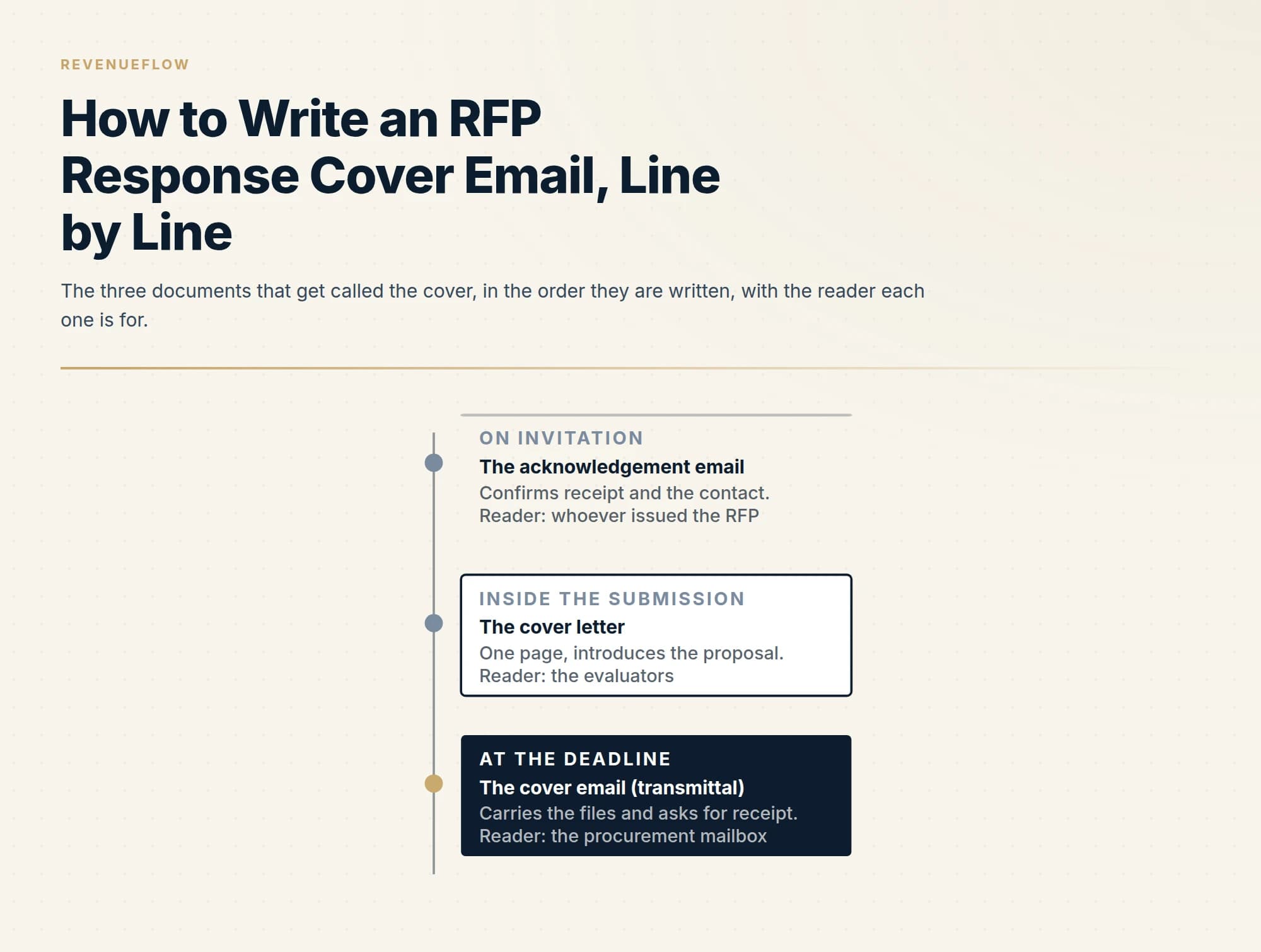
An RFP response cover email is the message the submission is attached to. It carries the RFP number in the subject, one identifying sentence, the attachment list in the RFP's own order, a compliance line, one named contact and a request to confirm receipt. It sells nothing. The cover letter is a separate page inside the submission, written for evaluators.
Key takeaways
- Three documents get called the cover: the acknowledgement email when the invitation arrives, the cover letter inside the submission, and the cover email that carries the files, each with a different reader.
- The RFP's submission instructions win on every point they address, including whether email is an authorised route, the subject format, file names and page limits.
- Write the cover email so an administrator can log the submission without opening a file: identifying sentence, attachment list, compliance line, one contact, receipt request.
- Send with margin: under US federal rule FAR 15.208 a late proposal is considered only in narrow cases, and the one written for electronic submission requires arrival at the government's point of entry by 5:00 p.m. one working day before the due date.
Reviewed and updated September 18, 2026
The response is finished at four in the afternoon, the deadline is five, and somebody on the team asks who is writing the cover email. Half the room thinks that means the letter on page two of the PDF. The other half means the message the PDF gets attached to. They are different documents with different readers, and the instructions in the RFP usually govern both.
This page is the craft of the message that carries a submission, with the cover letter beside it so the two stop being confused. The front of the response document itself is covered in the RFP response executive summary sample, which keeps the summary separate from the cover letter and notes that the email delivering the finished submission is its own short document. That short document is what follows. Whether to answer the RFP at all is a different decision, worked through in RFP in sales.
Three documents get called the cover
A search for the cover email returns advice about three separate things, and the first job is to know which one you are writing.
The acknowledgement email. Sent when the invitation arrives, weeks before anything is submitted. Loopio's guide to the RFP response email, published on 28 May 2025 and fetched on 18 September 2026, is about this message, and its subject advice is the plainest on the page: "Simply include key details like the RFP name and your company name so the client can quickly recognize and file the email."
The cover letter. A page inside the submission. AutoRFP's guide, updated on 26 August 2026 and fetched on 18 September 2026, defines it this way: "An RFP cover letter is the introductory document that accompanies your proposal in response to an RFP." HeyIris, on its template page as fetched on 18 September 2026, sets the length: "Your cover letter should be a polished, one-page introduction to your proposal."
The cover email, or transmittal. The message the files are attached to. Responsive's set of RFP response emails, last modified on 7 April 2026 and fetched on 18 September 2026, lists it as one of six moments in the process: "Proposal submission: This email confirms the submission of your proposal, expresses gratitude for the opportunity, and provides any additional information requested in the RFP."
The readers are the point. The cover letter is read by evaluators who score. The cover email is read by whoever administers the process, often a shared procurement mailbox, and its reader is checking that a compliant submission arrived on time. It scores nothing and it can lose everything.
The decision before the first line: the RFP's instruction wins
Before writing either document, find the section of the RFP that says how to submit, and treat every sentence of it as a requirement. That section decides whether a cover letter is wanted at all, whether email is an authorised route or a portal is, what the subject line must contain, which file formats and names are accepted, and where the message goes.
Public procurement shows how literal this is. The US Federal Acquisition Regulation, section 15.208, as published on Acquisition.GOV with an effective date of 13 March 2026 and fetched on 18 September 2026, puts the whole burden on the sender: "Offerors are responsible for submitting proposals, and any revisions, and modifications, so as to reach the Government office designated in the solicitation by the time specified in the solicitation." The same section says offerors "may use any transmission method authorized by the solicitation", which means a method the solicitation did not authorise is no method at all.
A private buyer's RFP is not bound by that regulation, but it is usually written by people who think the same way. If the document names a mailbox, a subject format and a file naming rule, the cover email's first job is to match all three exactly. Our industry guide to cold email for government describes the formal solicitations that outline submission requirements; this is the page for the moment those requirements are met or missed.
So the decision before the first line is a short list of lookups:
- Did the RFP ask for a cover letter, a cover email, both, or neither?
- Is email an authorised route, and to which address?
- What must the subject line carry?
- What formats, file names, size limits and page limits apply?
- Who is the single named point of contact on your side?
The cover email, line by line
The cover email is a receipt request with attachments. Every line exists so that an administrator can log the submission without opening a file.
- Subject: the RFP number, the RFP title, your company name. If the RFP dictates a subject format, use it character for character. If it does not, this order is the one that files correctly.
- The identifying sentence. What this is, for which RFP, from whom, submitted on which date. One sentence.
- The attachment list. Every file by name, in the order the RFP lists its required parts, with the format. A reader should be able to tick the list against what arrived.
- The compliance sentence. One line confirming the instructions followed: the page limit, the format, the number of copies, the signed forms included.
- The point of contact. One name, one title, one phone number, one address. The person who will actually answer during evaluation.
- The receipt request. Ask for confirmation that the submission was received and that the files open.
- Nothing else. No summary of the offer, no differentiators, no pricing. The evaluators may never see this message, and the administrator does not score it.
Here is the first worked example. The buyer, the vendor Northfold Systems, its bid manager Elena Marsh, RFP 2026-117 and the 14 May date are all invented for illustration.
To: the procurement mailbox named in the RFP. Subject: RFP 2026-117, Fleet Scheduling Software, Northfold Systems
Please find attached the response of Northfold Systems to RFP 2026-117, Fleet Scheduling Software, submitted on 14 May. 1
Attached, in the order the RFP lists them: the cover letter, the executive summary, the technical response, the pricing schedule and the signed forms, each as a PDF. 2
The response follows the page limit and the file naming rule in the submission instructions. 3
Our single point of contact during evaluation is Elena Marsh, Bid Manager, with her phone number and address below. 4
Could you confirm that the submission was received and that all five files open? 5
- 1The identifying sentence: what this is, for which RFP, from whom, on which date.
- 2The attachment list, in the order the RFP lists its required parts, so it can be ticked against what arrived.
- 3The compliance sentence, one line.
- 4One named point of contact, the person who will actually answer.
- 5The receipt request, including that the files open.
The message sells nothing, and that is deliberate. Compare the two openings below. The first is the one most teams write, because a deadline feels like the last chance to persuade.
Selling in the transmittal
We are thrilled to submit our proposal and are confident that our platform is the best fit for your needs. Our unique approach has helped many organisations like yours.
The administrator cannot log it from this, and the evaluators may never see it.
Identifying the submission
Please find attached the response of Northfold Systems to RFP 2026-117, Fleet Scheduling Software, submitted on 14 May.
What this is, for which RFP, from whom, on which date.
The cover letter, line by line
Where the RFP asks for a cover letter, it sits inside the submission and its reader is an evaluator. AutoRFP's guide lists seven components, from the greeting to the contact details, and asks for the identifier early: "Include the RFP title or reference number to show attention to detail and professionalism." That is the market's template. The order that serves an evaluator is tighter.
- The reference line. RFP number and title, above the salutation.
- The addressee. The person or committee the RFP names, spelled as the RFP spells it.
- The opening paragraph: their objective, in their words. Cite the RFP's own statement of what it wants. The same rule governs the executive summary, which that page places ahead of the letter in the running order it takes from Responsive's guide.
- One paragraph on the response. What is enclosed and the one thing the evaluator should look for in it.
- The commitments. Validity of the offer where the RFP asks for it, acceptance of the stated terms or the exceptions taken, and the authority of the signatory.
- The signature block. A person with authority to bind the company, with direct contact details.
The second worked example is the opening paragraph only, because the opening is where cover letters go wrong. It is invented, like the first.
RFP 2026-117, Fleet Scheduling Software

Dear Evaluation Committee,

Section 2 of the RFP states that the Authority wants one scheduling system across its four depots by the start of the next financial year, replacing the spreadsheets each depot maintains today. This response is built around that objective. The technical response shows the four-depot rollout in the order the RFP lists the depots, and the pricing schedule follows the structure in Appendix C without alteration.
The paragraph names their objective before it names the vendor, points at the RFP's own sections, and tells the evaluator where to look. It contains no adjective about the company. The live page on the executive summary quotes Responsive's line that the cover letter is more like a greeting and introduction, and the distinction holds: the letter introduces and commits, the summary argues. A proposal you initiated, where you choose the running order, is a different craft, and the structure that survives it is in a worked sales proposal.
The subject rule
One rule covers both the acknowledgement and the cover email: the RFP number first, then the title, then your company name, unless the RFP dictates a format, in which case the dictated format wins. A shared mailbox is sorted and searched by subject. A subject that opens with your company name or with the word proposal is filed under nothing.
Timing: before the deadline, with margin
The deadline is the moment of receipt at their end. It is never the moment you pressed send. The federal rule is the clearest published statement of how unforgiving that can be. Under section 15.208, a proposal that arrives late can be considered only in narrow cases, and for electronic submission the test is that "it was received at the initial point of entry to the Government infrastructure not later than 5:00 p.m. one working day prior to the date specified for receipt of proposals". Read that again as a sender: the protection for an electronic submission that goes astray depends on it having arrived a full working day early.
Two habits follow. Send with margin, measured in hours at least and in a working day where the process is public. And treat the receipt request as part of the submission: if no confirmation has arrived by the time the margin runs out, use the contact route the RFP names to ask, while there is still time to resend.
- Yes: Email is an authorised route, and the address is the one the RFP names
- Yes: The subject line matches the dictated format, or leads with the RFP number
- Yes: Every required part is attached, named and formatted as instructed
- Yes: The page limit and file size limit are met
- Yes: One named point of contact, with direct details
- Yes: A receipt request, and time left to resend if none arrives
- No: Any selling in the message body
- No: A personal mailbox as the sending or receiving address
The mistakes
Selling in the transmittal. The reader of the cover email is logging a submission. Persuasion belongs in the document, where it is scored.
A missing attachment list. Without it, nobody can tell a complete submission from one where a file failed to attach, and the first person to find out is an evaluator.
The wrong recipient. Sending to the contact you know rather than the address the RFP names. RFP in sales notes that most formal processes route contact through a mailbox or a portal on purpose. Going around it is at best unlogged and at worst a breach of the process.
A page limit exceeded. A cover letter that runs to two pages when the instructions allow one tells the evaluator how the rest of the instructions were read.
A personal mailbox. Submitting from an individual's address means the confirmation, the clarification questions and the award notice go to one person's inbox and one person's holiday. Send from an address the bid team shares. Tools that manage this part of the work are compared in RFP software.
Sending at the deadline. Large attachments are slow, mail gateways quarantine, and the case the published federal rule writes for a late electronic submission requires arrival a working day early.
The short version
Know which of three documents you are writing. The cover email is a receipt request with attachments: the RFP number in the subject, one identifying sentence, the attachment list, a compliance line, one named contact and a request to confirm receipt. The cover letter lives inside the submission, opens on the buyer's objective in the buyer's words and carries the commitments and the signature. Follow the RFP's instructions where it gives them, send with margin, and sell in neither the subject nor the transmittal.
An RFP from a buyer you have never spoken to is the hard kind to win. If you want more of yours to start as conversations, get a free campaign plan and we will show you how a one-message outbound campaign puts you in front of buyers before the document is written.
Publisher guidance quoted from the Loopio, AutoRFP, HeyIris and Responsive pages, and regulation text from FAR 15.208 on Acquisition.GOV, all as fetched on 18 September 2026. Confirm the current text, and the instructions in your own RFP, before relying on any of it.
Frequently asked questions.
Frequently asked questions- What is the difference between an RFP cover letter and a cover email?
- The cover letter is a page inside the submission, read by the evaluators who score the response. It opens on the buyer's objective, says what is enclosed and carries the commitments and the signature. The cover email is the message the files are attached to, usually read by a procurement mailbox. Its job is to identify the submission, list the attachments and ask for confirmation of receipt.
- What should the subject line of an RFP submission email be?
- Whatever the RFP dictates, character for character, if it dictates a format. If it does not, lead with the RFP number, then the RFP title, then your company name. A shared procurement mailbox is sorted and searched by subject, so a subject that opens with your company name or with the word proposal is hard to find and easy to misfile on deadline day.
- Should the RFP cover email summarise the proposal?
- No. The reader of the cover email is administering a process and scores nothing, and the evaluators may never see the message. A summary there is wasted at best. Put the argument in the executive summary and the cover letter, which are inside the document that gets scored, and keep the email to identification, the attachment list, a compliance line, one contact and a receipt request.
- How early should an RFP response be submitted by email?
- With margin measured in hours at least, and in a full working day for public processes. Receipt at the buyer's end is what counts. Under US federal rule FAR 15.208, a late proposal is considered only in narrow cases, and the case written for electronic submission requires that it reached the government's initial point of entry by 5:00 p.m. one working day before the due date. Ask for confirmation of receipt, and leave time to resend.
About the author.

Ben Carden is CRO at RevenueFlow, which builds and operates outbound revenue engines for B2B companies. Previously at Gartner Enterprise. Studied at London School of Economics.
Ben Carden · CRO
Connect on LinkedIn →Explore more.
Ready to scale your outreach?
We build GTM engines that book real meetings. See the receipts.
Related articles.
How to Reply to a Demo Request, Line by Line
How to reply to an inbound demo request before any demo happens: start from what they typed, offer two times or ask one question, and attach nothing.
How to Write a Third Follow Up Email, Line by Line
A third follow up email belongs only in a thread where the person replied or agreed to something. When to send one, and how to write it line by line.
How to Write a New Year Outreach Email, Line by Line
A new year outreach email works only where January is a fact about the account. Who that is, the structure line by line, and two worked examples.
Growbots Pricing: A Slider, Two Packages and a Credit
Growbots prices outreach by daily volume on a slider, sells two feature packages and a per prospect credit, and its help centre documents the ladder it retired.
Klenty Pricing: Starter Is Per Month, the Rest Per User
Klenty prices Starter per month for the account and Growth and Plus per user, at annual and quarterly states. The units, the minutes and the separate dialer ladder.
YAMM Pricing: Priced by the Google Account You Send From
YAMM prices by whether you send from a consumer Gmail or a Workspace account, then by seats. The three tabs, the daily quotas and their conditions, and the refund rules.