Growbots Pricing: Every Volume Step, Package and Credit
Growbots prices outreach by emails a day in six steps on two packages, sells database leads as a monthly line, and its help centre still documents the ladder it retired.

Growbots prices its All-in-One plan by emails sent per day: $29 per 100 a day on Starter and $39 on Pro, in six steps from 100 to 5,000 a day. Database leads are a separate monthly line from $50 for 250. The $49 and $199 plans still quoted are its retired pre-June 2024 ladder.
Key takeaways
- Growbots' All-in-One plan costs $29 per 100 emails a day on Starter and $39 on Pro, from $29 at 100 a day to $1,450 and $1,950 at 5,000 a day, with no volume discount inside that range.
- Database leads are a second monthly line: $50 for 250 or $150 for 1,000 with basic filters, and $75 or $200 with advanced filters. Uploading your own list costs nothing.
- Growbots' own pages disagree on two terms: the pricing page says credits reset each month while the help centre says they roll over, and the annual saving is 17 percent in the configurator and 14 in the help centre.
- The $49 Outreach and $199 All in one plans quoted by many reviews are the ladder Growbots' help centre labels Old pricing, valid for customers who signed up before 5 June 2024.
Reviewed and updated September 21, 2026
Growbots pricing starts at $29 a month for 100 emails a day on its Starter package and $39 on Pro, and climbs in fixed steps to $1,450 and $1,950 at 5,000 emails a day. Prospects from its database are a separate monthly line, from $50 for 250 leads. The $49 and $199 plans quoted across the web are the ladder Growbots' help centre files under Old pricing.
None of those figures sits on the pricing page as a rate card. The page carries a three-step configurator, and every number below was read by working it in a browser, position by position, on both feature packages. Where two of Growbots' own pages disagree, both are quoted and attributed.
Growbots pricing: every volume step on both packages
Growbots' All-in-One plan is priced by emails sent per day. The configurator offers six priced steps from 100 to 5,000 a day, at $29 per 100 on Starter and $39 per 100 on Pro, so 1,000 a day costs $290 or $390 a month. Above 5,000 a day the dropdown reads contact us, with a note about connecting up to 1,000 mailboxes.
The page opens with the line "Flexible plans tailored to your needs" and offers three routes: a Free plan, the All-in-One subscription and a Concierge service badged as the bestseller. Only All-in-One carries a price. Its first step asks for a feature package and an outreach volume, and the volume control is a dropdown with seven positions: 100, 200, 500, 1,000, 2,000 and 5,000 emails a day, then 5,000+.
The steps scale exactly. Each 100 emails a day adds $29 on Starter and $39 on Pro at every position, so Pro costs about 34 percent more than Starter wherever the dropdown sits, and there is no volume discount inside the published range. The comparison table at the foot of the page prints the entry points as "Starting from $29" and "Starting from $39", which are the lowest dropdown position rather than a typical bill.
Each step also carries a sentence about reach. At 100 a day the page says you can contact from 500 to 2,000 new prospects each month, and the range scales with the step, to 25,000 to 100,000 at 5,000 a day. The two ends differ by a factor of four. The top end, 2,000 prospects from 100 emails a day, is twenty days of sending with one message to each prospect, and the bottom end is the same volume spread across four messages each. So the reach a buyer gets depends on the sequence they plan to run, and a multi-step sequence should be budgeted against the lower figure.
The two feature packages
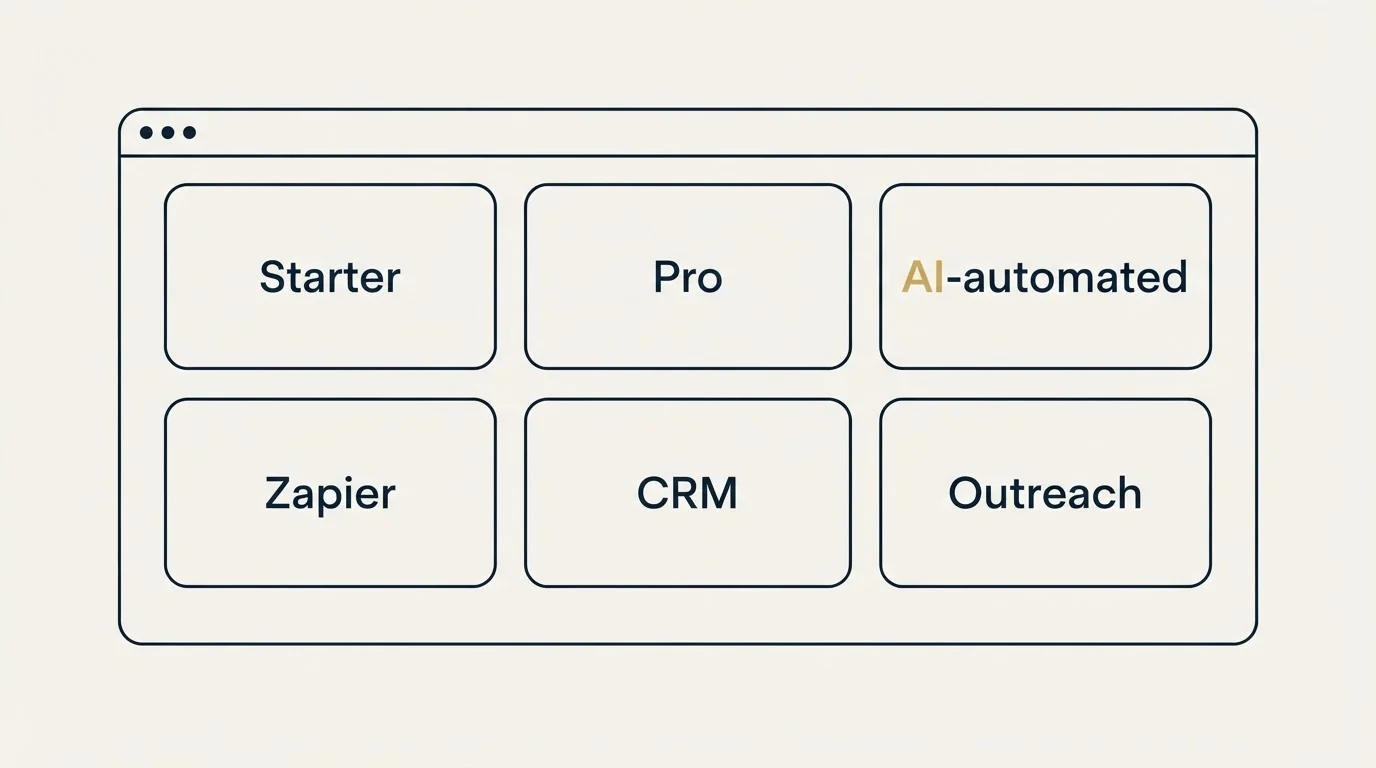
The two packages are Starter and Pro. Starter lists AI-automated message handling, a Zapier integration, deliverability monitoring, A/B testing, live chat support, unlimited user seats and unlimited email accounts. Pro lists everything in Starter plus advanced sending limits, CRM integrations, an AI template generator, verification of imported emails, campaign timeline access and priority live chat support.
The comparison table makes the practical differences concrete. Starter allows up to 100 sends per email account per day and Pro up to 500, against 20 on the free tier. Salesforce and HubSpot bi-directional sync, LinkedIn and call tasks, the activity timeline and the AI template and A/B variant generators are ticked for Pro only. Both paid packages list unlimited sequences with unlimited steps, unlimited users and unlimited email accounts.
The free tier is narrower than it first looks. The table gives it 20 email accounts, three sequences of up to five steps and partial access to the database, with no prospecting filter ticked at all. Its warm-up, authentication checks, deliverability dashboard and custom tracking domain are ticked, while separate sending limits, deliverability tests, open and reply tracking and the built-in reports start on Starter.
Database prospects are a second monthly line
Step two asks where the prospects come from. Uploading your own list is shown at $0 a month. Choosing Growbots' database adds a monthly line priced by how many new leads you want and which filters you use, and the configurator shows four priced positions:
- Basic filters, 250 new leads a month: $50, which the page labels $0.2 a lead.
- Basic filters, 1,000 a month: $150, or $0.15 a lead.
- Advanced filters, 250 a month: $75, or $0.3 a lead.
- Advanced filters, 1,000 a month: $200, or $0.2 a lead.
The third amount, unlimited, reads contact us on both filter tiers. Basic filters cover industry, finances, location, position, company size and seniority. Advanced filters add department headcount, funding, direct dials, web technologies, web traffic and a mobile app flag, and the comparison table adds email verification on import to that tier.
The comparison table prices credits "From $0.13" per prospect on every route, and no position in the configurator reaches it: the lowest rate the dropdowns show is $0.15, at 1,000 leads with basic filters. The page does not say where $0.13 applies, and the one position without a printed rate is unlimited, which asks you to contact the vendor.
The pricing page's FAQ defines the credit. One credit is charged when a prospect from the database is scheduled or exported, credits "can be translated to a monthly limit of new prospects contacted", they do not limit the messages sent to a prospect once spent, and an inaccurate or inactive address earns the credit back. The help centre's credits article adds that a bounce on an incorrect address refunds the credit automatically, that moving a prospect to a second campaign does not charge again, and that importing your own prospects does not touch the credit balance.
Where Growbots' own pages disagree
Three of the figures a buyer needs are stated twice on Growbots' own surfaces, and the two statements do not match.
| Question | One page says | Another says |
|---|---|---|
| Do unused credits roll over? | Pricing page FAQ: no, they reset at renewal | Help centre: yes, for sign-ups after 5 June 2024 |
| What does annual payment save? | Configurator summary: 17 percent | Help centre New pricing: 14 percent |
| What is the lowest lead price? | Comparison table: from $0.13 | Configurator: $0.15 at its cheapest position |
The rollover rule matters most. The pricing page FAQ says credits "don't roll over from month to month" and calls them "use it or lose it". The help centre's credits article says credits roll over "if you have our new pricing (signed up after June 5th 2024)" and reset only on the old pricing, and the New pricing article repeats the promise. By the help centre's account, anyone signing up today is on the rollover rule the pricing page says does not exist, so ask which applies before assuming either.
The annual saving has moved too. The configurator's summary step says annual payment saves 17 percent, while the help centre's New pricing article says "you can save 14% with the annual payments". Neither page prints the annual price itself, so the saving to budget against is the one confirmed in writing.
What a configured plan adds up to
Step three is a summary with add-ons. Custom reports are $29 a month for up to three fully customised reports a month, unlimited reports are $89 a month, and hiring data and intent filters are $199 a month. The configurator's own "Show the best starter deal" toggle builds a plan and prices it, and the summary it produces is the clearest single figure the page offers.
Your All-in-One plan summary
500 emails / day sending limit (Starter features): $145 1
1000 new leads / month (basic filters): $150 2
Add-ons: $0
Save 17% with annual payment 3
Total: $295 / month 4
- 1Five of the 100-a-day steps, at $29 each.
- 2The cheapest per-lead position the dropdowns show, $0.15 a lead.
- 3The help centre says 14 percent, and neither page prints an annual price.
- 4Before add-ons: reports from $29 a month, hiring data and intent at $199.
Two more totals come straight from the configurator. At the lowest volume, 100 emails a day on Starter, adding 1,000 database leads a month brings the total to $179 with basic filters and $229 with advanced ones. With your own list instead of the database, the same plan stays at $29.
The pricing page also runs a referral programme: a 15 percent discount for the referred account and 15 percent of their monthly subscription for the referrer, up to $2,000 per person.
What the retired ladder looked like, and why it still ranks

The help centre's Old pricing article publishes the ladder most ranking pages still describe: an Outreach plan at $49 a month with at least one user seat and one email account and no database access, an All in one plan at $199 a month with the ability to contact 500 new prospects from the database each month, and a PRO plan with unlimited contacts that the article says is usually tailored, so the price can vary. Its add-ons were an additional email account at $39, an additional outreach user with a free email account at $49, 250 more new contacts a month for $75, a one-time purchase of 250 credits for $100, and an outbound strategy consultant at $300 for three months on quarterly subscriptions.
The article states that "The pricing below is valid for customers who signed up before June 5th 2024", so those figures describe grandfathered accounts. A third-party review quoting $49 and $199 is quoting a page the vendor itself labels old. The change is informative as well: the retired ladder metered seats and email accounts, while the current one meters daily volume and leads and makes seats and accounts unlimited.
Concierge: three packages and no price
Concierge is the third route, and it is a service rather than software. In the configurator it shows three packages, Concierge Starter for companies new to outbound, Concierge Plus for steady growth and Concierge Scale for rapidly scaling businesses, each with a request demo button and no figure. The Concierge page's FAQ says the package includes "3 months of platform subscription & service", deliverability setup, campaign design and A/B testing, and contacting over 2,000 prospects on the buyer's behalf, and it tells buyers not to expect "a positive ROI in the first 3 months".
Growbots' homepage now leads with that service. It opens with "We Build Your Sales Pipeline. You Close Deals." and describes a full lead generation team that finds the customers, runs the campaigns and hands over qualified leads, for small and medium-sized businesses. A vendor selling its own software and a done-for-you service on one page prices the two on different things, and the page steers toward the one with no published figure.
RevenueFlow sells a done-for-you outbound motion too, paid on attended meetings that meet criteria agreed in writing before launch, so that comparison is one this site has an interest in. The provider-neutral questions to put to anyone in that category are set out in outbound for agency owners, and they apply to a software vendor's service arm as much as to an agency.
What an outbound team should weigh
Both paid packages sell sequences with unlimited steps, and the free tier's headline restriction is a sequence cap of five steps. Read that as a description of the category rather than a recommendation. RevenueFlow sends one message per campaign, with no bumps and no thread replies, so the step count of a sequencer is a feature this reader should weigh at nothing. The reasoning behind that position, and what it costs, is in email sequence software.
The rows worth weighing instead are the deliverability ones: warm-up, authentication checks and a custom tracking domain sit on every route, and separate sending limits start on Starter. Whether the tool holds up under a real list is a separate question from its feature grid, and what to evaluate in cold email software beyond features is the test to run before configuring anything.
Before configuring, set the dropdown to your real daily volume, decide between the database and your own list first because credits exist only on one of them, ask which rollover rule applies to a new account, confirm the annual saving in writing, and treat Concierge as a separate purchase with its own questions.
The short version
Growbots publishes a configurator rather than a rate card. All-in-One costs $29 per 100 emails a day on Starter and $39 on Pro, in six steps from 100 to 5,000 a day, with unlimited seats and email accounts. Database leads add $50 to $200 a month across the four priced positions, the free tier caps sends at 20 per inbox a day, and three add-ons run from $29 to $199 a month. The pricing page and the help centre disagree on credit rollover and on the annual saving, and the $49 and $199 figures still circulating are the ladder the help centre files under Old pricing.
For the field around it, the site's own Growbots alternatives page sets the product against the rest of the category, and the cold email pricing guide carries the sending platforms that publish a fixed ladder. If the constraint is the supply of qualified conversations rather than the software that sends them, see what a first campaign produces against a qualification standard agreed in writing before launch.
Plan structure, package contents, volume steps, database prices, add-ons and the annual saving were read from Growbots' pricing page by working its configurator in a browser on both feature packages, and the comparison table, credit definition and referral terms from the same page. The retired ladder, the rollover rule and the help centre's annual saving come from its articles Old pricing, New pricing and Credits, subscription and pricing FAQ, and the Concierge terms from its Concierge page. Figures are US dollars and the per-lead rates are the configurator's own. Verify current terms with the vendor before relying on them.
Frequently asked questions.
Frequently asked questions- How much does Growbots cost?
- Growbots' All-in-One plan costs $29 a month per 100 emails a day on the Starter package and $39 on Pro, in six steps up to 5,000 emails a day, where it reaches $1,450 or $1,950 a month. Leads from its database cost extra, from $50 a month for 250. There is also a free plan with tighter limits, and Concierge is priced on request.
- Does Growbots have a free plan?
- Yes. Its comparison table gives the free tier up to 20 email accounts, three sequences of up to five steps, up to 20 sends per email account a day and partial database access, with warm-up and email authentication checks included. Prospecting filters, A/B testing, reply tracking and separate sending limits start on the paid Starter package.
- What are Growbots credits and do they roll over?
- A credit is charged when you schedule or export a new prospect from Growbots' database, and a bounce on an incorrect address refunds it. On rollover the vendor's pages disagree: the pricing page FAQ says unused credits reset at renewal, while its help centre says they roll over for anyone who signed up after 5 June 2024. Confirm which applies before buying.
- Is Growbots still $49 and $199 a month?
- No. Those are the Outreach and All in one plans on Growbots' help centre article titled Old pricing, which says that pricing is valid for customers who signed up before 5 June 2024. The current model prices by emails sent per day, from $29 a month at 100 a day, with database leads as a separate monthly line.
About the author.

Ben Carden is CRO at RevenueFlow, which builds and operates outbound revenue engines for B2B companies. Previously at Gartner Enterprise. Studied at London School of Economics.
Ben Carden · CRO
Connect on LinkedIn →Explore more.
Ready to scale your outreach?
We build GTM engines that book real meetings. See the receipts.
Related articles.
Klenty Pricing: Starter Is Per Month, the Rest Per User
Klenty prices Starter per month for the account and Growth and Plus per user, at annual and quarterly states. The units, the minutes and the separate dialer ladder.
YAMM Pricing: Priced by the Google Account You Send From
YAMM prices by whether you send from a consumer Gmail or a Workspace account, then by seats. The three tabs, the daily quotas and their conditions, and the refund rules.
Saleshandy Review: The Meter Is Prospects, Not Seats
Every Saleshandy Outreach tier includes unlimited email accounts and no per-seat fee. What it meters instead is active prospects and monthly email volume.
Lemlist API: What You Can Automate, and What You Cannot
The lemlist API uses HTTP Basic auth with a leading colon, limits every route to 20 requests per 2 seconds per key, and ships on every published plan.
QuickMail Review: The Warm-Up It Handed Off
QuickMail retired its own warmer for a MailFlow integration and sends through your provider's servers. Two documented facts that decide the fit faster than a rating.
GMass Review: What the 4.8 Rating Measures
GMass carries a 4.8 from 9.2K Chrome Web Store ratings, and its own FAQ says subscribing cannot raise Gmail's limits. Both facts belong in the same review.