How to Reply to a Demo Request, Line by Line
How to reply to an inbound demo request before any demo happens: start from what they typed, offer two times or ask one question, and attach nothing.
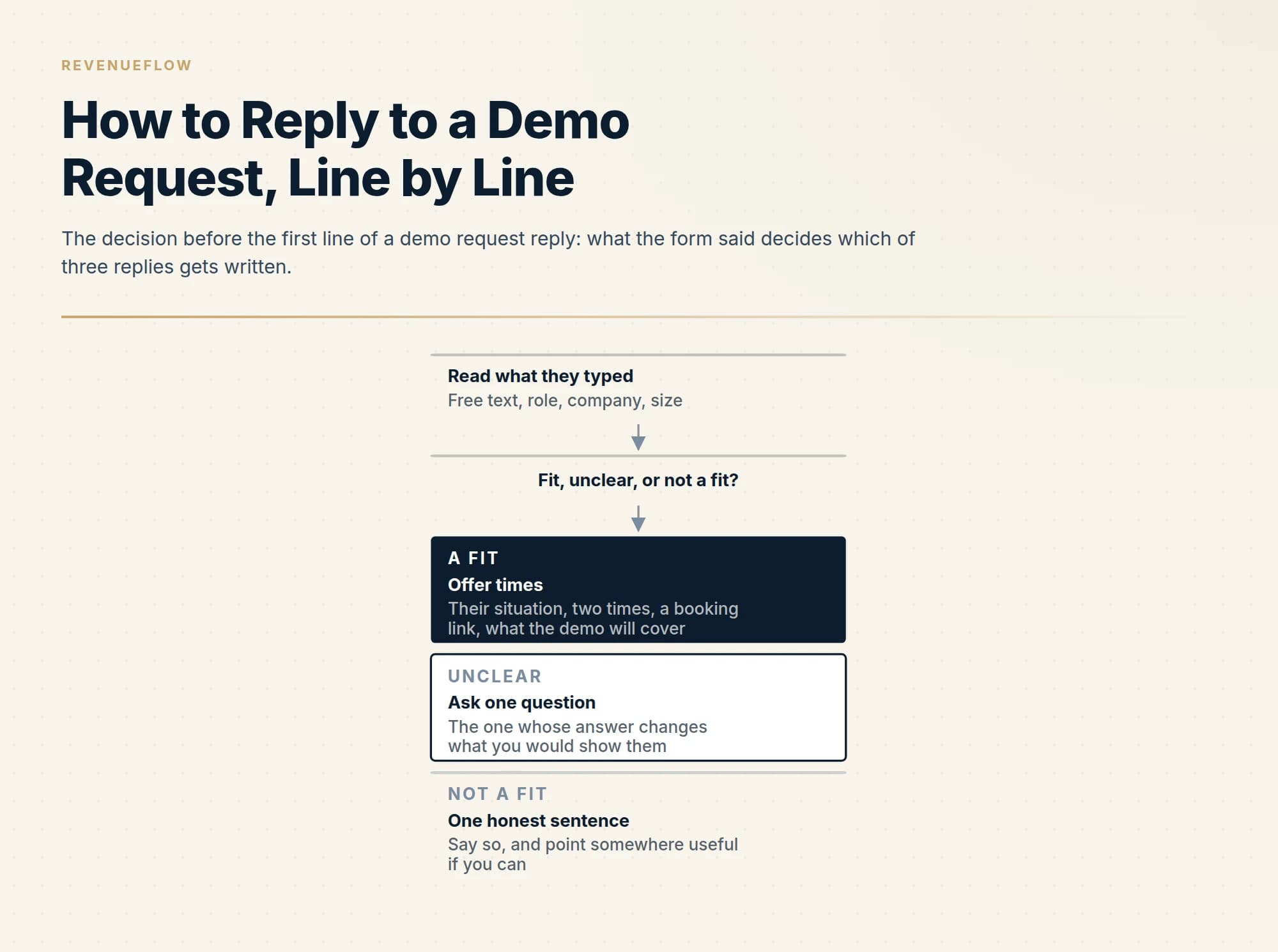
Reply to a demo request on the requester's own thread, inside the first hour, from a named person. Start with the specific thing they typed, say what the demo will cover given that, then offer two times and a booking link. If the fit is unclear, ask one question instead. Attach nothing, and keep the automated acknowledgement separate.
Key takeaways
- Decide three things before typing: what the form told you, whether the request is a fit, unclear or not a fit, and which named person replies inside the first hour.
- Open with the specific thing the requester typed, because that sentence is the proof a person read the request and the one line a triggered template cannot write.
- Offer two named times in their zone plus a booking link, or ask the single qualifying question whose answer changes what you would show; a list of five questions reads as a gate.
- A demo request is correspondence because the person wrote first, so one further note on the same thread is fine, but a quiet requester is never moved into a scheduled programme of messages.
Reviewed and updated September 18, 2026
A form notification lands at ten past two: somebody at a company you have never spoken to has asked for a demo, and in the free-text box they typed two sentences about what is going wrong. They are, at this moment, still thinking about the problem. The reply they get in the next hour tells them whether they reached a company or a queue, and the published templates for that reply are written to be sent without reading them.
This page is about one email: the reply to an inbound demo request, written before any demo has happened. It is a craft page, so it carries two worked examples and the reasoning, and it stops there. The messages that come after a demo, from the same-day recap to the no-show reschedule, are in demo follow-up templates. Asking a stranger for a demo is a cold email and a different problem, covered in our industry guide to cold email for demo requests. Neither carries the reply to somebody who asked you, so this page does.
What the market's version looks like
The published advice treats this reply as the first step of a sequence, and the published templates are built to be sent without reading the request. Regie's set of demo request follow-up templates, published on 10 November 2021 and fetched on 18 September 2026, states the sequence assumption and the way out of it in one sentence: "Demo requests should be followed up with multiple emails, but you can decrease how many it takes or even bypass needing multiple with a strong initial email." The same page is candid about how these replies are usually produced: "Because many demo request follow-ups are triggered messages".
TextExpander's demo request templates, last modified on 27 December 2024 and fetched on 18 September 2026, show the triggered shape in full. One opens "Thank you for requesting a demo of [Your Product]!" and moves to the instruction "To schedule your demo, please click the link below and choose a date and time that works best for you:". Every word of that could be sent to anybody, which is the problem with it.
Our glossary entry on the inbound lead explains why that matters in its section on the first hour: a first message referencing the specific thing they typed is a different object from one thanking them for their interest, and it takes the same amount of time to send. The same entry says a fast automated acknowledgement is not a reply. This page takes that as settled and turns it into lines.
The decision before the first line
Three things get decided before anything is typed, and all three come from the request itself.
What did the form tell you? Read the free text, the role, the company and the size field if there is one. If the person described a situation, the reply starts from it. If the form captured nothing but a name and an address, the company's own site is the only source, and the reply has to ask.
Is it a fit, unclear, or not a fit? A fit gets times. An unclear fit gets one question. A request you will not pursue gets one honest sentence saying so, pointing somewhere more useful if you can, which the glossary entry argues is better for everyone than silence.
Who replies, and inside what window? The owner should be named by hour rather than by territory, which is the glossary's mechanism and the reason it exists: lead response time is defined there as the time to a person making the first contact attempt, so an automated acknowledgement is not what it counts. How requests reach the right person is the subject of lead routing. Our guide to inbound lead generation calls this response work the job with no owner. Decide it once, in advance, so that the person reading the form at ten past two is the person who answers it.
The structure, line by line
- Reply on their thread. If the request produced an email to them, a confirmation or an acknowledgement, answer on that thread. If it produced only a record in a system, the subject names what they asked for. More on subjects below.
- First sentence: the specific thing they typed. Quote or restate their situation in their vocabulary. This one sentence is the proof that a person read the request, and it is the sentence a triggered template cannot write.
- Second sentence: what the demo will cover, given that. One line connecting their situation to what they will see. It tells them the demo will be about their problem and it tells a colleague they forward it to why the meeting exists.
- The time offer: two specific times and a link. Two named times in their zone for people who would rather reply with a word, and a booking link for people who would rather pick. Our page on B2B appointment setting explains why both belong: a link puts the work on the prospect, and proposed times fail when neither one fits.
- Or, instead of the time offer, one qualifying question. When the fit is unclear, ask the single question whose answer changes what you would show. One question gets answered. A list of five reads as a gate, and the person who asked for a demo did not ask to be interviewed.
- What happens next. One sentence: how long the demo takes, and that they can bring a colleague.
- A name. A person, with a direct line or address. The reply is from somebody.
That is five or six sentences. Nothing is attached. The deck, the case study and the pricing sheet all answer questions the person has not asked yet, and each one gives them something to read instead of replying.
Worked example one: the fit reply
The company, the product, the people and the details below are invented for illustration. Joanna Pike, an operations manager at a care provider called Fernhill Care, has asked for a demo of a rota product called Rotawise, and typed that agency shifts are being booked by phone because the rota is a spreadsheet nobody trusts after Thursday.
Re: Your demo request (Rotawise)
Joanna, you wrote that agency shifts are being booked by phone because the rota is a spreadsheet nobody trusts after Thursday. 1
That is the exact case the demo should cover: how the rota stays trusted through the week, and what happens when a shift drops out late. 2
We can do Tuesday at 10:00 or Wednesday at 14:30, both UK time, or pick any slot here: [booking link]. 3
It takes 30 minutes, and whoever builds the rota is welcome to join if that is somebody else. 4
Sam Okafor, Rotawise, direct line below. 5
- 1The specific thing they typed, in their vocabulary. Proof that a person read the request.
- 2What the demo will cover, given that. It also tells a forwarded colleague why the meeting exists.
- 3Two named times in their zone and a booking link, for the two kinds of replier.
- 4What happens next: how long it takes, and that a colleague is welcome.
- 5A person, with a direct line.
Worked example two: the unclear-fit reply
Same invented product, different request. The form came from a Daniel Reyes with a personal address, no company, and one line: that he wants to see how scheduling works. There is not enough here to offer times honestly, and there is not enough to decline.
Subject: Re: Your demo request (Rotawise)
Daniel, thanks for asking to see Rotawise. You mentioned wanting to see how scheduling works.

One question so we show you the right thing: are you building rotas for a team today, and roughly how many people are on them? The product looks quite different for a team of fifteen than for four sites.

Reply with a line and we will send times the same day.

[Your name and direct line]
The question is the one whose answer changes the demo, and the reply says why it is being asked. It also commits the sender to something: times the same day. The thanks in the first line is the only place the word belongs, attached to the specific thing he asked for.
| The request said | The reply does | First line starts |
|---|---|---|
| A situation, from a company that fits | Offers two times and a booking link | You wrote that... |
| Almost nothing, fit unclear | Asks one question, promises times the same day | You mentioned wanting to see... |
| Enough to know it is not a fit | Says so in one honest sentence | Thanks for asking. We are not the right tool for... |
The subject rule
Reply on their thread. A demo request usually generates a confirmation to the requester, and a reply on that thread arrives as the continuation of something they started. Where no thread exists, the subject names what they asked for, as in both examples: their demo request, and the product. A clever subject on a reply to an inbound request makes a wanted email look like an unsolicited one.
Send timing
The window is the first hour, and the mechanism behind that is set out in the inbound lead glossary entry and not repeated here. Two practical points belong on this page. An automated acknowledgement can go out instantly, and it should say only that the request arrived and that a named person will reply. It is not the reply and should not try to be. And a request that arrives outside working hours gets its reply first thing the next working morning, before anything else in the queue, which is a decision about ownership that has to be made before the request arrives.
- Says the request arrived
- Says a named person will reply
- Could be sent to anybody
- Is not a contact attempt by a person
- Starts from the specific thing they typed
- Says what the demo will cover, given that
- Offers two times and a booking link, or asks one question
- Comes from somebody, with a direct line
Where we differ from standard practice
The market's advice, in the Regie sentence quoted above, is a run of several emails. Our position on cold outbound is one message per campaign, with no bumps. A demo request sits on the other side of that line, because the person wrote first, and our page on the sales cadence says so directly: where somebody requested a demo, not following up is the actual error. A second short note on the same thread, if the first reply goes unanswered, is correspondence.
What we do not do is convert a quiet requester into a scheduled programme of messages. The glossary entry on the inbound lead sets out that position. If a requester goes quiet after a real reply and one further note, close the loop in a sentence and stop. When something changes on their side or yours, that is a reason to write again, as a new message with its own premise.
The mistakes
The auto-acknowledgement as the reply. It answers the question of whether they reached a company or a queue, in the wrong direction.
The deck attached. It gives the requester something to do other than book, and it answers questions nobody asked.
Five qualifying questions. A form after the form. One question, with the reason for it, gets an answer.
The calendar link with no sentence. The TextExpander shape: a link and an instruction. It works on the most motivated requesters and tells the rest that nobody read what they wrote.
Thanks for your interest. The phrase is the mark of a template. If the first sentence could be sent to anybody, it has been wasted.
Routing by territory while the request cools. Decide the owner by hour, in advance.
The short version
Read what they typed, decide whether it is a fit, unclear or not a fit, and write one of three replies. The fit reply restates their situation, says what the demo will cover given that, offers two times and a booking link, says what happens next and comes from a person. The unclear reply asks the one question that changes the demo. Reply on their thread, inside the first hour, attach nothing, and keep the acknowledgement and the reply separate.
Inbound only answers the people who come to you. For the accounts that have not asked yet, get a free campaign plan and we will show you what a one-message outbound campaign to your market looks like.
Publisher pages quoted as fetched on 18 September 2026: Regie (published 10 November 2021) and TextExpander (last modified 27 December 2024). Publishers revise these pages; confirm the current text before relying on it.
Frequently asked questions.
Frequently asked questions- How quickly should you reply to a demo request?
- Inside the first hour, from a named person. An automated acknowledgement can go out instantly, but it should say only that the request arrived and who will reply, because it is not the reply. A request that arrives outside working hours is answered first thing the next working morning. Both depend on deciding in advance who owns inbound requests at each part of the day.
- What should the first line of a demo request reply say?
- The specific thing the requester typed, quoted or restated in their own vocabulary. If the form captured a situation, start from it. That sentence proves a person read the request and sets up the next line, which says what the demo will cover given their situation. A first line that could be sent to anybody, such as thanks for your interest, wastes the one place a reply can be personal.
- Should you qualify a demo request before booking the demo?
- Only when the request leaves the fit unclear, and then with one question. Ask the question whose answer changes what you would show, say why you are asking, and promise times the same day once they reply. When the request already shows a fit, offer times straight away. When it shows the request is not a fit, say so in one honest sentence.
- Should you attach a deck or pricing to a demo request reply?
- No. The requester asked for a demo, and a deck, a case study or a pricing sheet each answer questions they have not asked yet. An attachment also gives them something to read instead of replying with a time. Keep the reply to five or six sentences: their situation, what the demo will cover, the time offer or one question, what happens next, and a name.
About the author.

Ben Carden is CRO at RevenueFlow, which builds and operates outbound revenue engines for B2B companies. Previously at Gartner Enterprise. Studied at London School of Economics.
Ben Carden · CRO
Connect on LinkedIn →Explore more.
Ready to scale your outreach?
We build GTM engines that book real meetings. See the receipts.
Related articles.
How to Write a New Year Outreach Email, Line by Line
A new year outreach email works only where January is a fact about the account. Who that is, the structure line by line, and two worked examples.
How to Write an RFP Response Cover Email, Line by Line
An RFP cover email is a receipt request with attachments, and the cover letter is a page inside the submission. How to write both, line by line.
How to Write a Third Follow Up Email, Line by Line
A third follow up email belongs only in a thread where the person replied or agreed to something. When to send one, and how to write it line by line.
Growbots Pricing: A Slider, Two Packages and a Credit
Growbots prices outreach by daily volume on a slider, sells two feature packages and a per prospect credit, and its help centre documents the ladder it retired.
Klenty Pricing: Starter Is Per Month, the Rest Per User
Klenty prices Starter per month for the account and Growth and Plus per user, at annual and quarterly states. The units, the minutes and the separate dialer ladder.
YAMM Pricing: Priced by the Google Account You Send From
YAMM prices by whether you send from a consumer Gmail or a Workspace account, then by seats. The three tabs, the daily quotas and their conditions, and the refund rules.