Sales Cadence: The Six Variables That Define One
Outreach calls it a sequence and Salesloft calls it a cadence. What the object is, the six variables that define one, and where a cadence genuinely belongs.
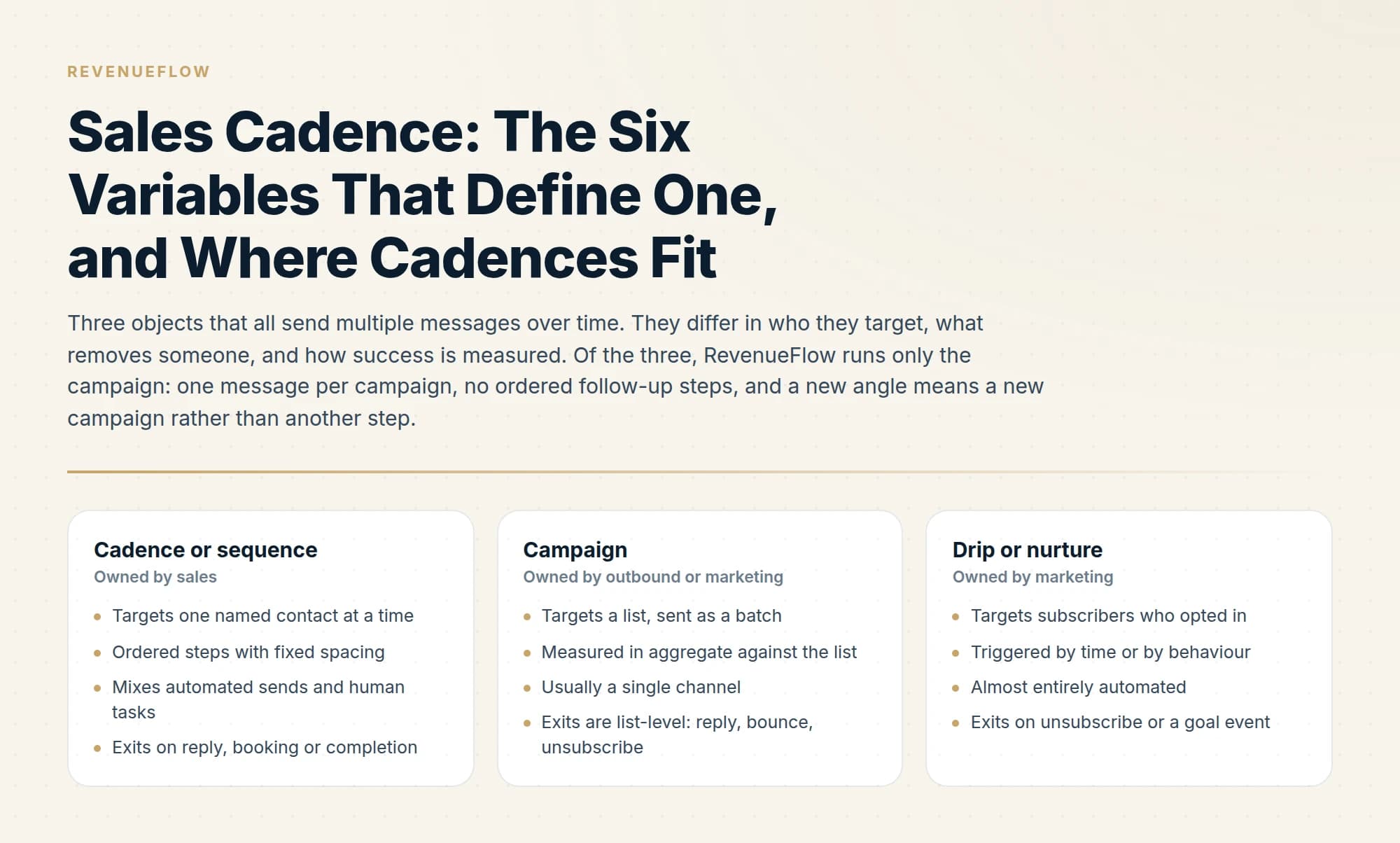
A sales cadence is an ordered, scheduled set of touchpoints aimed at one contact, running across one or more channels, with defined spacing and a defined exit condition. Six variables define one: channels, touch count, spacing, which steps are automated, the exit conditions, and who owns the manual steps.
Key takeaways
- Outreach documents the object as a Sequence and Salesloft markets the same machinery as a Cadence, so the word usually reflects which tool somebody learned first.
- The manual to automatic ratio is the constraint teams cost badly, because task steps scale with human hours rather than with sending capacity.
- For cold outbound we run one message per campaign, since every later touch reaches only people who already declined to answer.
- Cadences fit wherever the contact initiated, opted in or has a contract with you, and on warm inbound speed matters more than touch count.
Reviewed and updated September 1, 2026
Two of the largest sales engagement platforms sell the same object under different names. Outreach calls it a Sequence and defines it as "a series of touch points built to drive deeper engagement with a Prospect", offering five step types: auto email, manual email, phone call, generic task and LinkedIn task. Salesloft calls the same object a Cadence and markets it as multi-channel, sorting steps by channel, time zone and account. Buyers move between the two tools and keep using whichever word they learned first, which is why a conversation about cadences frequently involves two people describing identical machinery and disagreeing about it.
So it is worth pinning the term down before arguing about how many touches belong in one. This page defines what a cadence is, sets out how multi-channel cadences are actually structured, states our own position on cold outbound once, and gets specific about where a cadence is genuinely the right tool.
Salesloft Cadence is the product name for this object, and Salesloft Cadence Automations is the layer that fires the automated steps inside it, which is why buyers moving between the two platforms keep describing identical machinery in different words.
What a cadence is
The phrase sales engagement cadence usually arrives from a platform rather than from a concept, because Salesforce packages the feature under that name, and the six variables below are what any of those builders is actually asking you to set.
A cadence is an ordered, scheduled set of touchpoints aimed at one contact, running across one or more channels, with defined spacing and a defined exit condition.
A prospecting sequence is the same object under a third name, usually with the touch count raised and the exit condition left as a reply, which is where it collides with the position stated further down this page.
Six things have to be specified before a cadence exists as anything more than an intention.
A cadence strategy is a decision about those six variables rather than a separate discipline, and the phrase also names an unrelated subject, the meeting rhythm a company runs its planning on, which shares the word and nothing else.
Marketing cadence is the same word arriving from the other side of the funnel, and it usually names one of three things: the sending frequency on an opted-in email programme, the publishing rhythm on a content calendar, or the planning rhythm above, none of which is the ordered per-contact sequence this page defines.
- Yes: Channels: which of email, phone, LinkedIn, SMS or physical mail are in play
- Yes: Touches: how many of each, and in what order
- Yes: Spacing: the delay between touches, usually counted in business days
- Yes: Automation: which steps fire automatically and which create a task for a person
- Yes: Exit conditions: what removes a contact, and whether the cadence has an end date
- Yes: Owner: the named person whose task queue the manual steps land in
The exit condition is the variable that changes the character of the whole thing. Almost every cadence exits on a reply, which means each successive step is delivered only to the people who received the previous one and chose not to answer. Some tools extend the exit to a booking or a click. A cadence with no end date is a subscription the contact never agreed to.
Published answers to how many touchpoints a cold prospect needs disagree because they are counting different things: a buyer-journey figure counts every marketing and sales contact across a whole purchase, while a sequence figure counts steps inside one cadence, and the two are quoted interchangeably by people who have not checked which denominator produced them.
Two adjacent words get used interchangeably and mean different things.
- Targets one named contact at a time
- Ordered steps with fixed spacing
- Mixes automated sends and human tasks
- Exits on reply, booking or completion
- Measured per step and per contact
- Targets a list, sent as a batch
- Measured in aggregate against the list
- Usually a single channel
- Exits are list-level: reply, bounce, unsubscribe
- Measured per campaign, against other campaigns
- Targets subscribers who opted in
- Triggered by time or by behaviour
- Almost entirely automated
- Exits on unsubscribe or a goal event
- Measured on engagement over months
The distinction that matters commercially is permission. A nurture programme runs on people who asked. A cadence to a stranger runs on people who did not, and the number of touches in it is a decision about how much of somebody else's attention you are willing to take without an invitation.
The same object is searched for as an email cadence, and that phrase carries both senses at once: the email steps inside a sales sequence, which is what this page defines, and the sending frequency on an opted-in marketing programme, which is the marketing cadence sense above.
How multi-channel cadences are structured
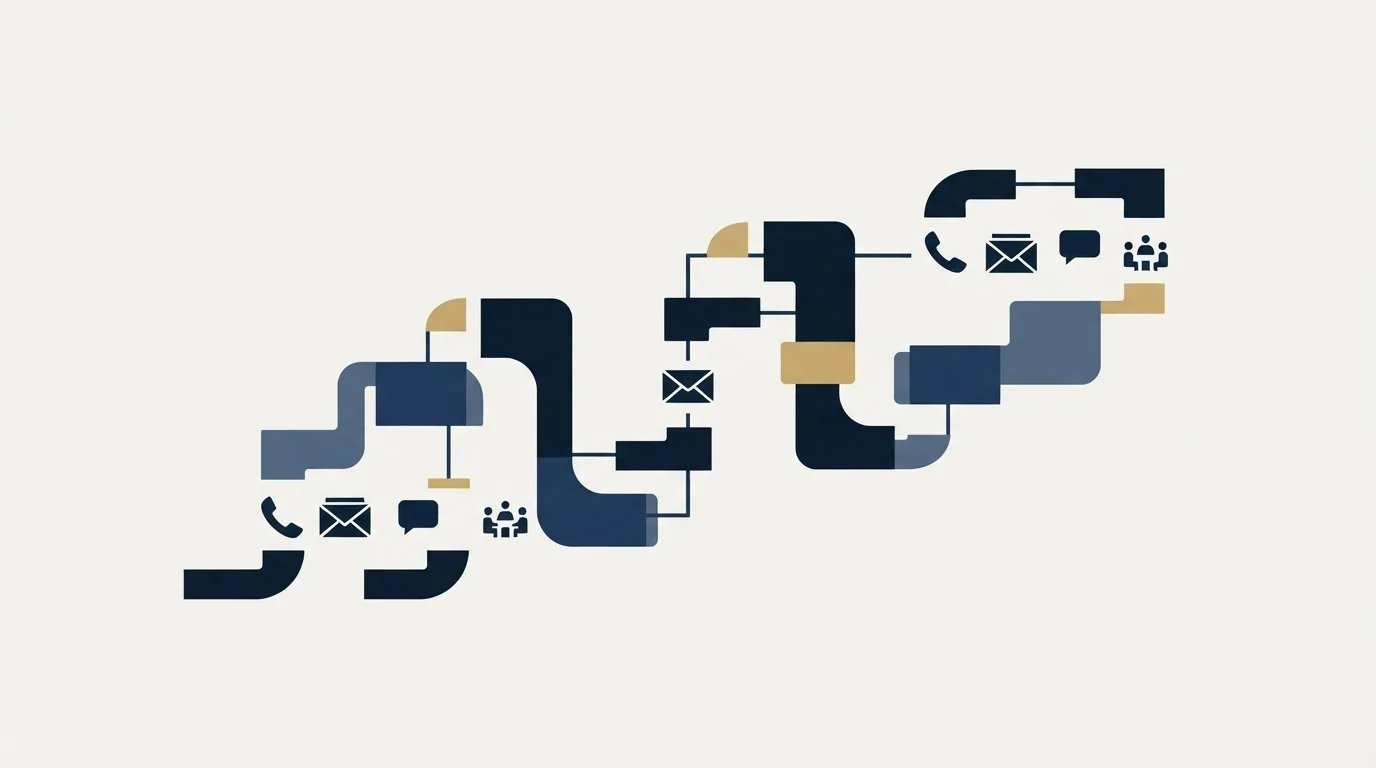
The standard shape is a mix of automated email and manual tasks, spread over two to four weeks, alternating channels so that no single channel carries consecutive touches.
Three structural choices do most of the work.
Spacing. Delays are counted in business days, and a cadence built on calendar days will fire its second touch on a Sunday within a week of going live. Spacing usually widens as the cadence progresses, on the reasoning that early touches establish presence and later ones are checking for a change in circumstance.
The manual to automatic ratio. This is the constraint nobody costs properly. Automated email steps scale to whatever your sending infrastructure supports. Manual steps do not, because each one becomes a task in a queue owned by a human being. A twelve-touch cadence with five manual steps, running against two hundred active contacts, generates a thousand tasks over the life of the cadence. If that arrives in one person's queue at a rate they cannot clear, the manual steps get skipped silently and the cadence you are measuring is not the cadence you designed. Work out the task load before the touch count.
Channel sequencing. Multi-channel cadences alternate deliberately so that a contact who ignores one channel encounters a different one. The complication is that channels have different social rules. An email in an inbox is a normal intrusion. A second LinkedIn message lands directly under the first one in the same thread, so it reads as a nudge whatever the campaign structure calls it, which is why we do not run LinkedIn re-touches on people who did not reply. Structure and templates for the multi-channel case, where it is appropriate, are in multi-channel templates.
Channel sequencing decisions rest on tone as much as wording, a nuance covered in what the tonality figure actually means.
Our position, stated once
We run one message per campaign for cold outbound. No thread replies, no bumps, ever.
The reasoning is structural rather than a claim that follow-ups produce no replies. Because the exit condition is a reply, every touch after the first is delivered exclusively to people who already saw a message from you and declined to answer it, which is the population most likely to file a spam complaint. The reply lift from those touches is measured inside the cadence, and the reputation cost is paid by the sending domain across every campaign running on it, so the unit of measurement and the unit of damage are different objects and no per-cadence report can show you the trade. We would rather not spend a budget we cannot see the meter for. The full argument, including the deliverability thresholds involved and the costs the position imposes on us, is in email sequence software.
What replaces the follow-up is a new campaign built on a genuinely different angle. The same person is reachable, the message arrives as its own message with its own subject line, and it gets judged on its own premise rather than being read as a reminder about the one they ignored. That requires suppression discipline: repliers, bounces and unsubscribes are excluded permanently, a lead pending in one active campaign is not enrolled in another, and a negative reply suppresses that person across the whole workspace. Cadence tooling handles a lot of that automatically, which is one of the honest costs of running the other way.
Where cadences are genuinely the right tool
The argument above depends on one condition: the recipient never asked to hear from you. Where they did, silence stops being an answer and multiple touches are simply competent follow-through.
Warm inbound. Somebody filled in a form, requested a demo, started a trial or asked a question. They initiated contact, so non-response is far more likely to be a busy week than a rejection. Not following up is the actual error here, and speed matters more than touch count, because the relevance window is short and closes fast.
Existing customers. Renewals, onboarding milestones, usage prompts, product changes, support follow-through. There is a contract and an expectation of contact.
Opted-in nurture. Somebody subscribed and can unsubscribe. The permission is explicit and the tooling for honouring it is mature.
Scheduled commitments. Confirming, reminding and rescheduling around a meeting the person agreed to. Nobody has ever objected to a reminder about a call they booked.
Here is what a warm inbound cadence looks like when it is built for speed rather than persistence. The point of the shape is that the useful touches are clustered at the front.
- Within the hourAutomated acknowledgement
Confirms receipt and offers a booking link. Fires on form submission with no human in the loop.
- Same dayManual email from the rep
References what they actually asked for. This is the touch that most often gets the reply, and it is the one most likely to be missed if the queue is overloaded.
- Day 1Phone attempt
While the request is still recent enough that they remember making it.
- Day 3Second call plus a short email
Different time of day from the first attempt. Same thread is fine here, because they asked.
- Day 7Value touch
Something relevant to the question they raised rather than a reminder that you emailed them.
- Day 14Close the loop
A short message stating you will stop and how to restart. Then the cadence ends and the contact returns to marketing.
Two details in that shape are worth copying. The cadence has an end date, so nobody stays in it indefinitely. And the last touch says explicitly that the follow-up is stopping, which is a courtesy and also reliably produces replies from people who genuinely were busy.
The handoff into a cadence like this is where most warm follow-up quietly fails, and the fix is a written response time and a minimum attempt count agreed between the functions rather than a better cadence design. That agreement is part of the same document as the lead definitions, covered in MQL versus SQL.
Cadence hygiene that applies whatever you run
Four rules travel across every situation above.
One active cadence per contact. Two cadences running against the same person is the most common cause of somebody receiving two unrelated messages from your company in one morning, and the tooling will not stop it by default.
Suppression is global. An unsubscribe, a hard bounce or a clear no should remove the person everywhere, not from the cadence that produced it. Check how your platform scopes this, because the default is often per-cadence. The scoping behaviour varies between tools and is worth checking before you buy one, which is one of the axes in sales engagement platforms.
Manual steps need a named owner and a realistic queue. A cadence whose manual steps are being skipped is reporting the performance of a different cadence.
Per-step reporting measures the step, not the programme. Attribution to the step that produced a reply is accurate as far as it goes. What it cannot show is anything happening outside the cadence, including inbox placement across the sending domain, which is exactly the measurement gap that shapes our own position above.
The short version
A cadence is an ordered, scheduled set of touchpoints to one contact across one or more channels, with defined spacing and a defined exit condition. Outreach calls the object a Sequence, Salesloft calls it a Cadence, and they are the same machinery. Six variables define one: channels, touch count, spacing, which steps are automated, exit conditions, and the person whose task queue the manual steps land in.
Multi-channel cadences alternate channels over two to four weeks with widening gaps. The constraint that gets missed is the manual step load, because task-based steps scale with human hours rather than with sending capacity, and an overloaded queue turns skipped steps into a cadence you are not actually running.
For cold outbound we run one message per campaign with no bumps, because every touch after the first is delivered only to people who already declined to answer, and the reply lift is measured inside the cadence while the reputation cost is paid across the whole sending domain. What replaces the follow-up is a new campaign with a genuinely different angle rather than a nudge in the same thread.
Cadences are the right tool wherever the person initiated contact, has a relationship with you, or opted in: warm inbound, customer lifecycle, opted-in nurture and confirming scheduled commitments. Give them an end date, a global suppression rule, one cadence per contact and a named owner for the manual steps.
How President's Club criteria decide who goes explains why this award functions as recognition rather than an incentive that moves a quarter.
Our clients get the cold half run this way, one message per campaign, with the angle carrying the work and billing tied to attended meetings that meet criteria agreed in writing before launch. You can see what a campaign would look like for your market.
Vendor terminology and product descriptions verified against the vendors' own pages in mid-2026. Verify current terms with the vendor before relying on them.
Sources: Outreach sequence overview, Salesloft cadence automation
Frequently asked questions.
Frequently asked questions- What is a sales cadence?
- An ordered, scheduled set of touchpoints aimed at one named contact across one or more channels, with defined spacing and a defined exit condition. Six things must be specified before it exists as more than an intention: the channels, the number and order of touches, the spacing, which steps are automated, what removes a contact, and who owns the manual steps.
- What is the difference between a cadence and a sequence?
- Nothing structural. Outreach documents the object as a Sequence and Salesloft markets the same machinery as a Cadence, so the word usually reflects which tool somebody learned first. A campaign is a different object, targeting a list rather than one contact and measured in aggregate, and a nurture programme runs on people who opted in.
- How many touches should a cold cadence have?
- We run one message per campaign for cold outbound, with no thread replies and no bumps. Because a cadence exits on reply, every touch after the first reaches only people who saw a message and chose not to answer. The reply lift is measured inside the cadence while the reputation cost lands on the sending domain across every campaign on it.
- When is a cadence the right tool?
- Wherever the person initiated contact or agreed to hear from you: warm inbound after a form fill or demo request, existing customers through renewals and onboarding, opted-in nurture, and confirming or rescheduling a meeting they booked. Give the cadence an end date, one cadence per contact, global suppression, and a named owner for the manual steps. That is how to run one safely where a cadence is legitimate; we do not run cold cadences ourselves, and send one message per campaign.
About the author.

B2B cold email experts helping companies generate qualified leads through done-for-you outreach campaigns.
RevenueFlow Team
Explore more.
Ready to scale your outreach?
We build GTM engines that book real meetings. See the receipts.
Related articles.
Inbound vs Outbound Sales: How the Two Motions Differ
Inbound and outbound sales compared as motions: what the rep knows at first touch, what each costs, the team each needs, and the metrics that belong to each.
Readymode Pricing: The Seat Is Dear for What Is Inside It
Readymode publishes $199 and $249 per licence per month, near the top of the dialer range. What the seat includes that others bill separately, and when that pays.
PhoneBurner Pricing: What the Seat Price Covers
PhoneBurner publishes all three seat prices in both billing states. The metered resource is contact imports, not minutes, and the spam layer is an add-on at every tier.
Multi-Threading in Sales: Who the Second Contact Should Be
Six contacts on an opportunity and one real relationship is still single-threaded. Which second person to add, when to ask, and how to tell whether it worked.
Koncert Dialers: Line Counts Published, Price Is Not
Koncert publishes the parallel line ceiling on every tier, which most of this category will not. It publishes no price. What its pages state, and what the quote decides.
Sales Productivity: Four Different Ratios Wear the Same Name
Sales productivity names four ratios that share no denominator, and improving one can move another the wrong way. The version you mean decides what happens next.