How to Write a Third Follow Up Email, Line by Line
A third follow up email belongs only in a thread where the person replied or agreed to something. When to send one, and how to write it line by line.
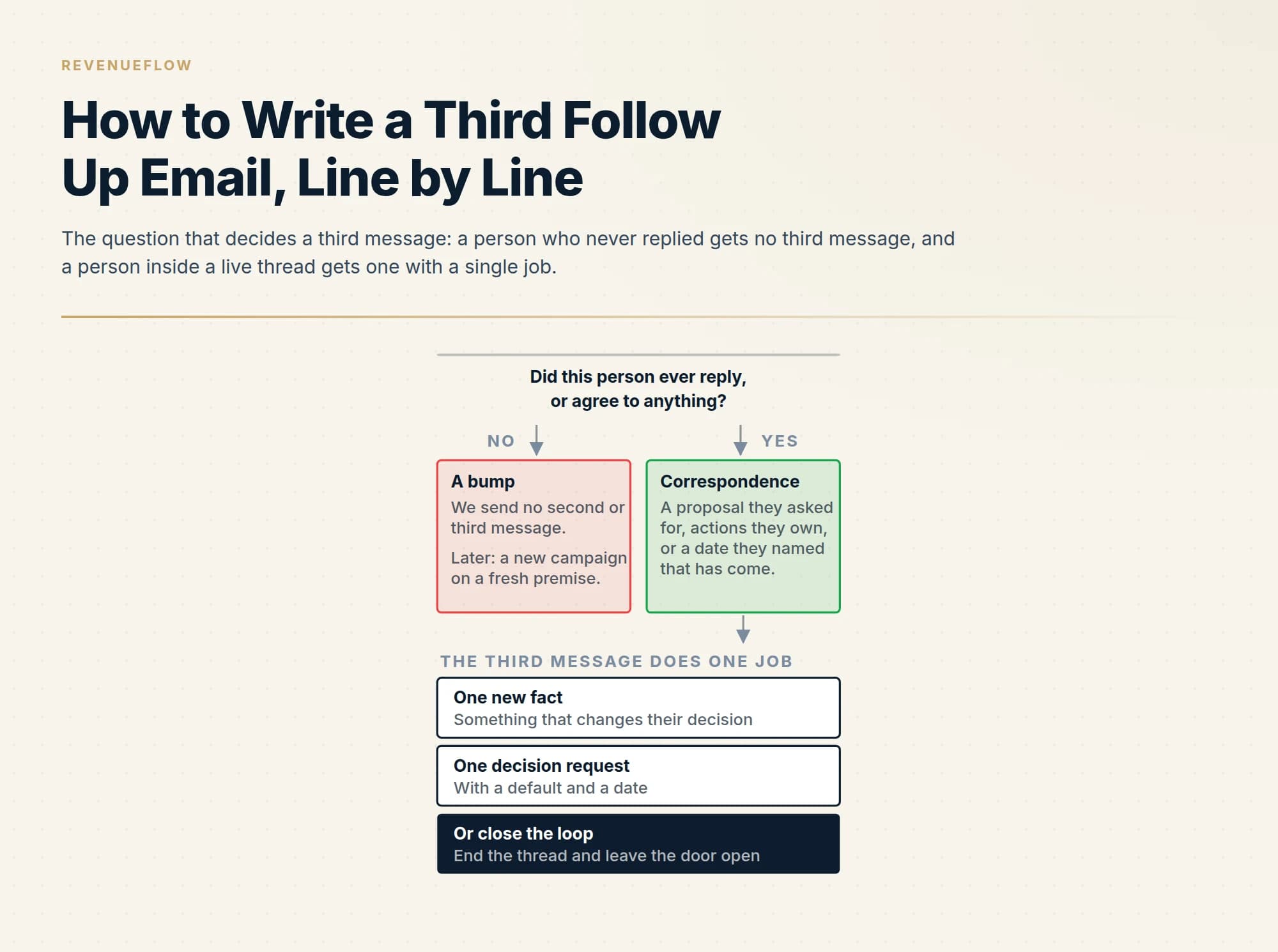
Write a third follow up email only to somebody who replied or agreed to something earlier in the thread. Reply on that thread, name the agreement in their terms, and do one job: give one new fact, make one decision request with a default and a date, or close the loop. Send none to a prospect who never replied.
Key takeaways
- The question that decides a third message is whether the person ever replied or agreed to anything; if not, this site sends no second or third message and the next approach is a new campaign on a fresh premise.
- A third message is correspondence in three situations: a proposal they asked for, a meeting that ended with actions they own, and a date they named that has now come.
- By the third message the reader has the context twice over, so it must do exactly one job: one new fact, one decision request with a default and a date, or a close-the-loop.
- Send it as a reply on their thread with the subject unchanged, tie it to a real date in the agreement, say what happens next on your side, and then actually stop.
Reviewed and updated September 18, 2026
Two messages have gone out, nothing has come back, and a third sits in drafts. Before a word of it gets edited, one fact settles almost everything about what it should say: whether this person ever replied, or agreed to anything.
If the answer is no, this site's position is short. A third message to somebody who has never replied is the one we do not send, and neither is the second. We run one message per campaign on cold outbound, the argument and our own published figures are in why we stopped using follow-ups, and the market's numbers are read against their cost in cold email follow-up benchmarks. If the answer is yes, a third message is ordinary correspondence, it is often the most important one in the thread, and almost nobody teaches how to write it. This page does both halves honestly: what the market teaches about the third cold follow-up, stated as the market's advice, and then the craft of the third message where it belongs.
What the market teaches about the third cold follow-up
The pages that rank for this topic assume a sequence and coach its third step. Prospeo's guide to the third follow-up email, as fetched on 18 September 2026, assigns each step a job: "Your first email addresses need, your second handles cost or value, and your third tackles urgency or trust." It also states the rule every one of these guides shares, "The cardinal rule: don't just bump the thread.", and the exit: "If you get nothing back, send a breakup email." HubSpot's collection of sales follow-up templates, fetched the same day, walks the same path in two sentences: "If that email doesn't work, you can try sending a third follow up." and then "At this point, it might be time for the break up email."
That is industry practice and it is described here as such. The advice inside it is sound on its own terms: add something new, keep it short, stop soon. Our own template gallery reflects the same convention, with a first cold follow-up and a break-up in our follow-up email templates page, and it says there that this site's own cold campaigns now send no follow-up at all, so that sample is the ceiling and not the plan.
Where we differ from standard practice
Our disagreement is with the premise. The craft is fine. The benchmarks page sets out the market's own table of what each additional message returns, in which both columns fall at every position, and then prices it: the added replies are bought with sending reputation and with the account's willingness to hear from us again. Our sales cadence page gives the mechanism. Because a sequence stops when somebody replies, every touch after the first is delivered only to people who saw a message and declined to answer it, which is the population most likely to file a spam complaint. The reply is measured inside the sequence, and the reputation cost is paid by the sending domain across everything else it sends.
What we do instead of a third cold follow-up is nothing, on that campaign. When something becomes true of the account that was not true before, it gets a new campaign on a fresh premise, sent as an opening message and judged as one.
Where a third message is correspondence
The test comes from meeting reminder emails: if the message would still make sense to send when the answer is already yes, it is correspondence, and if it only makes sense as another attempt to get a yes, it is a bump. Our follow-ups page names the one exception to its own rule in the same terms, an active conversation, where following up is expected and appropriate. Three situations put a third message on the right side of that line.
A proposal they asked for. They requested it, you sent it, and two notes have gone unanswered. The first and second follow-ups after a proposal are Templates 3 and 4 in our proposal email templates page. The third is the one that has to change character, because a third note with more value attached tells them the thread will go on forever.
A meeting that ended with actions they own. They said they would send the usage data, introduce the head of IT, or check a date with finance. Two reminders later, nothing. The agreement is theirs, and reminding them of it is administration.
A date they named, which has come. They replied with some version of reach out in the first quarter. The first note on that date and a second a week later drew nothing. The third closes the loop they opened.
In all three the person is inside an agreement. None of them is a stranger, and that is why the craft below is allowed to exist.
What a third message must carry
By the third message the reader has the context twice over. Repeating it a third time, more politely, is the failure. A third message earns its place by doing exactly one of three jobs.
One new fact. Something that changes their decision and did not exist when you last wrote: a date that moved, a constraint on your side, an answer to a question they raised. A case study is rarely a new fact. A start date that expires on the 14th is one.
One decision request. A question with a default and a date, so that silence becomes an answer. If we hear nothing by Friday we will release the March slot is a decision request. Any thoughts is not.
Or a close-the-loop. You end the thread, say what happens next on your side, and leave one door open. The no-show email template calls its version of this note the most underrated message in the set, because there is nothing left to dodge.
- Sent to somebody who never replied
- The third step tackles urgency or trust
- Then a breakup email
- We do not send it
- Sent to somebody who replied or agreed to something
- Does one job: a new fact, a decision request, or a close-the-loop
- Says what happens next on your side
- Ends the thread deliberately
The structure, line by line
- Reply on their thread. The first two notes and their original request sit underneath, which means the message itself can be three sentences.
- First sentence: the agreement, in their terms. The proposal you asked for on the 3rd. The usage data you offered to send after our call. No reference to your earlier notes and no count of how many you sent.
- Second sentence: the one job. The new fact, the decision request with its default and date, or the statement that you are closing the loop.
- Third sentence: what happens next on your side. What you will do on that date if you hear nothing. This is what makes it the last message, and it has to be true.
- A door. One line on how to reopen it, with no deadline attached.
- Your name. Nothing after it.
Leave out the apology for writing again, the guilt, the summary of the offer and any second question.
Worked example one: the proposal they asked for
The people, the company and the details are invented for illustration. Martin Leal, operations director at a catering supplier, asked for a proposal for a March rollout. It went on the 3rd. Notes on the 8th and the 15th drew nothing.
Re: Proposal for the March rollout (on his thread)
Martin, on the proposal you asked for on the 3rd. 1
The March start needs our install team booked by Friday the 26th, and we are holding the slot for you until then. 2
If we hear nothing by Friday we will release it and treat this as parked, with no further notes from us. 3
If the timing has moved, one line with the month that suits and we will rework the dates. 4
- 1The agreement in his terms: he asked for it. No count of earlier notes.
- 2One new fact, and it is real: a date that changes what he can have.
- 3The decision request with its default, so silence becomes an answer, and what happens next on your side.
- 4The door, with no deadline attached.
The deadline in it is a fact about the seller's own capacity. An invented deadline would turn the same four sentences into pressure, and the reader can usually tell.
Worked example two: closing the loop on actions they own
Also invented. After a call on the 2nd, Carla Voss said she would send last quarter's usage export so that a quote could be sized. Two reminders have gone unanswered.
Subject: Re: Usage export for the quote
Carla, on the usage export you offered to send after our call on the 2nd: we will stop asking for it.

Without it we cannot size the quote properly, so we are parking the quote and will not send one built on guesses.

If the export becomes easy to pull, reply here with it and we will turn the quote round that week.

[Your name]
It names the agreement, says what the missing action blocks, ends the asking and leaves one door. It contains no complaint. The general-purpose version of this note for cold prospects is the break-up email, and our breakup email templates page carries eight variants of it. The difference is who receives it. The recipient in this invented example made a commitment, so telling her the thread is closed is a courtesy she is owed.
The subject rule
A third message has no subject of its own. It is a reply on their thread, and the thread's subject is the record of what they asked for. Changing it makes the message look like a new approach and loses the one advantage correspondence has, which is the evidence underneath it. Never add Re: to a message that is not a reply.
Timing
There is no interval on this page, because no data exists here on third messages in live threads, and the market's cold-sequence spacing belongs to a different situation. The mechanism is what matters. Tie the third message to a date in the agreement: the date they named, the deadline the proposal carries, the day the slot has to be released. If no such date exists, the honest third message is the close-the-loop, since there is no decision left to request.
- Yes: They replied, or agreed to something, earlier in this thread
- Yes: It does one job: a new fact, a decision request, or a close-the-loop
- Yes: Any date in it is real
- Yes: It says what happens next on your side, and that is true
- Yes: It is a reply on their thread
- No: It counts your earlier notes, apologises for writing, or attaches more material
- No: The person never replied to anything
The mistakes
Sending it to somebody who never replied. That is the third cold follow-up, and the pages linked above explain why this site sends none.
A third helping of value. Another case study tells the reader the thread has no end, so there is no reason to answer this particular note.
Counting. A line that counts your own emails puts the reader in the wrong and gives them a reason to stay silent.
A manufactured deadline. Urgency that is not a fact about your capacity or their plan is pressure, and it spends the trust the thread was built on.
Threatening to close the file and then writing again. The close-the-loop works once, and only if you stop.
Changing the subject line to get noticed. It discards the evidence that they asked.
The short version
Ask first whether the person ever replied or agreed to anything. If not, there is no third message, and no second one either, on this site's own campaigns: the next approach is a new campaign on a fresh premise. If they did, write the third message as a reply on their thread that names the agreement, does one job, says what happens next on your side and leaves a door. Tie it to a real date or make it the close-the-loop, and then stop.
If you want outbound that does not depend on chasing, get a free campaign plan and we will show you how a one-message campaign is built for your market.
Publisher pages quoted as fetched on 18 September 2026: Prospeo's third follow-up guide and HubSpot's sales follow-up templates. Publishers revise these pages; confirm the current text before relying on it.
Frequently asked questions.
Frequently asked questions- Should you send a third follow-up email after no response?
- To somebody who never replied to a cold email, no. Our own campaigns send one message and no follow-ups, because each later touch goes only to people who saw a message and declined to answer it. To somebody who replied or agreed to something, such as a proposal they requested, a third message is ordinary correspondence, and it should either request a decision or close the loop.
- What should a third follow-up email say?
- Three or four sentences on the existing thread. Name the agreement in their terms, such as the proposal they asked for. Then do one job: give one new fact that changes their decision, ask for a decision with a default and a date so that silence becomes an answer, or say you are closing the loop. Finish with what happens next on your side and one line on how to reopen it.
- How long should you wait before a third follow-up email?
- Tie it to a date inside the agreement and not to a fixed interval: the date they named, the deadline the proposal carries, or the day a slot has to be released. The published spacing advice is written for cold sequences, which is a different situation. If no real date exists in the thread, the honest third message is the close-the-loop note, since there is no decision left to request.
- Is a third follow-up email the same as a break-up email?
- They overlap. A break-up email, as the market teaches it, ends a cold sequence to somebody who never replied, which we do not send. A close-the-loop note ends a thread with somebody who made a commitment, such as promising to send data after a call. It names the agreement, says what the missing action blocks, stops the asking and leaves one door open, with no complaint in it.
About the author.

Ben Carden is CRO at RevenueFlow, which builds and operates outbound revenue engines for B2B companies. Previously at Gartner Enterprise. Studied at London School of Economics.
Ben Carden · CRO
Connect on LinkedIn →Explore more.
Ready to scale your outreach?
We build GTM engines that book real meetings. See the receipts.
Related articles.
How to Write a New Year Outreach Email, Line by Line
A new year outreach email works only where January is a fact about the account. Who that is, the structure line by line, and two worked examples.
SMTP Reply Codes: What Each Class Instructs
The digits are a verdict and the text is the reason. Separating an address failure from a policy refusal before reacting is what decides whether the fix works.
No-Reply Email Address: What It Costs a Sender
A no-reply address is defensible on a receipt and indefensible on a cold message, because the reply is the entire product of a first contact.
CEO Email Addresses: Finding One That Resolves
Seniority is the thinnest coverage band in every contact database. How an executive address is resolved, why verification is a separate purchase, and when to stop.
CMO Email List: What You Are Actually Buying
Seven of the ten results for this phrase sell a file filtered on a title that describes forty percent of the market. What to build instead, and why.
Email Tracking Software: Six Tools, Priced and Capped
Streak, Mailsuite, Right Inbox, Mixmax, Yesware and HubSpot compared on free-tier caps and published prices, plus what an open event still proves.