No-Reply Email Address: What It Costs a Sender
An unmonitored mailbox is an email address that accepts incoming mail that nobody reads, so replies and opt-out requests vanish without a bounce. It is one form of no-reply address; the other refuses mail, so replies bounce back. Either is defensible on a receipt and self-defeating on a cold email, where the reply is the point.
Key takeaways
- An unmonitored mailbox accepts replies that nobody reads, so nothing bounces and the sender never learns that a customer answered or asked to leave.
- A refusing no-reply address bounces the reply back, and the recipient sees a delivery failure for a message the company started.
- Google's sender guidelines do not prohibit a no-reply sender, but they do require an easy way to unsubscribe and one-click unsubscribe for marketing messages.
- For cold outreach, send from a monitored mailbox belonging to a named person and use Reply-To, not a no-reply From, when replies must go elsewhere.
A no-reply email address is a sender address on a company's own domain whose mailbox is either not monitored by anyone or configured to refuse incoming mail entirely, so a recipient who presses reply is writing to nothing. When the mailbox accepts mail that nobody reads, it is an unmonitored mailbox, the arrangement a footer line such as this mailbox is not monitored describes. It usually takes the obvious shape, something on the pattern of noreply@example.com, and it exists because somebody decided that answering the replies to a large send would cost more than ignoring them.
That decision is defensible for one class of message and indefensible for another, and the whole of the argument about no-reply addresses comes down to which class you are sending. A receipt does not need an answer. A cold message that asks a stranger for a meeting is asking for exactly one thing, which is a reply, and sending it from an address that discards replies is a contradiction the recipient can see.
What is an unmonitored mailbox?
An unmonitored mailbox is an email address that accepts incoming mail but that nobody reads. Replies are delivered normally, nothing bounces, and the sender never learns that anyone answered, so an opt-out request sent that way is silently lost. An unmonitored email address means the same thing, and a footer reading this mailbox is not monitored signals one.
The meaning matters because the mailbox looks healthy from every technical angle. It passes authentication, it accepts delivery, and it produces no errors, so nothing in a sending tool's reports flags it. The cost only shows up in what the recipients do next, which is the subject of the rest of this entry.
What happens if you reply to a no-reply email
It depends on how the address is set up. The reply is either delivered to a mailbox nobody reads, with nothing telling you so, or it bounces straight back to you as a delivery failure. Only behind an autoresponder does a person ever see it. Two configurations hide behind the label, and they fail differently.
The first is an unmonitored mailbox. The address accepts mail, the mail is delivered, and it lands in a folder nobody opens. Nothing bounces, nothing errors, and the sender has no idea that a customer answered. Messages accumulate there for years.
The second is a mailbox that does not exist or refuses delivery. The reply generates a bounce back to the person who wrote it, and what they see is a delivery failure notice for a message they sent to a company that wrote to them first. From the recipient's side that reads as a broken address rather than a policy.
There is a third arrangement that gets called a no-reply address and is not one: a monitored mailbox with an autoresponder saying replies are not read. That is a monitored mailbox with a discouraging sign on it, and it behaves like a normal address for every technical purpose: mail is accepted and read, the autoresponder points elsewhere, and opt-out requests still arrive and can be actioned.
The three sending classes, and where the address belongs
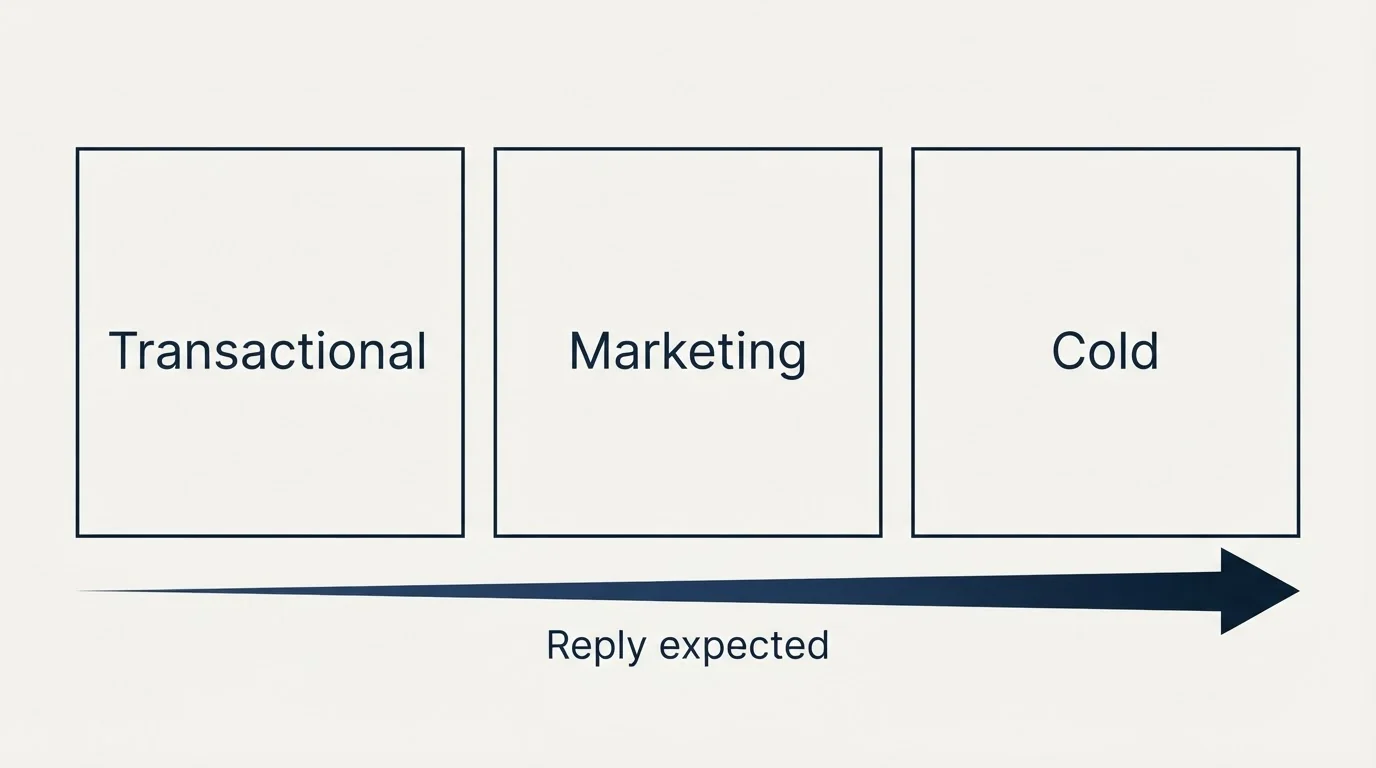
Outbound mail from a company divides into three classes that should never share a domain, and the live entry on transactional email draws that split and the domain separation behind it. The relevant point here is narrower: the classes have different reply expectations, and the address should match.
| Class | Replies | A no-reply address |
|---|---|---|
| Transactional the recipient did something | Close to zero | Costs almost nothing |
| Marketing the list opted in | Low, not zero; some are opt-outs | Starts costing something real |
| Cold nobody asked | The entire product of the send | Throws the output away |
Transactional messages are triggered by something the recipient did. A password reset, an order confirmation, a receipt. Nobody expects a conversation, the reply volume is close to zero, and a no-reply address costs almost nothing except the occasional confused customer.
Marketing messages go to a list that opted in. Reply volume is low but not zero, and some of what arrives is a person trying to unsubscribe by answering rather than by clicking. Discarding those is where a no-reply address starts costing something real.
Cold messages go to somebody who did not ask. The reply is the entire product of the send, including the negative replies, which are how a list gets cleaned and a premise gets tested. A no-reply address on this class is not a cost-saving measure, it is a way of paying for sends and throwing away the output.
What Gmail's guidelines actually require
It is often implied that a no-reply address is penalised by mailbox providers. That is not what the published requirements say, and the difference matters because it changes which argument you are making.
Google's email sender guidelines for Workspace administrators set out authentication, spam-rate and unsubscribe requirements and say nothing prohibiting a no-reply sender address. What the page does require of bulk senders is a working opt-out path. Its guidance is that senders should "Always give recipients an easy way to unsubscribe from your messages", with one-click unsubscribe headers required above the bulk threshold, and the mechanics of that header are covered in one-click unsubscribe.
The same page constrains the display name rather than the address, and it is worth reading because it catches a related trick. Google states that the display name "should not imply a message reply or threaded conversation", and lists a name in the shape of a reply counter as an example of a deceptive display name. A sender that cannot receive replies while dressing its messages up as part of a conversation is doing exactly the thing that guidance names.
So the honest position is this. A no-reply address does not breach a published Gmail requirement. It does interact badly with the requirement that exists, because a recipient trying to opt out by replying has sent their request into a mailbox nobody reads, and the obligation to honour it does not disappear because the channel they chose was inconvenient. That is why the opt-out belongs on the record as data rather than in a sending tool's report, which is the argument in suppression list.
The reputational cost is real but indirect. A reply asking to be removed lands unread or bounces, and the sender never sees it. A recipient who wants out then looks for an unsubscribe link, which is the path that works if it is there. Failing that, two options remain: ignore you and be contacted again, or press the spam button. The second is the one that moves sender reputation, and it is measured against a threshold rather than forgiven.
Why a cold programme never sends from one

The mechanical reason comes first. A cold campaign exists to produce replies, and every class of reply is useful. A positive reply is a meeting. A referral names the right person. A negative reply removes an address from every future campaign, which is worth more than the send cost. An out-of-office confirms the person exists and dates their return. Sending from an address that discards all four means paying for the send and refusing the return.
The second reason is that the reply is the only honest measurement available. Opens are unreliable and clicks are unreliable, and neither tells you whether a premise landed. A reply is a person choosing to spend a minute answering, which is the closest thing to evidence a first contact can produce. That evidence is what our practice is built around: one message per campaign, no bumps and no thread replies. Why we run it that way is set out in why we stopped using follow-ups. The relevant consequence here is that a single message has one chance to earn an answer, so removing the ability to answer removes the campaign.
The third reason is that the address is read as a signal about the sender. A stranger asking for a conversation from an address that cannot hold one has told the recipient which direction the relationship is expected to run.
A related mistake is worth separating out. Sending cold mail from a shared role mailbox such as info@ or sales@ is a different problem from sending it from a no-reply address, and the case there is genuinely more mixed. The live entry on role-based email covers where the blanket rule against role addresses is wrong.
What to do instead
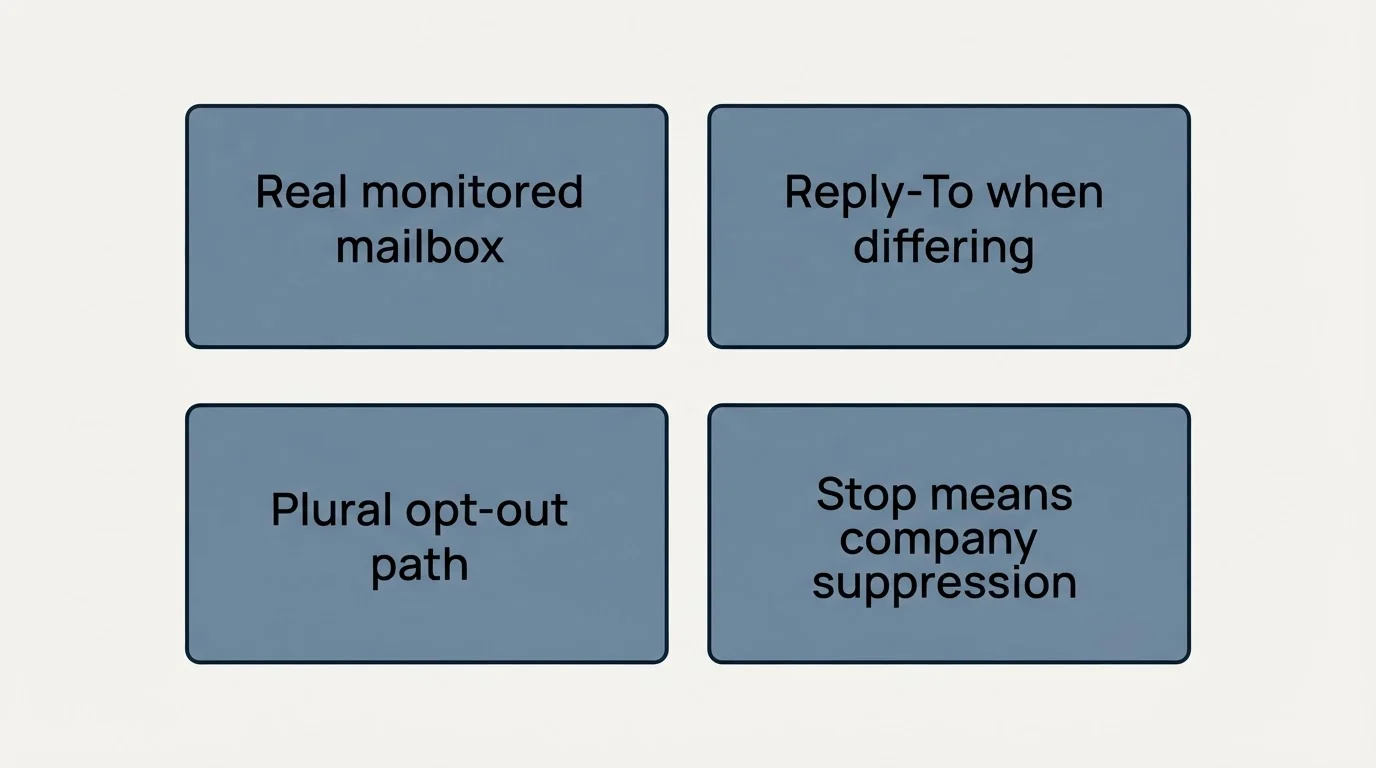
Send from a real mailbox belonging to a named person, on a domain built for the purpose, and monitor it. That is the whole recommendation, and everything else is detail about how the mailbox is arranged.
From: a named person at a domain built for the purpose 1
Reply-To: a mailbox a person reads, only where it must differ 2
The message itself, one per campaign.
A visible unsubscribe link, plus the one-click header where the volume requires it 3
- 1Send from a real mailbox belonging to a named person, and monitor it.
- 2Use the Reply-To header rather than a no-reply From, so the sending identity stays aligned.
- 3Keep the opt-out path plural: the link, the header, and a monitored reply address.
Where a genuinely automated message must go out at volume and replies are not expected, the honest version is a monitored mailbox with a low-attention rota rather than a discarded one. Somebody checks it weekly, and opt-out requests found there are actioned as if they had come through the link.
Where a reply address must differ from the sending address, use the Reply-To header rather than a no-reply From. That keeps the sending identity aligned for authentication purposes while routing answers somewhere a person reads them. The alignment rules that constrain this are in email authentication, and the practical setup order for a sending domain is in the SPF, DKIM and DMARC guide.
Keep the opt-out path plural. A visible unsubscribe link, the one-click header where the volume requires it, and a monitored reply address covers everybody who wants to leave, including the person who will only ever answer the email.
And treat a reply asking to stop as a suppression event on the company record, not a campaign setting. That is the difference between a request honoured once and a request honoured permanently. If placement rather than replies is the presenting problem, a deliverability audit is the faster path than changing the From address.
Related terms and guides
Transactional email is the class where a no-reply address is defensible, and it draws the domain separation between the three sending classes. Role-based email covers the adjacent question of shared mailboxes such as info@ and support@. Suppression list is where an opt-out has to live, and one-click unsubscribe is the header mechanism Google's bulk-sender requirements name.
On the deliverability side, sender reputation is what a spam complaint moves, hard bounce covers what a refusing address does to the person who wrote to it, and email deliverability covers the whole measurement. For the sending setup itself, the SPF, DKIM and DMARC guide covers the records in order and warming a new sending domain covers the ramp before the first campaign.
If the reason a reply address feels expensive is that nobody owns the replies, that is the part we operate: one message per campaign, on infrastructure we authenticate and monitor ourselves. See what a first campaign looks like.
Requirements quoted above are from Google's published email sender guidelines page for Workspace administrators. Verify current requirements with the provider before relying on them.
Frequently asked questions.
Frequently asked questions- What is an unmonitored mailbox?
- An unmonitored mailbox is an email address that accepts incoming mail but that nobody reads. Replies are delivered normally and nothing bounces, so the sender never learns that anyone answered, and an opt-out request sent by reply is silently lost. A footer reading this mailbox is not monitored usually marks one.
- What happens if you reply to a no-reply email?
- It depends on the setup. If the address is an unmonitored mailbox, your reply is delivered and nobody reads it, with no error to tell you. If the address refuses mail, the reply bounces back to you as a delivery failure. Only when a person monitors the mailbox behind an autoresponder does anyone see what you wrote.
- Is a no-reply address against Gmail's rules?
- Not as published. Google's email sender guidelines for Workspace administrators set out authentication, spam-rate and unsubscribe requirements and say nothing prohibiting a no-reply sender address. They do say senders should always give recipients an easy way to unsubscribe, and a recipient who opts out by replying to an unread mailbox has still asked to leave.
- Should cold emails come from a no-reply address?
- No. A cold message asks a stranger for exactly one thing, a reply, and every class of reply is useful: a meeting, a referral, a removal, an out-of-office. Send from a real, monitored mailbox belonging to a named person, on a domain built for the purpose, and use the Reply-To header if answers must go elsewhere.