How to Write a New Year Outreach Email, Line by Line
A new year outreach email works only where January is a fact about the account. Who that is, the structure line by line, and two worked examples.
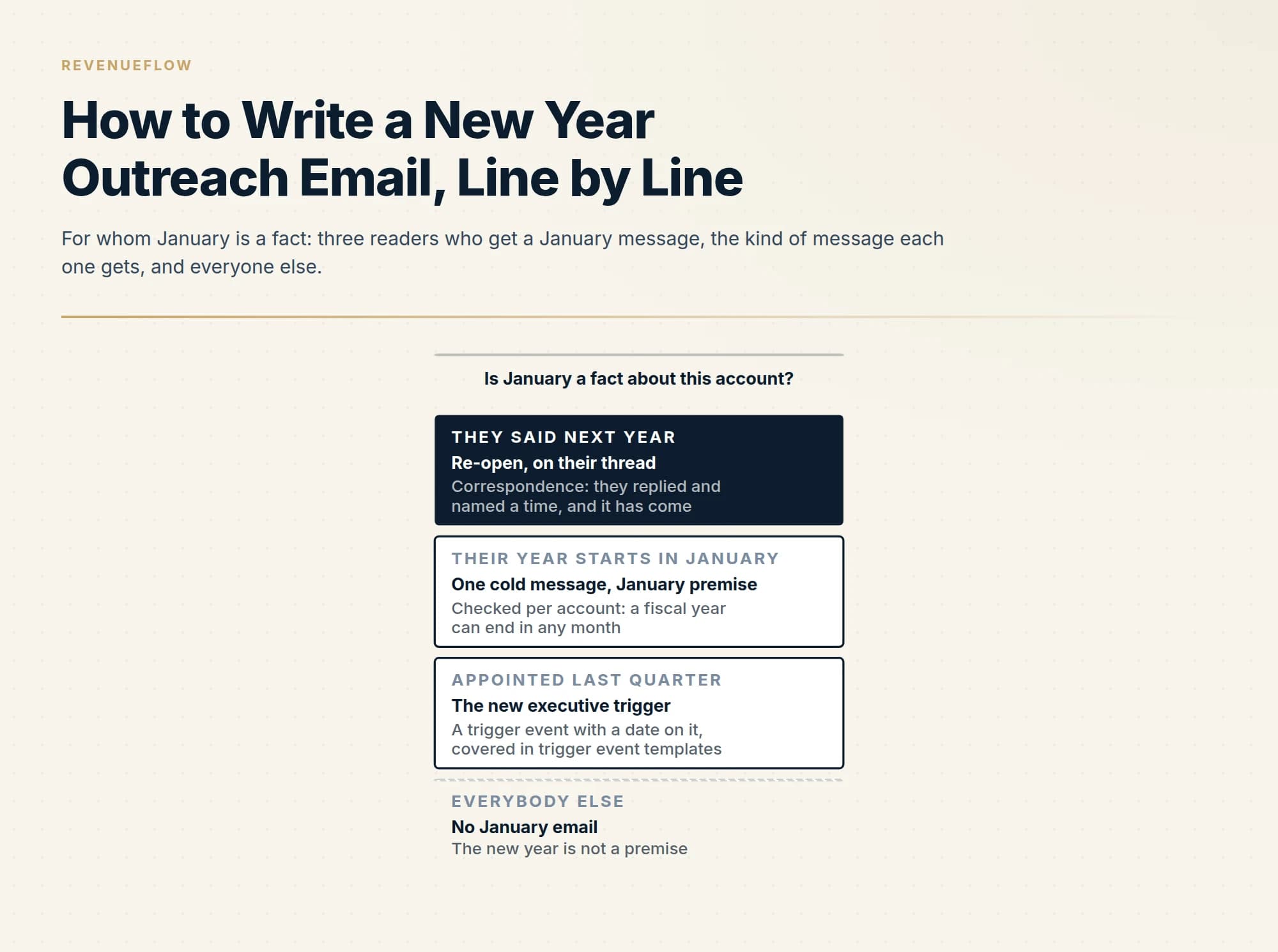
Write a new year outreach email only where January is a fact about the account: they asked you to come back in the new year, their financial year starts in January, or a leader was appointed last quarter. Open on that fact, make one ask, and for a cold account send one message with nothing scheduled behind it.
Key takeaways
- The new year is true of every recipient and every sender in the same week, so it cannot be the premise; a premise has to be true of this company and false of most others.
- A re-open to somebody who replied with not now, next year is correspondence: reply on their thread, open with their own words and the date they gave, and make one ask.
- Check the financial year before writing about a new budget, because the IRS defines a fiscal year as 12 consecutive months ending on the last day of any month except December.
- A cold January message is one message on a checked premise with a question answerable in one line, and if it gets no reply nothing is scheduled behind it.
Reviewed and updated September 18, 2026
In the first working week of January a finance director opens her inbox to forty messages that begin with the same three words. Some wish her a prosperous year. Some hope she had a restful break. One of them says: you asked us in November to come back once the new budget was signed, and it is. She answers that one.
A new year outreach email works when January means something specific to the person receiving it, and fails when January is only the sender's excuse to write. This page is the craft of the first kind, for a B2B seller: who is worth a January message, the structure line by line, two worked examples, the subject rule, the timing and the mistakes. The general method for a first message, when it is the only one you send, is in how to write a cold email. This page is the January case of it, and it starts by removing the greeting.
What the market's version looks like
The pages that rank for this topic mostly teach the greeting. Mailsoftly's collection of new year sales templates, published on 8 December 2023 and fetched on 18 September 2026, opens on the premise that the date itself is the reason to write: "As we step into the new year, it's an opportune moment to revitalize your outreach strategy." Its templates carry the year as a merge field in the subject line. IndustrySelect's guide to B2B new year emails, published on 10 January 2024 and fetched the same day, names the idea underneath: "The answer is to craft engaging B2B new year emails that tap into the concept of a fresh start."
The rest of the results are further from a seller's problem. They cover consumer promotions for online shops, subject line lists for newsletters, and career advice on greeting colleagues. Those are different readers with different jobs, and nothing on this page is for them.
The fresh start is real as a feeling and useless as a premise, because it is true of every recipient and every sender in the same week. A premise has to be true of this company and false of most others. January supplies three of those, and only three.
The decision before the first line: for whom is January a fact?
The people who told you to come back. Somebody replied in the last quarter with a version of not now, next year. Our page on why we stopped using follow-ups describes that reply as a common one, the prospect who says the offer sounds interesting and asks to be contacted again later. Their date has now come. Writing to them is correspondence: they replied, they named a time, and the message would make sense even if the answer is already yes, which is the test meeting reminder emails uses to separate correspondence from a bump.
Accounts whose financial year starts in January. For these companies a new budget exists this month that did not exist last month. That is a cold send, so it is one message on a January premise, and the premise has to be checked per account. A company's year does not have to follow the calendar. The US Internal Revenue Service's page on tax years, last reviewed on 27 January 2026 and fetched on 18 September 2026, defines a fiscal year as "12 consecutive months ending on the last day of any month except December." A company on a fiscal year that ends in June has no new budget in January, and a message that assumes one is wrong in its first line.
Leaders appointed in the last quarter. Somebody who took a role in October or November spends January turning a first read of the business into a plan. That is a trigger event with a date on it, and the template for it is Template 4, the new executive hire, in trigger event templates. The same page separates triggers that are predictable from those that are merely observable, and names a fiscal year end among the ones that recur on a calendar and can be planned around.
Everybody else gets no January email. They stay in whatever campaign they were already in, on whatever premise is true of them. The new year is not one.
The structure, line by line
- No greeting opener. The first sentence is the first thing the preview pane shows, and in January every competing message spends it on the holidays. Spend yours on the reason.
- The trigger sentence. For a re-open, their own words and the date they gave. For a cold send, the checked fact: their financial year, the budget line, the announcement. One sentence.
- What that fact means for them. One sentence connecting the fact to a problem they plausibly have this month, such as a plan that has to be staffed or a number that now has a budget behind it.
- What you do about it, once. One sentence, specific enough to be falsifiable. No list of services.
- One ask. For a re-open, a time. For a cold send, a question answerable in one line, which is the kind of ask the cold email page recommends.
- Your name. No seasonal sign-off.
The whole message is five or six sentences. The re-open can be shorter, because the thread above it carries the context.
Worked example one: the re-open
The people, the companies and every detail below are invented for illustration. In November, Helen Brandt, finance director at a packaging company called Oakmere, replied to a message about invoice automation: sounds useful, but we are frozen until the new budget is signed, try again in January.
Re: Invoice approvals at Oakmere (on her November thread)
Helen, in November you said you were frozen until the new budget was signed, and to try again in January. 1
If the budget landed the way you expected, the approvals backlog you mentioned is now a line somebody owns. 2
Could we take 20 minutes next week? Tuesday or Thursday afternoon both work. 3
If the freeze is still on, one line back is enough and we will leave it with you. 4
- 1Her own words and the date she gave. No greeting, no reference to the holidays.
- 2What the fact means for her this month, using the problem she named herself.
- 3One ask, a time, because she already said the offer sounds useful.
- 4An easy way to say not yet, which keeps the thread alive for the next date she names.
It is sent as a reply on her thread, so her own sentence sits directly beneath it. Nothing in it would change if it were sent in April to somebody who had said try again in the spring. The new year is incidental. The date she named is the premise.
Worked example two: the one-message January first touch
Same invented seller, a cold account. Castlebrook Logistics states in its annual report that its financial year runs to 31 December, and its most recent report says it plans to open two depots in the coming year.
Subject: Two new depots on this year's budget
Priya, Castlebrook's annual report says your financial year closed on 31 December and that two depots open this year.

New sites usually mean supplier invoices double before the finance team does. We automate invoice approvals for logistics firms so month-end does not stretch when volume jumps.

Is approvals capacity on the plan for this year, or already handled?

[Your name]
The first sentence is a checked fact from their own document, and it is what makes January relevant: this company's new year really did start this month. The second paragraph is one consequence and one sentence on what the seller does. The ask can be answered in a word. There is no second message behind it.
- Opens on the holidays or the fresh start
- Carries the year as a merge field
- Asks for a call to discuss plans
- Could be sent to anybody
- Opens on their own words and the date they gave
- Sent as a reply on their thread
- One ask: a time
- An easy way to say not yet
- Opens on a checked fact from their own document
- One consequence, one sentence on what you do
- One ask, answerable in a word
- No second message behind it
The subject rule
For the re-open there is no new subject. It rides their thread, and the thread is the evidence that they asked. For the cold send, the subject names the fact and leaves the calendar out: two new depots on this year's budget, and never anything about new beginnings. If the subject would still make sense on a greeting card, it is the wrong subject. The year as a merge field is the clearest marker of a template, and the market's examples carry it.
Timing, as a mechanism
No data sits behind this section on which January day performs best, so it describes mechanisms and gives no numbers.
The last week of December is the wrong moment for both messages. A recipient on leave gets the message as part of a backlog, and a backlog is cleared in bulk with everything else that built up.
For the re-open, the right moment is the one they named. If they said January, the first or second working week is reasonable. If they said once the budget is signed, their signing date matters more than the calendar, and asking is fine.
For the cold send, the premise decides. A message about a new budget is early if the budget is not yet released and stale once the plans are committed. Where you cannot see that from outside, the first weeks of their financial year are the defensible window, and the message should say which document told you when their year starts.
| They said | Opens with | Sent as |
|---|---|---|
| Try again in January | Their words and the date they gave | A reply on their thread |
| Once the budget is signed | Their words, and a question about the signing | A reply on their thread |
| Nothing: a cold account whose year starts now | A checked fact from their own document | One new message |
| Nothing, and January is not a fact about them | No January email | Whatever campaign they were in |
Where we differ from standard practice
The market's new year advice arrives as a campaign of several sends: a greeting, then an offer, then a reminder. Our position on cold outbound is one message per campaign, with no bumps and no thread replies to people who did not answer, and the January first touch follows it. If it gets no reply, nothing is scheduled behind it. A later approach is a new campaign on a different premise, when something else becomes true of the account.
The re-open is a different case, and the difference is the reply. They wrote back, they set the date, and honouring that date is what a competent seller does. One message on the date they named, with an easy way to say not yet, is the whole of it.
The mistakes
The happy new year opener. It spends the preview pane on the one sentence every other sender wrote.
The year in review. A paragraph about what your company achieved last year answers a question the reader did not ask.
New year, new goals. Attributing goals to somebody you have never spoken to is a guess presented as insight. Use a fact from their own document or leave it out.
Assuming their year starts in January. Check the annual report or the filing. A company can run a fiscal year that ends in any other month, as the IRS definition above allows.
Sending it in the last week of December. It is read late and in bulk, if it is read at all.
The special offer to kick off the year. A discount tied to your calendar tells the reader the price was arbitrary.
The short version
Send a January message only where January is a fact about the account: they told you to come back, their financial year starts now, or a leader was appointed last quarter. Open on that fact, never on a greeting. Re-open on their thread with their own words and one ask. For a cold account, send one message on a checked premise with a question answerable in a word, and schedule nothing behind it.
If you would like a January campaign built on premises that are true of each account, get a free campaign plan and we will show you what that looks like for your market.
Publisher pages quoted as fetched on 18 September 2026: Mailsoftly (published 8 December 2023), IndustrySelect (published 10 January 2024) and the IRS tax years page (last reviewed 27 January 2026). Confirm the current text before relying on it.
Frequently asked questions.
Frequently asked questions- When should you send a new year outreach email?
- For somebody who asked to be contacted in the new year, on the date they named, which usually means the first or second working week of January. For a cold account whose financial year starts in January, in the first weeks of that year. Avoid the last week of December, when a recipient on leave gets the message as part of a backlog that is cleared in bulk.
- Should a B2B sales email start with happy new year?
- No. The first sentence is what the preview pane shows, and in early January every competing message spends it on the holidays. Open on the reason you are writing: the recipient's own words and the date they gave you, or a checked fact about their financial year or a new appointment. A greeting is true of everybody, which makes it useless as a reason to reply.
- How do you follow up with a prospect who said to reach out next year?
- Reply on the original thread so their own sentence sits beneath your message. Open by restating what they said and the date they gave, connect it to the problem they named, make one ask such as a time for a short call, and give them an easy way to say not yet. That message is correspondence, because they replied and named the time themselves.
- Is January a good time for cold outreach?
- Only for accounts where January is a fact. A company whose financial year starts in January has a new budget this month, and a leader appointed in the last quarter is turning a first read into a plan. For everybody else the month changes nothing, and a company on a fiscal year ending in June has no new budget in January, so a message that assumes one is wrong in its first line.
About the author.

Ben Carden is CRO at RevenueFlow, which builds and operates outbound revenue engines for B2B companies. Previously at Gartner Enterprise. Studied at London School of Economics.
Ben Carden · CRO
Connect on LinkedIn →Explore more.
Ready to scale your outreach?
We build GTM engines that book real meetings. See the receipts.
Related articles.
How to Write a Third Follow Up Email, Line by Line
A third follow up email belongs only in a thread where the person replied or agreed to something. When to send one, and how to write it line by line.
How to Reply to a Demo Request, Line by Line
How to reply to an inbound demo request before any demo happens: start from what they typed, offer two times or ask one question, and attach nothing.
SMTP Reply Codes: What Each Class Instructs
The digits are a verdict and the text is the reason. Separating an address failure from a policy refusal before reacting is what decides whether the fix works.
No-Reply Email Address: What It Costs a Sender
A no-reply address is defensible on a receipt and indefensible on a cold message, because the reply is the entire product of a first contact.
CEO Email Addresses: Finding One That Resolves
Seniority is the thinnest coverage band in every contact database. How an executive address is resolved, why verification is a separate purchase, and when to stop.
CMO Email List: What You Are Actually Buying
Seven of the ten results for this phrase sell a file filtered on a title that describes forty percent of the market. What to build instead, and why.