Lead Response Time: What the Clock Actually Measures
Lead response time is the elapsed time between a lead arriving and a person making the first contact attempt. It contains two legs: processing, covering deduplication, enrichment and assignment before an owner can see the record, and response, the time that owner then takes to act.
Key takeaways
- The metric has two legs with different owners: a processing leg that is a systems problem and a response leg that is a workload problem, and reporting them together makes the first one unmanageable.
- Most disagreements about the number are disagreements about its endpoints, so the start event per channel and the stop event, an attempt or a two-way exchange, have to be written down before instrumenting.
- The median is the least useful statistic in the distribution, because the loss sits in the tail where the unowned records are, and the mean hides them.
- A record that never got an owner has no response time at all, so the worst outcome in the system is invisible to the report built to catch it.
Lead response time is the elapsed time between a lead arriving and a person making the first contact attempt. It is one clock with two legs inside it: the processing leg, everything that happens between arrival and a named owner being able to see the record, and the response leg, the time that owner then takes to act.
Splitting those two legs is where the value in the metric sits, because they have different owners and opposite fixes. A slow processing leg is a systems problem nobody is accountable for. A slow response leg is a workload or a priority problem somebody is.
What the clock starts and stops on
An argument about this number is usually an argument about its endpoints, and neither endpoint is obvious.
The start. Arrival is not one event. A form submission, a reply to a message, a booked meeting and a phone call all arrive through different systems, and the timestamp available to you is usually the moment your system recorded the event rather than the moment the person acted. Where an integration batches, the recorded start can be minutes after the real one, and the metric quietly under-reports the thing it exists to measure.
The stop. A contact attempt is not a contact. The common implementation stops the clock on an outbound action, a call placed or a message sent, because that is the part the company controls. That is defensible, and it means the number describes your responsiveness rather than the buyer's experience. A second clock stopping on a two-way exchange measures something different and usually much longer.
Write both definitions down before instrumenting either, because a team that has not settled them will compare two quarters measured differently and conclude something about its performance.
- Step 1Arrival
A form, a reply, a booking or a call is recorded by some system. The recorded timestamp may lag the real one.
- Step 2Processing
Deduplication, enrichment and assignment. Owned by operations, invisible to the rep, and the leg most often ignored.
- Step 3Owner sees it
The record appears in a named person's queue with an alert. This is the boundary between the two legs.
- Step 4First attempt
A call placed or a message sent. Most implementations stop the clock here rather than on a reply.
Why it matters, and what the number cannot tell you
The mechanism is simple and worth stating plainly: a person who has just made contact is thinking about the subject at that moment and will not be thinking about it tomorrow. The value of a reply decays because attention decays, and every hour of delay is spent against a buyer who is progressively less interested and progressively more likely to have opened a competitor's page in the meantime.
That is the argument, and it does not need a statistic. The category's marketing is saturated with response-time figures, and they are worth treating carefully. Most trace back to a small number of studies, often quoted at second hand, sometimes without their sampling frame, and frequently applied to buying situations nothing like the one they measured. A figure drawn from consumer web forms says very little about a reply to a business message, and quoting it as though it does is how a reasonable idea acquires a fake precision.
The honest position is that the direction is well established and the magnitude is yours to measure. Your own distribution, read against your own conversion, is a better instrument than any published benchmark, and it takes a week to produce.
Three properties decide whether the number is useful once you have it.
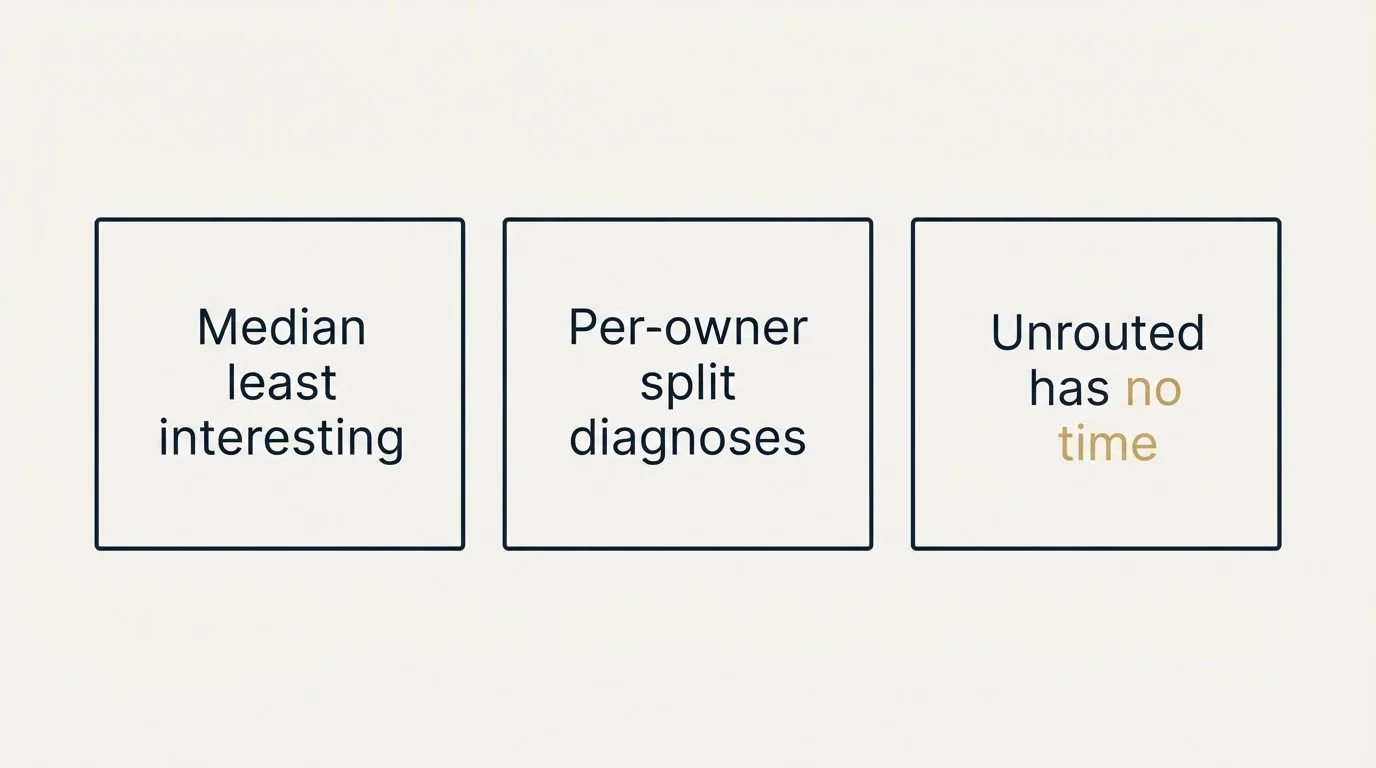
The median is the least interesting statistic in it. A median of eleven minutes with a tail of records answered three days later is not a fast programme. It is a fast programme with a pile of unowned records in it, and the two need different responses. The tail is where the loss sits and the mean hides it.
A per-owner split is where the diagnosis actually happens. One person on holiday with an active assignment rule produces a distribution that looks like a general slowdown. The round-robin assignment that distributes fairly is the same mechanism that keeps sending records to somebody who is not there.
An unrouted record has no response time at all. This is the failure the metric cannot see. A record that never got an owner does not appear in a report built from owned records, so the worst outcome in the system is invisible to the number designed to catch it. The count worth watching beside this one is records with an owner and no activity, aged past your stated window, which is the report described in lead routing.
- Yes: The start event is defined per channel, and the recorded timestamp is known to track the real one
- Yes: The stop event is defined as an attempt or as a two-way exchange, and stated
- Yes: The processing leg and the response leg are reported separately
- Yes: The distribution is reported, median and tail, never a single average
- Yes: Records with no owner are counted somewhere, because they have no response time
- No: A published benchmark is used in place of your own measured distribution
- No: The target is set below what the staffing pattern can actually sustain
Where the textbook definition breaks
It is treated as a rep metric when the processing leg dominates. Enrichment, deduplication and assignment can consume most of the elapsed time before anybody sees the record, and a team told to answer faster cannot reach any of it. Measuring the two legs separately is what stops a systems problem from being managed as a motivation problem.
A target is set without staffing behind it. A one-hour commitment means somebody is available for every hour it applies to. Set across a time zone spread with no coverage plan, the commitment holds during the working day and collapses at the edges, which is exactly where the tail comes from.
Speed is optimised past the point where it helps. Answering in two minutes with nothing to say is worse than answering in twenty with the account read. The lead qualification evidence has to travel with the record, and a routing layer that assigns instantly while stripping the context has moved the delay rather than removed it.
The number is reported for a population that does not hold together. Inbound demo requests, content downloads and replies to outbound messages behave nothing alike, and averaging them produces a figure that describes none of them. Split by source before anything else, which is the same discipline MQL versus SQL applies to the definitions upstream.
How it is used in outbound

An outbound programme meets this metric from an unusual angle, and the angle makes it more important rather than less.
In an inbound motion, a lead that goes unanswered can often be re-engaged. Somebody who filled in a form is discoverable, contactable and, where a nurture stream exists, entered into one that will reach them again. The cost of a slow answer is a lower conversion rate rather than a lost contact.
In our motion there is no second attempt to fall back on. We run one message per campaign, with no bumps and no thread replies. The reasoning is set out in why we stopped using follow-ups. The consequence for this metric is direct: a reply is the only shot the campaign produced, and an unanswered reply is the entire result of that account's contact thrown away. Response time is therefore not a refinement on an outbound programme, it is the conversion mechanism the sending paid for.
Three things follow for a team running it that way.
The clock starts on the reply, not on a form. The arrival event is a message landing in a shared or rotated mailbox, which is a harder thing to instrument than a form post and a much easier thing to miss. Whoever owns the inbox owns the start of this clock.
A named person, not a queue. A shared alias with nine people on it produces the routing failure mode where nobody is late because nobody was assigned. One named owner per window, with a fallback owner for everything the rules cannot resolve.
Positive and neutral replies need different windows, and both need one. A clear yes is obvious and gets answered. A qualified or ambiguous reply is the one that sits, because it requires a decision, and it is often the more valuable of the two. The tooling side of the queue is covered in lead routing software, and what happens in the first hour of an inbound reply generally is in inbound lead generation.
The commercial boundary sits in the same place as everywhere else in our practice: meetings are qualified against criteria agreed in writing before launch, so the person answering a reply quickly knows what they are answering toward. Agreeing that after the replies arrive is a negotiation held with results on the table, and the argument is in B2B appointment setting.
The short version
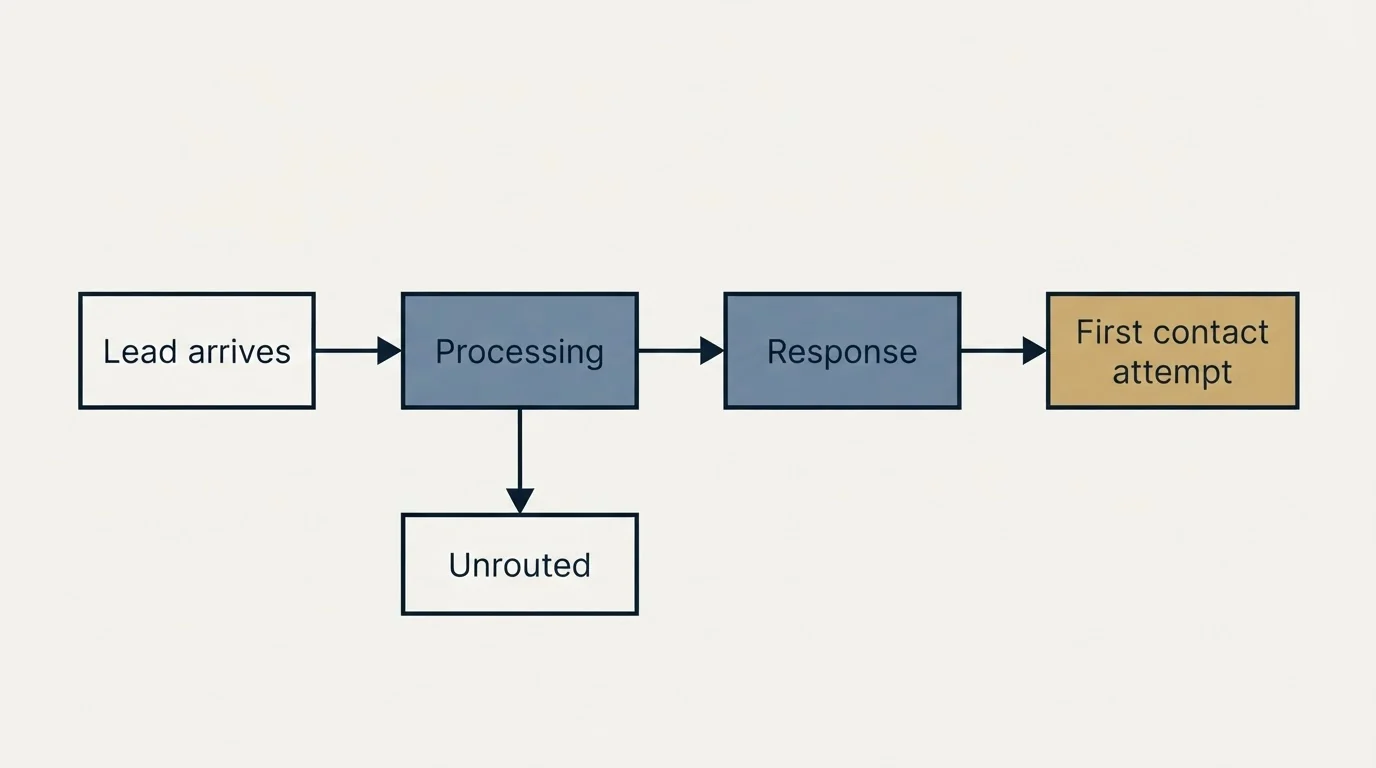
Lead response time is the elapsed time from a lead arriving to a person making the first contact attempt, and it contains two legs with different owners: processing, which is a systems problem, and response, which is a workload problem. Reporting them together makes one of them unmanageable.
Define the start and stop events per channel and write them down, because most disagreements about the number are disagreements about its endpoints. Report the distribution rather than the median, split by source and by owner, and count unrouted records separately, because a record with no owner has no response time and is the worst outcome in the system.
Measure your own distribution rather than importing a benchmark. The direction is not in doubt and the magnitude is specific to your buyers, your channels and your staffing pattern.
In an outbound programme this is the number that decides what the sending was worth, because the reply is the only shot the campaign produced. If the constraint is that too few replies arrive at all, see what one campaign against your criteria produces. The neighbouring definitions are lead routing, round-robin assignment and inbound lead.
Frequently asked questions.
Frequently asked questions- What is lead response time?
- The elapsed time between a lead arriving and a person making the first contact attempt. Inside it sit two separate legs: the processing leg, which is deduplication, enrichment and assignment happening before anybody can see the record, and the response leg, which is how long the assigned owner then takes to act on it.
- What is a good lead response time?
- Measure your own rather than importing one. Published figures in this category mostly trace back to a small number of studies, are often quoted at second hand, and are frequently applied to buying situations nothing like the one they measured. The direction is not in doubt and the magnitude depends on your channels, your buyers and your staffing pattern.
- Why should the processing leg be measured separately?
- Because enrichment, deduplication and assignment can consume most of the elapsed time before anybody sees the record, and a rep told to answer faster cannot reach any of it. Separating the two legs is what stops a systems problem from being managed as a motivation problem, which is the most common failure in how this metric gets used.
- How does lead response time apply to outbound rather than inbound?
- It matters more, because there is no second attempt behind it. Under a one-message-per-campaign policy a reply is the only shot the campaign produced, so an unanswered reply throws away the whole result of contacting that account. The clock starts when a message lands in a sending mailbox, which is harder to instrument and easier to miss than a form post.