Marketing RFPs: What the Format Carries and Suppresses
An RFP makes a decision defensible to people who will not be in the room. Which parts of the choice the document can carry, and which lighter instruments beat it.
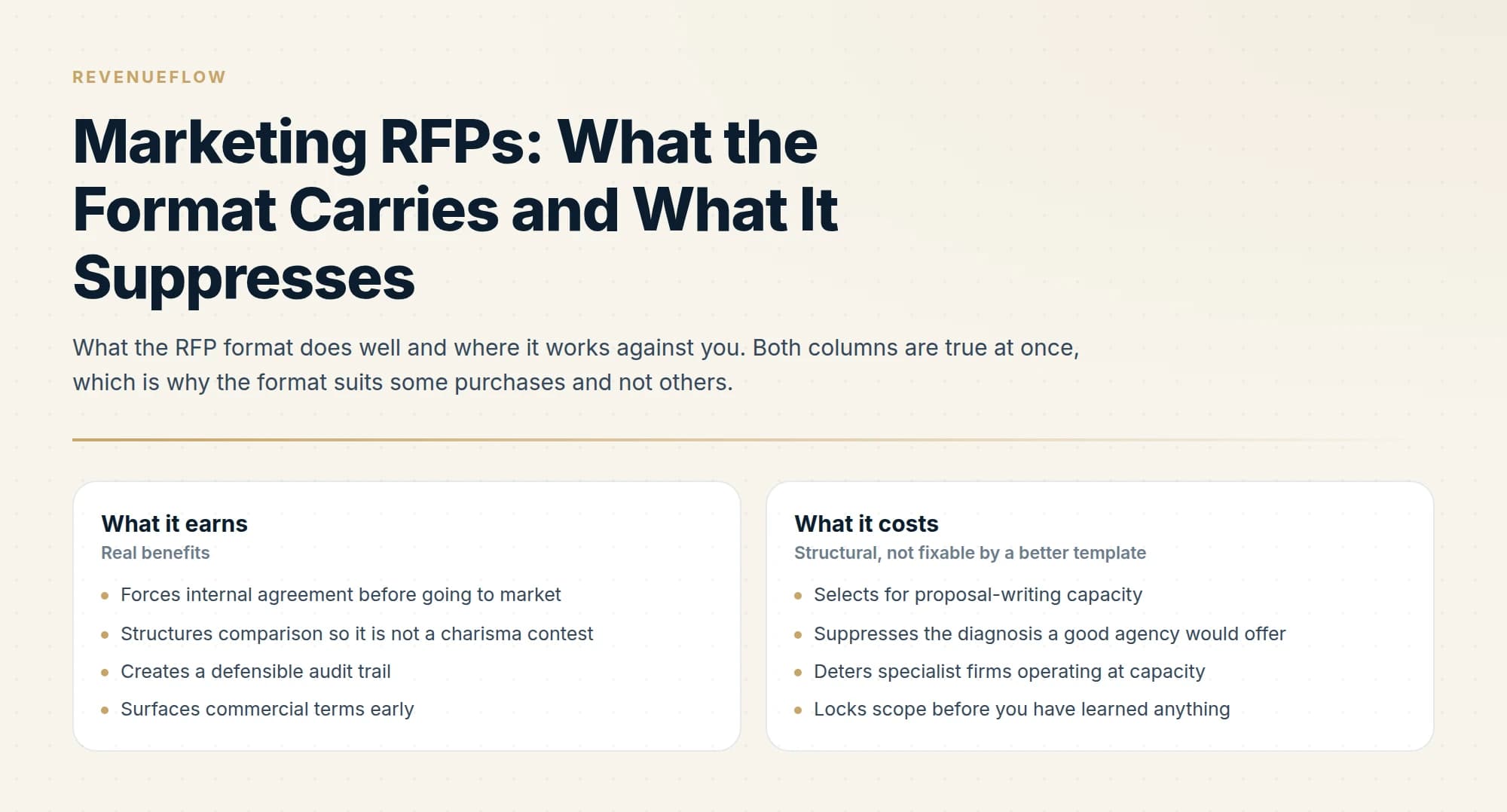
An RFP exists to make a decision defensible to people who will not be in the room when it is made. It forces internal agreement, structures comparison and creates an audit trail. It also selects for proposal-writing capability, suppresses the diagnosis a good agency would offer, and deters specialist firms working at capacity.
Key takeaways
- Most of an RFP's value is extracted before it is issued, in the arguments it forces among the people funding the work.
- Specifying activity volumes gets you those volumes and collapses every response to rate, while specifying the outcome and leaving the method open produces proposals that differ informatively.
- Relevant experience cannot discriminate because every respondent claims it, so criteria have to be specific and awkward enough that a weak respondent cannot answer them.
- Publishing all answers to all respondents makes the question window the best feature of the format, because the questions reveal what the brief left ambiguous.
Reviewed and updated September 2, 2026
An RFP is a device for making a decision defensible to people who will not be in the room when it is made. That is its real function, and understanding it explains both when a marketing RFP is the right instrument and why so many of them produce a disappointing shortlist.
If you are writing one to select a marketing or outbound agency, the useful question is not what template to use. It is which parts of the decision the document can actually carry.
What an RFP is good at
Three things, and they are genuinely valuable.
Forcing internal agreement before the market sees you. Writing down the objective, the scope, the budget range and the evaluation criteria requires the people funding it to agree on what they are buying. Most of the value of an RFP is extracted before it is issued, in the arguments it forces.
Making comparison structured. Free-form pitches are compared on charisma. A structured response set is compared on content, which is fairer and considerably easier to defend afterwards.
Creating an audit trail. In organisations with procurement oversight, a documented process is not bureaucracy for its own sake; it is the thing that lets the decision survive scrutiny.
What an RFP is bad at
Also three, and they are the reason experienced buyers use RFPs selectively.
It selects for proposal-writing capability. The agencies best at responding to RFPs are the ones with people whose job is responding to RFPs. That correlates with size and with process maturity, and only loosely with whether they will do good work for you.
It suppresses the diagnosis. A good agency's first instinct is to question the brief. An RFP asks them to answer it instead, and the questions they would have asked are exactly the information you needed.
Strong specialist firms frequently decline. A small agency with full capacity will not spend forty hours on a speculative response. That is a rational decision on their side and it removes a whole tier of candidate from your process.
- Forces internal agreement before going to market
- Structures comparison so it is not a charisma contest
- Creates a defensible audit trail
- Surfaces commercial terms early
- Selects for proposal-writing capacity
- Suppresses the diagnosis a good agency would offer
- Deters specialist firms operating at capacity
- Locks scope before you have learned anything
The section most marketing RFPs get wrong
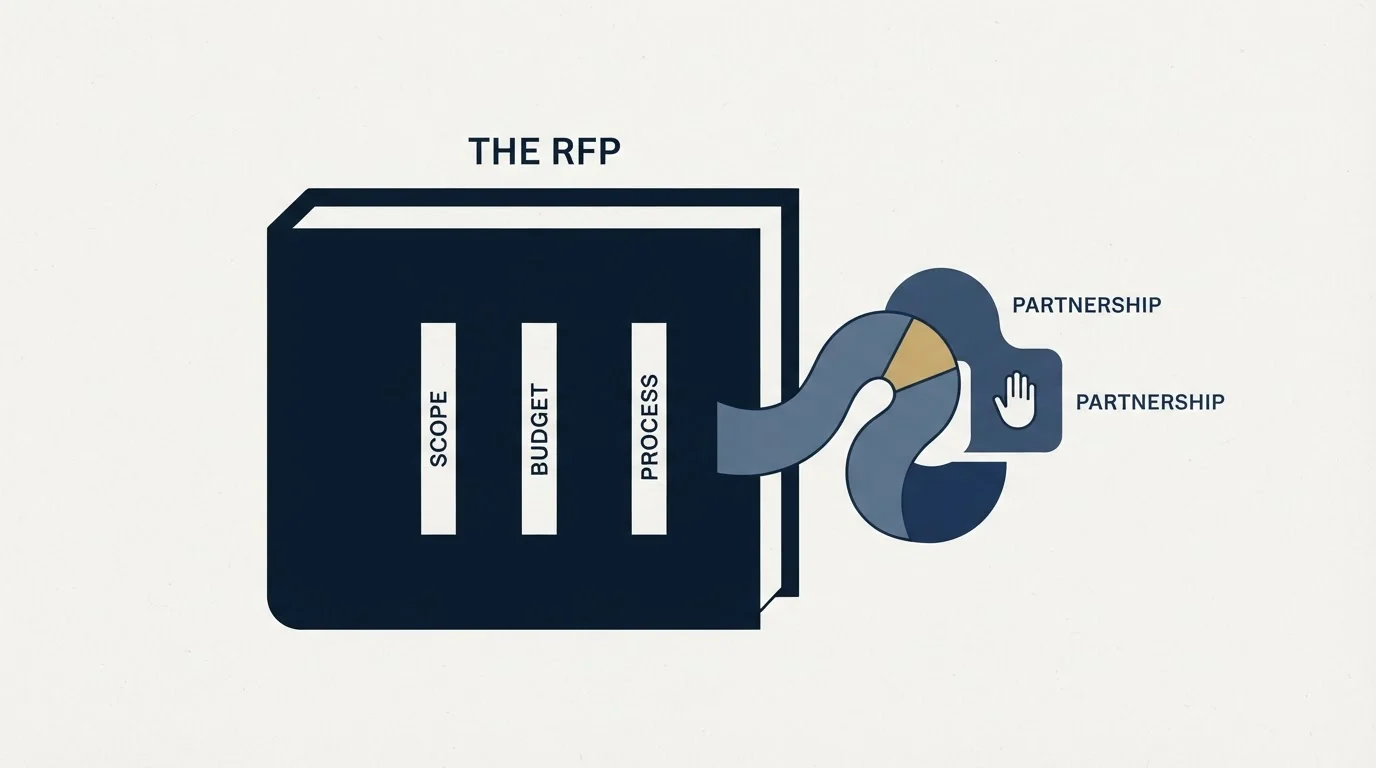
Scope, and specifically the difference between describing the outcome and prescribing the method.
An RFP that specifies deliverables in detail, so many emails, so many posts, so many calls, gets exactly those deliverables and forecloses the possibility that the right answer was different. It also makes the responses incomparable in a subtle way, because every agency prices the same activity list and the differences collapse to rate.
The email subdomain inheritance guide explains why specifying deliverables like sending volume overlooks the deeper technical inheritance questions an RFP for outbound email work should raise.
An RFP that specifies the outcome, the constraints and how success will be judged, and leaves the method open, gets proposals that differ in approach. Those are harder to score and far more informative, because the variation between them is the market telling you something about the problem.
The practical compromise is to state the outcome and the constraints precisely, ask for the respondent's proposed method, and require a defined structure only for the commercial section so the money is comparable.
Making the evaluation criteria do real work
Publish the weighting. If price is forty percent, say so. Formalised, that published set of weights is an RFP scoring matrix: each criterion, the weight it carries, and a scoring scale applied identically to every response, with weighted scoring producing one total per vendor. Vendors deserve to know whether they are competing on cost or capability, and you get better-aimed responses either way.
Then write criteria that can actually discriminate. "Relevant experience" cannot; every respondent will claim it. Criteria that discriminate are specific and awkward: name the two most similar engagements and what went wrong in each, describe the diagnostic process when results are flat in month three, state who specifically will do the work and what else they carry.
For an outbound engagement in particular, one criterion is worth more than the rest: how the deliverable is defined. A proposal promising meetings without defining a qualified meeting has not made a commitment. What that definition should contain is set out in B2B lead generation services, and the wider diligence set is in B2B lead generation companies.
Since outbound proposals often assume purchased or scraped lists, it is worth checking what Brevo's anti-spam policy prohibits before signing off on the tooling.
- Yes: The outcome and constraints are precise; the method is left open
- Yes: Evaluation criteria and their weightings are published
- Yes: You ask who specifically does the work and what else they carry
- Yes: You ask for the definition of the deliverable, in their words
- Yes: A realistic budget range is stated
- No: The document prescribes activity volumes rather than outcomes
- Depends: Whether a paid pilot would answer more than a written response
On stating a budget
Buyers withhold the budget believing it prevents agencies from pricing to it. What it actually does is produce a spread of proposals, some of which were never viable, and it wastes the time of everyone who guessed wrong.
State a range. Agencies who cannot work within it decline, which is the correct outcome, and the ones who respond are proposing something you could actually buy. The concern about being anchored is real and is smaller than the cost of a shortlist you cannot afford.
Making that range credible rather than aspirational means knowing roughly what the work costs before the document goes out, which is separate homework and worth doing first. Published entry points across the agency market are collected in the lead generation agency cost guide.
Reading the responses

Once they arrive, three habits separate a decision from a scoring exercise.
Read the questions they asked before you read the answers they gave. The question window is where thinking shows. A respondent who asked what happens to the data at the end, or how success will be judged in month three, has engaged with the engagement rather than the document.
Score independently before discussing. Panels converge fast on whoever spoke first, so have each evaluator score alone against the published criteria and compare afterwards. Where scores diverge sharply, that is the useful conversation.
Notice what every response has in common. If all of them propose the same approach, either it is genuinely the right one or your brief prescribed it. If all of them flag the same risk, take the risk seriously; that is the market telling you something your internal discussion missed.
The response to discount is the one that reads as tailored but contains no specifics about you. Named case studies from your sector are cheap to include. A proposal that engages with your actual constraint, including saying which part of your brief it thinks is wrong, is expensive to write and is the signal worth paying for.
When to run something else instead
An RFP is a heavy instrument. Three lighter ones frequently produce a better decision.
A paid pilot. For outbound in particular, six to eight weeks of real work tells you more than any written response, because the thing you are buying is execution rather than a plan. Structure it with a written success condition agreed in advance; how to design one that decides something is covered in B2B lead generation companies.
A structured brief plus three conversations. Same discipline, a tenth of the effort, and it preserves the diagnosis that an RFP suppresses.
A diagnostic engagement. Where the problem is not yet well defined, paying two candidates a small fee to tell you what they think the problem is will be the best-value spend in the whole process, and it doubles as an assessment of how they think.
The case for the full RFP is strongest where procurement requires it, the spend is large, the scope is genuinely well understood, and several credible vendors exist. Where two of those four are absent, something lighter is usually better.
Checking that the credible vendors are genuinely separate companies matters too, since a sales enablement shortlist drawn from ranking pages turned out to hold several names owned by the same firms.
- Step 1Agree internally first
Objective, constraints, budget range and who decides. Most of an RFP's value is extracted here.
- Step 2Publish outcome and criteria, not method
Precise on what success looks like and how it is weighted; open on approach.
- Step 3Allow a question window, and share answers with everyone
The questions are the diagnosis the format would otherwise suppress.
- Step 4Shortlist on content, then meet
Use the written round to cut, and the conversation to decide.
- Step 5Pilot before committing at scale
A paid, time-boxed pilot with a written success condition beats a longer document.
The question window deserves its own note. Collecting questions and publishing all answers to all respondents is standard practice and it is the single best feature of the format, because the questions reveal what your brief left ambiguous. Read them as feedback on the document rather than as an administrative task.
Timeline, and the cost you are imposing

An RFP is expensive on both sides, and being realistic about that improves the response quality.
Two weeks is not enough for a considered response to anything substantial. That window is one phase of an RFP timeline that also has to carry scope definition, drafting and internal review, evaluation and shortlisting, and the award itself, and when the whole sequence has to compress it should compress on your side rather than on the respondents'. Three to four is reasonable, and it should include a question window closing several days before the deadline so answers can be published while respondents still have time to use them.
Say when you will decide, and then decide then. Processes that slip lose the strongest respondents, who have other work and read a slipping timeline as a signal about what the engagement will be like. If the date moves, tell everyone rather than letting them find out by silence.
Finally, tell the unsuccessful respondents why, in two or three specific sentences. It costs ten minutes, it is the only thing they get for forty hours of work, and it is the reason good agencies respond to your next one.
The short version
An RFP exists to make a decision defensible, and it does that well while selecting for proposal-writing capability and suppressing the diagnosis a good agency would offer. Specify the outcome and constraints precisely and leave the method open, publish your criteria and their weightings, state a budget range, and ask who specifically does the work. For outbound, require a written definition of the deliverable, because a promise of meetings without one is not a commitment. Where procurement does not require the full instrument, a structured brief plus a paid pilot usually produces a better decision for a fraction of the effort.
If you are running a process to select an outbound partner, we work on a pay-per-qualified-meeting basis with the definition agreed in writing before anything sends, and you can see what a campaign would look like for your market.
Frequently asked questions.
Frequently asked questions- When is a marketing RFP the right instrument?
- When procurement requires it, the spend is large, the scope is genuinely well understood and several credible vendors exist. Where two of those four are absent, something lighter usually produces a better decision: a structured brief plus three conversations, a paid time-boxed pilot with a written success condition, or a small paid diagnostic from two candidates.
- Should you state a budget in an RFP?
- State a range. Withholding it produces a spread of proposals, some of which were never viable, and wastes the time of everyone who guessed wrong. Agencies who cannot work within the range decline, which is the correct outcome, and the responses you get are things you could actually buy. The anchoring concern is real and smaller than an unaffordable shortlist.
- How do you write evaluation criteria that discriminate?
- Publish the weightings so vendors know whether they are competing on cost or capability. Then ask for things a weak respondent cannot supply: the two most similar engagements and what went wrong in each, the diagnostic process when results are flat in month three, and who specifically will do the work and what else they carry. For outbound, require a written definition of the deliverable.
- How should you read the responses?
- Read the questions they asked before the answers they gave, because the question window is where thinking shows. Score independently before discussing, since panels converge fast on whoever spoke first. Notice what every response has in common, because a shared risk flag is the market telling you something your internal discussion missed. Discount responses that read tailored while containing no specifics about you.
About the author.

B2B cold email experts helping companies generate qualified leads through done-for-you outreach campaigns.
RevenueFlow Team
Explore more.
Ready to scale your outreach?
We build GTM engines that book real meetings. See the receipts.
Related articles.
LinkedIn Outreach for Utilities: Selling to the Sector
How a vendor selling to utilities uses LinkedIn next to a published sourcing process: the three ownership models, the registration gate and what a message may ask.
B2B Lead Lists for Aviation Companies: Build or Buy
Aviation is one of the few industries whose accounts are published by its regulator, which changes what is worth buying and what is worth downloading yourself.
Cold Calling for Food and Beverage Companies: Three Doors
Cold calling for a food or beverage company: who picks up at a chain, a distributor and an independent grocer, where each publishes its door, and when the phone is wrong.
Win Rate Benchmarks: Which Figures State a Population
A catalogue of the published average sales win rates, sorted by whether the page names the population behind its own number. Most do not.
LinkedIn Outreach for Banks: A Regulated Message
How a bank's relationship managers use LinkedIn to reach business owners: what the FFIEC guidance, FINRA's notices and LinkedIn's own rules require, and where to stop.
Cold Calling for PPC Agencies: What You Can See First
A paid media prospect is partly readable before the call and has already been told by the platform what to do when a stranger rings about its ads.